
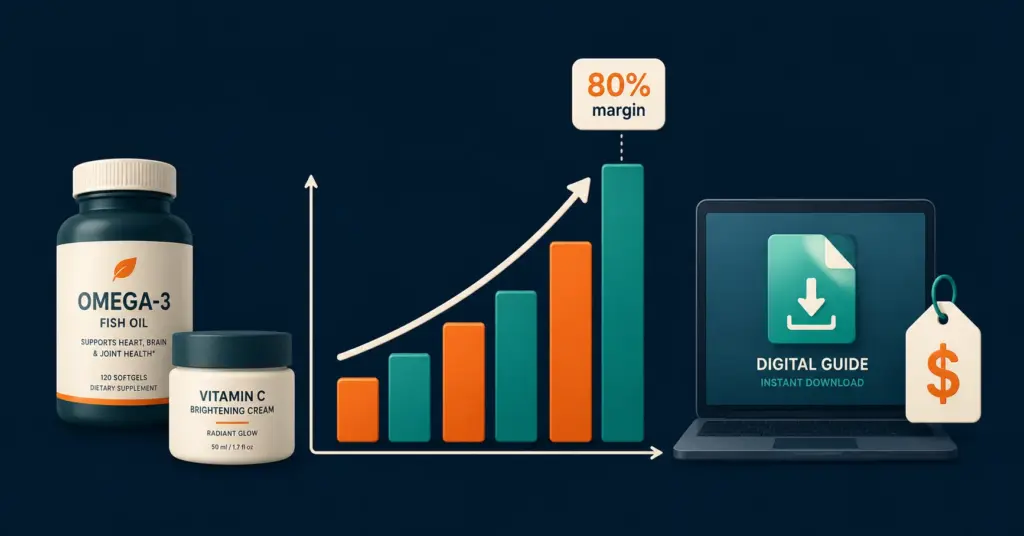
- Digital products, software, and online courses routinely hit 70–90% margins because fulfillment costs are near zero.
- Physical categories like beauty, jewelry, and supplements can deliver 50–80% gross margins when sourced well, but ad costs erode net margins fast.
- Dropshipping margins are typically 15–30%: workable, but only if you control traffic costs and pick suppliers with fast shipping.
- Protecting margins long-term requires brand differentiation, owned-channel traffic, and regular cost audits, not just finding a hot product.
High profit margin products are items where the gap between what you pay to source or create them and what customers pay you is wide enough to leave meaningful profit after all costs, including shipping, ads, and platform fees. The best categories today include digital goods, beauty consumables, private-label supplements, and B2B software, all of which can sustain margins above 50%.
Before diving into specific categories, it helps to understand that margin is not one number. Gross margin tells you how much is left after product cost. Net margin is what remains after every other expense: ads, apps, fulfillment, refunds, and staff. Most roundups on this topic only show gross margin, which can be misleading. This guide covers both, along with the risks that erode profit over time. If you are still deciding what to sell, the overview of what to sell online is a good starting point, and the breakdown of ecommerce business models will help you understand which structure suits each category.
How Do You Actually Calculate Profit Margin on a Product?
Gross margin is calculated as: (selling price minus cost of goods sold) divided by selling price, expressed as a percentage. A product you buy for $10 and sell for $40 has a 75% gross margin. That sounds excellent until you subtract $12 in Facebook ads, $3 in shipping, $2 in platform fees, and $1 in chargebacks. Your net margin on that $40 sale is now $12, or 30%.
Net margin is the number that actually determines whether your business is sustainable. Here are realistic net margin benchmarks by model:
- Digital products and courses: 70–90% net margin. Fulfillment is near-zero, and a single piece of content sells indefinitely.
- Private-label physical goods (beauty, supplements): 35–60% gross, 20–40% net after paid traffic.
- Print-on-demand: 20–40% gross, 10–20% net. Margins are thin because base costs are high.
- Dropshipping: 15–30% gross, 5–15% net. Viable only with low customer acquisition costs.
- Wholesale resale: 30–50% gross, 15–30% net depending on volume and channel fees.
- SaaS and software licenses: 70–85% net at scale, once development costs are recouped.
For a deeper look at how to model these numbers before you launch, the ecommerce startup costs guide walks through fixed and variable cost structures by model. The ecommerce profit margins guide goes further into tracking and improving your numbers over time.
What Are the Best High Profit Margin Products in 2026?
The categories below are ranked roughly by how reliably they deliver strong net margins across different business sizes and traffic strategies, not just on paper.
1. Digital Products
Digital products sit at the top of every honest margin discussion because after the initial creation cost, each sale costs almost nothing to fulfill. Templates, presets, patterns, ebooks, stock assets, and Notion dashboards all fall here. A $29 Lightroom preset pack costs nothing to duplicate and can sell thousands of times from a single Etsy listing or a direct-to-consumer storefront.
The digital products to sell guide covers over a dozen specific formats with demand signals. If you want a launch framework, the digital product launch checklist walks through every step from creation to first sale.
2. Online Courses and Coaching
Courses are arguably the highest-margin product category available to solo operators. Platforms like Teachable and Kajabi charge flat monthly fees, meaning your per-sale cost is essentially zero beyond payment processing. A $297 course with a 2% conversion rate from an email list of 5,000 people generates $29,700 with no inventory, no shipping, and no supplier relationship to manage.
Consulting and coaching follow the same logic. Your time has a cost, but there is no COGS in the traditional sense. A B2B consultant charging $5,000 per engagement with two days of actual work time is running margins that no physical product can touch.
3. Software and SaaS Licenses
Software has the most scalable margin profile of any product type. Once built, each additional license sold costs a fraction of a cent to deliver. The challenge is that upfront development costs are high and customer acquisition for SaaS is competitive. However, for entrepreneurs who can build lightweight tools, browser extensions, or WordPress plugins, even small audiences can generate recurring revenue with margins above 80%.
If you are exploring AI-powered tools in this space, the AI tools for ecommerce guide covers what is actually worth building or reselling right now.
4. Beauty and Skincare
Private-label beauty is one of the most consistently high-margin physical product categories. Gross margins of 60–75% are common because the cost of formulation and packaging is low relative to perceived value. A moisturizer that costs $4 to produce and package can retail for $28–$45 when positioned correctly.
The risk is customer acquisition cost. Beauty is competitive on Meta and TikTok, and cost-per-click has risen significantly over the past three years. Brands that sustain margins long-term are the ones building email lists and repeat-purchase programs rather than relying on paid traffic for every sale. The ecommerce customer retention guide is essential reading for anyone in this category.
TikTok Shop has created a genuine opportunity for beauty brands willing to work with micro-creators. According to Statista’s beauty industry data, the global cosmetics market continues to expand year over year, and social commerce is a growing share of that. The TikTok Shop strategy guide explains how to structure creator partnerships without destroying your margin on commission.
5. Supplements and Wellness Products
Supplements share many traits with beauty: low unit cost, high perceived value, and strong repeat-purchase behavior. A 60-capsule magnesium supplement might cost $3–$5 to produce and sell for $25–$35. If a customer subscribes, lifetime value climbs quickly and customer acquisition cost gets amortized across multiple orders.
The complication is regulatory. In most markets, supplement claims are restricted, and compliance costs (lab testing, label review, FDA compliance in the US) add to overhead. Source carefully. The Alibaba sourcing guide covers vetting manufacturers, and the wholesale suppliers directory lists verified domestic options if you prefer to avoid overseas sourcing entirely.
6. Jewelry and Accessories
Handmade or private-label jewelry regularly hits gross margins of 70–80%. A piece that costs $4 in materials and basic labor can sell for $30–$60 in the right niche. Fine jewelry operates on different economics, but fashion jewelry with strong brand storytelling can sustain exceptional margins.
Etsy remains a strong channel for jewelry, particularly for handmade and vintage positioning. The Etsy shop setup guide covers optimization for discovery. For scale, running your own store alongside a marketplace listing protects you from algorithm changes and fee increases.
7. Print-on-Demand Products
Print-on-demand gets included in every list like this, but the margin reality is more nuanced than most posts admit. A $25 t-shirt through a POD provider might cost $12–$14 to produce, leaving a 44–52% gross margin. After Etsy fees, Shopify fees, and any paid promotion, net margin often sits at 15–25%.
That said, POD has one major advantage: zero inventory risk. If you are testing designs or building a brand with no upfront capital, the margin trade-off is worth it early on. The print-on-demand guide covers supplier comparisons and pricing strategies to maximize what you keep per sale.
8. High-Margin Dropshipping Products
Dropshipping margins are famously thin on commodity items, but there are categories that consistently outperform. Products with low return rates, high perceived value, and limited price comparison options tend to deliver better net margins:
- Home decor and wall art: Difficult to price-compare, strong gifting demand, low return rates.
- Specialized pet products: Emotional purchase, less price-sensitive buyers.
- Outdoor and survival gear: Niche audiences, lower competition than general gadgets.
- Personalized products: Customization justifies premium pricing and eliminates direct price comparison.
For sourcing, the dropshipping suppliers directory filters by category and shipping speed, and the best dropshipping products guide includes current demand data. If you want to compare dropshipping economics against other models, the dropshipping vs ecommerce breakdown is worth reading before committing.
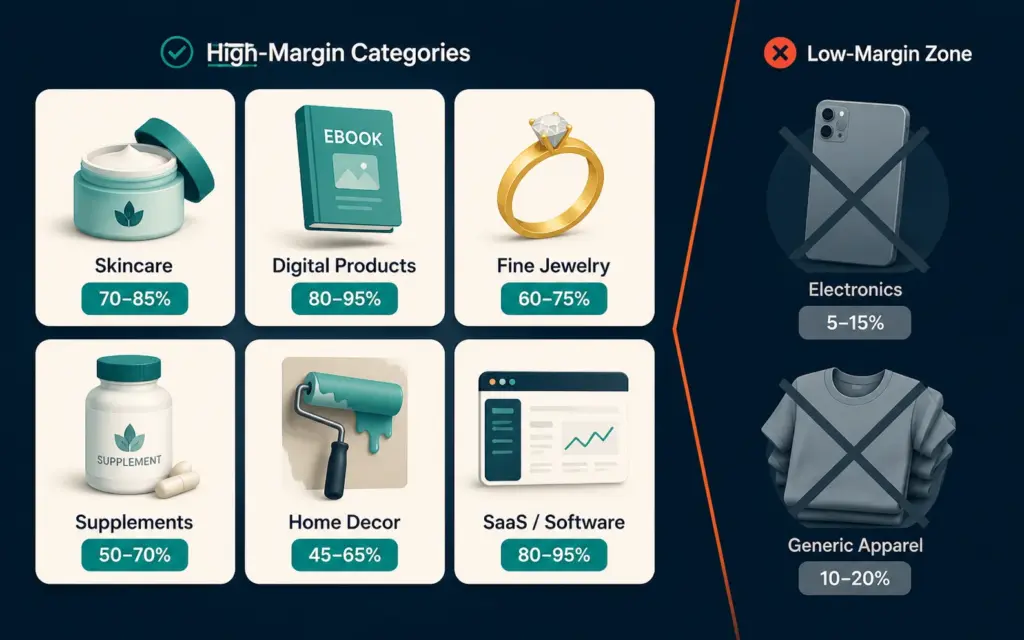
Which Product Categories Should You Avoid If Margins Matter?
Not every popular product category translates to healthy margins. Electronics, for example, tend to run 5–15% gross margins at the consumer level because suppliers are concentrated and price competition is brutal. Consumer electronics returns also run higher than average, typically 15–20%, which further erodes net margin.
Books and media have similarly compressed margins in most channels. Commodity clothing (basic tees, generic activewear) is saturated, and the winning brands are either operating at volume or spending heavily on brand-building to justify premium pricing.
The pattern across low-margin categories is usually the same: high supplier concentration, easy price comparison, and established players with cost advantages. If you are entering any of these, you need a differentiation story, not just a product listing.
What Makes a Good Profit Margin for an Online Store?
This depends heavily on your business model and traffic strategy. A business running entirely on organic SEO and email can sustain healthy profits at 25–35% net margin because customer acquisition is cheap. A business relying primarily on paid Meta or Google ads needs gross margins above 50% to have any chance of net profitability after blended CAC.
A reasonable framework: if your gross margin is below 40%, you need a very low-cost traffic model or very high order values. If your gross margin is above 60%, you have room to test paid channels without immediately running at a loss. Digital products and SaaS, with margins above 70%, can afford expensive acquisition because lifetime value is high and fulfillment cost is negligible.
For benchmarking your own numbers, the GA4 ecommerce setup guide explains how to track revenue and conversion data properly, and the AI tools for ecommerce analytics section covers tools that can automatically surface margin issues by product or channel.
How Do You Protect Margins as Competition Increases?
Finding a high-margin product is the easy part. Keeping those margins as competitors discover the same opportunity is the real challenge. Most roundup articles skip this entirely, which is why stores that follow generic “high-margin product” advice often see margins collapse within 12–18 months.
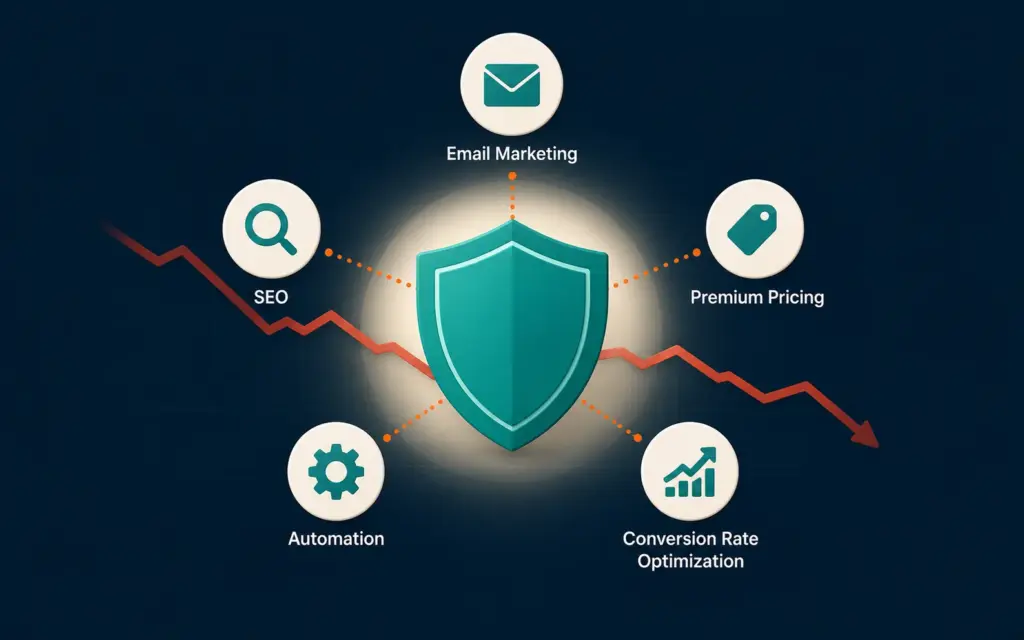
The most effective margin-protection strategies are:
Build owned traffic channels. Paid traffic costs rise as more competitors bid on the same audiences. An email list, a strong SEO presence, or a loyal social following insulates you from CAC inflation. The ecommerce SEO guide and the technical SEO for ecommerce guide are the starting points for building traffic you do not have to pay for on every order.
Differentiate the product itself. Private labeling, custom formulations, unique bundling, or branded packaging all make direct price comparison harder. A customer who wants your exact product cannot simply find it cheaper on Amazon if you own the formulation or design.
Raise prices deliberately. Many store owners undercharge out of fear. According to McKinsey’s pricing research, a 1% improvement in price realization delivers roughly 8–11% improvement in operating profit for the average business, far outperforming cost reductions of the same magnitude. Testing higher price points, especially for differentiated products, is one of the fastest margin improvements available.
Reduce fulfillment and operational costs. As order volume grows, renegotiate supplier pricing, audit your app stack for unused subscriptions, and look at where automation can replace manual tasks. The ecommerce automation guide and AI automation for ecommerce both cover practical tools for this.
Improve conversion rate rather than increasing ad spend. A store converting at 4% instead of 2% on the same traffic budget effectively halves its customer acquisition cost. The product page design guide and the category page design guide cover the highest-leverage CRO improvements for ecommerce.
How Do You Source Low-Cost, High-Margin Products Reliably?
Sourcing strategy directly shapes your margin floor. The same product can have wildly different COGS depending on where and how you source it. A supplement that costs $8 from a domestic white-label supplier might cost $2.50 from a vetted overseas manufacturer producing to the same standard.
For physical products, the primary options are: direct manufacturer sourcing (highest margin, highest minimum order quantities and quality control burden), white-label or private-label suppliers (middle ground, reasonable MOQs, pre-tested formulations), and wholesale distributors (lowest margin but lowest risk and fastest time to market).
The white-label products guide covers categories with strong white-label supplier ecosystems. For reselling existing branded products, products to resell includes vetted wholesale sources by category. The Alibaba sourcing guide covers due diligence for overseas manufacturer relationships, including sample ordering, factory verification, and contract basics.
For marketplace sellers, the Amazon FBA guide walks through how to calculate landed cost and margin after Amazon’s fees, which are easy to underestimate when first modeling a product.
Are Digital Products Really the Most Profitable Things to Sell?
On a pure margin basis, yes. Digital products regularly deliver 80–90% net margins because there is no inventory, no shipping, no returns (in most cases), and no supplier dependency. The constraint is demand: a digital product only sells well if there is an audience for it and you can reach that audience cost-effectively.
The categories within digital products worth exploring for high margins include:
- Notion and Airtable templates (low creation time, recurring search demand)
- Design assets and Canva templates (evergreen, passive sales on Etsy or Gumroad)
- Excel and Google Sheets tools (strong B2B demand, higher price points)
- Photography presets and video LUTs (high volume, low price, or lower volume, premium price)
- Online courses and workshops (highest revenue ceiling, highest creation investment)
- Licensing and stock content (create once, earn indefinitely)
The digital products to sell guide has demand data and platform recommendations for each of these. For building a store to sell them, the how to sell on Shopify guide and the ecommerce web design overview both cover setup for digital-first stores.
What Are the Best High-Margin Products for Beginners?
If you are starting with limited capital and want the fastest path to positive net margin, the ranking looks like this:
First choice: digital products. No inventory cost, no shipping, and you can validate demand with a simple landing page before creating anything. The downside is that creating genuinely valuable digital products takes time and skill.
Second choice: print-on-demand. No upfront inventory, no supplier negotiation. Margins are thin but the risk is near zero, making it a good starting point for testing product concepts and building a brand.
Third choice: dropshipping in a focused niche. More operational complexity than digital or POD, but access to physical product categories with strong demand. Focus on niches where you can build content and community rather than competing purely on price. The how to start dropshipping guide covers setup, and the best ecommerce platform for dropshipping comparison helps you pick the right technical foundation.
Across all three, the path to strong net margins is the same: build owned traffic, differentiate your positioning, and track your numbers from day one rather than waiting until you scale.
Frequently Asked Questions
A gross margin above 50% gives most ecommerce businesses room to cover paid traffic costs and still turn a net profit. Net margins of 15–30% are considered healthy for physical product stores. Digital product businesses regularly achieve net margins of 60–80%, and SaaS businesses can exceed that at scale. Below 30% gross margin, you typically need either very high order volume or very low customer acquisition costs to stay profitable.
Beauty and skincare, supplements, candles, jewelry, and specialty food products consistently deliver the highest gross margins among physical goods, typically 60–80% before operating expenses. The key in each category is private labeling or custom formulation, which removes direct price comparison and justifies premium positioning. Sourcing quality matters too: a supplier who ships reliably reduces return rates, which quietly erode margins in many physical product businesses.
Yes, but it requires careful product selection and tight control over customer acquisition costs. Dropshipping gross margins typically range from 15–30%, which means paid ads can easily eliminate your profit if cost-per-click rises. The most profitable dropshipping businesses focus on niches where organic content, influencer partnerships, or email marketing can drive a meaningful share of sales. Personalized products, specialty home goods, and niche pet accessories tend to outperform commodity items on net margin.
Gross margin is (selling price minus cost of goods sold) divided by selling price, multiplied by 100. Net margin adds all other costs: shipping, platform fees, payment processing, returns, marketing, and overhead. For example, a product selling for $50 with a $15 COGS has a 70% gross margin. After $10 in ads, $3 in shipping, $2 in platform fees, and $1 in returns, net margin drops to 38%. Always model net margin before deciding a product is viable, not just gross.
Almost always, yes. Once a digital product is created, the cost to deliver each additional copy is essentially zero. There is no shipping, no inventory, no returns processing, and no supplier to manage. Net margins of 70–90% are normal for well-positioned digital products. The constraint is not margin, it is demand: you need an audience or a discovery channel. Platforms like Etsy, Gumroad, and Teachable handle distribution, but you still need marketing to stand out.
Margins erode when competitors discover the same opportunity and bid up ad costs, when suppliers raise prices, or when platform fees increase. The most reliable protection is diversifying your traffic sources away from paid channels, differentiating your product so direct price comparison is difficult, and building repeat-purchase behavior through subscriptions or loyalty programs. Brands that invest in SEO, email lists, and owned communities consistently outperform those relying purely on paid acquisition when market conditions tighten.
Related Reads
- What to Sell Online: High-Demand Product Ideas for 2026
- Ecommerce Business Models Compared
- Best Digital Products to Sell Online
- Print on Demand: Complete Beginner’s Guide
- Best Dropshipping Products to Sell
- How to Improve Ecommerce Profit Margins
- Dropshipping vs Ecommerce: Which Is Right for You?
- Ecommerce Pricing Strategy Guide
- Ecommerce Customer Retention Strategies
- Product Page Design That Converts
Enjoying this? Get more like it every week.
One email per week with ecommerce strategies, tool picks, and seller insights. No spam.