
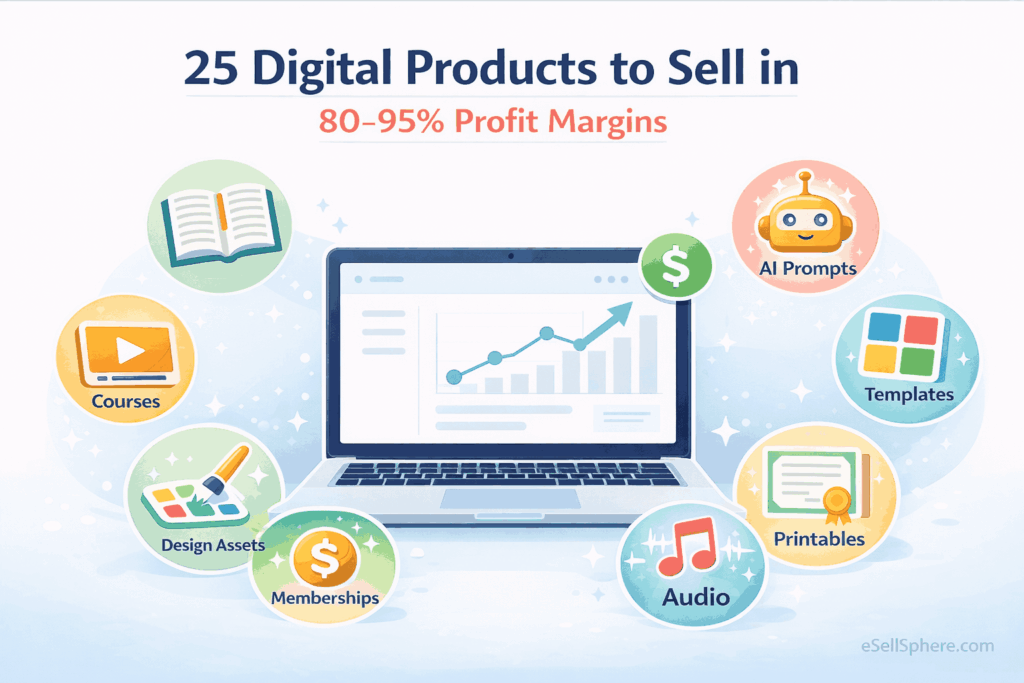
- Digital products have 80-95% profit margins because there's no manufacturing, no inventory, and no shipping costs. You create once and sell forever.
- The global digital content market is projected to surpass $1 trillion by 2030 (Statista), and the barrier to entry has never been lower.
- Online courses, templates (Notion, Canva, spreadsheets), ebooks, printables, and AI prompt packs are the top-performing digital product categories in 2026.
- You don't need to be a tech expert. Tools like Gumroad, Etsy, Shopify, and Teachable handle payments and delivery. Your job is creating something people actually want.
- The biggest mistake is building a product nobody asked for. Validate demand first with a waitlist, pre-sale, or simple landing page before spending weeks creating.
If you told me five years ago that people were making $10K/month selling Notion templates and budget spreadsheets, I would’ve laughed. I’m not laughing anymore.
Digital products are non-physical goods sold and delivered online, including ebooks, online courses, templates, printables, design assets, software, music, and digital art. They require zero inventory, zero shipping, and carry profit margins between 80-95% because your only real costs are creation time and platform fees. The global digital content market is projected to surpass $1 trillion by 2030 (Statista), and 2026 is shaping up to be the strongest year yet for creators selling digital downloads.
I’ve been watching this space closely, and here’s what changed: buyers got pickier. The bar for “I’ll pay for that” went up. Generic ebooks and basic PDFs don’t cut it anymore. But creators who solve specific problems for specific audiences? They’re printing money. If you’re exploring what to sell for your new ecommerce business, digital products are hands-down the best margin play available to someone starting with a small budget.
Let me show you what’s actually selling and what’s worth your time.
Why Digital Products Are the Best Starting Point in 2026
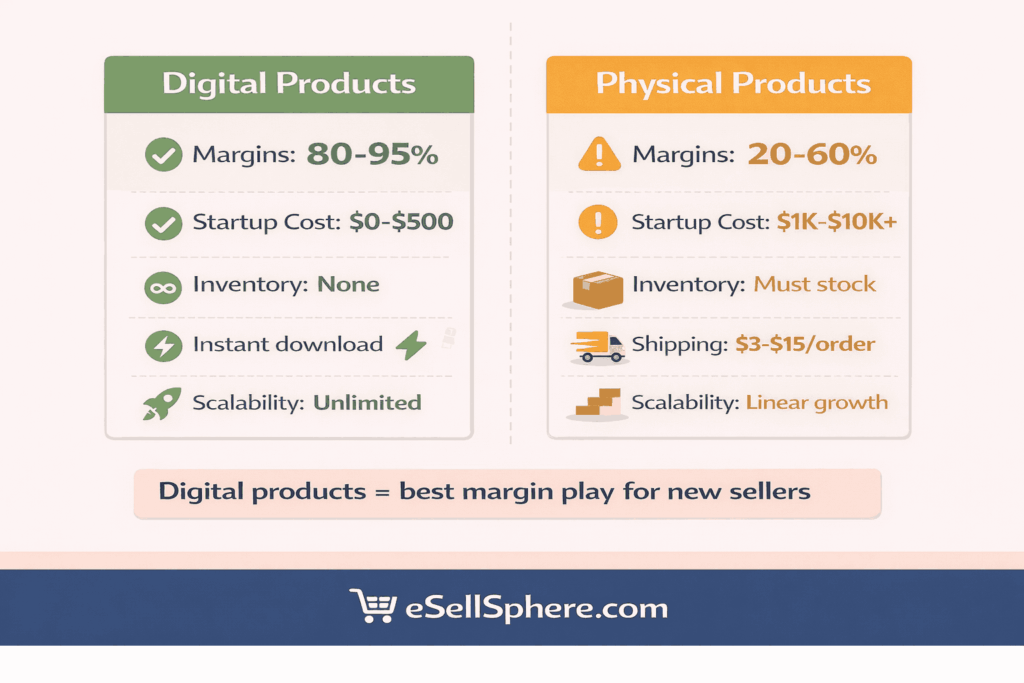
Before we get into the list, let’s be clear about why digital products deserve your attention over physical ones, especially if you’re just starting out.
| Factor | Digital Products | Physical Products |
|---|---|---|
| Profit margins | 80-95% | 20-60% |
| Startup cost | $0-$500 | $1,000-$10,000+ |
| Inventory | None (infinite supply) | Must purchase/store |
| Shipping | Instant delivery | $3-$15+ per order |
| Returns/refunds | Under 5% | 15-40% |
| Scalability | Sell to 10 or 10,000 with zero extra cost | More sales = more inventory/logistics |
| Time to launch | Days to weeks | Weeks to months |
The catch? Marketing digital products requires a different skill set than marketing physical ones. You’re selling transformation and convenience, not tangible objects. Content marketing, email lists, and social proof matter more than paid ads in most digital product niches. But if you’re willing to invest in building an audience, the payoff is exponential.
The 25 Best Digital Products to Sell in 2026
I’ve organized these by category with real-world viability in mind. Each one includes who it’s best for, difficulty to create, and realistic income potential.
Knowledge Products (Teach What You Know)
1. Online courses. Still the king of digital products. The online education market exceeds $200 billion globally and shows no signs of slowing. The key shift in 2026: short, specific courses outperform long, sprawling ones. “Launch Your First Shopify Store in 14 Days” beats “Everything About Ecommerce” every time. Platforms like Teachable, Thinkific, and Kajabi make hosting simple. Price range: $47-$997 depending on depth and niche.
2. Ebooks and digital guides. Lower price point than courses but faster to create. Self-help, finance, fitness, and niche how-to guides consistently perform well. The winners focus on solving one problem extremely well rather than being comprehensive. Sell on Amazon KDP, Gumroad, or your own site. Price range: $9-$49.
3. Workshops and masterclasses (recorded). A middle ground between courses and ebooks. Record a 60-90 minute deep-dive on a specific topic, package it with worksheets, and sell it. Less production than a full course, more perceived value than an ebook. Price range: $27-$197.
4. Coaching frameworks and playbooks. These are condensed versions of what a consultant would charge $5,000+ for. Frameworks, summaries, step-by-step workflows, and decision templates. Buyers want fast wins without watching hours of video. Price range: $47-$297.
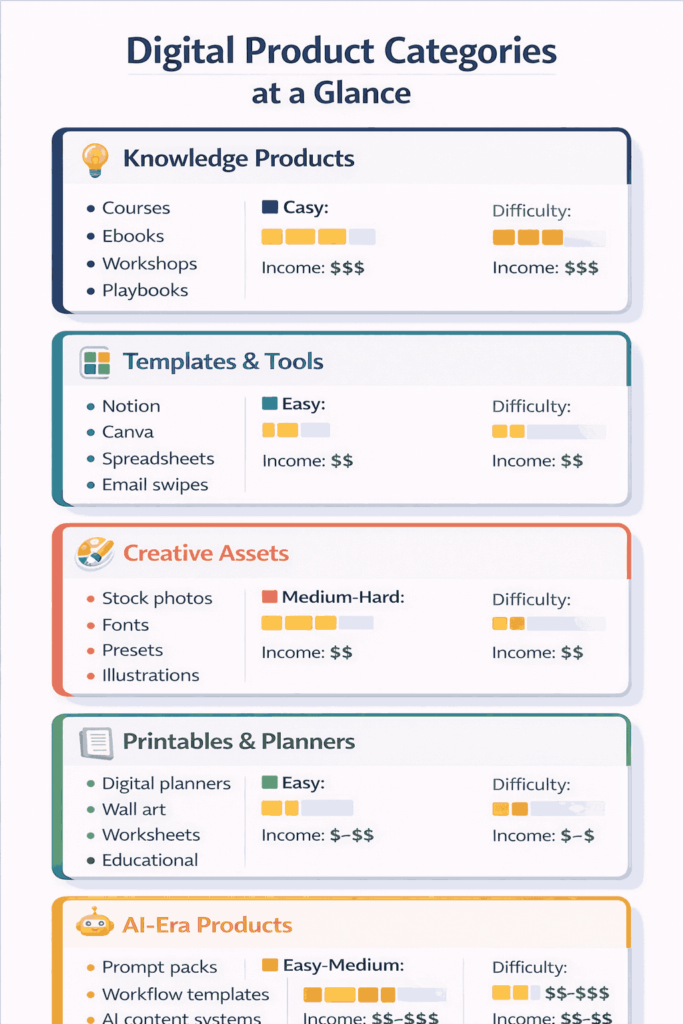
Templates and Tools (Save People Time)
5. Notion templates. One of the fastest-moving digital products right now. Business owners use them to replace messy spreadsheets, manage projects, track finances, and organize content. They require no coding, can be built in under a week, and sell for $15-$79 on Gumroad and Etsy. Some creators are doing $5K-$20K/month with template bundles alone.
6. Canva templates. Social media templates, presentation decks, brand kits, resume templates, media kits. If someone needs to look professional without hiring a designer, Canva templates are the answer. Sell on Etsy, Creative Market, or your own store. Price range: $9-$49 per pack.
7. Spreadsheet templates. Budget trackers, financial models, inventory calculators, project planners, CRM sheets. Google Sheets and Excel templates sell especially well in the business and finance niches. Price range: $12-$69.
8. Email templates and swipe files. Businesses constantly need email copy. Cold outreach sequences, welcome series, abandoned cart flows, launch sequences. If you can write emails that convert, package them. Price range: $29-$149.
9. Website themes and templates. WordPress themes, Shopify themes, landing page templates. Higher technical barrier to create, but also higher prices and stickier customers. Price range: $29-$199.
10. Business document templates. Contracts, proposals, invoices, onboarding packets, SOPs. Freelancers, agencies, and small businesses buy these to look professional without paying a lawyer. Price range: $19-$99.
Creative and Design Assets (Fuel Other Creators)
11. Stock photography and video. If you have photography or videography skills, stock media sites like Shutterstock, Adobe Stock, and iStock pay royalties per download. You can also sell exclusive packs directly. Niche photography (specific industries, diverse representation, unusual angles) commands premium prices.
12. Fonts and typefaces. Font design is a specialized skill, but the market is steady. A single popular font can generate passive income for years on Creative Market or MyFonts. Price range: $15-$79 per font family.
13. Graphic design assets. Icons, illustrations, UI kits, social media graphics, logo templates. Designers sell these on Creative Market, Envato Elements, and Etsy. Price range: $5-$49 per pack.
14. Lightroom and video presets/LUTs. Photographers and videographers love presets that give their content a consistent look. Some creators have built six-figure businesses selling preset packs alone. Price range: $19-$99.
15. Digital art and illustrations. Prints, wallpapers, clip art, pattern designs, and custom illustrations for print-on-demand. The audience ranges from home decor shoppers to other businesses licensing your work. Sell on Etsy, Gumroad, or Creative Market.
Printables and Planners (The Etsy Goldmine)
16. Digital planners. Daily, weekly, monthly, and yearly planners designed for tablets (GoodNotes, Notability) or printing. The digital planner market on Etsy is enormous. Successful sellers create themed bundles: fitness planners, wedding planners, student planners, budget planners. Price range: $5-$39.
17. Printable wall art. Buyers download, print at home or at a print shop, and frame. Minimal art, typography prints, nursery art, and motivational quotes sell consistently. Startup cost is essentially $0 if you use Canva. Price range: $3-$15 per print.
18. Worksheets and workbooks. Therapy worksheets, journaling prompts, goal-setting workbooks, habit trackers. These work especially well as lead magnets that upsell to courses or coaching. Price range: $7-$29.
19. Educational printables. Flashcards, learning activities, homeschool curriculum supplements, coloring pages. Parents and teachers are a reliable, repeat-purchase audience. Price range: $3-$19.
AI-Era Products (The 2026 Frontier)
20. AI prompt packs. This is the newest and fastest-growing category. Curated prompts for ChatGPT, Midjourney, DALL-E, and other AI tools. Business prompt packs, content creation prompts, coding prompts, image generation prompts. People will pay for prompts that save them hours of trial and error. Price range: $9-$49.
21. AI workflow templates. Step-by-step automation workflows that show people how to use AI tools for specific business processes. “Automate your customer support with ChatGPT” or “Create 30 days of social content in 2 hours.” Price range: $27-$97.
22. Done-for-you AI content systems. Pre-built systems combining prompts, templates, and workflows into a complete package. A “Content Marketing Machine” kit with AI prompts, editorial calendar template, and social media swipe files bundled together. Price range: $47-$197.
Software and Membership (Recurring Revenue)
23. SaaS micro-tools. Small, focused software that solves one problem. No-code tools like Bubble and Webflow make it possible to build simple apps without being a developer. Think: invoice generators, SEO audit tools, social media schedulers for niche platforms. Price range: $9-$49/month.
24. Membership sites. Charge monthly for access to a library of content, templates, or community. Lower individual transaction value but recurring revenue. Works brilliantly when combined with any of the products above. A design template membership at $19/month with 500 members is $9,500/month. Price range: $9-$99/month.
25. Licensed digital assets. Music tracks, sound effects, background loops for content creators. If you produce audio, licensing it to YouTubers, podcasters, and video editors creates passive royalty income. Sell on AudioJungle, Epidemic Sound, or directly. Price range: varies by license type.
Where to Sell Digital Products (Platform Comparison)
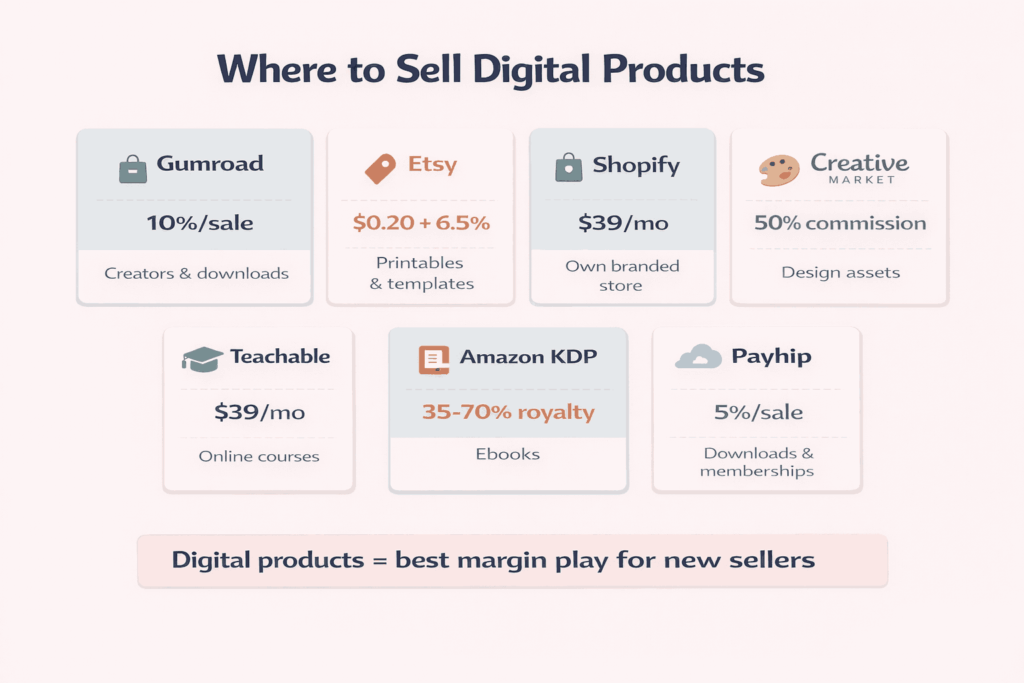
| Platform | Best For | Fees | Audience Built-In? |
|---|---|---|---|
| Gumroad | Creators, simple digital downloads | 10% per sale | Some (discover page) |
| Etsy | Printables, templates, planners | $0.20 listing + 6.5% transaction | Yes (huge search traffic) |
| Shopify | Own branded store, full control | $39/month + payment processing | No (drive your own traffic) |
| Teachable | Online courses, coaching | $39/month (basic plan) | No |
| Creative Market | Design assets, fonts, themes | 50% commission | Yes (designer marketplace) |
| Amazon KDP | Ebooks, low-content books | 30-65% royalty (you keep the rest) | Yes (massive reach) |
| Payhip | Downloads, memberships, courses | 5% per sale (free plan) | No |
My recommendation for beginners: Start on a marketplace with built-in traffic (Etsy for printables/templates, Creative Market for design assets, Amazon KDP for ebooks). Use the revenue and audience data to validate demand. Then build your own store on Shopify or WordPress for higher margins and full control.
For platform deep-dives, check our ecommerce platform comparison guide.
How to Validate Before You Create
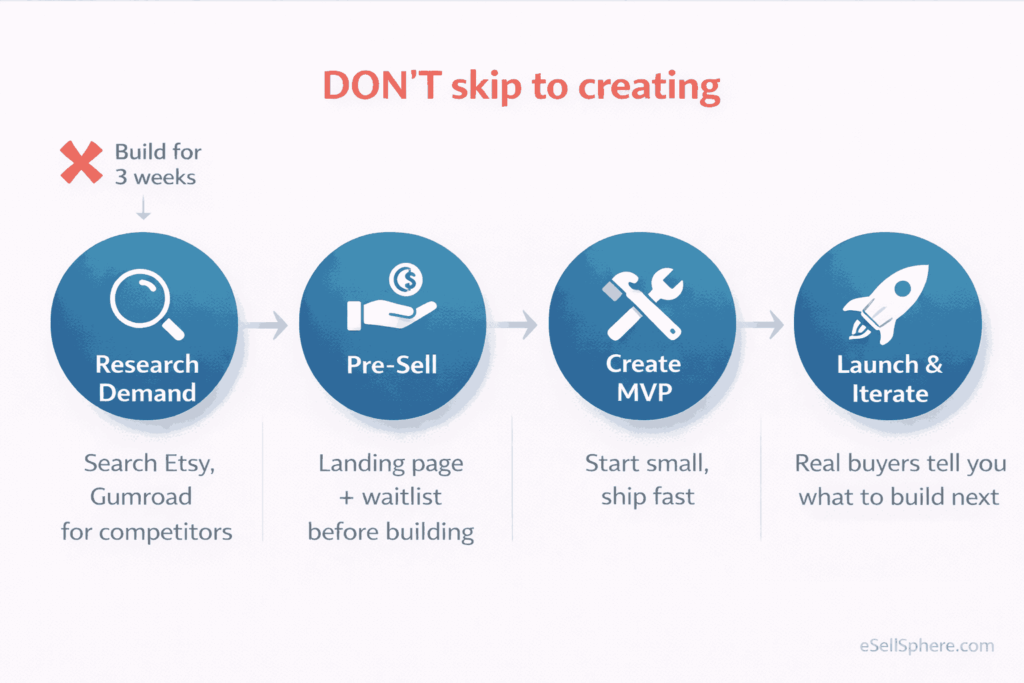
The biggest mistake I see: spending three weeks building a digital product nobody wants. Validate first, create second.
Step 1: Check existing demand. Search Etsy, Gumroad, and Creative Market for similar products. Are they selling? Check reviews and “favorited” counts. If nothing similar exists, that could mean opportunity or it could mean nobody wants it. If competitors exist and are selling, that’s a green light.
Step 2: Pre-sell before building. Create a landing page describing your product and collect emails or actual pre-orders. If 50 people sign up for a waitlist, you have validation. If 5 people do, rethink the concept. Tools like Carrd ($19/year) make this dead simple.
Step 3: Start with a minimum viable product. Don’t build the ultimate 200-page course on day one. Create the core offering (maybe 3-5 modules or a 20-page ebook) and sell it at a lower price. Use buyer feedback to expand it.
Step 4: Iterate based on real data. What questions do buyers ask? What do reviews say? What related products do they buy? Let your audience tell you what to build next.
For more on validating your niche before investing time and money, read our guide on ecommerce niche research methods.
Pricing Your Digital Products (Don’t Undercharge)
New creators almost always price too low. A Notion template you spent 20 hours building shouldn’t sell for $5. Here’s how I think about digital product pricing:
Price based on value, not effort. If your budget spreadsheet saves someone $500/month in overspending, charging $29 for it is a steal. If your course helps someone land a job that pays $20K more per year, $497 is nothing.
Use price anchoring. What’s the alternative? If the alternative to your $47 template pack is hiring a designer for $500, your price feels like a bargain. State the comparison explicitly in your sales copy.
Bundle for higher AOV. Individual templates at $12 each, or a bundle of 10 for $79. Bundles almost always outsell individual products because perceived value jumps while the price feels like a discount.
Tiered pricing works. Basic version for $29, pro version with extras for $79, ultimate bundle for $149. Let buyers self-select their commitment level. Most revenue comes from the middle tier.
Frequently Asked Questions
What are digital products and how do they work?
Digital products are non-physical goods created and delivered electronically. They include ebooks, online courses, templates, printables, software, music, design assets, and digital art. When a customer purchases, they receive instant access via download link or online platform. There’s no shipping, no inventory to manage, and no per-unit manufacturing cost, which is why margins typically range from 80-95%.
What are the most profitable digital products to sell in 2026?
Online courses and coaching programs offer the highest revenue per product ($47-$997). Notion and Canva template packs are the fastest-growing category with strong Etsy and Gumroad demand. AI prompt packs and workflow templates are the newest high-demand category. Membership sites generate the most predictable recurring revenue. The most profitable choice depends on your skills and audience more than the category itself.
How much money can you make selling digital products?
Income varies enormously based on product, audience, and marketing. A single well-positioned Etsy printable shop can earn $1,000-$5,000/month. Course creators with established audiences often hit $10,000-$50,000+ per launch. Template bundle sellers on Gumroad commonly report $2,000-$15,000/month. The advantage is that once created, digital products generate revenue with minimal ongoing effort, making them the closest thing to genuine passive income.
Where is the best place to sell digital products online?
For beginners, start on marketplaces with built-in traffic: Etsy for printables and templates, Creative Market for design assets, Amazon KDP for ebooks, Teachable for courses. Once you validate demand, build your own store on Shopify or WordPress for higher margins and full brand control. Gumroad is a good middle ground offering simple setup with decent discovery features and a flat 10% fee per sale.
Do I need technical skills to create digital products?
Not for most categories. Ebooks can be created in Google Docs. Templates in Canva (free). Planners in Canva or Affinity Publisher. Notion templates in Notion (free). Online courses with a smartphone camera and Teachable. The only categories requiring technical skills are software/SaaS products, WordPress themes, and custom fonts. Start with what you can create using tools you already know.
How do I sell digital products without getting copied?
Copying is a real concern but less damaging than most creators fear. Your brand, audience relationship, and ongoing updates are your moat. Practical protections include watermarking previews, using platforms with built-in DRM, adding terms of use to your files, and reporting copyright violations when they occur. The best defense is building a brand people want to buy from, not just a product they want to use.
Stop Planning, Start Creating
Here’s my challenge to you: pick one product from this list that matches something you already know how to do. Not the one with the “highest potential.” The one you can actually finish this week.
A shipped product that’s 80% perfect will always outperform a planned product that’s 100% perfect and stuck in your head. The fastest path to $1,000/month in digital product income isn’t finding the perfect idea. It’s launching your first imperfect product, learning from real buyers, and iterating.
Once you’ve chosen your product type, figure out the right ecommerce business model to support it, and check our guide on profitable ecommerce niches to make sure you’re targeting a market that’s actually spending money.
Want a head start on your first digital product?
Work through our free 30-step launch checklist covering ideation, validation, creation, platform setup, pricing, and marketing. Use it online or download the printable PDF.
Get the Free Launch Checklist →Related reads: Complete Guide to Starting an Ecommerce Business | Profitable Ecommerce Niches 2026 | Ecommerce Business Models Explained | Niche Research Methods | Things to Make and Sell Online | Best Ecommerce Platforms Compared
Enjoying this? Get more like it every week.
One email per week with ecommerce strategies, tool picks, and seller insights. No spam.