
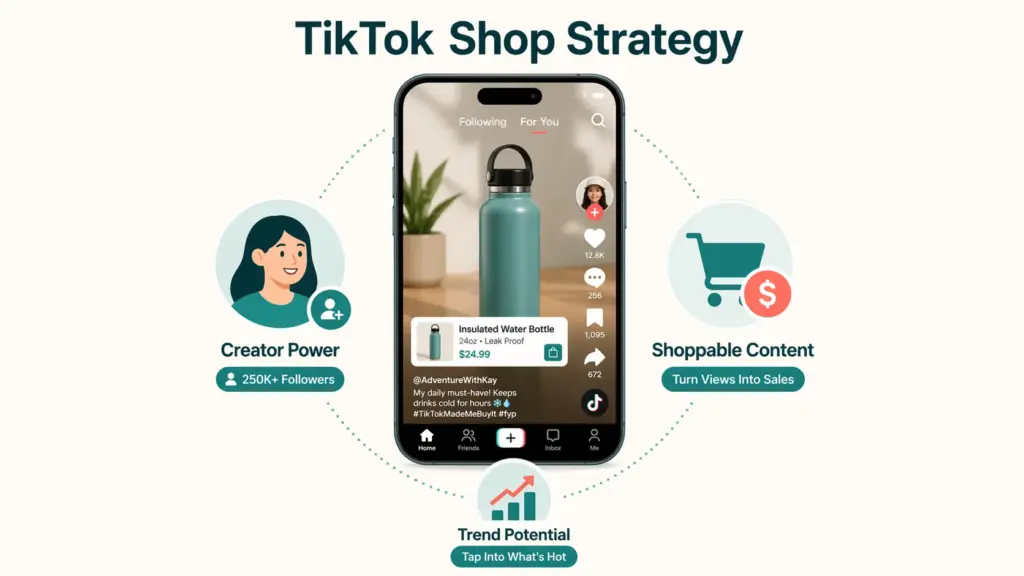
- TikTok Shop is the fastest-growing ecommerce channel because it merges discovery and purchase into one fluid action. Viewers see a product in a video, tap the product tag, and buy without leaving the app. This eliminates the multi-step funnel that loses customers between "I want that" and "checkout complete."
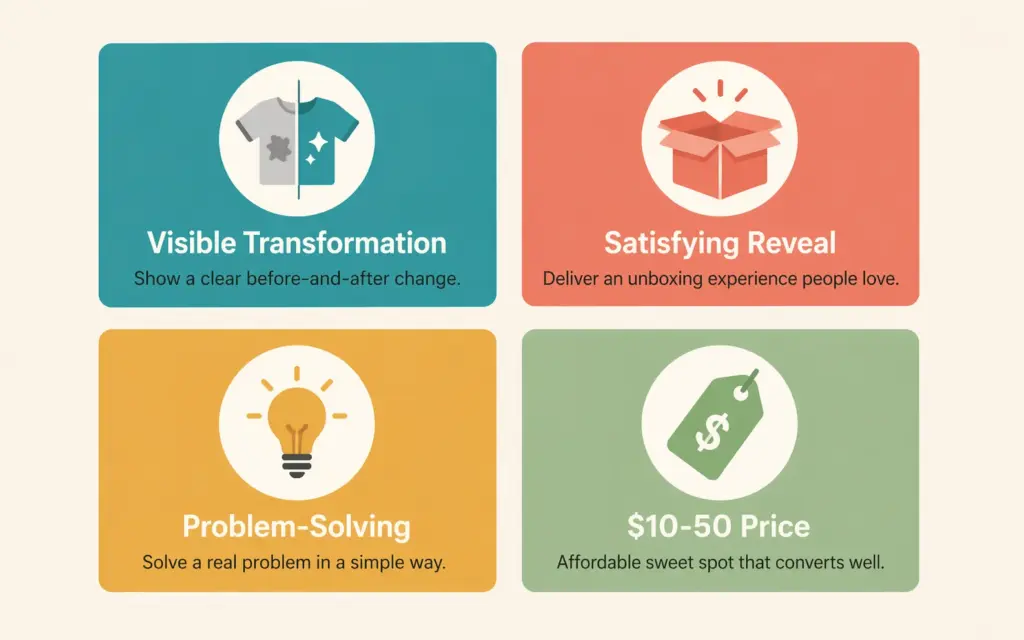
- Products that sell on TikTok share one trait: they demonstrate well on video. Before-and-after transformations, satisfying product reveals, unexpected utility, and visually striking results all perform. If your product needs a paragraph to explain its value, TikTok isn't the right channel.
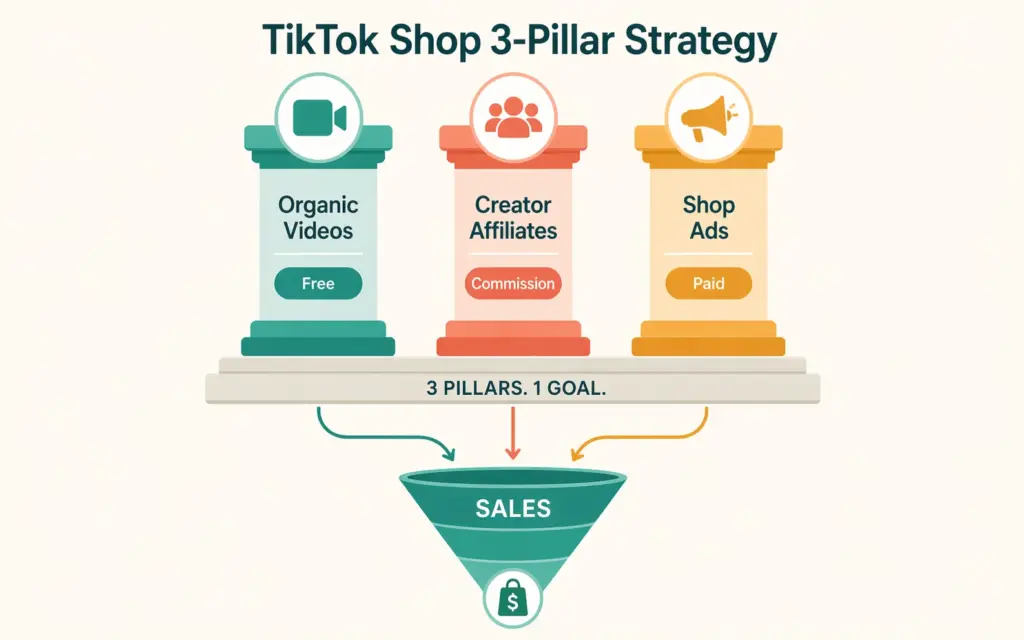
- Three sales channels on TikTok Shop: your own product videos (free, organic reach), creator/affiliate partnerships (commission-based, scales reach), and TikTok Shop Ads (paid, targeted traffic). Most successful sellers use all three simultaneously.
- TikTok's commission is approximately 5% per sale plus payment processing. Lower than Amazon's 15% and competitive with Shopify's payment processing fees, making it one of the cheapest marketplace channels available.
A tiktok shop strategy is a structured approach to selling physical products through TikTok’s built-in ecommerce platform, combining organic video content, creator affiliate partnerships, and paid advertising to drive product discovery and in-app purchases. Unlike traditional ecommerce where you drive traffic to your store, TikTok Shop brings the store to where the audience already spends their time: scrolling through short-form video content.
TikTok has over 1.5 billion monthly active users according to TikTok. TikTok Shop processed over $20 billion in global merchandise volume in 2024, and the trajectory for 2026 is steeper. The platform is no longer experimental. It’s a primary sales channel for brands selling products that demonstrate well on video.
This guide covers the complete tiktok ecommerce strategy from account setup through scaling to thousands of daily orders. If you’re evaluating whether TikTok Shop fits your business model, our platform comparison and free selling platforms guide cover where TikTok Shop fits in the broader channel landscape.
How TikTok Shop Works
TikTok Shop operates differently from every other ecommerce channel. Understanding the mechanics prevents the mistake of treating it like Amazon or Shopify with video attached.
Discovery-first commerce. On Amazon, shoppers search for products. On TikTok, products find shoppers. The algorithm shows your product video to users based on interest signals, not search queries. This means your “marketing” IS your content. There’s no separate step between discovery and selling.
Three storefronts in one:
- LIVE shopping: Sell products in real-time during live streams. Viewers tap product pins to purchase while watching.
- Shoppable videos: Tag products in short-form videos. A product link appears on-screen. Viewers tap to buy without leaving TikTok.
- Product showcase: Your TikTok profile has a shopping tab displaying your full product catalog, similar to an Instagram Shop.
Fees: TikTok charges approximately 5% commission per sale plus payment processing (varies by region). No monthly subscription fee. No listing fees. You pay only when you sell. Compare that to Amazon’s 15% referral fee or eBay’s 13%.
Setting Up TikTok Shop
Apply at seller.tiktok.com. You’ll need: a business email, phone number, government-issued ID or business registration, a US bank account for payouts, and a warehouse or fulfillment address in the US (required for US TikTok Shop).
Approval takes 1-5 business days. Once approved:
- Upload your product catalog with images, descriptions, variants, and pricing
- Set shipping templates (free shipping drives significantly higher conversion on TikTok)
- Connect your TikTok account to your seller center
- Enable the affiliate program so creators can promote your products for commission
If you already sell on Shopify, BigCommerce, or WooCommerce, TikTok’s integration syncs your product catalog automatically. You manage inventory from one place. Our Shopify setup guide covers the TikTok channel connection.
Products That Sell on TikTok Shop
Not every product works on TikTok. The platform rewards visual demonstration. Products that sell share these traits:
Visible transformation. Before-and-after results: skincare clearing acne, a cleaning product removing stains, a hair tool creating curls. The transformation IS the content. Viewers watch the result and immediately want the product.
Satisfying reveal. Unboxing premium packaging, peeling protective film, a gadget doing something unexpectedly cool. These videos trigger the “I want that” impulse that drives impulse purchases.
Problem-solving in action. A kitchen gadget that solves a daily frustration, an organizer that transforms a messy space, a tool that makes a task dramatically easier. The value proposition is self-evident without explanation.
Affordable impulse range. $10-50 is the sweet spot for TikTok Shop. Under $10 and margins are too thin. Over $50 and impulse buying decreases. Products in this range convert best because the perceived risk is low enough for spontaneous purchase.
Products that DON’T work: Anything that needs a long explanation, products where the value is in specs rather than visuals (electronics with subtle performance differences), high-ticket items requiring research before purchase, and commodities where brand doesn’t matter (basic cables, generic office supplies).
Cross-reference with our trending products guide and low competition products for product ideas that fit TikTok’s format.
Content Strategy: Videos That Sell
The Hook-Demo-CTA Framework
Every successful TikTok product video follows this structure:
Hook (0-3 seconds): Stop the scroll. “I can’t believe this actually works” or a visual surprise that makes viewers pause. You have 1-3 seconds before they swipe. Front-load the most visually compelling moment.
Demo (3-25 seconds): Show the product doing what it does. No talking-head explanations needed. The product performing is the content. Speed up slow processes. Show the most impressive result. Multiple angles build credibility.
CTA (final 3-5 seconds): “Link in the video” or “Tap the product tag.” Don’t just show the product. Tell viewers exactly how to buy it. The product tag should be visible throughout, but the verbal CTA at the end converts the watchers into buyers.
Content Formats That Convert
- “TikTok made me buy it” reviews: Present the product as a discovery you’re sharing. Authentic, first-person reactions outperform polished ads.
- Before-and-after: Split screen or sequential showing the problem state and the product solving it.
- Pack an order with me: Film yourself packaging customer orders. This format humanizes your brand and creates FOMO (“people are buying this, I should too”).
- Comparison content: Your product versus the competitor or the old way of doing something. Side-by-side demonstrations are inherently engaging.
- Trending sound + product: Attach your product demonstration to a trending audio. The algorithm boosts content using trending sounds.
Posting Frequency
Post 1-3 product videos per day for the first 30 days. TikTok’s algorithm needs volume to learn which audiences respond to your products. One viral video can generate more sales than 30 days of ads. But you can’t predict which video goes viral, so volume is your strategy. After 30 days, analyze which formats and products performed best, then double down on winners.
Creator Affiliate Program: Scale Through Partnerships
This is where tiktok shop marketing gets powerful. TikTok’s affiliate program lets creators promote your products in their videos and earn a commission (you set the rate, typically 10-20%) on every sale they drive.
How to set up: In TikTok Seller Center, go to Affiliate > Open Collaboration. Set your commission rate and approve/reject creator applications. Creators browse your products, select what they want to promote, create content featuring your product, and earn commission on sales through their videos.
Why it works: Creators have established audiences that trust their recommendations. A creator with 50,000 followers recommending your product carries more persuasive power than your brand account reaching 50,000 strangers. You pay commission only on actual sales, making it zero-risk marketing spend.
Finding the right creators: Look for creators in your niche with 10,000-500,000 followers (micro and mid-tier creators have higher engagement rates than mega-influencers). Check their recent video views versus follower count: a creator with 100,000 followers averaging 5,000 views per video has 5% view rate, which is healthy. Under 1% signals declining engagement.
Set your commission rate competitive with your category. 15% is standard for most products. Premium or high-margin items can offer 20-25% to attract top creators. Track which creators drive actual sales (not just views) and build deeper relationships with your top performers.
TikTok Shop Ads: Paid Amplification
TikTok Shop Ads amplify content that’s already performing organically. The workflow:
- Post organic product videos for 2-4 weeks
- Identify videos with above-average engagement (views, saves, shares, product clicks)
- Boost those specific videos through TikTok Ads Manager using “Product Shopping Ads”
- Target audiences similar to people who engaged with the organic version
- Start with $20-50/day per ad and scale what converts
This approach works better than creating ads from scratch because the algorithm has already validated the content with organic viewers. You’re amplifying proven winners, not guessing which creative will work.
Spark Ads let you boost creator affiliate content with their permission. If a creator’s video featuring your product performs well organically, Spark Ads extend its reach to new audiences while the creator retains the engagement on their profile. This combines paid reach with creator credibility.
For sellers also running ads on other platforms, our marketing overview covers how TikTok fits into a multi-channel strategy alongside Google, Facebook, and organic search.
TikTok Shop vs Other Sales Channels
| Factor | TikTok Shop | Amazon | Shopify Store |
|---|---|---|---|
| Traffic source | Algorithm serves your content | Buyer searches for products | You drive all traffic |
| Commission/fees | ~5% | ~15% + FBA fees | 2.9% + $0.30 |
| Customer data | Limited | Amazon owns | You own everything |
| Content requirement | Continuous video creation | Listing optimization | Site content + ads |
| Best products | Visual, demonstrable, $10-50 | Everything with search demand | Brand-driven, any price |
| Time to first sale | Days-weeks (organic) | Weeks-months | Weeks (with ads) |
The smart play: use TikTok Shop for discovery and impulse sales, your own ecommerce store for brand building and customer data ownership, and Amazon FBA for search-driven demand. Multi-channel sellers consistently outperform single-channel ones.
Common TikTok Shop Mistakes
Treating TikTok like a billboard. Static product photos, formal ad copy, and corporate messaging bomb on TikTok. The platform rewards authentic, entertaining, and visually interesting content. Your product video should feel like content first and an ad second.
Posting once and waiting. TikTok rewards consistency. One video has a 1-5% chance of significant reach. Twenty videos over a month have a much higher cumulative probability. Volume is strategy, not desperation.
Setting affiliate commission too low. 5% commission won’t attract quality creators. They’ll promote your competitor’s product at 15% instead. Competitive commissions attract better creators who drive more sales. The 15% you pay on an affiliate sale is still cheaper than the 30-50% ad cost to acquire that customer through paid campaigns.
Ignoring fulfillment speed. TikTok Shop has strict shipping requirements (typically 3-day ship-by deadline). Late shipments tank your shop rating and reduce visibility. Have your fulfillment dialed in before scaling volume. Connect to a reliable supplier or ensure your own warehouse can handle volume spikes from viral content.
Not offering free shipping. Free shipping converts 2-3x better on TikTok than paid shipping. TikTok buyers are impulse purchasers. A $4.99 shipping charge on a $19.99 product creates enough friction to kill the impulse. Build shipping into your product price. Our pricing guide covers how to absorb shipping costs without destroying margins.
Frequently Asked Questions
Apply at seller.tiktok.com with your business details. Once approved, upload products, set free shipping, and enable the affiliate program. Post 1-2 product demonstration videos daily using the hook-demo-CTA framework. Focus on products that show visible results on camera. Your first sale typically comes within 1-3 weeks of consistent posting.
Products with visible transformations (skincare, cleaning products), satisfying reveals (gadgets, organizers), and clear problem-solving demonstrations perform best. Price sweet spot is $10-50. The product must demonstrate its value on camera within 15 seconds. If you need a paragraph to explain why it’s good, it’s wrong for TikTok Shop.
TikTok Shop charges approximately 5% commission per sale plus payment processing fees. No monthly subscription, no listing fees, no upfront costs. This makes TikTok one of the cheapest marketplace channels: Amazon charges 15% referral plus FBA fees, eBay charges 13%, and Etsy charges ~11%. You only pay when you make a sale.
You set a commission rate (typically 10-20%) in TikTok Seller Center. Creators browse your products, apply to promote them, and create videos featuring your product with a tagged product link. When their viewers purchase through the link, the creator earns the commission. You pay only on completed sales, making it zero-risk marketing.
Yes, but you need US-based fulfillment that meets TikTok’s 3-day ship-by requirement. Standard AliExpress dropshipping with 2-3 week shipping times won’t work. Use US-based suppliers through Spocket or CJdropshipping’s US warehouses. Print on demand through Printful also works since they have US fulfillment centers meeting TikTok’s shipping deadlines.
Post 1-3 product videos daily for the first 30 days. The algorithm needs volume to learn which audiences respond to your products. After 30 days, analyze performance data and focus on the formats and products that generated the most sales. Consistency matters more than perfection. A decent video posted daily beats a perfect video posted weekly.
Related Reads
- Trending Products to Sell
- High Demand Low Competition Products
- Free Selling Platforms
- Best Platform for Dropshipping
- Amazon FBA Guide
- Customer Retention Strategies
Enjoying this? Get more like it every week.
One email per week with ecommerce strategies, tool picks, and seller insights. No spam.