
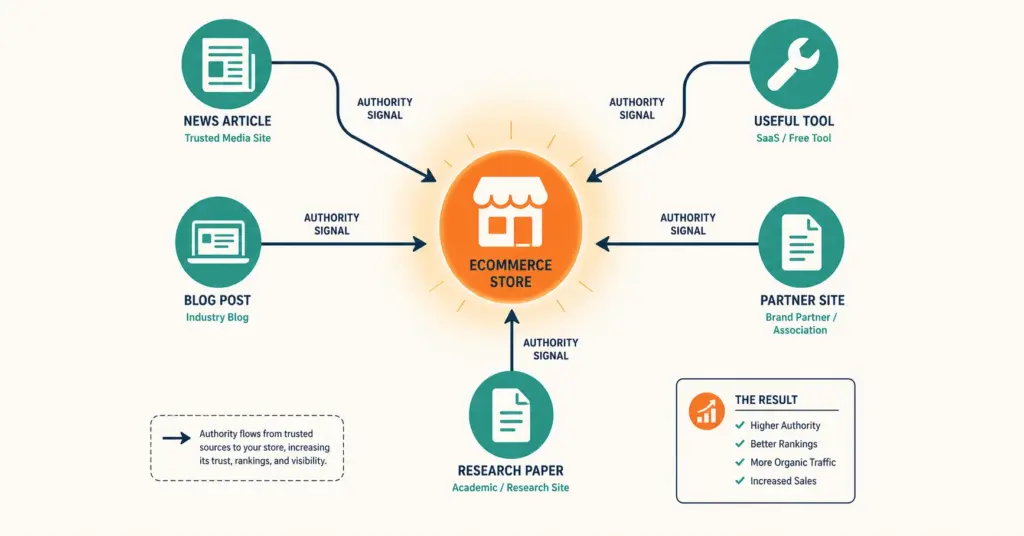
- Link building for ecommerce earns backlinks from external websites to your store, which signals authority to Google and directly improves organic rankings. Domain authority correlates with ranking position more strongly than any other off-page factor: sites with 50+ referring domains rank 3 to 5x more often on page 1 than sites with under 10.
- The 7 ecommerce link building tactics ranked by effectiveness: digital PR and data studies, product-led linkable assets (calculators, tools), resource page outreach, expert roundup contributions, broken link building, supplier and partner link exchanges, and HARO/journalist query responses.
- Buying links, participating in link schemes, or using PBNs (private blog networks) carries Google penalty risk that can remove your entire site from search results. The risk is never worth the shortcut. Earned links from genuine editorial coverage, useful tools, and original research compound value over years.
- Link building ROI is slow but durable. A single authoritative backlink from a DR 60+ site can take 3 to 6 months to impact rankings but continues improving authority for years. 10 high-quality links per quarter is a realistic, impactful target for most ecommerce brands.
Link building for ecommerce is the practice of earning backlinks from other websites to your store, which tells Google your site is trustworthy and authoritative enough to rank for competitive search terms. Every backlink is essentially a vote of confidence from another website. Sites with more high-quality votes rank higher, attract more organic traffic, and pay less per customer than sites relying entirely on paid acquisition. According to Ahrefs’ search traffic research, the #1 ranking page has an average of 3.8x more backlinks than pages ranking in positions 2 through 10, making link building one of the strongest levers for organic visibility.
Most ecommerce stores neglect link building because the results take months, the process requires outreach (which feels like cold calling), and the tactics aren’t as intuitive as running ads or writing blog posts. But the brands that invest consistently in earning 5 to 15 quality links per month build a compounding advantage that paid channels can never replicate: free, intent-driven traffic that grows every month. The technical SEO foundation should be solid before investing in link building, since links to a poorly optimized site waste their authority potential.
7 Link Building Tactics That Work for Ecommerce
1. Original data studies and industry research
Create original research that journalists and bloggers want to cite. Analyze your own sales data, survey your customers, or aggregate public data into new insights. “We analyzed 10,000 ecommerce orders and found the checkout field that causes 23% of cart abandonments” is linkable because it provides a statistic other writers need for their own articles. Data studies earn 5 to 50 backlinks per piece from sites that cite your findings. The content production pipeline should prioritize 1 to 2 data pieces per quarter.
2. Product-led linkable assets
Free tools and calculators that solve a specific problem attract links naturally because they’re genuinely useful. A profit margin calculator or an FBA fee calculator earns links from blog posts, forums, and resource pages that recommend useful tools. The key: the tool must be good enough that someone would bookmark and share it independently of your brand. Build 1 to 2 tools relevant to your niche and promote them through outreach to bloggers who cover your product category.
3. Resource page outreach
Thousands of websites maintain “best resources for [topic]” pages. If your content or tools genuinely belong on those lists, a brief outreach email converts at 5 to 15%. Find resource pages: search “[your niche] + resources” or “[your niche] + useful links” in Google. Evaluate the page’s domain authority (aim for DR 30+). Send a short email: “I noticed your [topic] resource page. We recently published [your content/tool] that might be a useful addition for your readers.” No fluff, no paragraph-long introductions. Specific, brief, value-focused.
4. Expert roundup contributions
Bloggers and publications regularly compile expert opinions: “15 ecommerce experts share their top 2026 predictions.” Contributing a thoughtful, quotable answer earns a backlink with your name and brand attached. Monitor HARO (Help a Reporter Out), Qwoted, and Connectively for journalist queries in your niche. Respond within 2 hours of the query posting (speed matters; journalists work on deadlines). Aim for 3 to 5 successful placements per month.
5. Broken link building
Find dead links on relevant websites and offer your content as a replacement. Tools: Ahrefs Broken Link Checker or Check My Links (Chrome extension). Process: find a resource page in your niche, scan for broken links, check what the dead page used to contain (Wayback Machine), create or identify your own content that covers the same topic, and email the site owner: “I noticed a broken link on your [page]. It pointed to [dead URL]. We have a similar resource at [your URL] that might be a good replacement.” Conversion rate: 3 to 8% of outreach emails.
6. Supplier and partner link exchanges
Your suppliers, wholesale partners, technology vendors, and complementary (non-competing) brands all have websites. Many maintain partner pages, case studies, or “brands we work with” sections. Request inclusion. These links are easy to earn because the relationship already exists. A supplier listing you as a retailer, a Shopify app featuring you as a case study, or a complementary brand mentioning you in a “brands we love” post all count as genuine editorial links. Your marketplace partnerships and wholesale relationships are untapped link sources.
7. Digital PR
Getting your brand mentioned in online publications (trade press, niche blogs, local news, industry magazines) earns the highest-authority links available. Digital PR approaches: launch a newsworthy product (unique angle, not just “we sell stuff”), publish original research (tactic #1 feeds into PR), offer expert commentary on industry trends, or create a campaign with a human-interest angle. Even one link from a DR 70+ publication (Forbes, Business Insider, niche authority sites) can meaningfully move rankings for competitive keywords.
What Makes a Backlink Valuable?
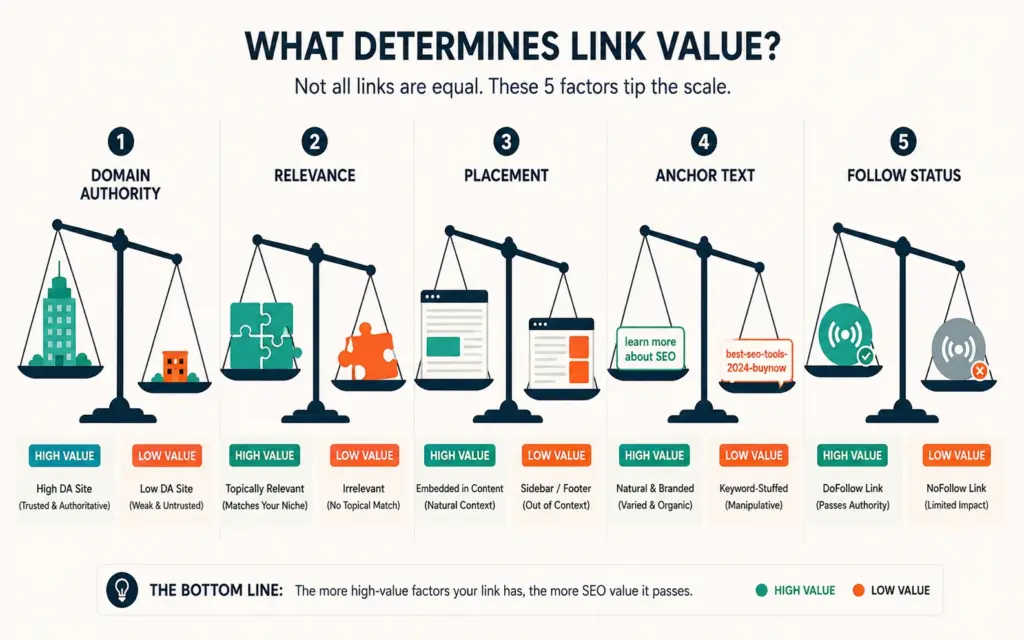
Not all links are equal. The factors that determine link value:
Domain authority of the linking site. A link from a DR 70 site (major publication) passes dramatically more authority than a link from a DR 10 site (random blog). Prioritize earning fewer links from stronger sites over many links from weak ones.
Relevance of the linking page. A link from a fitness blog to your running shoes store is more valuable than a link from a cooking blog to the same store. Google evaluates topical relevance between the linking and linked content. Links from within your industry carry more weight.
Link placement on the page. Editorial links within the body content of an article (someone citing your data or recommending your tool) are more valuable than sidebar, footer, or author bio links. Contextual placement signals editorial endorsement.
Anchor text. The clickable text of the link. Natural anchor text varies: sometimes your brand name, sometimes a descriptive phrase, sometimes a bare URL. Unnatural anchor text patterns (every link using the same exact-match keyword) trigger Google penalties. Let linking sites choose their own anchor text naturally.
Follow vs nofollow. Followed links pass full authority. Nofollow links (social media, some press sites, sponsored content) pass less direct authority but still drive referral traffic and brand visibility. A healthy link profile includes both. The tracking infrastructure should attribute referral traffic from earned links to measure their direct traffic value beyond SEO.
Link Building Outreach That Actually Gets Responses
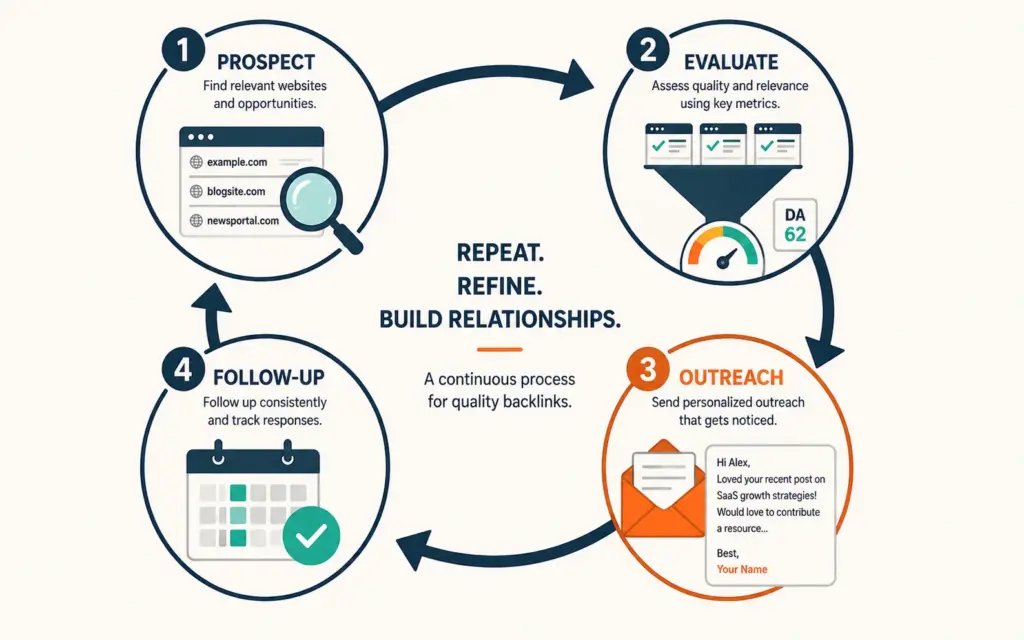
The outreach email structure
Subject line: specific, not salesy. “Quick question about your [topic] resource page” outperforms “Link exchange opportunity!!!” by 10x on open rate.
Body: 3 to 4 sentences maximum. Sentence 1: specific reference to their content that proves you actually read it. Sentence 2: what you have that might be useful to their readers. Sentence 3: the ask (would they consider linking/mentioning it). No attachments, no walls of text, no “I’ve been a huge fan of your work” filler.
Follow-up: one follow-up email 5 to 7 days later if no response. No more than that. Pestering creates negative brand association.
Response rate benchmarks
Cold outreach: 3 to 8% response rate, with 30 to 50% of responses resulting in a link. Warm outreach (you have an existing relationship or have engaged with their content): 15 to 25% response rate. According to Backlinko’s link building research, personalized outreach emails that reference specific content on the target site earn 2 to 3x higher response rates than templated mass emails. Broken link outreach: 5 to 12% response rate. HARO/journalist queries: 5 to 15% placement rate. Plan outreach volume based on these rates: 100 cold emails typically yields 3 to 8 links. For measuring the SEO impact, track referring domains monthly in Ahrefs or SEMrush alongside organic traffic changes.
Tactics to Avoid
Buying links. Link sellers offer “guaranteed” placements on high-DA sites for $50 to $500 per link. Google’s spam detection identifies paid link patterns with increasing accuracy. A manual action penalty removes your site from search results entirely, wiping out months or years of organic traffic. The risk outweighs any possible benefit.
Private Blog Networks (PBNs). Networks of sites created solely to link to each other and to client sites. Google has penalized PBN-linked sites in every major algorithm update since 2014. The sites look real superficially but share hosting, registration, and content patterns that Google detects algorithmically.
Mass directory submissions. Submitting to 500 web directories was a valid tactic in 2008. It’s now a spam signal. The only directory submissions worth doing: your specific industry’s trade directory, your local Chamber of Commerce, and the Better Business Bureau.
Comment spam and forum signature links. Dropping your URL in blog comments and forum signatures generates nofollow links with zero authority value and negative brand perception. Engage genuinely in communities where your expertise helps; links will follow naturally if your contributions are valuable.
Building a Sustainable Link Building Practice
Link building isn’t a project; it’s an ongoing practice. The stores that win organic rankings invest 3 to 5 hours per week consistently, not 40 hours once per quarter.
Weekly cadence: 1 hour creating or improving linkable content, 1 hour prospecting link targets, 1 hour sending outreach emails, 30 minutes following up on previous outreach, 30 minutes monitoring new backlinks in Ahrefs/SEMrush.
Quarterly targets: 8 to 15 new referring domains from DR 30+ sites. Track in Ahrefs or SEMrush. Compare quarter-over-quarter to ensure the practice is building momentum. Rising referring domain count with rising organic traffic confirms the strategy is working. The retargeting approach captures organic visitors earned through link building who don’t convert on their first visit.
Content investment: Allocate 20 to 30% of your content budget to linkable assets (tools, original research, comprehensive guides) rather than purely promotional blog posts. Linkable content serves dual duty: it ranks for keywords AND earns backlinks that lift your entire domain’s authority. Every page benefits when domain authority rises, including your product pages and category content.
Frequently Asked Questions
Link building earns backlinks from external websites to your store, signaling authority to Google and improving organic search rankings. Each backlink acts as a vote of confidence from another site. Ecommerce stores with more high-quality backlinks rank higher for product and category keywords, attract more organic traffic, and reduce dependence on paid acquisition. The #1 ranking page averages 3.8x more backlinks than positions 2 through 10.
It depends entirely on competition for your target keywords. Low-competition long-tail keywords might require 5 to 15 referring domains. High-competition commercial keywords might require 50 to 200+. Focus on referring domains (unique sites linking to you) rather than total backlinks (one site linking 100 times counts once). A realistic target is 8 to 15 new referring domains per quarter from DR 30+ sites, which compounds meaningfully over 12 to 18 months.
No. Buying links violates Google’s guidelines and risks a manual action penalty that removes your site from search results. Google’s spam detection identifies paid link patterns with increasing accuracy through algorithm updates. The penalty can take months to recover from and wipes out all organic traffic during that period. Earned links from genuine editorial coverage, useful tools, and original research are the only sustainable approach.
Supplier and partner link exchanges are the lowest-effort tactic because the relationship already exists. Request inclusion on your suppliers’ retailer pages, technology vendors’ case study sections, or complementary brands’ partner listings. Beyond that, HARO journalist query responses require only 15 to 20 minutes per response and earn high-authority media links at a 5 to 15% placement rate. Both tactics require minimal technical skill or content creation.
Individual links take 3 to 6 months to impact rankings as Google recrawls, reindexes, and recalculates authority. Consistent link building (8 to 15 new referring domains per quarter) typically shows measurable organic traffic improvement within 6 to 9 months. The compounding effect means month 12 results are dramatically better than month 6, and month 24 better still. Unlike paid ads that stop producing the moment you stop spending, earned links continue passing authority indefinitely.
Essential: Ahrefs or SEMrush ($99 to $199/month) for backlink monitoring, competitor link analysis, and broken link discovery. Helpful: Hunter.io (find email addresses for outreach, free tier available), Google Sheets (track outreach and responses), and Check My Links (free Chrome extension for finding broken links on target pages). HARO or Connectively (free) for journalist query opportunities. Total investment: $100 to $200/month in tools plus 3 to 5 hours weekly in time.
Related Reads
- Technical SEO for Ecommerce
- Content That Ranks and Converts
- Working with Influencers
- Product Page Optimization
- Tracking What Matters
- The Right Tools for the Job
Enjoying this? Get more like it every week.
One email per week with ecommerce strategies, tool picks, and seller insights. No spam.