
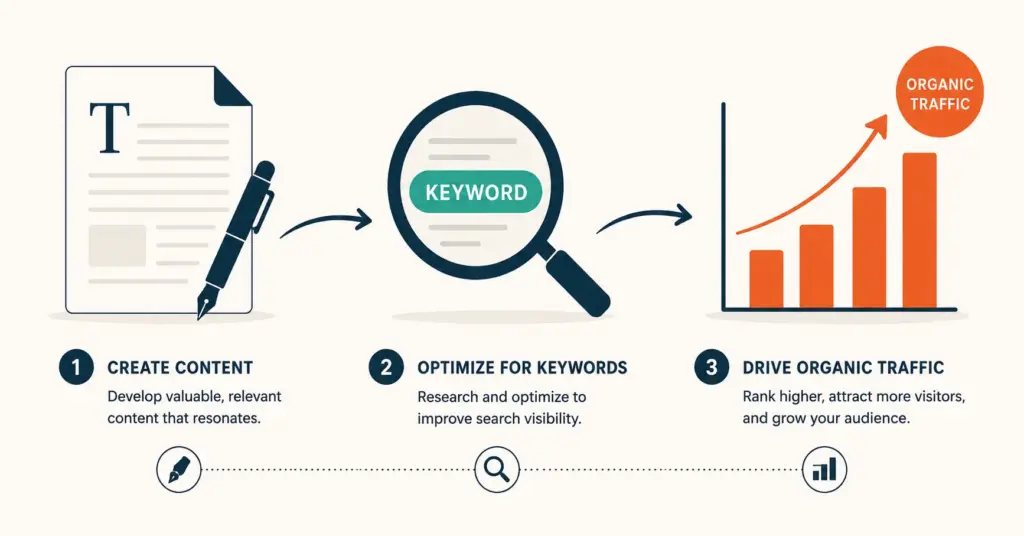
- Content marketing for ecommerce is the strategy of creating blog posts, guides, videos, and product content that attracts organic traffic, builds trust, and converts visitors into buyers without relying entirely on paid ads. Top ecommerce brands generate 30 to 50% of revenue from organic channels built through content.
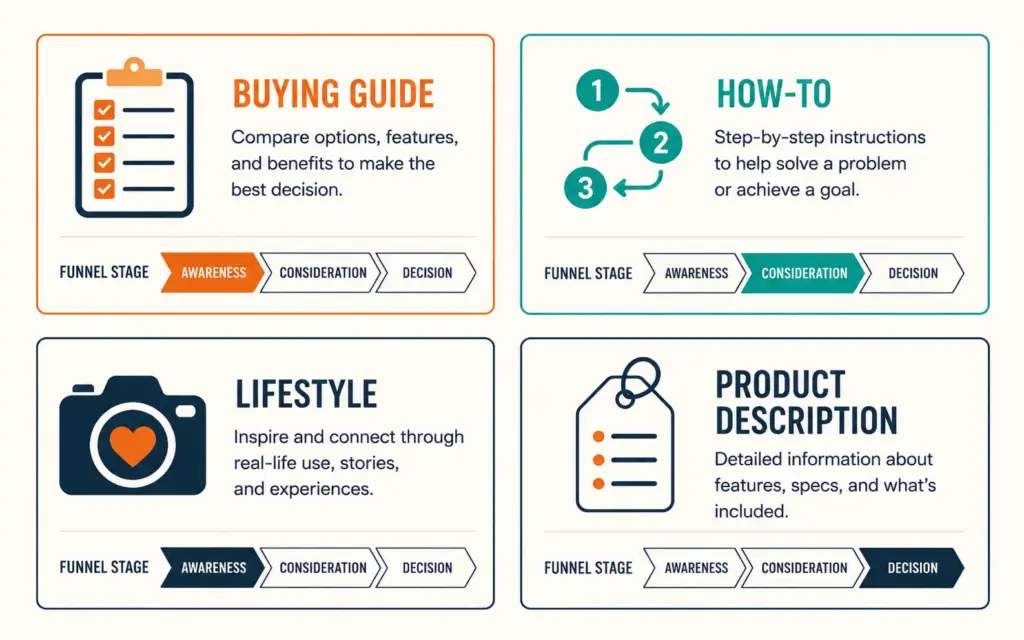
- The 4 content types that drive ecommerce revenue: buying guides (comparison, "best of" posts), how-to educational content, product-adjacent lifestyle content, and optimized product descriptions. Each targets a different stage of the buyer journey.
- Publishing cadence matters more than publishing volume. Two high-quality posts per week that target validated search demand outperform daily posts written without keyword research by 5 to 10x on organic traffic per post.
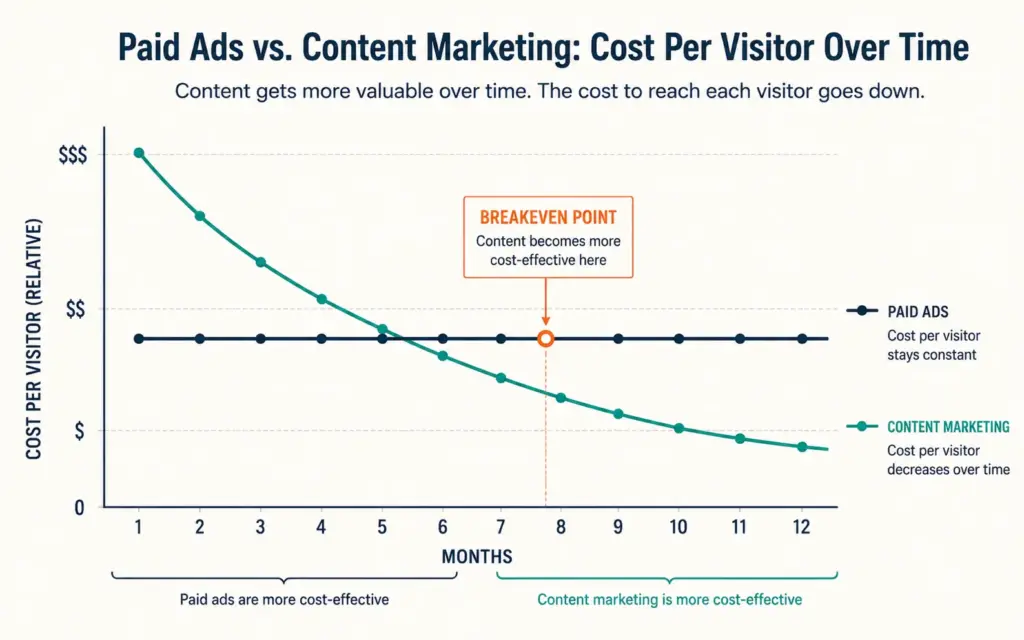
- Content marketing ROI compounds over time. A blog post published today continues generating traffic and revenue for 12 to 36 months. Paid ads stop the moment you stop paying. The breakeven point for content investment typically arrives at month 6 to 9.
Content marketing for ecommerce is the strategy of creating blog posts, buying guides, videos, and product-adjacent content that attracts organic search traffic, builds brand trust, and converts visitors into buyers without paying for every click. Top-performing ecommerce brands generate 30 to 50% of total revenue through organic channels built on content, according to SEMrush’s content marketing research. The compounding effect is what makes content marketing uniquely valuable: a blog post published today continues generating traffic and revenue for 12 to 36 months, while a paid ad stops working the moment you stop paying.
The problem is that most ecommerce brands approach content marketing wrong. They publish product announcements nobody searches for, write generic blog posts without keyword research, or outsource to agencies that produce volume without strategy. The brands that succeed treat content like a product: researched, designed for a specific audience need, optimized for discovery, and measured by revenue contribution. For the SEO foundation that makes content discoverable, see our ecommerce technical SEO guide.
This guide covers the 4 content types that drive ecommerce revenue, the keyword-first publishing process, the content calendar that builds momentum without burning out a small team, and the measurement framework that separates content that generates revenue from content that generates vanity metrics.
What Types of Content Drive Ecommerce Revenue?
Not all content is equal. Four content types consistently drive measurable revenue for ecommerce stores, each targeting a different stage of the buyer journey:
1. Buying guides and comparison content
“Best [product] for [use case],” “[Product A] vs [Product B],” and “How to choose [product category]” posts target shoppers actively comparing options before purchasing. These posts convert at 3 to 8% (visitors to purchase) because the reader has already decided to buy something; they’re deciding what. Position your product naturally within honest comparisons. Readers who trust your comparison trust your recommendation.
Example: A kitchen knife brand publishing “Best Chef’s Knives Under $100” ranks for commercial-intent searches, builds authority, and naturally positions their product alongside competitors. The post generates revenue for 18 to 24 months from search traffic alone.
2. How-to and educational content
“How to [achieve outcome using your product category]” posts target earlier-stage shoppers who haven’t decided to buy yet. Conversion rates are lower (0.5 to 2%) but traffic volume is typically 3 to 10x higher than buying guides. The value is brand awareness plus email capture (offer a downloadable guide or checklist in exchange for email). Educational content builds the top of your funnel without paid ad costs.
3. Product-adjacent lifestyle content
Content about the lifestyle, hobby, or identity your product serves rather than the product itself. A fitness apparel brand writing about workout routines. A coffee brand writing about brewing methods. A skincare brand writing about ingredient science. This content builds community, earns social shares, and creates brand association that lifts conversion on product pages even when the content itself doesn’t directly sell.
4. Optimized product descriptions and category pages
Product pages with detailed descriptions, comparison tables, use-case scenarios, and embedded FAQ sections rank for long-tail product queries. Most ecommerce stores treat product descriptions as afterthoughts (50-word manufacturer copy). Stores that write 300 to 800 word original descriptions with specifications, use cases, and answers to common buyer questions see 15 to 30% higher organic traffic to product pages. For product page depth, see our product page design guide.
How Do I Build a Keyword-First Content Strategy?
Content without keyword research is guessing. The process that connects content to actual search demand:
Step 1: Map your product to search intent
List every product category you sell. For each category, brainstorm the questions buyers ask before, during, and after purchasing. “Best [category] for beginners,” “How to use [product],” “[Product A] vs [Product B],” “[Category] buying guide,” “Is [product] worth it.” These become your content topics.
Step 2: Validate demand with keyword data
Run each topic through a keyword tool (Ahrefs, SEMrush, Ubersuggest, or Google Keyword Planner). Look for primary keywords with 500+ monthly searches and keyword difficulty under 50 (for newer sites) or under 70 (for established sites). Prioritize keywords where the top-ranking content is thin, outdated, or poorly written because you can outrank it.
Step 3: Build topic clusters
Group related keywords into clusters around pillar topics. A “coffee brewing” pillar might cluster: “pour over vs French press,” “best coffee grinder under $50,” “how to make cold brew at home,” and “coffee to water ratio chart.” The pillar page links to each cluster post, and each cluster post links back. This internal linking structure signals topical authority to search engines. For internal linking strategy, see our ecommerce SEO strategy guide.
Step 4: Prioritize by revenue potential
Not all keywords are worth the same revenue. “Best running shoes for flat feet” (buying intent, direct product recommendation) drives more revenue per visitor than “how to start running” (informational, early stage). Score each keyword by: search volume x estimated conversion rate x average order value. Publish highest-revenue-potential topics first.
What Publishing Cadence Works for Ecommerce?
Two high-quality posts per week that target validated search demand outperform daily posts without keyword research by 5 to 10x on organic traffic per post. Quality and relevance trump volume.
The realistic content calendar
| Team Size | Posts Per Week | Content Mix | Expected Results (Month 6) |
|---|---|---|---|
| Solo founder | 1 | 100% buying guides | 2,000 to 5,000 organic visits/month |
| Founder + 1 writer | 2 | 60% buying guides, 40% how-to | 5,000 to 15,000 organic visits/month |
| Small team (3 to 5) | 3 to 4 | 40% buying guides, 30% how-to, 20% lifestyle, 10% product | 15,000 to 50,000 organic visits/month |
| Content team (5+) | 5 to 7 | Full mix with video | 50,000 to 200,000+ organic visits/month |
The content production workflow
- Monday: Research and outline next week’s posts (keyword validation, competitive analysis, outline structure)
- Tuesday to Thursday: Write and edit drafts
- Friday: Optimize for SEO (internal links, meta tags, image alt text, FAQ sections), schedule for publication
- Ongoing: Update top-performing posts quarterly with fresh data, new product recommendations, and current year references
Updating vs publishing new
A 2-year-old post ranking #8 for a 5,000-search keyword can often be updated to rank #3 in 2 to 4 weeks. Publishing a brand-new post targeting the same keyword takes 3 to 6 months to reach the same position. Allocate 20 to 30% of content time to updating existing posts that rank in positions 5 to 20. The ROI per hour is typically 3 to 5x higher than new content.
How Does Ecommerce Content Marketing Differ from SaaS or B2B?
Ecommerce content marketing has three distinct characteristics:
Product integration is direct
SaaS content educates toward a free trial. Ecommerce content can link directly to a purchasable product. “Best yoga mats for hot yoga” can include your product alongside competitors, with a direct “Buy Now” link. The path from content to revenue has fewer steps, which means attribution is cleaner and ROI is faster.
Visual content matters more
Ecommerce products are physical objects people want to see before buying. Blog posts with high-quality product images, comparison photos, and lifestyle shots convert 2 to 3x better than text-only posts. Invest in photography for content, not just for product pages. For ad creative principles that apply to content imagery, see our ad creative tips guide.
Seasonality drives the calendar
Publish seasonal content 6 to 8 weeks before the season peaks. “Best gifts for Dad” should publish in April (Father’s Day is June). “Back to school supplies” should publish in June (shopping starts July). Google takes 4 to 8 weeks to fully index and rank new content. Late publishing means your content peaks after the season ends.
What Content Formats Work Beyond Blog Posts?
Video content
Product demo videos on YouTube rank in Google search results and drive purchase intent. “How to use [product]” and “[product] review” videos generate high-intent traffic at low production cost (phone-shot, edited in CapCut). YouTube is the second largest search engine, and most ecommerce categories have minimal video competition compared to written content.
User-generated content
Customer reviews, unboxing videos, and social media posts create authentic content at zero production cost. Encourage UGC through post-purchase email requests, branded hashtags, and small incentives (10% off next order for a review with photo). UGC builds social proof and generates long-tail search traffic. For email automation depth, see our email marketing strategy guide.
Interactive tools and calculators
Interactive content (sizing guides, product finders, cost calculators) generates backlinks, social shares, and high-engagement visits. Our profit margin calculator is an example: it solves a specific user problem, ranks for relevant keywords, and drives traffic to related content. Interactive tools earn 2 to 3x more backlinks than static blog posts.
Email content
Repurpose blog content into weekly email newsletters. This extends the reach of every post and re-engages subscribers who missed the original publication. Content-led emails (educational value first, product promotion second) generate 3 to 5x higher engagement than promotional-only emails. For email strategy depth, see our email marketing strategy guide.
How Do I Measure Content Marketing ROI?
The measurement framework that separates revenue-generating content from vanity-metric content:
The 4 content metrics that matter
- Organic traffic per post: GA4 landing page report filtered by blog URLs. Target 500+ organic sessions/month per post within 6 months of publication.
- Content-assisted revenue: Revenue from sessions that included a blog page in the path. GA4 attribution reports show which content pages appear in converting journeys. For attribution depth, see our attribution modeling guide.
- Email capture rate: Email signups from content pages. Target 1 to 3% of blog visitors converting to email subscribers through inline forms, exit-intent popups, or content upgrades.
- Search ranking positions: Track primary keyword rankings for each published post. Target top-10 ranking within 3 to 6 months for keywords with difficulty under 50.
The content marketing breakeven point
Content marketing investment (writer time, tools, editing) typically breaks even at month 6 to 9 when organic traffic from published posts surpasses the equivalent cost of buying that traffic through paid ads. According to Ahrefs’ content marketing ROI analysis, the average blog post generates $0.15 to $0.50 in organic traffic value per month after reaching steady-state ranking, compounding as the post library grows. By month 12, a consistent publishing program typically returns 3 to 8x the investment.
What Are the Most Common Content Marketing Mistakes?
Publishing without keyword research
Blog posts written around “what we want to say” instead of “what people search for” generate zero organic traffic. Every post should target a validated keyword with 500+ monthly searches. No keyword validation, no publish.
Writing for search engines instead of buyers
The opposite extreme: keyword-stuffed content that technically ranks but reads like a robot wrote it. Google’s helpful content system specifically downgrades content that prioritizes search engine signals over user value. Write for people first, optimize for search second. The best content does both naturally.
Ignoring content updates
A post published 2 years ago with outdated product recommendations, old pricing, and last year’s statistics loses rankings gradually. Updating top performers quarterly with fresh data and current references maintains rankings at 3 to 5x lower effort than publishing new. For A/B testing content changes, see our A/B testing guide.
No internal linking strategy
Each new post should link to 3 to 5 existing posts and be linked from 2 to 3 existing posts. Internal links pass authority, guide readers through related topics, and signal topical clusters to search engines. Most ecommerce blogs have zero strategic internal linking, leaving significant ranking potential untapped.
Measuring pageviews instead of revenue
A post with 50,000 pageviews and zero revenue contribution is a vanity metric. A post with 2,000 pageviews that generates $5,000 in assisted revenue is the content you want more of. Measure content by revenue impact, not traffic volume. For analytics setup, see our GA4 ecommerce setup guide.
Frequently Asked Questions
Content marketing for ecommerce is the strategy of creating blog posts, buying guides, videos, and product content that attracts organic search traffic, builds brand trust, and converts visitors into buyers. Unlike paid ads, content compounds: a post published today continues driving traffic and revenue for 12 to 36 months. Top ecommerce brands generate 30 to 50% of revenue through organic channels built on content.
Solo founders should target 1 quality post per week. Small teams can publish 2 to 4 posts per week. Quality and keyword targeting matter more than volume. Two posts per week targeting validated 1,000+ search-volume keywords outperform daily posts written without research by 5 to 10x on organic traffic. Consistency over 6 to 12 months matters more than intensity over 2 months.
Blog posts typically take 3 to 6 months to reach stable search rankings. Organic traffic from a consistent publishing program usually surpasses the equivalent paid-traffic cost by month 6 to 9 (the breakeven point). By month 12, a well-executed program typically returns 3 to 8x the investment. Content marketing is a compounding asset, not an instant-return channel.
Buying guides and comparison content (“Best [product] for [use case],” “[A] vs [B]”) convert at 3 to 8% because readers have already decided to buy and are choosing what. How-to content converts at 0.5 to 2% but attracts 3 to 10x more traffic. Product-adjacent lifestyle content builds brand awareness and email lists. The highest-revenue strategy combines all three types targeting different funnel stages.
Track four metrics: organic traffic per post (target 500+ sessions/month within 6 months), content-assisted revenue (GA4 attribution showing which blog pages appear in converting paths), email capture rate (1 to 3% of blog visitors), and keyword ranking positions (top 10 within 3 to 6 months). Measure content by revenue contribution, not pageviews. A post with 2,000 views generating $5,000 revenue beats a post with 50,000 views and zero revenue.
Start by writing your own content or hiring a single freelance writer who understands your niche ($0.10 to $0.30/word for quality ecommerce content). Agencies make sense above $5,000/month content budgets when you need 8+ posts per month with professional editing, SEO optimization, and content strategy. Below that budget, a freelancer guided by keyword research and your product expertise outperforms most agency output on relevance and conversion.
Related Reads
- Ecommerce Technical SEO
- Ecommerce SEO Strategy
- Email Marketing Strategy
- Ad Creative Tips
- Product Page Design
- GA4 Ecommerce Setup
Enjoying this? Get more like it every week.
One email per week with ecommerce strategies, tool picks, and seller insights. No spam.