
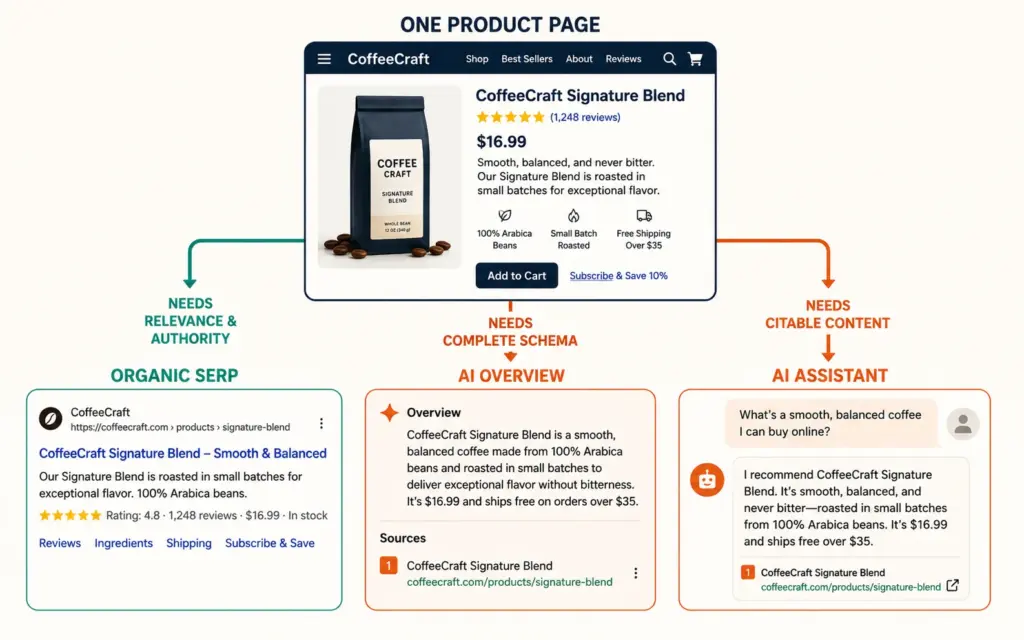
- Product page SEO in 2026 is graded by three systems at once: the classic organic search results, Google AI Overviews (appearing on a rapidly growing share of shopping queries), and AI shopping assistants like ChatGPT Shopping and Perplexity. A page can rank in traditional search but stay invisible in AI answers if it lacks the structured signals those systems need. Only about 38% of AI-cited pages also rank in the top 10 organic results, which means ranking and citation are now two separate games.
- The three highest-impact factors: keyword strategy built around the full product entity (brand, model, specs, use cases), complete and unique product descriptions (not manufacturer copy), and attribute-rich Product schema markup. Generic Product schema gives no AI citation advantage; the detail in the attributes is what earns rich results and AI citations.
- Core Web Vitals gate rankings. A 1-second mobile speed improvement lifts conversion roughly 7%, so page speed is both an SEO factor and a revenue lever. Product pages that load slowly lose rankings and sales simultaneously. Sub-2-second mobile LCP is the practical target.
- Google's March 2026 core update demoted thin pages that restated product feeds without adding insight. Manufacturer copy used verbatim creates duplicate content that struggles to rank. Original benefits, use cases, comparisons, care details, and buyer-focused explanations are what separate ranking product pages from invisible ones.
Product page SEO is the practice of optimizing individual product pages so they rank in search results, appear in Google Shopping, and get cited by AI shopping assistants. For years this meant one thing: rank the page in the ten blue links. That changed. In 2026, the same product page is evaluated by three different systems simultaneously, and optimizing for one no longer guarantees visibility in the others.
The shift is measurable. According to DigitalApplied’s product page SEO analysis, Google AI Overviews appeared in roughly 14% of shopping queries as of March 2026, a 5.6x jump from 2.1% just months earlier. Meanwhile most product pages leave the easy wins on the table: schema fields missing, copy lifted verbatim from the manufacturer, and faceted URLs multiplying faster than search engines can crawl them. Winning in 2026 means treating structured data, unique content, crawl hygiene, and performance as one connected system. The ecommerce technical SEO audit covers the site-wide foundation; this guide focuses on the product page itself.
Optimize the Full Product Entity, Not Just a Keyword
Modern product page SEO targets the entire product entity: brand, model, specifications, pricing, availability, reviews, and policies. Search engines and AI systems need clear, complete information about what the product is, who it’s for, and why it’s trustworthy. Targeting a single keyword and hoping to rank is a 2019 strategy.
Title Tags and H1s That Match How Buyers Actually Search
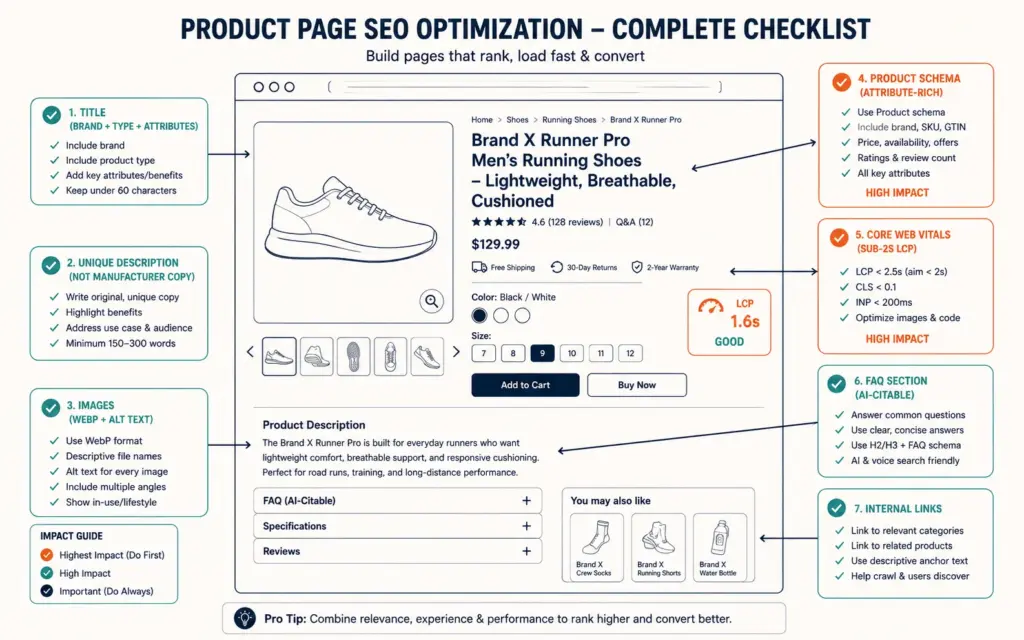
Your title tag and H1 should include the brand, product type, and key differentiating attributes. “Stainless Steel Insulated Water Bottle 32oz with Straw Lid” beats “Premium Hydration Companion.” Buyers search in specific, attribute-rich language. Match it. According to Get Ryze’s product page SEO research, stores that optimize for both traditional search and AI discovery see 127% more organic traffic than those focusing on rankings alone. Front-load the most important terms since both search engines and AI systems weight early words more heavily. The product descriptions guide covers the copywriting structure that serves both SEO and conversion.
Unique Descriptions That Add Insight, Not Feed Restatement
Google’s March 2026 core update specifically demoted thin pages that restated product feeds without insight. Manufacturer-provided copy used verbatim creates duplicate content shared across every retailer selling the same product. You can use manufacturer copy as a base, but you must add original value: specific benefits, real use cases, comparisons to alternatives, care and maintenance details, and buyer-focused explanations of who the product suits.
A product description that answers the questions buyers actually ask (Does it fit X? How does it compare to Y? How do I care for it?) ranks better and converts better than a spec dump. These are the same questions your reviews and social proof and customer service inbox reveal. Mine them for description content.
Product Schema Markup: The Data That Earns Rich Results
Product schema (schema.org Product markup) tells search engines and AI systems the structured facts about your product: name, image, price, availability, reviews, brand, and more. This markup unlocks rich results (the star ratings, prices, and availability shown directly in search results) and increasingly determines whether AI systems cite your page.
The critical nuance: generic Product schema with minimal fields gives no AI citation advantage. Attribute-rich Product markup does. Include every applicable field: name, image, description, brand, SKU, GTIN, price, priceCurrency, availability, aggregateRating, review, color, size, material. The more complete and accurate your structured data, the more likely both rich results eligibility and AI citation.
Implementation: most Shopify themes include basic Product schema, but it’s often incomplete. Apps like Schema Plus or manual JSON-LD injection fill the gaps. WooCommerce uses Yoast SEO or Rank Math for schema, again often needing enrichment. The best WooCommerce plugins guide covers schema-capable SEO plugins. Validate your markup with Google’s Rich Results Test before assuming it works. Broken or incomplete schema fails silently: the page still loads, but you lose the rich result and the AI citation you were counting on. Re-validate after any theme update, since template changes can break schema output without any visible sign on the page itself.
Core Web Vitals: Where SEO and Conversion Are the Same Fix
Core Web Vitals (loading speed, interactivity, visual stability) are ranking factors and conversion factors at the same time. A 1-second improvement in mobile load time lifts conversion by roughly 7%. A slow product page loses rankings AND sales in the same moment, which makes speed optimization the rare fix that pays twice.
The practical targets: Largest Contentful Paint (LCP) under 2 seconds on mobile, minimal layout shift, and fast interactivity. The most common product page speed killers: unoptimized images (compress to WebP under 200KB), too many apps injecting scripts, and heavy themes. The mobile CRO guide covers the speed work in depth since 60 to 70% of product page traffic is mobile. Run Google PageSpeed Insights on your top product pages and fix the flagged issues in priority order. Prioritize by traffic: the product pages receiving the most visits deserve speed optimization first, because the conversion gain compounds across more sessions. A hero product converting 200 sessions per day at a 7% lift from a 1-second speed improvement recovers more revenue than optimizing a long-tail page with 5 daily sessions.
Making Product Pages Citable in AI Answers
AI shopping assistants (Google AI Overviews, ChatGPT Shopping, Perplexity) surface product recommendations directly in their responses. Getting cited requires signals beyond traditional ranking. Since only about 38% of AI-cited pages also rank in the top 10 organically, you can’t assume good rankings equal AI visibility.
What makes a product page citable: complete attribute-rich schema (so AI systems can extract structured facts confidently), an ecosystem of supporting content around the product (FAQs, buyer guides, comparison content, policies), genuine reviews with substantive text, and clear, factual product information that AI can quote without ambiguity. The moat isn’t the product page alone. It’s the content ecosystem around it. The content marketing assets you build (buying guides, comparisons, how-tos) that link to and contextualize your products increase the odds AI systems cite you as an authoritative source.
Add an FAQ section to high-value product pages answering the real questions buyers ask. FAQ content is highly extractable by AI systems and often becomes the cited answer. Structure each answer to stand alone as a complete response to a specific question.
Internal Linking and Crawl Hygiene for Product Pages
Product pages need internal links from category pages, related products, buying guides, and blog content to signal their importance and distribute ranking authority. Orphaned product pages (no internal links pointing to them) rank poorly because search engines interpret the lack of links as low importance. The link building guide covers external authority, but internal linking is the lever you fully control.
Crawl hygiene matters especially for stores with faceted navigation (filters for size, color, price). Faceted URLs multiply fast: every filter combination can generate a unique URL, wasting crawl budget on thin, near-duplicate pages. Use canonical tags, robots directives, and parameter handling to keep search engines focused on your primary product pages instead of thousands of filter permutations. The ecommerce category page design guide covers faceted navigation SEO in detail.
Image Optimization for Product Page SEO
Product images serve SEO through image search traffic and page speed. Optimize them: descriptive filenames (stainless-steel-water-bottle-32oz.webp not IMG_4471.jpg), alt text describing the product accurately (for accessibility and image search), WebP format compressed under 200KB, and appropriate dimensions (don’t load a 3000px image displayed at 600px). The product photography quality affects conversion, while image optimization affects speed and image search visibility. Both matter. Serve appropriately sized images per device: a mobile shopper doesn’t need the desktop-resolution version, and forcing it wastes bandwidth and slows the page. Lazy-load images below the fold so the initial page render stays fast while additional product photos load as the shopper scrolls. This keeps your Largest Contentful Paint low without sacrificing the multiple-image galleries that improve conversion. Modern Shopify and WooCommerce themes support lazy loading natively; verify it’s enabled on your product template.
Frequently Asked Questions
Three factors carry the most weight: keyword strategy built around the full product entity (brand, model, specs, use cases, not a single keyword), unique product descriptions that add insight beyond manufacturer copy, and attribute-rich Product schema markup. In 2026, these three determine both traditional ranking and AI citation. Generic schema and copied descriptions are the two most common reasons product pages fail to rank or get cited.
Yes. Product schema (schema.org Product markup) unlocks rich results (star ratings, prices, availability shown in search) and increasingly determines AI citation. But generic schema with minimal fields provides no AI advantage. Include every applicable attribute: name, image, price, availability, brand, SKU, GTIN, reviews, ratings, color, size, material. The completeness of your structured data is what earns rich results and makes your page citable by AI shopping assistants.
Only as a starting base. Google’s March 2026 core update demoted pages that restate product feeds without adding insight. Manufacturer copy used verbatim creates duplicate content shared across every retailer selling the same product. Add original value: specific benefits, real use cases, comparisons to alternatives, care details, and buyer-focused explanations of who the product suits. Unique content is what separates ranking product pages from invisible ones.
Core Web Vitals (loading speed, interactivity, visual stability) are direct ranking factors. The practical target is Largest Contentful Paint under 2 seconds on mobile. Speed is also a conversion factor: a 1-second mobile speed improvement lifts conversion roughly 7%. A slow product page loses rankings and sales at the same time. The most common speed killers are unoptimized images, excessive apps, and heavy themes. Fix these to improve both SEO and revenue.
AI citation requires signals beyond traditional ranking (only about 38% of AI-cited pages rank in the top 10 organically). What helps: complete attribute-rich Product schema so AI can extract facts confidently, an ecosystem of supporting content around the product (FAQs, buyer guides, comparisons), genuine reviews with substantive text, and clear factual information AI can quote unambiguously. Adding an FAQ section to product pages helps because FAQ content is highly extractable and often becomes the cited answer.
Product pages should receive internal links from category pages, related product sections, buying guides, and relevant blog content. There’s no fixed number, but orphaned product pages (zero internal links) rank poorly because search engines interpret the absence as low importance. Ensure every product page is linked from at least its category page and a few related products. Buying guides and blog content linking to products add topical context that strengthens both ranking and AI citation potential.
Related Reads
- Ecommerce Technical SEO
- Product Descriptions
- Ecommerce Category Page Design
- Mobile CRO
- Product Photography
- Content Marketing
Enjoying this? Get more like it every week.
One email per week with ecommerce strategies, tool picks, and seller insights. No spam.