
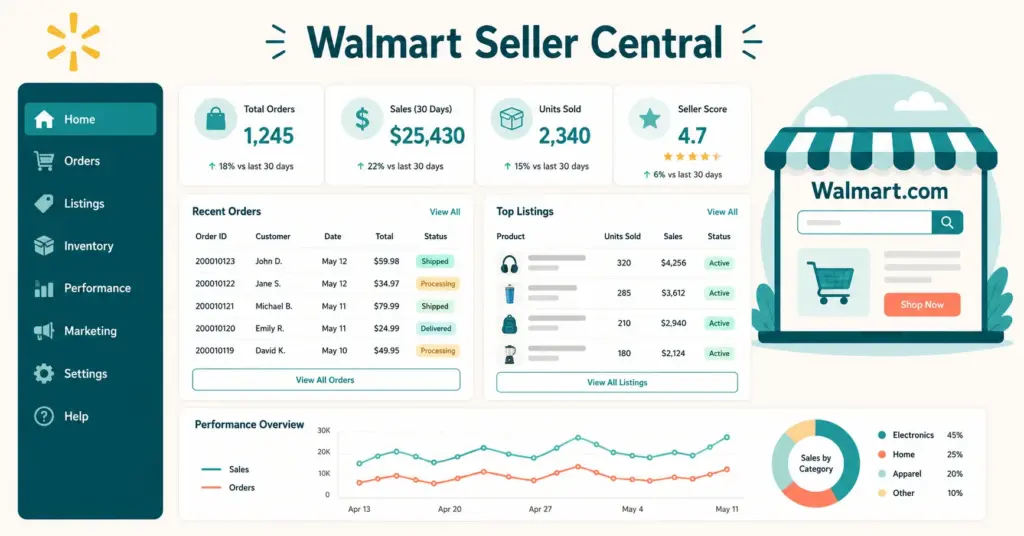
- Walmart Seller Central is the dashboard you use to manage a Walmart Marketplace account, with approval based on your business history, product mix, and US tax registration. Approval takes 2 to 4 weeks for most applicants and 4 to 8 weeks if Walmart asks for additional documentation.
- Walmart Marketplace charges referral fees of 6% to 15% per sale depending on category, with no monthly account fee. That structure beats Amazon's $39.99/month plus 8% to 15% referral fees for sellers doing under $400/month in Amazon volume but loses to Amazon at scale.
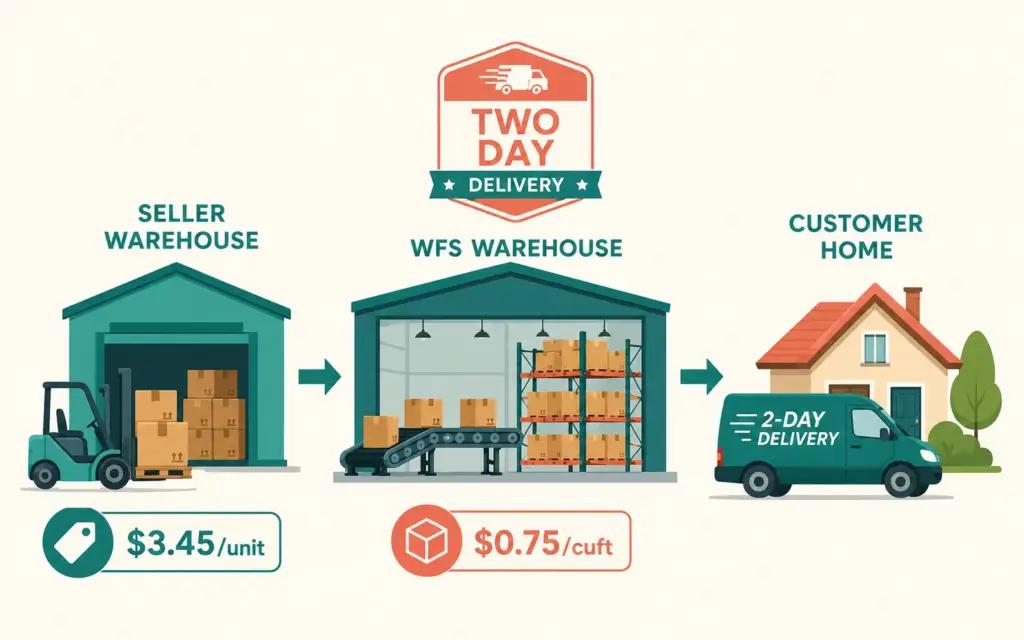
- Walmart Fulfillment Services (WFS) costs $3.45 per unit for items under 1lb and scales by weight and dimensions, broadly comparable to Amazon FBA. WFS items qualify for 2-day shipping badges and TwoDay Delivery placement, which lifts conversion roughly 30% versus seller-fulfilled listings on identical SKUs.
- Walmart Marketplace works best for established sellers with 5+ years of multi-channel ecommerce experience, US-based businesses, branded or differentiated products, and category fit (home, beauty, electronics, baby, pet supplies see strongest demand). Dropshippers, single-product launchers, and resellers of Amazon items get rejected most often.
Walmart Seller Central is the seller dashboard for Walmart Marketplace, the third-party selling platform on Walmart.com that hosts roughly 175,000 approved sellers as of 2026. Sellers use Seller Central to apply for approval, list products, manage inventory, set pricing, fulfill orders, and access Walmart’s promotional and advertising tools. Unlike Amazon’s open registration, Walmart vets every applicant and rejects roughly 80% of applications based on business history, product fit, and operational standards.
The opportunity is real. Walmart.com generated $73 billion in ecommerce sales in 2024 and grew faster than Amazon for the third consecutive year. For sellers who get approved, less competition than Amazon plus growing traffic creates a window that Amazon hasn’t offered since 2015. The gate is harder, but the rewards on the other side justify the effort. For broader context on multi-channel strategy, see our multi-channel selling guide.
This guide covers the application and approval process, Seller Central setup, fee structure, fulfillment options, listing optimization, and the strategic decisions that separate Walmart winners from sellers who get suspended in their first 90 days.
What is Walmart Marketplace?
Walmart Marketplace is Walmart’s third-party seller program, similar to Amazon’s third-party marketplace but smaller and more selective. Approved sellers list products on Walmart.com alongside Walmart’s first-party inventory, and customers see both side-by-side in search results. Walmart handles the storefront, payment processing, customer service infrastructure, and (optionally) fulfillment. Sellers handle product sourcing, listings, inventory, and pricing.
The marketplace launched in 2009 but only opened broadly to outside sellers in 2016. Approval criteria have tightened significantly since 2020 as Walmart prioritizes quality over volume. Compared to Amazon’s roughly 2 million active sellers, Walmart’s 175,000 approved sellers face less direct competition on most queries.
Walmart Marketplace vs Walmart.com (first-party)
Two different things. Walmart.com first-party means Walmart buys your inventory wholesale and sells it themselves (you’re a vendor). Walmart Marketplace means you keep ownership of inventory and sell directly to customers (you’re a third-party seller). Most ecommerce sellers want Marketplace, not vendor relationships. Vendor relationships require minimum order commitments, EDI integration, and typically $1M+ annual revenue with Walmart specifically.
Who Gets Approved for Walmart Seller Central
Walmart’s approval bar is significantly higher than Amazon’s. Based on what they ask for in the application and patterns from rejected applicants, Walmart wants:
- US business with US tax ID: Federal tax ID (EIN) and US business address required. International sellers can apply through Walmart Marketplace International but face additional scrutiny.
- Multi-channel ecommerce history: Most approved sellers have 2+ years of selling on Amazon, eBay, Shopify, or comparable platforms with documented sales history. First-time sellers get rejected at high rates.
- Branded or differentiated products: Private label, manufacturer brands, or unique products. Not just Amazon arbitrage or thin reseller catalogs.
- Catalog of 50+ SKUs: Single-product applications usually fail. Walmart wants sellers who’ll commit to building a real catalog.
- Operational maturity: Customer service email response under 24 hours, return policy that matches Walmart’s 90-day standard, ability to ship within 1 business day.
- Category fit: Home, beauty, electronics, baby, pet supplies, sporting goods see strongest demand and approval rates. Restricted categories (alcohol, weapons, supplements) face additional vetting.
Have those covered before applying. Sellers who apply without them waste 2 to 4 weeks waiting for a rejection letter. For context on building the operational foundation Walmart wants, see our order management systems guide and 3PL guide.
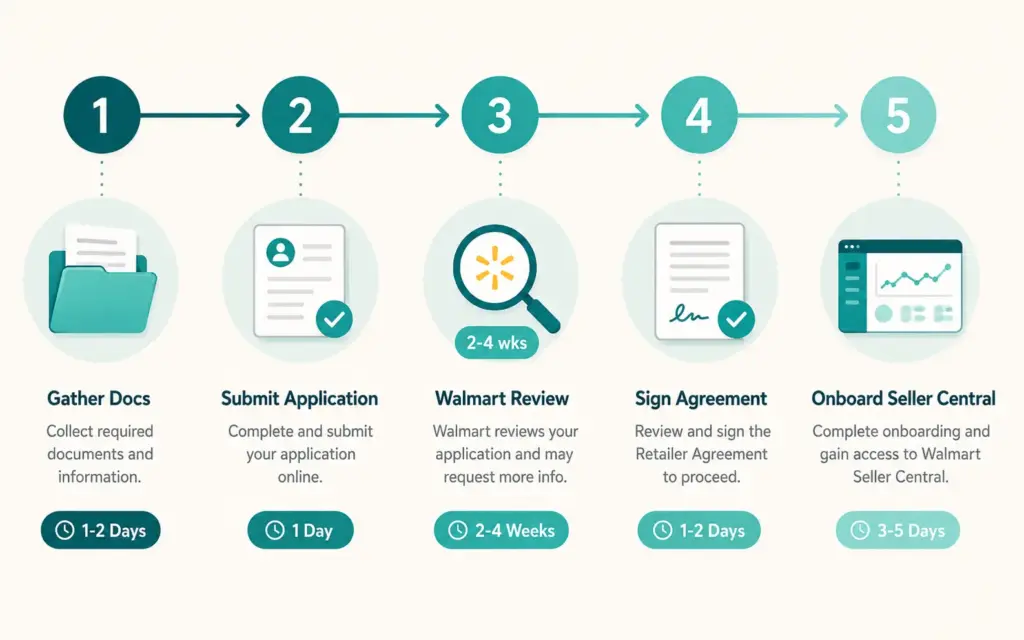
The Walmart Seller Central Application Process
Step 1: Gather required documentation
Before starting the application, prepare:
- US business tax ID (EIN) and W-9 form
- Business address and operating history
- Product catalog overview (categories, SKU count, price range)
- Examples of existing online sales channels with screenshots or marketplace seller IDs
- Bank account for payouts
Step 2: Submit the marketplace application
Apply at marketplace.walmart.com/apply. The application asks for company info, product details, integration approach (do you have an existing inventory management system, or will you use Walmart Seller Center directly), and primary product categories. Plan for 30 to 45 minutes. Save mid-application using the email confirmation link.
Step 3: Walmart approval review
Walmart’s marketplace team reviews applications in batches. Approval timelines vary:
- 2 to 4 weeks: Standard review for clean applications
- 4 to 8 weeks: Applications requiring follow-up documentation
- Indefinite hold: Applications missing key requirements get pushed to bottom of queue
Walmart sometimes requests sample product photos, additional sales channel proof, or compliance documents (FDA registration for supplements, manufacturer agreements for branded resale). Respond within 7 days or the application gets archived.
Step 4: Sign the Retailer Agreement
Once approved, Walmart sends a Retailer Agreement (the contract). Read carefully. The agreement covers fees, performance standards, dispute resolution, and termination clauses. Have legal review for sellers planning $500k+ annual Walmart volume.
Step 5: Onboard and configure Seller Central
After signing, you get Seller Central credentials. Initial onboarding takes 1 to 2 weeks: tax setup, payment configuration, shipping templates, return policies, and your first listings. Walmart provides an onboarding specialist for the first 60 days. Use them. They know which technical traps trip up new sellers.
Walmart Marketplace Fee Structure
Walmart’s fee model differs from Amazon’s significantly:
| Fee Type | Walmart Marketplace | Amazon (for comparison) |
|---|---|---|
| Monthly account fee | $0 | $39.99 (Professional) |
| Referral fee (per sale) | 6% to 15% by category | 8% to 15% by category |
| Closing fee per item | $0 | $1.80 (Media only) |
| Fulfillment fees | WFS variable, or self-ship | FBA variable, or FBM |
| Storage fees | $0.75/cu ft (WFS) | $0.78 to $2.40/cu ft (FBA) |
| Long-term storage | $7.50/cu ft after 30 days | $6.90/cu ft after 365 days |
Referral fees by category (sample)
- 6% category fees: Personal computers
- 8% category fees: Cameras, consumer electronics
- 10% category fees: Most home, baby, beauty, kitchen
- 12% category fees: Apparel, jewelry, shoes
- 15% category fees: Health and personal care, books, collectibles
The exact fee for any product is shown in Seller Central before you list. Don’t guess; check the calculator. Walmart updates category fees 1 to 2 times per year, usually January and July.
Walmart Fulfillment Services vs Self-Fulfillment
Walmart Fulfillment Services (WFS) is Walmart’s equivalent of Amazon FBA. You ship inventory to Walmart’s warehouses, and Walmart picks, packs, ships, and handles returns.
WFS pricing structure
- Standard fulfillment: $3.45 per unit for items under 1lb, scaling up to $50+ for oversized items
- Storage: $0.75 per cubic foot per month (cheaper than FBA’s tiered structure)
- Returns processing: Free for WFS items (FBA charges $1 to $5)
- Inbound shipping: You pay carrier rates to ship to WFS facilities
WFS benefits beyond logistics
- 2-day delivery badge: WFS items show “TwoDay Delivery” badges in search and product pages, which improve click-through and conversion roughly 30% on identical SKUs versus self-fulfilled.
- Buy Box priority: WFS items win Buy Box more often than self-fulfilled when other factors are equal
- Walmart+ eligibility: WFS products qualify for free 2-day shipping for Walmart+ subscribers (52 million households)
- Reduced operational complexity: No customer service for shipping issues, no return processing, no warehouse management
For most sellers above 200 orders per month, WFS economics beat self-fulfillment once you factor in the conversion lift. Below that volume, self-fulfillment usually wins on margin. For deeper economics on this decision, see our 3PL guide.
Listing Optimization for Walmart Search
Walmart’s search algorithm differs from Amazon’s. Walmart weights price more heavily, content quality matters significantly, and content score (a Walmart-internal metric) directly affects ranking.
Title structure
Walmart titles should be 50 to 75 characters and follow this pattern:
[Brand] [Item Name] [Distinguishing Feature], [Pack/Size]
Example: “Hario V60 Ceramic Coffee Dripper, White, 02 Size 4-Cup”. Avoid Amazon-style keyword-stuffed titles. Walmart penalizes keyword density above roughly 4%.
Bullet points and description
Use 3 to 10 features in bullet format. Walmart’s bullet section is more visible than Amazon’s on mobile. Lead with the strongest selling point. Description should be 150 to 300 words, focused on use cases and benefits rather than features.
Images
Walmart requires:
- Main image on white background, product fills 85% of frame
- Minimum 1000×1000 pixels (Walmart penalizes lower-resolution images in ranking)
- 2 to 9 additional images showing scale, lifestyle, and detail
- JPG or PNG, RGB color, under 5MB each
Content score
Walmart shows a Listing Quality score in Seller Central (0 to 100). Anything below 75 gets ranking suppression. Common gaps: missing GTIN, fewer than 4 images, blank “About this item” sections, missing manufacturer info. Fix all listings to 80+ before driving traffic. For broader marketplace listing principles, see our Amazon listing optimization guide.
Walmart Pro Seller Badge
Walmart awards a “Pro Seller” badge to sellers who meet performance standards. Pro Seller listings show a badge in search results and convert roughly 12% better than non-Pro listings.
Requirements (all must be met):
- Order Defect Rate under 2%
- Cancellation Rate under 1.5%
- On-time shipment rate above 99%
- Active for 90+ days
- Minimum 100 orders in last 90 days
Hit Pro Seller status as fast as possible. The badge effect compounds: better conversion means more orders means stronger metrics means easier to maintain Pro status. Sellers who lose Pro status see 10 to 15% revenue drops within 30 days.
Common Walmart Marketplace Mistakes
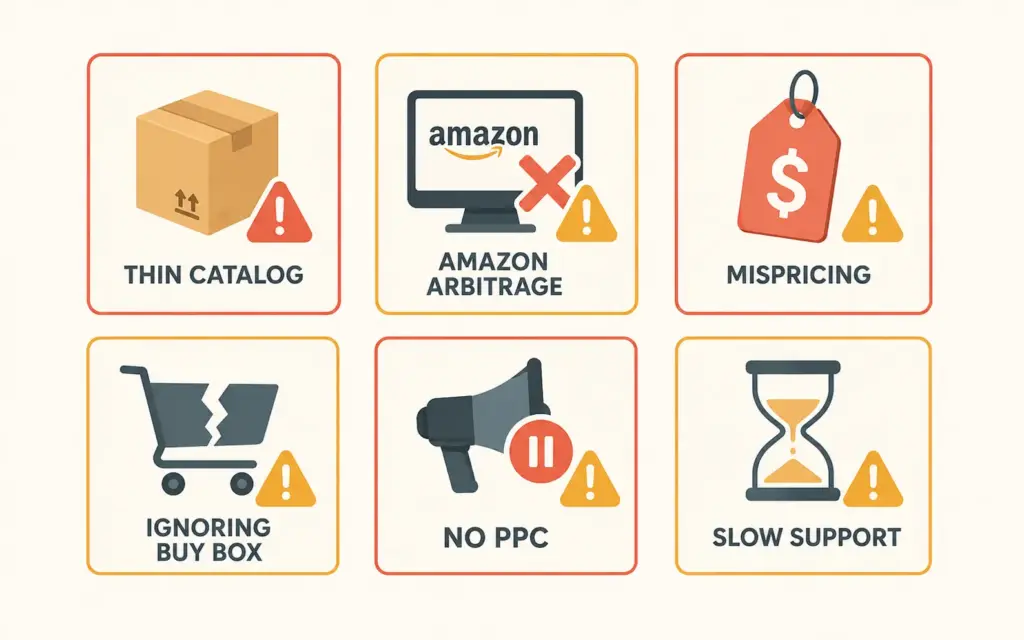
Applying with thin product catalog
Walmart wants 50+ SKUs minimum. Single-product applicants get rejected. If you only have 5 to 10 SKUs, build the catalog before applying or expand into accessories and bundles first.
Reselling Amazon items
Walmart actively rejects sellers whose catalogs match Amazon arbitrage patterns (popular FBA items with thin margins). They run automated checks. Have a differentiated catalog or branded products.
Mispricing during onboarding
Walmart’s pricing parity rule says your Walmart price must match or beat your other channels. List items at Amazon prices and you’ll get warnings, then suspensions. Adjust pricing strategy before listing. For deeper pricing approaches, see our ecommerce pricing strategies and dynamic pricing guides.
Ignoring the Buy Box
Walmart Buy Box logic considers price, fulfillment speed, seller rating, and inventory levels. Suppressed items don’t sell. Check Buy Box win rate weekly in Seller Central. If under 80%, audit pricing and fulfillment versus competition.
Skipping Sponsored Search ads
Walmart Connect ads (the marketplace’s PPC platform) are dramatically less competitive than Amazon PPC. Average CPCs run 30 to 50% lower for equivalent search volume. New sellers should allocate 8 to 15% of revenue to Sponsored Search for the first 90 days to build organic ranking signals. For ad strategy, see our ad creative tips.
Slow customer service response
Walmart’s standard is 24-hour email response. Sellers who exceed 48 hours regularly get warnings. After three warnings in 90 days, accounts get suspended. Set up shared inbox or helpdesk software (Gorgias, Help Scout, or even shared Gmail) before approval.
Walmart vs Amazon: Honest Comparison
Walmart isn’t a replacement for Amazon. Most established sellers operate on both. Where each wins:
Walmart wins on: Lower competition, no monthly fee, lower PPC costs, better margins on premium products, growing traffic, less algorithmic volatility, more US-focused customer base.
Amazon wins on: Total volume, breadth of categories, mature seller tools, faster approval, larger Prime customer base, established brand registry, more advertising sophistication.
The right answer for most growth-stage sellers: Amazon as primary channel, Walmart as growth channel once Amazon is producing $30k+ monthly. Don’t try to launch on both simultaneously; the operational complexity overwhelms most teams. For deeper context on the platform decision, see our Amazon FBA guide.
Frequently Asked Questions
Walmart Seller Central is the dashboard third-party sellers use to manage Walmart Marketplace accounts. It handles listings, inventory, pricing, orders, fulfillment settings, advertising, and performance metrics. Access requires Walmart approval, which has a roughly 80% rejection rate for unprepared applicants.
Standard approval takes 2 to 4 weeks for clean applications. Applications requiring follow-up documentation take 4 to 8 weeks. Incomplete applications can sit indefinitely. Respond to any Walmart requests within 7 days to avoid going to the bottom of the queue.
Walmart Marketplace charges 6% to 15% referral fees per sale depending on category, with no monthly account fee. Walmart Fulfillment Services adds $3.45+ per unit fulfilled and $0.75 per cubic foot per month for storage. Total cost typically runs 12 to 22% of revenue, comparable to Amazon for most categories.
Walmart Marketplace International accepts approved sellers from Canada, China, India, Mexico, and several other countries, but US-based businesses face fewer barriers. International sellers need US tax registration through Walmart’s program or local tax compliance for their region. Approval rates are lower for international applicants.
For most new sellers, no. Amazon is easier to get approved, has more sophisticated tools, and produces higher volume faster. Walmart works better as a second channel once a seller has $30k+ monthly Amazon revenue and operational maturity. Walmart’s stricter approval makes it the wrong starting point for first-time sellers.
Home goods, beauty, baby supplies, pet products, electronics, sporting goods, and kitchen items see strongest Walmart demand. Walmart customers skew slightly older and more value-conscious than Amazon, so practical everyday items outsell trendy or luxury products. Branded or private-label products outperform thin resellers significantly.
Related Reads
- Amazon FBA Guide for Beginners
- Multi-Channel Selling Strategy
- Amazon Listing Optimization
- Order Management Systems for Multi-Channel
- 3PL Guide for Ecommerce
- Ecommerce Pricing Strategies
Enjoying this? Get more like it every week.
One email per week with ecommerce strategies, tool picks, and seller insights. No spam.