
- Inventory sync tools maintain a single source of truth for your stock levels across every sales channel. When a unit sells on Amazon, available quantity decreases on Shopify, eBay, Etsy, and every other connected platform within seconds to minutes. Without sync, selling on multiple channels guarantees overselling.
- The best inventory sync tool depends on your scale: Sellbrite ($29/mo) for sellers on 2-3 channels with under 100 listings, Cin7 Core ($349/mo) for growing stores needing warehouse management alongside sync, and Linnworks ($449/mo+) for high-volume UK/EU sellers managing 5+ marketplaces.
- Sync speed matters. A 15-minute sync delay during a flash sale can oversell dozens of units. Look for tools offering near-real-time sync (under 2 minutes) for your highest-velocity products. Most tools sync faster for Shopify and Amazon than for eBay and Etsy.
- Every oversold order costs you: the refund processing, the customer complaint, the marketplace penalty, and the time spent handling the cancellation. At 50+ orders per day across channels, a $29-100/month sync tool pays for itself by preventing a single day's worth of overselling incidents.
Inventory sync software is a tool that connects your product inventory to every sales channel you sell on and automatically adjusts available stock quantities in real-time as orders come in, returns are processed, and new inventory is received, preventing the overselling that inevitably happens when you manage stock levels manually across multiple platforms.
If you sell on your own Shopify store AND Amazon AND eBay, you have 10 units of a product, and you just sold the last one on Amazon, how quickly do your other channels know? Without sync, the answer is “whenever you manually update them,” which means someone could buy that now-unavailable item on eBay five minutes later. That creates a canceled order, a frustrated customer, and a defect on your eBay seller metrics.
This guide compares the tools that solve this problem, from affordable options for small multi-channel sellers to enterprise systems for high-volume operations. For the broader inventory strategy, our inventory management guide covers formulas, methods, and warehouse organization. For multi-channel strategy, our multi-channel guide covers channel selection and operations.
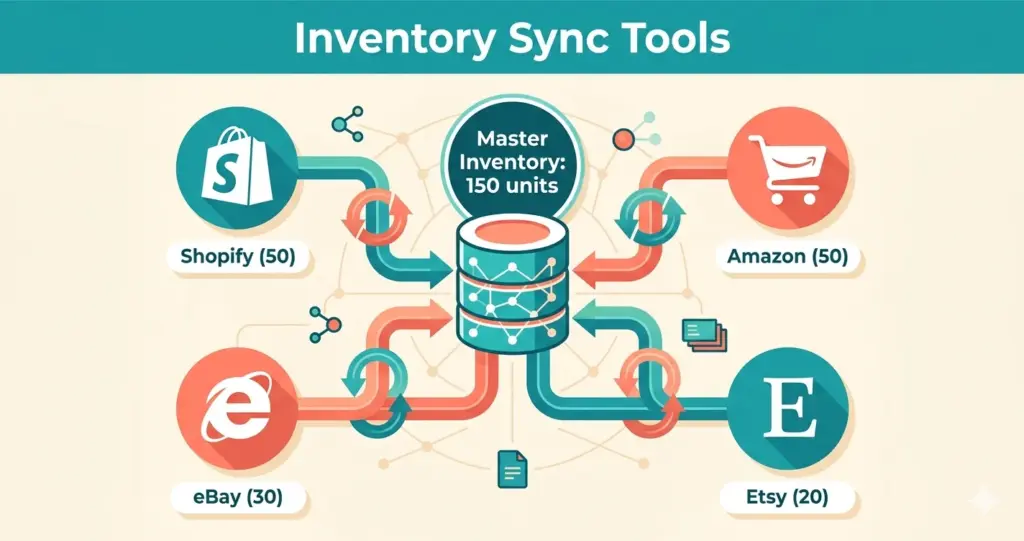
How Inventory Sync Works
The concept is simple: one central inventory count connected to all channels. The execution involves three components:
Central hub: Your sync tool maintains the master inventory count for every SKU. This is the single source of truth that all channels reference.
Channel connectors: API integrations with each platform (Shopify, Amazon Seller Central, eBay, Etsy, WooCommerce, Walmart, etc.) that both pull order data AND push inventory updates.
Sync engine: The logic that processes events. Sale on Channel A triggers: reduce central count by 1 → push updated count to Channels B, C, D. Return processed on Channel B triggers: increase central count by 1 → push updated count to Channels A, C, D. New stock received triggers: increase central count → push to all channels.
Buffer stock: Most sync tools let you set a buffer per channel. If you have 20 units total and sell on 3 channels, you might allocate 8 to Amazon, 8 to your store, and 4 to eBay based on historical sales velocity. This prevents one channel from consuming all available stock during a sudden demand spike.
Top Inventory Sync Tools Compared
| Tool | Monthly Cost | Best For | Channels Supported | Sync Speed |
|---|---|---|---|---|
| Sellbrite | $29-179 | Small sellers, 2-3 channels | Amazon, eBay, Etsy, Shopify, Walmart, Google | Near real-time |
| Cin7 Core | $349+ | Growing stores needing full inventory mgmt | 300+ integrations including all major marketplaces | Near real-time |
| Linnworks | $449+ | High-volume UK/EU sellers | 70+ channels including EU marketplaces | Real-time |
| Ordoro | $59-149 | Stores needing inventory + shipping | Shopify, Amazon, eBay, Etsy, BigCommerce | 15-minute intervals |
| ChannelAdvisor | Custom ($1K+) | Enterprise multi-marketplace | 100+ global marketplaces | Real-time |
| Listing Mirror | $99-499 | Mid-size multichannel | Amazon, eBay, Etsy, Shopify, Walmart, and more | Near real-time |
| Codisto | $29-99 | Shopify/BigCommerce to Amazon/eBay | Amazon, eBay, Google, Walmart | Near real-time |
Detailed Tool Reviews
Sellbrite: Best for Small Multi-Channel Sellers
Sellbrite (owned by GoDaddy) is the most affordable entry point for multi channel inventory sync. The $29/month plan supports up to 100 orders/month across unlimited channels. Setup takes under an hour for most sellers.
Strengths: Simple interface, fast setup, affordable pricing, includes listing management alongside inventory sync. Weaknesses: Limited reporting, no warehouse management features, order cap on lower plans means growing sellers hit the ceiling quickly.
Best for: Sellers doing 50-500 orders/month across 2-3 channels who need sync without the complexity of full inventory management systems.
Cin7 Core: Best for Growing Operations
Cin7 is a full multichannel inventory management system that includes sync as one feature among many: warehouse management, purchase order automation, demand forecasting, barcode scanning, and B2B ordering. The $349/month starting price reflects its comprehensive feature set.
Strengths: 300+ integrations, warehouse management, automated purchasing, reporting depth. Weaknesses: Expensive for small sellers, steeper learning curve, implementation takes 1-2 weeks versus hours for simpler tools.
Best for: Sellers doing 500+ orders/month who need inventory management, not just sync. If you’re outgrowing spreadsheets and need operational infrastructure, Cin7 is the platform to grow into.
Linnworks: Best for UK/EU Multi-Marketplace
Linnworks dominates the UK and EU multi-channel market with deep integrations into European marketplaces (Amazon EU, eBay EU, Allegro, Bol.com, Cdiscount) that North American-focused tools often lack.
Strengths: EU marketplace depth, real-time sync, strong automation rules, fulfillment management. Weaknesses: Higher starting price ($449/mo+), interface feels dated compared to newer tools, primarily designed for UK/EU sellers.
Ordoro: Best Budget Inventory + Shipping Combo
Ordoro combines inventory sync with shipping label generation in one $59/month tool. For sellers who need both without paying for two separate subscriptions, Ordoro delivers solid value.
Strengths: Combined inventory + shipping, dropship automation, affordable. Weaknesses: 15-minute sync intervals (not real-time), fewer marketplace integrations than dedicated sync tools, limited warehouse features.
Choosing the Right Tool
Match the tool to your operational reality:
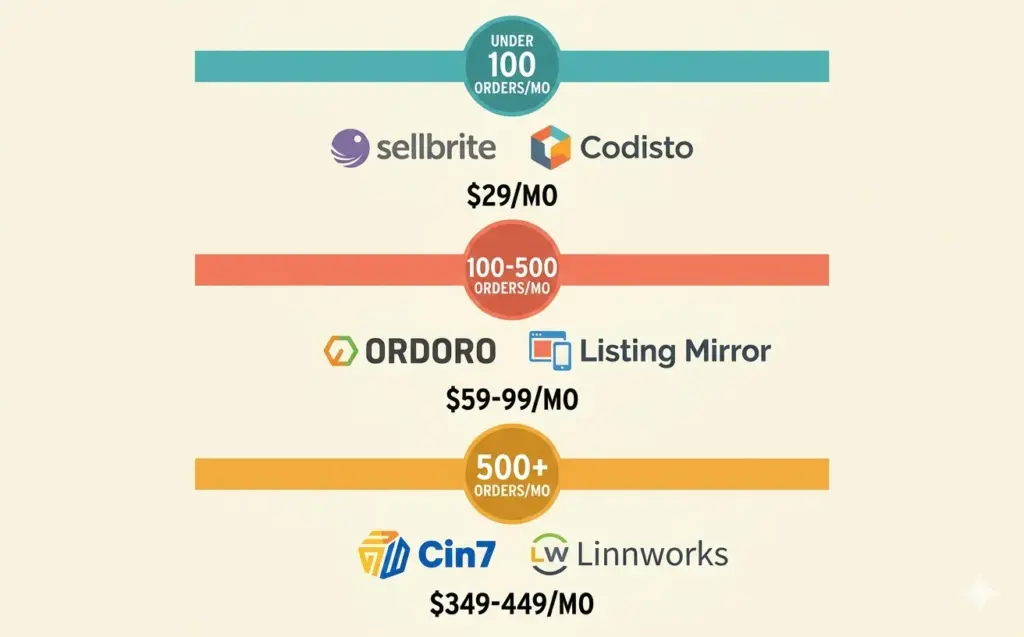
Under 100 orders/month, 2-3 channels: Sellbrite ($29/mo) or Codisto ($29/mo). Both handle basic sync affordably. The money saved versus premium tools goes toward inventory and marketing.
100-500 orders/month, 3-5 channels: Ordoro ($59/mo) if you also need shipping, or Listing Mirror ($99/mo) if you need better listing management alongside sync. These mid-tier tools handle growing complexity without enterprise pricing.
500+ orders/month, 4+ channels: Cin7 ($349/mo) for full inventory management or Linnworks ($449/mo) for EU-focused operations. At this volume, the cost of overselling (canceled orders, account penalties, customer complaints) far exceeds the subscription cost.
Enterprise (2,000+ orders/month, 5+ channels): ChannelAdvisor (custom pricing) or Extensiv (custom pricing). These enterprise tools handle the operational complexity that smaller tools can’t: multi-warehouse routing, international fulfillment, and real-time analytics across dozens of channels.
Your ecommerce tech stack should integrate cleanly with your sync tool. Verify platform compatibility before subscribing. Most tools offer 14-30 day free trials.
Implementation Best Practices
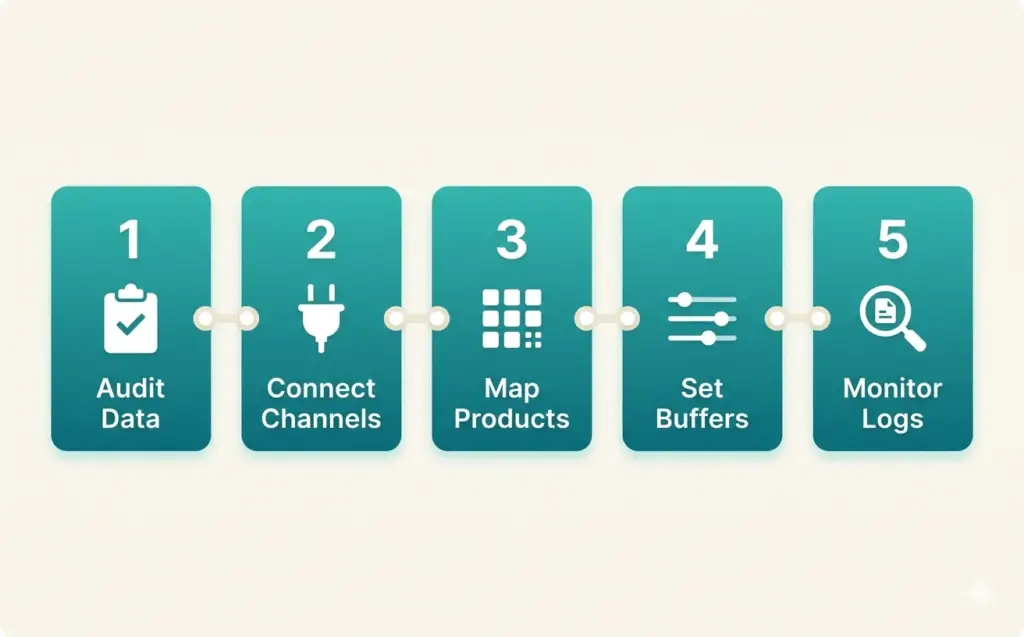
Audit your current inventory before connecting channels. Sync tools mirror your data. If your Amazon inventory says 50 units but you actually have 40, the sync tool will show 50 everywhere. Clean your data on each channel before connecting them.
Set buffer stock strategically. Don’t allocate 100% of inventory to all channels equally. Analyze which channel sells fastest and allocate proportionally. If Amazon does 60% of your sales, allocate 60% of stock there. Buffer protects against over-allocation.
Test with low-risk products first. Connect your lowest-volume products first. Run for a week to verify sync timing, order flow, and inventory accuracy before connecting your best sellers.
Monitor sync logs daily for the first month. Every sync tool provides event logs showing when updates were pushed. Check for failed syncs, unusual delays, or mismatched quantities. Catching a sync failure at 9 AM prevents a day of overselling.
Plan for peak periods. Black Friday, holiday season, and flash sales create order volume spikes that test sync speed limits. Contact your tool’s support before peak periods to confirm your plan can handle projected volume without delays. Consider upgrading temporarily if needed. For managing demand spikes, our pricing strategy and automation guides cover complementary approaches.
Frequently Asked Questions
Sellbrite ($29/month) is the best inventory sync software for small multi-channel sellers. It supports Amazon, eBay, Etsy, Shopify, Walmart, and Google with near real-time sync, simple setup, and includes listing management. Codisto ($29/month) is a strong alternative specifically for Shopify or BigCommerce sellers syncing to Amazon and eBay.
Most tools sync within 1-5 minutes (near real-time). Linnworks and ChannelAdvisor offer true real-time sync. Ordoro syncs on 15-minute intervals. For most sellers, near real-time is sufficient. True real-time matters for products selling 50+ units per hour during flash sales or peak periods where even a 5-minute delay can cause overselling.
Shopify’s Amazon integration provides basic product listing sync but limited real-time inventory sync. For reliable stock synchronization that prevents overselling, a dedicated tool like Sellbrite or Codisto is recommended. The $29/month cost is negligible compared to the revenue lost and penalties incurred from a single day of overselling incidents.
A failed sync means stock levels stop updating across channels, creating immediate overselling risk. Good sync tools alert you to failures via email or dashboard notifications. Set up alerts and check sync logs daily during your first month. Have a backup plan: if sync fails, manually pause listings on secondary channels until the issue resolves. Most failures stem from expired API tokens (re-authorize) or platform outages (wait and verify).
Choose a sync tool matching your scale (Sellbrite for small, Cin7 for growing, Linnworks for enterprise). Connect each sales channel by authorizing the tool’s API access. Map products across channels using SKU matching. Set buffer stock per channel based on sales velocity. Test with low-volume products for one week. Then connect your full catalog and monitor sync logs daily for the first month.
Yes, if both channels sell the same products. Even two channels without sync create overselling risk. At 20+ orders per day combined, manually updating inventory across two platforms becomes impractical and error-prone. A $29/month Sellbrite or Codisto subscription prevents overselling from day one and saves the 30-60 minutes per day you’d spend on manual updates.
Related Reads
- Inventory Management Guide
- Multi-Channel Ecommerce Strategy
- Ecommerce Tools and Tech Stack
- Ecommerce Automation Guide
- Amazon FBA Guide
- eBay Selling Tips
Enjoying this? Get more like it every week.
One email per week with ecommerce strategies, tool picks, and seller insights. No spam.