
- Etsy is the largest marketplace for handmade, vintage, and craft supply products with 96 million active buyers actively looking for unique, non-mass-produced items. If you make things by hand, sell vintage items 20+ years old, or supply crafting materials, Etsy provides a built-in audience that Amazon and Shopify don't offer for these categories.
- Etsy charges three fees: $0.20 per listing (lasts 4 months or until sold), 6.5% transaction fee on the sale price including shipping, and 3% + $0.25 payment processing. Total per-sale cost: approximately 10-11% of revenue. Cheaper than Amazon's 15% but higher than selling on your own store.
- Etsy SEO determines whether your products get seen. The algorithm ranks listings based on keyword relevance in titles and tags (13 tags per listing), listing quality score (how often your listing converts when shown), recency, and shop quality metrics. Getting these right from day one prevents the "I listed products but nobody sees them" problem.
- Your first 30 days are critical because Etsy gives new shops a temporary visibility boost. Use this period to optimize listings, generate reviews, and establish your shop's quality signals. Wasting the new shop boost on unoptimized listings is a missed opportunity that's hard to recover.
How to start an etsy shop is a question with a deceptively simple answer: create an account, list products, and wait for sales. The real question is how to set up your Etsy shop so it actually gets found by buyers, converts visitors into customers, and generates sustainable income rather than sitting with zero views alongside the 9 million other active Etsy sellers competing for attention.
Etsy is not a “build it and they will come” platform. It’s a search engine for handmade, vintage, and craft products, and like any search engine, it rewards shops that optimize for its algorithm while delivering excellent buyer experiences. Sellers who understand etsy shop setup as an optimization exercise rather than just a registration process are the ones generating consistent income.
This guide covers every step from account creation to your first sale, with specific attention to the Etsy-specific tactics that actually move the needle. If you’re deciding between Etsy and other selling channels, our free selling platforms comparison covers the trade-offs. For a broader view, our multi-channel strategy guide explains how Etsy fits alongside your own store and Amazon.
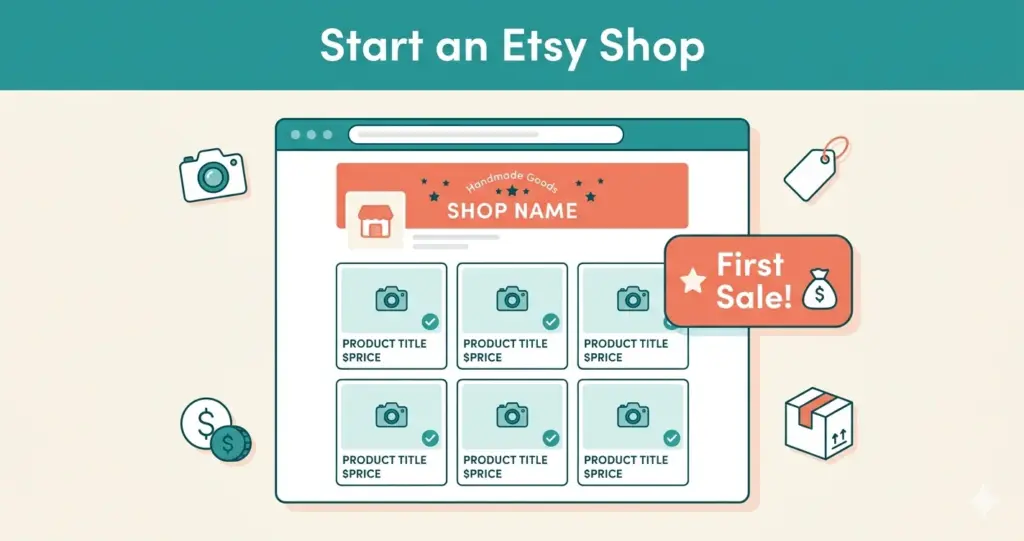
Step 1: Create Your Etsy Shop
Go to etsy.com/sell and click “Get started.” You’ll set up:
Shop preferences: Language (English), country, and currency. These determine which Etsy marketplace your shop appears on and how prices display.
Shop name: 4-20 characters, no spaces or special characters. Choose a name that’s memorable, hints at what you sell, and isn’t already taken. Check that the name isn’t trademarked by searching the USPTO database. You can change your shop name once, so choose carefully but don’t overthink it.
Billing: Connect a credit or debit card for Etsy’s listing fees. Set up Etsy Payments (required in most countries) to receive buyer payments via direct deposit to your bank account. Payouts arrive on a schedule you choose (daily, weekly, biweekly, or monthly).
Step 2: Build Your Shop’s Brand
Before listing products, set up the elements that make your shop look professional and trustworthy.
Shop icon: 500x500px minimum. Use your logo or a branded image. This appears next to your shop name everywhere on Etsy.
Shop banner: 1200x300px (standard) or 3360x840px (big banner). Feature your best products or a branded lifestyle image that communicates what you sell and who it’s for.
About section: Tell your story. Etsy buyers actively seek the human behind the products. How you started, why you make what you make, and what makes your process special. Include a photo of yourself or your workspace. Shops with completed About sections convert at higher rates because they satisfy the “who am I buying from?” question that drives Etsy purchases.
Shop policies: Set clear policies for processing time, shipping, returns and exchanges, and privacy. Etsy provides templates, but customize them. Key decisions: will you accept returns (accepting returns builds buyer confidence)? What’s your processing time (under 3 days is ideal, never exceed 7)? Who pays return shipping?
Step 3: Create Optimized Listings
Each listing is a search-optimized sales page. The etsy store setup guide that actually works focuses heavily on this step because listing quality determines whether anyone ever sees your products.
Product Photography (10 Images Per Listing)
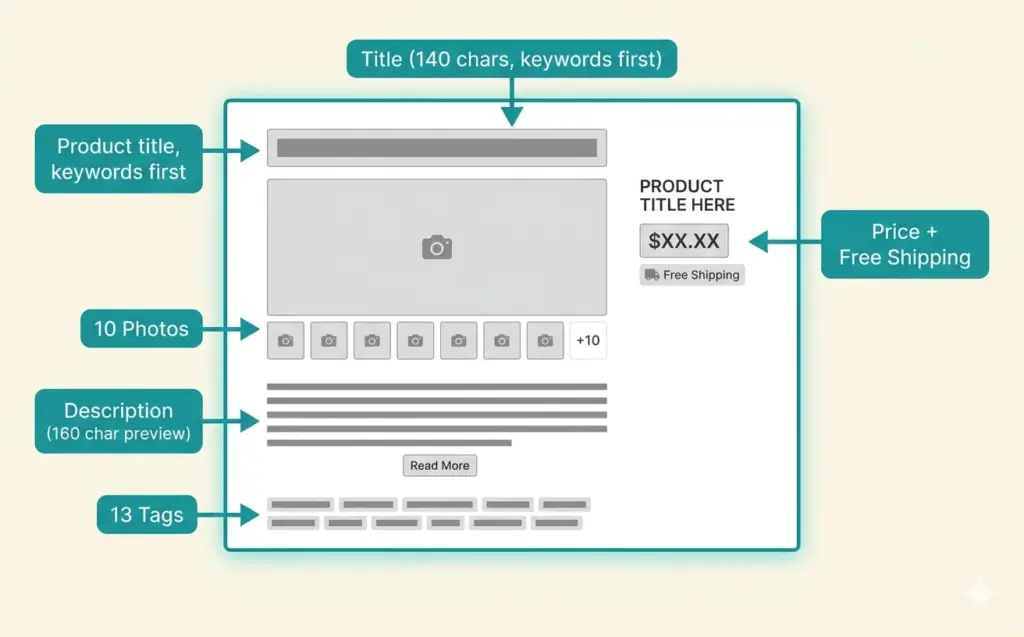
Etsy allows 10 photos per listing. Use all 10. Buyers on Etsy are buying unique, often handmade products they can’t examine in person. Your photos must replace the entire in-store experience.
- Image 1 (thumbnail): Clean, well-lit product photo that looks great at thumbnail size. This is what buyers see in search results. It must stand out.
- Images 2-4: Multiple angles showing the product from every relevant perspective
- Image 5-6: Lifestyle/context shots showing the product in use or in a styled setting
- Image 7-8: Detail shots showing quality, texture, materials, or unique features
- Image 9: Size reference (product next to a common object, on a model, or with a ruler)
- Image 10: Packaging or process photo (Etsy buyers appreciate seeing how their order ships or how the product is made)
Minimum 2000px on the longest side. Natural lighting produces the best results. White or simple backgrounds for thumbnail images, styled environments for lifestyle shots. Consistency across your entire shop creates a cohesive brand impression.
Titles (140 Characters, Front-Load Keywords)
Etsy’s search algorithm weights the beginning of your title more heavily. Front-load the most important keywords.
Good: “Personalized Leather Journal | Custom Engraved Name | Handmade A5 Notebook | Anniversary Gift for Him”
Bad: “Beautiful Amazing Leather Journal That Makes a Great Gift!!!”
Include the primary keyword, material, personalization options, size, and occasion/recipient. Separate keyword phrases with pipes (|) for readability. Don’t repeat words. Use all 140 characters.
Tags (13 Tags, Use Every One)
Etsy gives you 13 tags per listing. Each tag can be up to 20 characters. Use all 13. Tags are how Etsy matches your listing to buyer searches.
Tag strategy: Mix broad tags (“leather journal”), medium tags (“personalized notebook”), and long-tail tags (“anniversary gift for husband”). Include material, style, recipient, and occasion variations. Don’t repeat words already in your title. Tags and title words are combined by the algorithm, so repeating wastes tag slots.
Research tags by typing keywords into Etsy’s search bar and noting autocomplete suggestions. These are actual buyer search terms with proven volume.
Description
The first 160 characters of your description appear in search result previews. Front-load the most compelling selling point. After that:
- What the product is and what makes it special
- Materials and dimensions
- Personalization instructions (if applicable)
- Care instructions
- Processing and shipping timeline
Write for humans, not algorithms. Etsy’s search algorithm uses titles and tags for ranking. Descriptions convert the humans who click through.
Step 4: Pricing Your Products
Etsy fee calculation: On a $25 product with $5 shipping:
- Listing fee: $0.20
- Transaction fee: $1.95 (6.5% of $30 total)
- Payment processing: $0.96 (3% + $0.25 of $30)
- Total Etsy fees: $3.11
Your pricing formula: Materials + Labor + Overhead + Etsy Fees + Desired Profit = Price. For handmade items, value your labor at a fair hourly rate. A product that takes 2 hours to make with $5 in materials at $15/hour labor: $5 + $30 + $3 fees + $5 profit = $43 minimum price.
Research competitor pricing by searching your product type on Etsy and filtering by “Most Recent” and “Best Selling.” Price within the range of successful competitors unless your quality, materials, or brand justify a premium. Our pricing strategy guide covers the psychology behind pricing decisions.
Step 5: Shipping Setup
Free shipping increases Etsy visibility. Etsy’s algorithm favors listings offering free shipping, especially for US orders over $35. Build shipping cost into your product price when possible.
Shipping profiles: Create reusable shipping profiles for products of similar size and weight. Set processing time realistically (1-3 business days is ideal). Offer tracking on all orders over $10 (required for Etsy’s seller protection and for Star Seller eligibility).
Domestic shipping: USPS First Class Mail ($3-5 for items under 13 oz) or Priority Mail ($8-15 for heavier items). Use Etsy’s discounted shipping labels (purchased through the platform) for the best rates.
International shipping: Start with the countries where you’re comfortable shipping (US sellers: add Canada, UK, and Australia first). Use Etsy’s calculated shipping rates so international buyers see accurate costs based on their location. Our international selling guide covers cross-border logistics.
Step 6: Launch Marketing
First 30 Days: The New Shop Boost
Etsy gives new shops increased visibility in search results for approximately 30 days. Maximize this window:
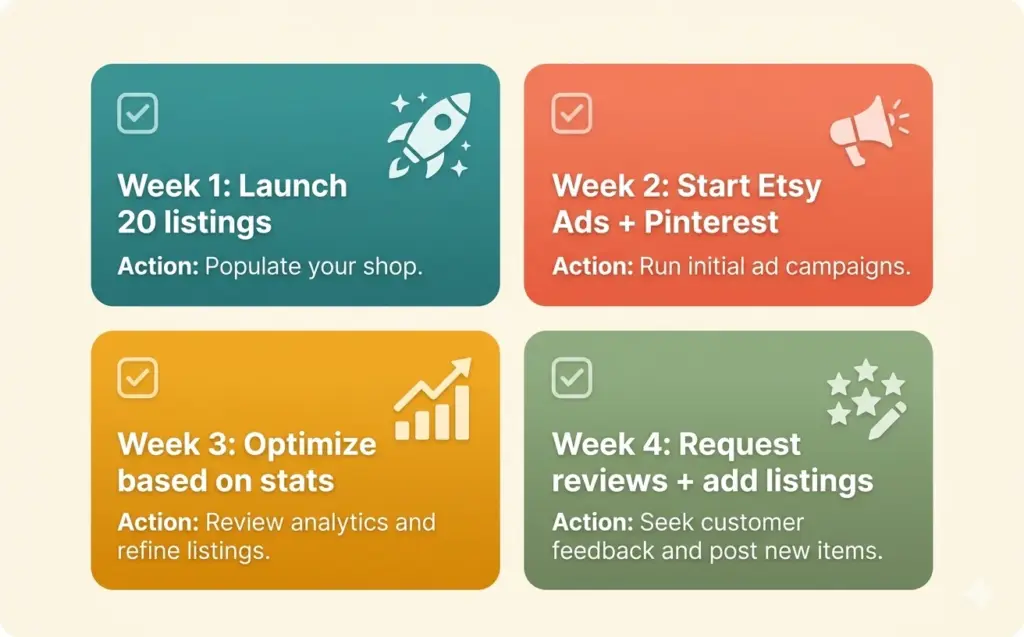
- Launch with at least 15-20 listings (more listings = more chances to appear in search)
- Ensure every listing is fully optimized (all 10 photos, 13 tags, complete descriptions)
- Respond to any messages within 24 hours (response time affects shop metrics)
- Ship orders within your stated processing time (on-time shipping builds your quality score)
Ongoing Marketing
Etsy Ads: Start with $1-5/day budget. Etsy Ads place your listings in promoted positions in search results. You pay per click. Turn on Ads for your best-performing listings only. Pause Ads on listings that get clicks but no sales (these drain budget without return).
Social media: Pinterest is Etsy’s best external traffic source because Pinterest users are planners and buyers. Pin every product to relevant boards. Pinterest for Business provides analytics on which pins drive traffic. Instagram works for lifestyle-focused products. TikTok works for products with visual making processes.
Etsy SEO maintenance: Renew listings that aren’t getting views (renewing costs $0.20 and gives a small recency boost). Test different photos, titles, and tags on underperforming listings. Check Etsy Stats weekly to see which search terms bring visitors and which listings convert best.
For sellers building alongside a separate store, our platform comparison covers when to add your own website as a second channel, and the things to make and sell guide covers product ideas that work well on both Etsy and your own store.
Frequently Asked Questions
Opening an Etsy shop is free. Per-listing cost is $0.20 (lasts 4 months). Transaction fee is 6.5% of sale price including shipping, plus 3% + $0.25 payment processing. Starting with 20 listings costs $4.00 upfront. Total per-sale cost is approximately 10-11% of revenue. No monthly subscription unless you upgrade to Etsy Plus ($10/month) for additional features.
Start with products you already make or can source. Create your shop with a professional icon, banner, and About section. List 15-20 products with 10 photos each, keyword-optimized titles, and all 13 tags used. Set competitive pricing based on sold listings research. Enable free shipping where possible. Launch during Etsy’s new shop boost period and post products on Pinterest for external traffic.
Launch with minimum 15-20 listings. More listings mean more chances to appear in search results for different keywords. Shops with under 10 listings look incomplete and signal low commitment to buyers. Each listing is only $0.20, so 20 listings cost $4.00. Add new listings weekly to maintain freshness signals in the algorithm.
Top-selling categories for new Etsy sellers: personalized gifts (jewelry, journals, home decor), digital downloads (planners, wall art, invitations), handmade jewelry, craft supplies, vintage items 20+ years old, custom clothing and accessories, and home decor. Products with personalization options convert well because they can’t be found on Amazon. Digital downloads have zero inventory and shipping costs.
With optimized listings and active marketing, most new shops get their first sale within 1-4 weeks. The new shop boost helps visibility during the first 30 days. Shops with poor optimization (few photos, missing tags, uncompetitive pricing) may wait months. Focus on listing quality, competitive pricing, and driving external traffic from Pinterest and social media to accelerate first sales.
Etsy’s search algorithm ranks listings based on keyword relevance (title + tags matching buyer searches), listing quality score (conversion rate when shown in results), recency (newer listings get a temporary boost), and shop quality (on-time shipping, response time, reviews). New shops get a visibility boost for approximately 30 days. Use all 13 tags, front-load keywords in titles, and maintain excellent shop metrics to rank well.
Related Reads
- Free Selling Platforms Comparison
- Multi-Channel Selling Strategy
- Things to Make and Sell
- Ecommerce Pricing Strategy
- Selling Internationally Guide
- Digital Products to Sell Online
Enjoying this? Get more like it every week.
One email per week with ecommerce strategies, tool picks, and seller insights. No spam.