
- eBay's Cassini search algorithm ranks listings based on listing quality, seller performance metrics, price competitiveness, and buyer experience signals. Understanding what Cassini rewards is the difference between page one visibility and buried listings nobody sees.
- The highest-impact eBay selling tips: use all 80 title characters with relevant keywords, provide 12 photos per listing (eBay allows 24 free), offer free shipping (Cassini favors it), maintain Top Rated Seller status for the 10% final value fee discount, and accept returns (30-day minimum for Top Rated Plus).
- eBay has 134 million active buyers worldwide. Unlike your own store where you drive all traffic, eBay provides built-in buyer intent. People on eBay are shopping, not browsing. Your job is making your listing the one they choose.
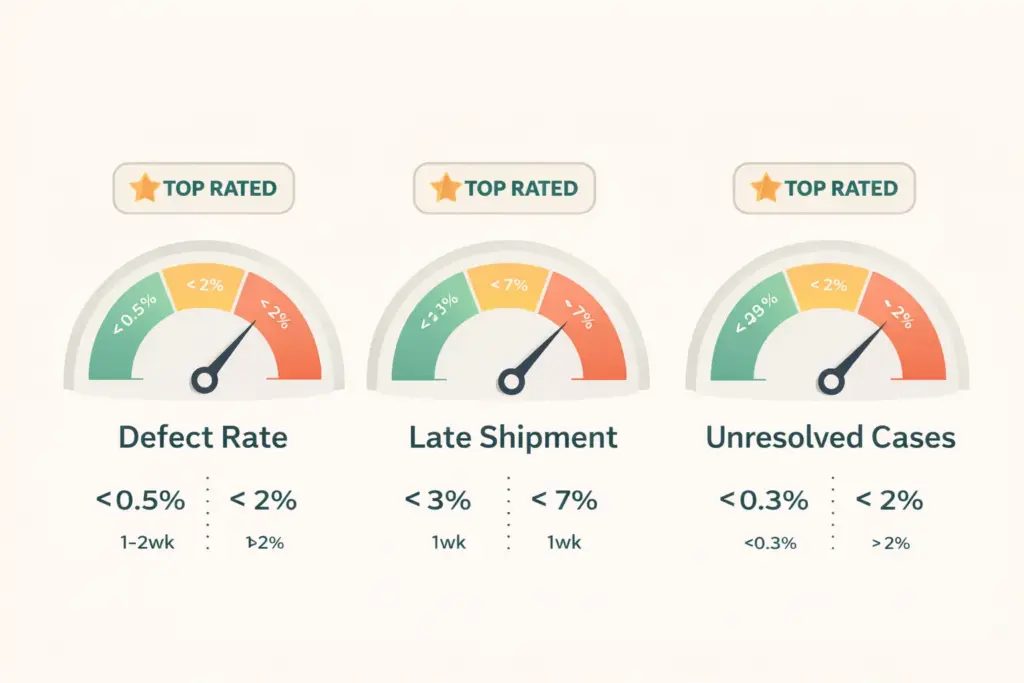
- Seller performance directly impacts visibility. Defect rate below 2%, late shipment rate below 3%, and cases closed without resolution below 0.3% are the thresholds. Exceed any of them and Cassini demotes your listings in search results.
eBay selling tips are the optimization strategies that improve your listing visibility in eBay’s search results, increase click-through rates, and convert more browsers into buyers on a marketplace with 134 million active buyers who are already in buying mode. Unlike selling on your own store where you build traffic from zero, eBay provides the audience. Your job is winning their attention and their purchase against competing listings.
Most eBay sellers treat listings as a place to dump product specs and a photo. That’s why most eBay sellers struggle. The sellers making consistent revenue understand that eBay is a search engine for products, and like any search engine, it rewards listings that are optimized for its algorithm (called Cassini) and for human buyers simultaneously.
This guide covers what actually moves the needle: listing optimization, search ranking factors, pricing strategy, photography, seller metrics, and scaling tactics. If you’re also considering dropshipping on eBay, that guide covers the model-specific setup. This one covers selling tactics that apply to every eBay business model.
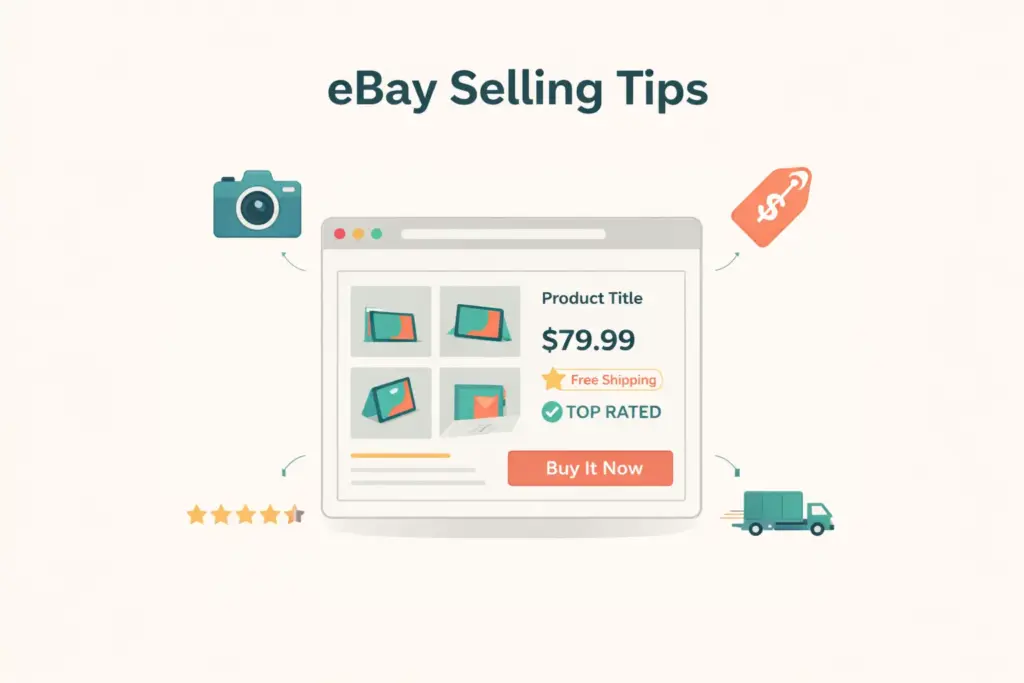
How eBay’s Cassini Search Algorithm Works
Cassini decides which listings appear first when a buyer searches. Understanding its ranking factors is the foundation of every ebay seller tip that follows.
Relevance: Does your listing match the search query? Cassini evaluates your title, item specifics, category selection, and product identifiers (UPC, MPN, Brand). A listing titled “Nice Blue Thing For Sale” will never rank for “Men’s Nike Air Max 90 Size 11 Blue.”
Listing quality: Listings with more photos, complete item specifics, detailed descriptions, and proper categorization rank higher than bare-minimum listings. Cassini interprets completeness as quality.
Seller performance: Your defect rate, late shipment rate, tracking upload speed, and return handling all feed Cassini’s ranking decisions. Top Rated Sellers get a visibility boost. Below Standard sellers get demoted.
Value signals: Free shipping, competitive pricing, free returns, and fast handling time all signal value to both Cassini and buyers. Listings offering free shipping consistently outrank identical listings with shipping charges.
Buyer experience: Click-through rate, purchase rate, and return rate on your listings tell Cassini whether buyers find your listings valuable. High click-through but low purchase rate signals misleading titles or photos, which Cassini penalizes over time.
Listing Optimization: The Biggest Impact Area
Title Optimization (80 Characters)
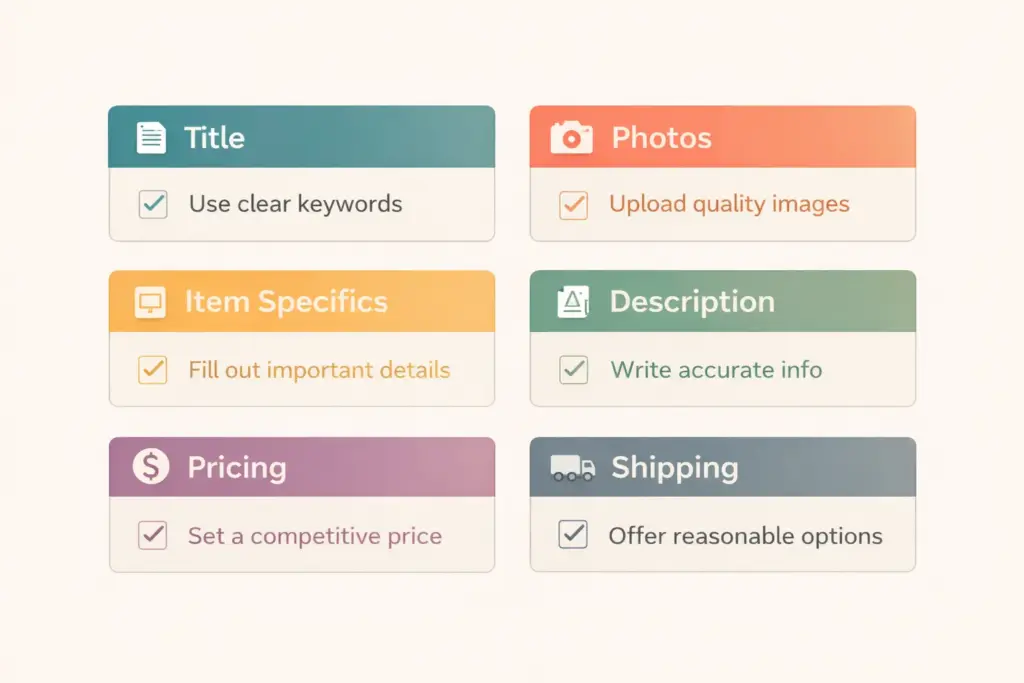
Your title is the most important ranking factor. eBay gives you 80 characters. Use every single one with relevant search terms buyers actually type.
Title formula: Brand + Product Name + Key Features + Size/Color/Variant + Condition
Good: “Nike Air Max 90 Men’s Running Shoes Size 11 White Black Leather NEW With Box”
Bad: “AWESOME SHOES!! MUST SEE!! L@@K!! Great Deal Nike”
Rules: no ALL CAPS words (one or two for brand is fine), no spam characters (L@@K, !!!), no filler words (“awesome,” “great deal”), and front-load the most important keywords since Cassini weights the first few words more heavily. Research what buyers search by checking eBay’s search suggestions (start typing in the search bar and note the autocomplete suggestions).
Item Specifics (Fill Every Field)
Item specifics are the structured data fields (Brand, Size, Color, Material, Style, etc.) that eBay uses for filtered search. When a buyer searches “Nike running shoes” then filters by Size 11, only listings with Size 11 in their item specifics appear. Missing item specifics means missing from filtered results, and filtered searches account for a significant portion of eBay purchases.
Fill every available field, even optional ones. Cassini uses item specifics completion as a quality signal. A listing with 15 of 15 fields completed outranks one with 8 of 15, all else being equal.
Photos (12 Minimum, 24 Maximum Free)
eBay allows 24 free photos per listing. Most sellers use 3-5. Using 12+ photos measurably increases conversion rate because buyers can examine the product from every angle without uncertainty.
Photo requirements:
- Main photo: white or light background, product fills 80%+ of frame, minimum 1600px on longest side for zoom
- Multiple angles: front, back, sides, top, bottom
- Detail shots: labels, tags, stitching, connectors, any flaw (for used items)
- Scale reference: product next to a common object or ruler
- Packaging: if sealed or includes original box, photograph it
- No watermarks, no text overlays, no collages (eBay’s photo policy prohibits these on the main image)
Good photography on eBay doesn’t require a studio. A smartphone, natural window light, and a white poster board as background produce professional-quality listing photos. Consistency across all your listings signals professionalism.
Description Strategy
eBay’s search algorithm puts less weight on descriptions than titles and item specifics, but descriptions convert the buyers who click through. Keep descriptions scannable:
- Lead with a 2-3 sentence summary of what the product is and its condition
- Use bullet points for key features and specifications
- Include measurements, dimensions, and weight where relevant
- State what’s included (accessories, packaging, manuals)
- For used items: honestly describe any wear, damage, or missing parts with corresponding photos
- End with your shipping timeframe and return policy summary
Never copy descriptions from other sellers or manufacturers. eBay’s algorithm detects duplicate content and can demote your listing.
Pricing Strategy on eBay
Research completed listings. Filter eBay search results by “Sold Items” to see what your exact product (or similar items) actually sold for. This shows real market prices, not aspirational asking prices. Price your listing within the range of recent sold items.
Fixed price vs auction. Fixed price (Buy It Now) listings work better for most products in 2026. Auctions work for rare collectibles, one-of-a-kind items, and situations where true market value is uncertain. For standard products, fixed price with Best Offer enabled captures more sales at predictable margins.
Free shipping vs calculated shipping. Cassini gives a ranking boost to free shipping listings. Build shipping cost into your product price. A $24.99 item with free shipping outranks and outsells a $19.99 item with $5.99 shipping, even though the buyer pays essentially the same amount. Our pricing strategy guide covers margin calculations that account for built-in shipping costs.
Best Offer. Enable Best Offer on fixed-price listings and set an automatic accept threshold (e.g., accept any offer above 90% of listed price) and automatic decline threshold (reject anything below 70%). This captures price-sensitive buyers without requiring manual negotiation on every offer.
Seller Performance: The Metrics That Control Visibility
eBay evaluates seller performance monthly. Your metrics directly control search visibility and fee discounts.
| Metric | Top Rated Seller | Above Standard | Below Standard |
|---|---|---|---|
| Defect rate | Under 0.5% | Under 2% | Over 2% |
| Late shipment rate | Under 3% | Under 7% | Over 7% |
| Cases closed w/o resolution | Under 0.3% | Under 2% | Over 2% |
| Tracking uploaded on time | 95%+ | No minimum | N/A |
Top Rated Seller benefits: 10% discount on final value fees (saves real money at volume), Top Rated Plus badge on listings (increases buyer trust and click-through), priority placement in search results (Cassini boost), and eligibility for eBay’s seller protections.
Top Rated Plus requires: Top Rated Seller status PLUS 1-day handling time AND 30-day free returns on individual listings. The 10% fee discount only applies to listings that meet ALL Top Rated Plus criteria.
Protect your metrics aggressively. One bad month of late shipments or unresolved cases can drop you from Top Rated to Above Standard, losing the fee discount and search visibility. Ship same-day or next-day, upload tracking immediately, and resolve buyer issues before they escalate to cases.
Scaling Your eBay Business
eBay Store subscription. Once you’re selling 50+ items per month, an eBay Store subscription reduces final value fees and gives you more free listings. The Basic Store ($7.95/month) includes 250 free listings. The Premium Store ($15.95/month) includes 1,000 free listings with lower fees. The math: if you pay $0.35/listing in insertion fees on 250 listings per month ($87.50), the Basic Store pays for itself immediately.
Promoted Listings. eBay’s advertising platform places your listing in premium positions. You set an ad rate (1-20% of sale price) and pay only when the promoted listing results in a sale. Start at 2-5% ad rate on your best-performing products. Check the “Suggested ad rate” eBay provides, which is based on what competing sellers bid in your category.
Multi-channel expansion. Once your eBay business is stable, expand to your own store for higher margins and Amazon for a different buyer pool. Our platform comparison covers setting up your own storefront, and the Amazon FBA guide covers the marketplace expansion path. Use inventory sync tools to manage stock across channels.
Automation tools. At 100+ listings, manual management becomes unsustainable. Tools like Sellbrite, ChannelAdvisor, and InkFrog handle bulk listing creation, inventory sync across channels, automated repricing, and order management. Investing in automation at the right stage frees your time for sourcing and strategy instead of data entry.
Common eBay Selling Mistakes
Keyword-stuffed titles. “Nike Shoes Running Walking Jogging Training Athletic Sport Gym” tries to rank for everything and converts for nothing. Focus on the specific product terms buyers search when they know what they want.
Incomplete item specifics. Missing size, color, or brand from your item specifics removes your listing from filtered searches. A buyer filtering by “Size 11” will never see your Size 11 shoes if you didn’t fill in the size field.
Slow shipping without tracking. Late shipment and missing tracking are the two fastest ways to lose Top Rated status. Ship within your stated handling time. Upload tracking within 24 hours of shipping. Use eBay’s discounted shipping labels for automatic tracking upload.
Fighting with buyers. A $20 refund costs less than a defect on your account. Defects affect search ranking for months. When a buyer opens a case, resolve it quickly even if you believe you’re right. The long-term cost of a defect exceeds the short-term cost of almost any refund. Check our legal setup guide for structuring your business to handle disputes professionally.
Frequently Asked Questions
Use all 80 title characters with specific product keywords. Upload 12+ photos per listing. Fill every item specific field. Offer free shipping with cost built into your price. Ship within 1 day and upload tracking immediately. Accept 30-day returns to qualify for Top Rated Plus. These six eBay selling tips have the biggest impact on visibility and sales for new sellers.
Successful eBay sellers do three things consistently: source products with proven demand (check sold listings before buying inventory), optimize every listing for Cassini’s ranking factors (complete item specifics, competitive pricing, free shipping), and maintain Top Rated Seller metrics (under 0.5% defect rate, under 3% late shipment). Consistency in all three areas compounds into reliable income.
eBay’s Cassini algorithm ranks listings based on title relevance, item specifics completeness, photo count, seller performance, price competitiveness, and shipping terms. Optimized listings with keyword-rich titles, all item specifics filled, 12+ photos, free shipping, and Top Rated Seller status consistently appear on page one. Unoptimized listings get buried regardless of product quality.
Key best practices: research sold listings before pricing, use eBay’s free 24-photo allowance fully, enable Best Offer with automatic accept/decline thresholds, maintain Top Rated Plus status for the 10% fee discount, use Promoted Listings at 2-5% ad rate on top products, and automate with listing tools once you exceed 100 active listings.
Yes. eBay’s algorithm gives ranking preference to free shipping listings, and buyers psychologically prefer “$24.99 free shipping” over “$19.99 + $5.99 shipping” even when the total is similar. Build shipping cost into your product price. Free shipping also contributes to Top Rated Plus eligibility, which gives you a 10% fee discount and a trust badge on your listing.
Maintain these metrics over a 12-month evaluation period: defect rate under 0.5%, late shipment rate under 3%, cases closed without resolution under 0.3%, tracking uploaded on 95%+ of orders, and 100+ transactions with $1,000+ in sales. For Top Rated Plus (10% fee discount per listing), add 1-day handling time and 30-day free returns on individual listings.
Related Reads
- eBay Dropshipping Guide
- Products to Resell for Profit
- Amazon FBA Guide
- Free Selling Platforms
- Ecommerce Pricing Strategy
- Inventory Management Guide
Enjoying this? Get more like it every week.
One email per week with ecommerce strategies, tool picks, and seller insights. No spam.