
- Multi-channel ecommerce sellers generate 190% more revenue on average than single-channel sellers. Selling on Amazon, your own store, eBay, and social commerce simultaneously captures buyers wherever they prefer to shop rather than hoping they find your one storefront.
- The operational challenge isn't selling on multiple channels. It's keeping inventory accurate, pricing consistent, and operations manageable across all of them. One central system managing inventory, orders, and fulfillment across every channel is the difference between multi-channel success and multi-channel chaos.
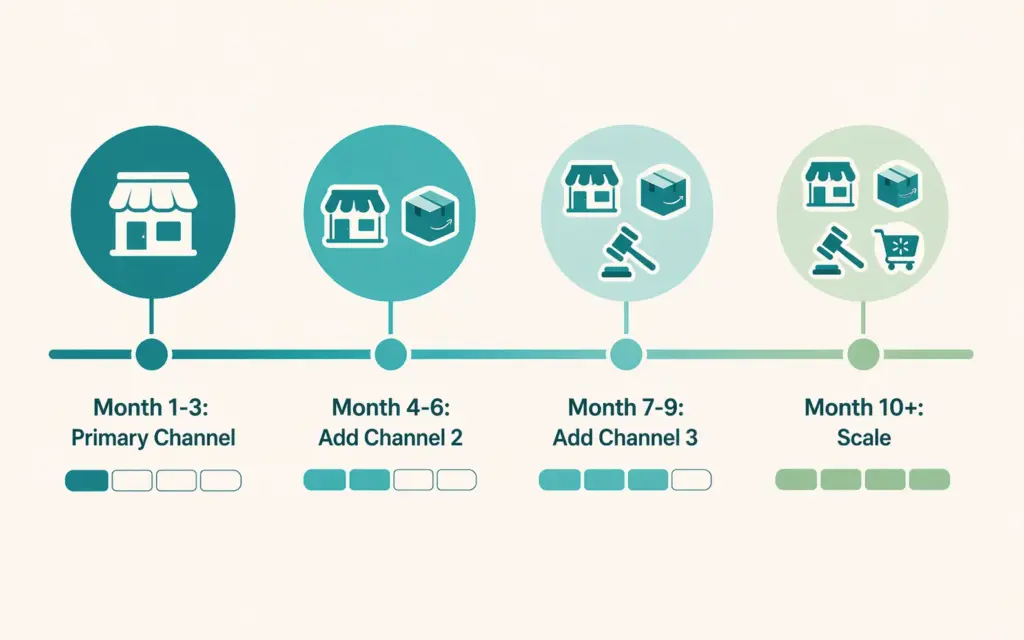
- Don't launch on five channels simultaneously. Start with your primary channel (usually your own store or Amazon), prove demand, then add one new channel every 2-3 months. Each addition should be operationally stable before you add the next.
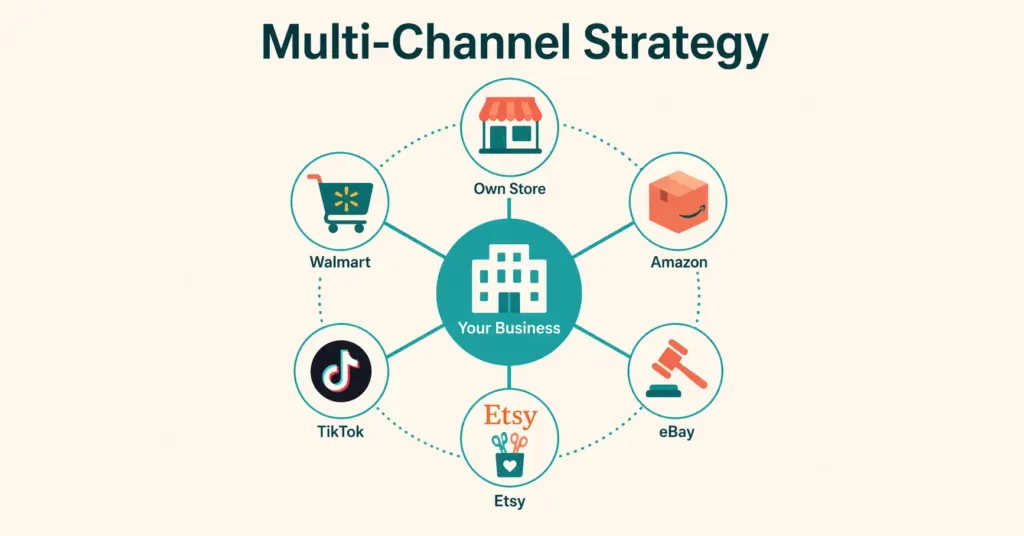
- Channel selection depends on your products: Amazon for search-driven commodity products, your own store for brand building and customer ownership, eBay for used/refurbished/collectible, Etsy for handmade/vintage, and TikTok Shop for visually demonstrable products under $50.
Multi channel ecommerce is the strategy of listing and selling your products across multiple online platforms simultaneously, including your own website, Amazon, eBay, Etsy, TikTok Shop, Walmart Marketplace, and social commerce channels, using centralized systems to manage inventory, orders, pricing, and fulfillment from a single operational hub instead of managing each channel independently.
Single-channel sellers leave money on the table. A customer who searches Amazon for your product category won’t find you if you only sell on Shopify. An eBay buyer hunting for deals won’t discover your Amazon listing. A TikTok scroller won’t navigate to your website. Each channel has its own buyer pool with its own shopping behavior. Multichannel ecommerce captures demand from all of them.
The challenge isn’t whether to sell on multiple channels. It’s how to do it without drowning in operational complexity. This guide covers channel selection, infrastructure setup, and the operational systems that make selling on multiple platforms sustainable. If you haven’t chosen your primary platform yet, our platform comparison covers that decision first.
Which Channels to Sell On (And Why)
Each channel serves a different buyer type. Choose channels that match your product type and business goals:
| Channel | Buyer Behavior | Best Products | Fees | You Own Customer Data? |
|---|---|---|---|---|
| Your own store | Brand-loyal, research-driven | Any, especially brand-differentiated | 2.9% + $0.30 processing | Yes (full ownership) |
| Amazon | Search, compare, Prime-expecting | Commodity, private label, consumables | 15% referral + FBA fees | No (Amazon owns) |
| eBay | Deal-seeking, collectors, bargain hunters | Used, refurbished, collectible, closeouts | ~13% total fees | Limited |
| Etsy | Handmade-seeking, gift-buying | Handmade, vintage, craft supplies | ~11% total fees | Limited |
| TikTok Shop | Impulse, discovery-driven | Visual, demonstrable, $10-50 | ~5% commission | Limited |
| Walmart | Value-conscious, mainstream | Household, electronics, essentials | 6-15% referral | No |
The non-negotiable first channel: Your own store. Even if Amazon generates 80% of your revenue, your own store is the only channel where you own the customer relationship, their email address, their purchase history, and their lifetime value. Every other channel is rented real estate that can change its rules, raise fees, or suspend your account at any time.
The Multi-Channel Tech Stack
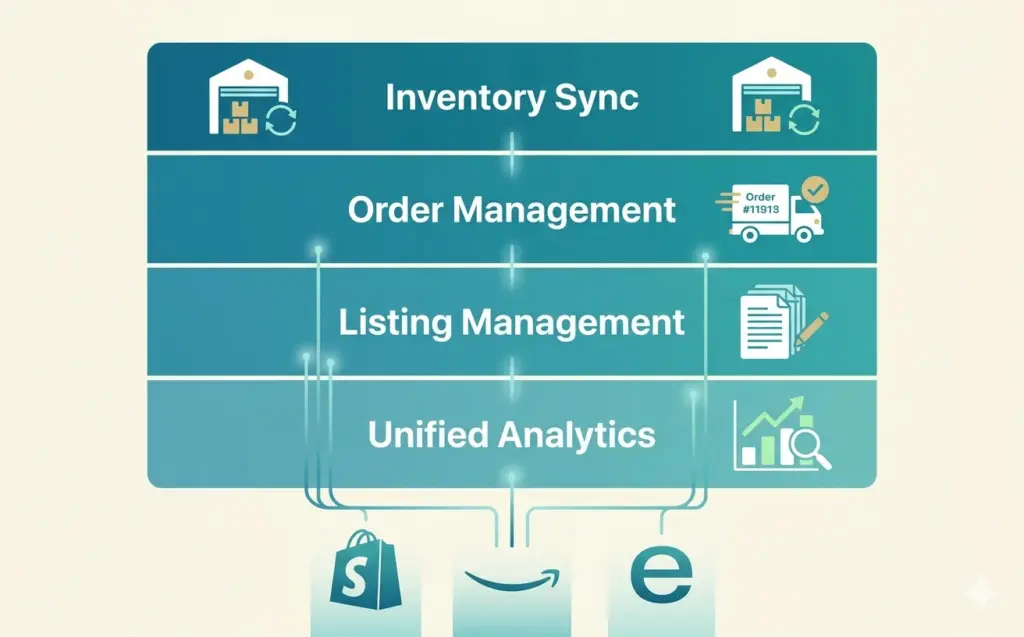
Running multiple channels from separate admin panels is a recipe for overselling, missed orders, and pricing errors. You need a centralized hub.
Central Inventory Management
One inventory system connected to all channels. A sale on any platform instantly reduces available stock everywhere else. This prevents the nightmare scenario: selling the last unit on Amazon AND eBay AND your store simultaneously, then canceling two of three orders.
Tools: Cin7 ($349/mo) for full multi-channel inventory management. Sellbrite ($29/mo) for smaller sellers on 2-3 channels. Linnworks for UK/EU multi-marketplace management. ChannelAdvisor for enterprise operations. Our inventory management guide covers these systems in detail.
Central Order Management
All orders from all channels funneled into one dashboard. You process fulfillment from a single screen instead of logging into five separate seller portals. Most inventory management tools include order management, or you can use dedicated order management systems (OMS) like ShipStation or Extensiv.
Listing Management
Create a product listing once and syndicate it across channels with platform-specific formatting. Tools like Sellbrite, Listing Mirror, and Codisto transform a single master listing into optimized versions for each marketplace, adjusting titles, descriptions, and images to match each platform’s requirements and best practices.
Unified Analytics
Revenue, profit margins, and performance metrics consolidated across all channels. Without unified analytics, you can’t answer basic questions like “which channel is most profitable per unit?” or “where should I allocate more inventory?” Connect your GA4 analytics to your own store and use marketplace-provided analytics for Amazon and eBay data, then consolidate in a spreadsheet or tool like Sellerboard for Amazon-specific profitability.
Channel-Specific Optimization
Your Own Store: Brand and Margins
Your Shopify, WooCommerce, or BigCommerce store is where you control the experience completely. Invest in product page design, SEO, and email marketing to build direct relationships. Your store should offer the best brand experience with exclusive products, content, and loyalty rewards not available on marketplaces.
Priority metrics: Conversion rate, customer lifetime value, email list growth, organic traffic.
Amazon: Volume and Discovery
Amazon FBA provides built-in traffic, Prime shipping trust, and the largest product search audience. Optimize listings with keyword-rich titles, A+ Content, and competitive pricing. Amazon is a volume channel where you trade margin (15% referral + FBA fees) for reach.
Priority metrics: BSR, conversion rate, ACOS (advertising cost of sale), organic rank.
eBay: Value and Velocity
eBay works for products where price sensitivity dominates: used goods, refurbished electronics, closeout inventory, and collectibles. Optimize for Cassini’s search algorithm with complete item specifics and Top Rated Seller status.
Priority metrics: Sell-through rate, defect rate, Top Rated status, promoted listings ROAS.
TikTok Shop: Discovery and Impulse
Our TikTok Shop strategy guide covers the full approach. Products that demonstrate well on video and sit in the $10-50 impulse range thrive here. The affiliate creator program scales reach without upfront ad cost.
Priority metrics: Video views, product clicks, creator affiliate sales, organic conversion rate.
Pricing Strategy Across Channels
Pricing the same product at different prices across channels is common and necessary because each channel has different fee structures and buyer expectations.
The pricing framework:
- Calculate your target margin per unit (e.g., $10 profit)
- Add each channel’s fees to determine the selling price that delivers that margin
- Adjust for channel-specific competitive pricing
Example for a product costing $8 to source, targeting $10 profit per unit:
| Channel | Fees on $25 Sale | Price Needed for $10 Profit |
|---|---|---|
| Own store | $1.03 (Shopify Payments) | $19.03 (sell at $19.99) |
| Amazon FBA | $7.50 (referral + fulfillment) | $25.50 (sell at $25.99) |
| eBay | $3.25 (final value + promoted) | $21.25 (sell at $21.99) |
| TikTok Shop | $1.25 (5% commission) | $19.25 (sell at $19.99) |
Your own store and TikTok Shop can price lowest because fees are lowest. Amazon pricing must be highest to maintain margins. This is normal. Buyers on each channel have different price expectations. Amazon buyers pay more because they trust Prime delivery. Your pricing strategy should reflect each channel’s value proposition.
MAP (Minimum Advertised Price) consideration: If you sell branded products with MAP policies, all channels must display the same price. In this case, your margin varies by channel rather than your price.
Multi-Channel Fulfillment Options
Option 1: Fulfillment per channel. Amazon FBA for Amazon orders, your own warehouse for direct store orders, eBay handled from your warehouse. Simple to start but creates multiple inventory pools.
Option 2: Multi-Channel Fulfillment (MCF). Amazon stores all your inventory and fulfills orders from ALL channels (your Shopify store, eBay, even TikTok Shop). One inventory pool, one fulfillment partner. Amazon’s MCF charges are higher than standard FBA but eliminates managing multiple warehouses.
Option 3: Third-party 3PL. A single 3PL partner (ShipBob, Deliverr, ShipMonk) stores your inventory and fulfills orders from every channel through integrations. This gives you one inventory pool without relying on Amazon for non-Amazon fulfillment. Best when Amazon isn’t your primary channel.
Our automation guide covers how to automate the order routing that makes multi-channel fulfillment work without manual intervention.
Common Multi-Channel Mistakes
No inventory sync. Managing stock in separate spreadsheets per channel guarantees overselling within weeks. Centralized inventory management isn’t optional for multi channel selling strategy. It’s the foundation.
Identical listings across channels. Each platform has different search algorithms, title limits, image requirements, and buyer expectations. A great Amazon listing performs poorly on eBay if you don’t adapt the title format, item specifics, and pricing. Optimize per platform.
Launching all channels simultaneously. Each new channel adds operational complexity. Add one channel at a time, stabilize operations, then add the next. A typical expansion timeline: Month 1-3 own store, Month 4-6 add Amazon, Month 7-9 add eBay or TikTok Shop, Month 10+ add additional channels.
Neglecting your own store for marketplace sales. Amazon’s 15% fee and customer data ownership mean every dollar moved from Amazon to your own store is more profitable AND builds long-term brand equity. Use marketplaces for discovery and volume, then invest in retention strategies to migrate marketplace buyers to your direct channel over time.
Ignoring channel-specific customer service. Amazon, eBay, and Etsy all have strict response time and resolution requirements. Missing a 24-hour response window on eBay impacts your seller metrics. Each channel’s customer service expectations must be met independently. Factor support time into your operational costs.
Frequently Asked Questions
Multi channel ecommerce means selling products on multiple platforms simultaneously (own store, Amazon, eBay, TikTok Shop, etc.) using centralized systems for inventory, orders, and fulfillment. It matters because multi-channel sellers generate 190% more revenue on average than single-channel sellers by capturing buyers wherever they prefer to shop.
Use a centralized inventory management tool that syncs stock levels in real-time across all channels. Cin7 ($349/mo), Sellbrite ($29/mo), and Linnworks handle automatic stock updates so a sale on Amazon instantly reduces available quantity on eBay and your own store. Without real-time sync, overselling is inevitable at any meaningful order volume.
Yes, unless MAP pricing policies apply. Each channel has different fee structures: Amazon takes 15%+ while your own store takes about 3%. Price to maintain consistent profit margins per unit rather than consistent selling prices. Amazon can be priced higher because buyers value Prime shipping. Your own store can price lower because fees are lower. Buyers on each channel have different price expectations.
Start with your own store (brand ownership) or Amazon (built-in traffic), depending on your product type. Add a second channel after 2-3 months of stable operations. Typical expansion: Month 1-3 primary channel, Month 4-6 add Amazon or own store (whichever you didn’t start with), Month 7-9 add eBay or TikTok Shop, Month 10+ additional channels as operations support it.
Multi-channel means selling on multiple platforms. Omnichannel means creating a unified customer experience across those platforms where a customer can start on one channel and continue on another. For example, browsing on TikTok, adding to cart on your website, and picking up in-store. Most ecommerce sellers operate multi-channel. True omnichannel requires deeper integration and is typically relevant for retailers with physical locations.
Three options: use Amazon MCF (Multi-Channel Fulfillment) to fulfill all channel orders from Amazon’s warehouses, use a single 3PL like ShipBob that integrates with all your channels, or fulfill from your own warehouse using ShipStation to consolidate orders from all platforms into one shipping workflow. The best choice depends on whether Amazon is your primary channel and your daily order volume.
Related Reads
- Amazon FBA Guide
- eBay Selling Tips
- TikTok Shop Strategy
- Inventory Management Guide
- Ecommerce Automation Guide
- Best Ecommerce Platform Comparison
Enjoying this? Get more like it every week.
One email per week with ecommerce strategies, tool picks, and seller insights. No spam.