
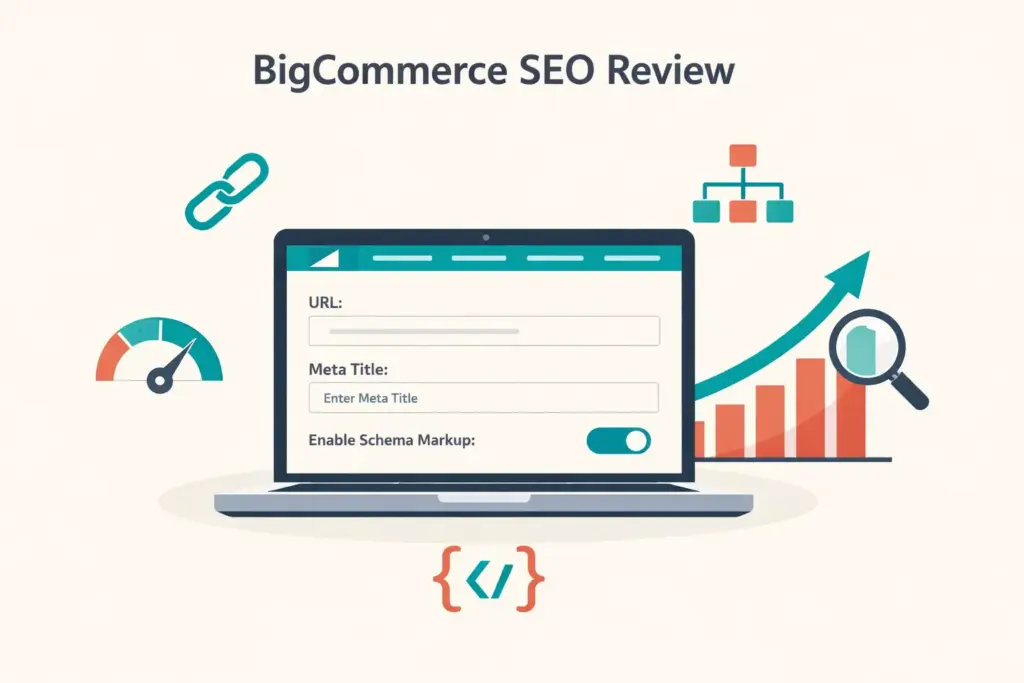
- BigCommerce has the strongest built-in SEO capabilities of any hosted ecommerce platform. Customizable URLs, automatic sitemaps, 301 redirects, native schema markup, and full metadata control are included without needing third-party apps.
- The platform's SEO advantages over Shopify: fully editable URLs (Shopify forces /collections/ and /products/ prefixes), built-in faceted search handling, and no app dependency for core SEO functions.
- BigCommerce dropshipping is supported through integrations with AliExpress, Spocket, Printful, and other suppliers, though the app ecosystem is smaller than Shopify's.
- BigCommerce works best for mid-size to large stores (500-50,000 products) that prioritize SEO and built-in features over app ecosystem size. Shopify wins for beginners and stores that need maximum app flexibility.
BigCommerce SEO refers to the search engine optimization capabilities built into the BigCommerce ecommerce platform, including customizable URL structures, automatic XML sitemaps, native structured data markup, full meta title and description control, 301 redirect management, and CDN-powered page speed optimization, all available without installing third-party apps. Among hosted bigcommerce ecommerce platforms, BigCommerce offers the most comprehensive native SEO toolkit.
If you’re choosing an ecommerce platform and organic search traffic matters to your business (it should), BigCommerce deserves serious consideration. It solves several SEO problems that Shopify requires paid apps to address. But it also has limitations, particularly around theme flexibility and app ecosystem depth, that matter depending on your business model.
This review covers what BigCommerce does well for SEO, where it falls short, its dropshipping capabilities, and an honest comparison to the alternatives. If you’re still evaluating platforms, our ecommerce platform comparison covers the full landscape across all major options.
BigCommerce SEO Features: What’s Built In
Here’s what you get for SEO out of the box with BigCommerce, no apps or workarounds needed:
Fully Customizable URLs
This is BigCommerce’s biggest SEO advantage. You control the entire URL path for products, categories, and pages. Want your running shoes category at /running-shoes/ instead of /collections/running-shoes/? Done. Shopify forces the /collections/ and /products/ prefixes into every URL, which wastes characters and adds unnecessary URL depth. On BigCommerce, your URLs are exactly what you want them to be.
Automatic XML Sitemaps
BigCommerce generates and updates your XML sitemap automatically as you add or remove products. It submits to Google without manual intervention. The sitemap includes all products, categories, brands, and content pages with proper priority and frequency settings.
Native 301 Redirect Management
When you change a URL, BigCommerce lets you create 301 redirects directly in the admin panel. No app needed. This is critical during product updates, category reorganizations, or platform migrations where broken URLs would otherwise destroy your existing search rankings.
Built-In Structured Data
BigCommerce automatically adds Product schema markup to product pages, including price, availability, ratings, and brand data. BreadcrumbList schema is also included natively. This structured data powers rich results in Google (star ratings, price displays, stock status) that boost click-through rates from search results.
Full Metadata Control
Edit page titles, meta descriptions, and heading tags for every product, category, and content page. BigCommerce doesn’t limit character counts artificially and provides clear fields in the admin for each SEO element. Many bigcommerce seo experts cite this granular control as the primary reason they recommend the platform.
CDN and Speed Optimization
BigCommerce includes Akamai CDN on all plans, serving your store content from servers closest to each visitor. The platform also handles image optimization and caching at the infrastructure level. Out-of-the-box page speed is generally competitive with Shopify and ahead of most self-hosted WooCommerce setups.
Faceted Search Handling
BigCommerce’s built-in product filtering uses AJAX loading that doesn’t create duplicate indexable URLs by default. This solves one of the biggest technical SEO problems in ecommerce without custom development or apps.
BigCommerce SEO Limitations: What Falls Short
No platform is perfect. Here’s where big commerce seo has genuine weaknesses:
Fewer free themes. BigCommerce offers about 12 free themes compared to Shopify’s 13+, but the bigger issue is design variety. Shopify’s theme ecosystem (free and paid) is significantly larger. If visual design is a priority, Shopify provides more options without custom development.
Smaller app ecosystem. BigCommerce’s app marketplace has roughly 1,000 integrations versus Shopify’s 8,000+. For SEO specifically this matters less (BigCommerce’s native features reduce app dependency), but for marketing, analytics, and operational tools, Shopify offers more choices.
AMP pages limited. While Google has de-emphasized AMP, BigCommerce’s mobile optimization relies more on responsive design than dedicated mobile page technologies. Performance is good but not exceptional on slower mobile connections.
Blog functionality is basic. BigCommerce includes a blog, but it lacks the flexibility of WordPress or even Shopify’s blogging capabilities. If content marketing is a major part of your ecommerce SEO strategy, you may need to run a separate WordPress blog and integrate it.
Learning curve for technical SEO. BigCommerce’s admin panel has more settings and options than Shopify’s, which means more power but also more complexity. Beginners may find it overwhelming compared to Shopify’s simpler setup.
BigCommerce Dropshipping: What’s Available
BigCommerce dropshipping is supported through several integrated supplier platforms. You can dropship on BigCommerce using:
| Integration | Supplier Type | Best For |
|---|---|---|
| Spocket | US/EU suppliers | Fast shipping, branded invoicing |
| Printful | Print on demand | Custom apparel, accessories, home decor |
| Inventory Source | Multi-supplier | Connecting with 200+ wholesalers |
| AliExpress (via apps) | Chinese suppliers | Low-cost product testing |
| Modalyst | US/EU brands | Premium branded products |
The bigcommerce dropship experience works well for stores that have validated their products and want a more feature-rich platform than Shopify’s basic plan. However, if you’re just starting with dropshipping, Shopify’s larger dropshipping app ecosystem (DSers, Oberlo legacy, CJdropshipping) offers more supplier options for beginners.
Where BigCommerce shines for dropshipping is scalability. Its built-in features for multi-channel selling (Amazon, eBay, Walmart, Facebook, Google Shopping) let you expand beyond your own store without stacking app subscriptions.
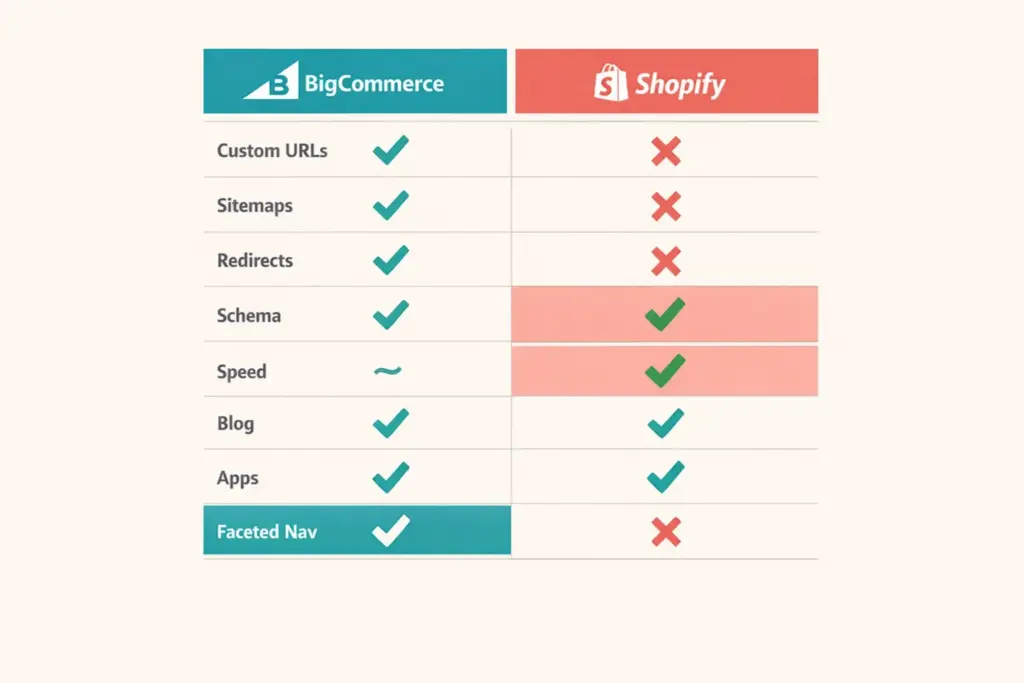
BigCommerce vs Shopify vs WooCommerce for SEO
| SEO Feature | BigCommerce | Shopify | WooCommerce |
|---|---|---|---|
| Custom URL structure | Full control | Forced prefixes (/products/, /collections/) | Full control |
| Auto XML sitemap | Built-in | Built-in | Plugin (Rank Math, Yoast) |
| 301 redirects | Built-in admin panel | Built-in (URL redirects page) | Plugin or .htaccess |
| Product schema | Automatic | Theme-dependent | Plugin required |
| Page speed (average) | Good (CDN included) | Good (CDN included) | Varies (hosting dependent) |
| Blog SEO | Basic | Good | Excellent (it’s WordPress) |
| App ecosystem | ~1,000 apps | ~8,000+ apps | 59,000+ plugins |
| Faceted nav handling | Built-in AJAX | App-dependent | Plugin + config |
| Best for SEO | Mid-large stores prioritizing native SEO | Beginners, app-dependent customization | Maximum flexibility, technical users |
Bottom line: BigCommerce wins on native SEO features. Shopify wins on ease of use and ecosystem. WooCommerce wins on flexibility and content marketing. Choose based on your priority. For stores where organic search is the primary traffic channel and you want the least app dependency, seo bigcommerce is the strongest hosted option.
When to Hire BigCommerce SEO Services
BigCommerce’s native features handle 70-80% of SEO needs. You may need bigcommerce seo services when:
- Your catalog exceeds 2,000 products and needs systematic optimization at scale
- You’re migrating from another platform and need redirect mapping and indexation management
- Competitors with professional SEO are outranking you despite BigCommerce’s built-in advantages
- You need advanced content strategy, link building, or international SEO beyond what native features cover
When evaluating bigcommerce seo experts, look for consultants with documented case studies on the BigCommerce platform specifically. Generic SEO agencies may not understand BigCommerce’s unique URL architecture, theme system, or API capabilities. Ask for BigCommerce-specific results, not just general ecommerce wins.
BigCommerce Pricing and Plans
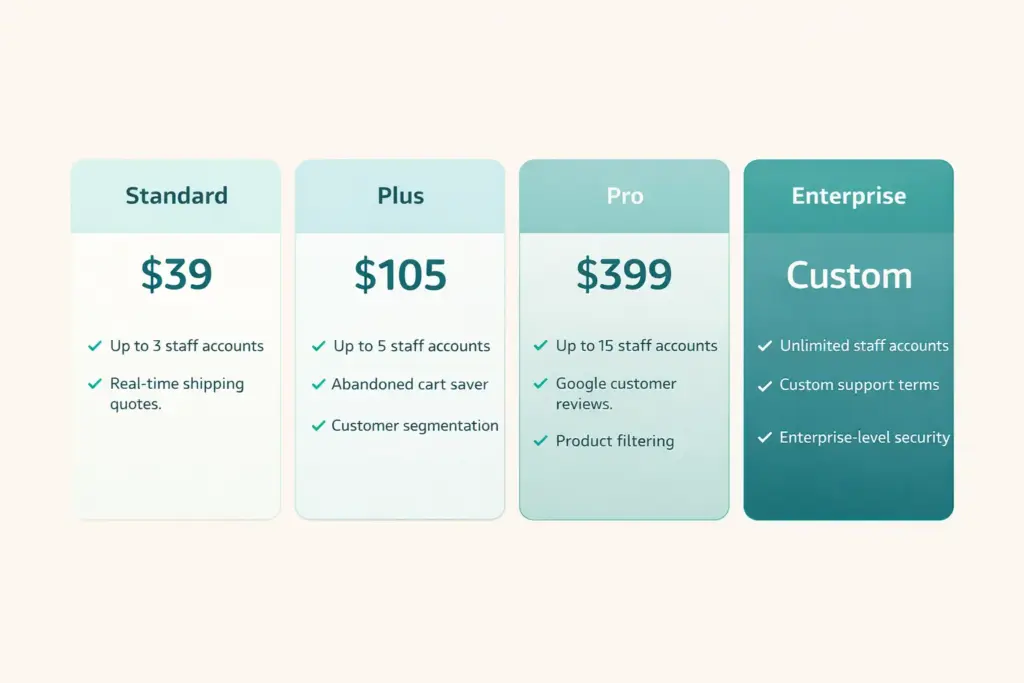
| Plan | Monthly Price | Annual Revenue Limit | Key Features |
|---|---|---|---|
| Standard | $39/mo | $50K/year | All core features, no transaction fees |
| Plus | $105/mo | $180K/year | Customer groups, abandoned cart recovery |
| Pro | $399/mo | $400K/year | Custom SSL, Google reviews, advanced filtering |
| Enterprise | Custom | Unlimited | Priority support, custom integrations, API access |
Notable: BigCommerce charges zero transaction fees on all plans. See current BigCommerce pricing. Shopify charges 0.5-2% on transactions not processed through Shopify Payments. For high-volume stores, this fee difference adds up significantly. Your startup costs should factor in both the monthly fee and per-transaction impact.
Frequently Asked Questions
Is BigCommerce good for SEO?
BigCommerce has the strongest built-in SEO features of any hosted ecommerce platform. Fully customizable URLs, native structured data, automatic sitemaps, built-in 301 redirects, and AJAX-based faceted navigation are all included without apps. For stores that prioritize organic search traffic, bigcommerce seo capabilities are genuinely superior to Shopify’s native offering.
How does BigCommerce SEO compare to Shopify?
BigCommerce wins on native SEO: custom URLs (Shopify forces /products/ and /collections/ prefixes), built-in faceted search handling, and zero transaction fees. Shopify wins on app ecosystem size, theme variety, and ease of use. If SEO is your primary growth channel, BigCommerce has the edge. If you need maximum flexibility through apps, Shopify is stronger.
Can I dropship on BigCommerce?
Yes. BigCommerce dropshipping works through integrations with Spocket, Printful, Inventory Source, Modalyst, and AliExpress-connected apps. The ecosystem is smaller than Shopify’s but covers the major supplier categories. BigCommerce’s built-in multi-channel selling (Amazon, eBay, Walmart) gives dropshippers an advantage for selling across multiple platforms simultaneously.
Do I need bigcommerce seo services or can I do it myself?
DIY works for stores under 1,000 products. BigCommerce’s native tools handle most optimization without external help. Hire bigcommerce seo services when your catalog is large (2,000+ products), you’re migrating platforms, or competitors with professional SEO operations are outranking you. Always verify the agency has BigCommerce-specific experience.
What are the biggest BigCommerce SEO limitations?
The main limitations are a basic built-in blog (content marketing is harder), a smaller app ecosystem than Shopify, and a steeper learning curve for the admin panel. For stores where content marketing drives significant organic traffic, running a separate WordPress blog alongside BigCommerce is a common workaround.
Is BigCommerce worth it for small stores?
For stores under 100 products run by beginners, Shopify’s simpler setup and larger support community is usually the better choice. BigCommerce becomes worth it for stores with 500+ products that need strong native SEO, zero transaction fees, and built-in multi-channel selling without stacking app subscriptions.
Related Reads
- Best Ecommerce Platform Comparison
- Ecommerce SEO Complete Guide
- Ecommerce Technical SEO Audit
- Ecommerce Tools and Tech Stack
- How to Start Dropshipping
- Ecommerce Startup Costs
Enjoying this? Get more like it every week.
One email per week with ecommerce strategies, tool picks, and seller insights. No spam.