
- Dropshipping lets you sell products online without holding inventory. Your supplier ships directly to customers. Startup cost: $100-$500.
- Margins are thin (15-30%) and competition is brutal. It works best as a testing ground, not a forever business model.
- 84% of new dropshippers say finding a reliable supplier is their biggest obstacle. Vet suppliers by ordering samples before listing anything.
- The real money in dropshipping comes from treating it as a product research tool, then transitioning your winners to private label or bulk inventory.
Every dropshipping guide on the internet starts the same way: “You can start for zero dollars, work from a beach, and make passive income!” And then it turns out the guide is written by the same platform trying to sell you a $39/month subscription.
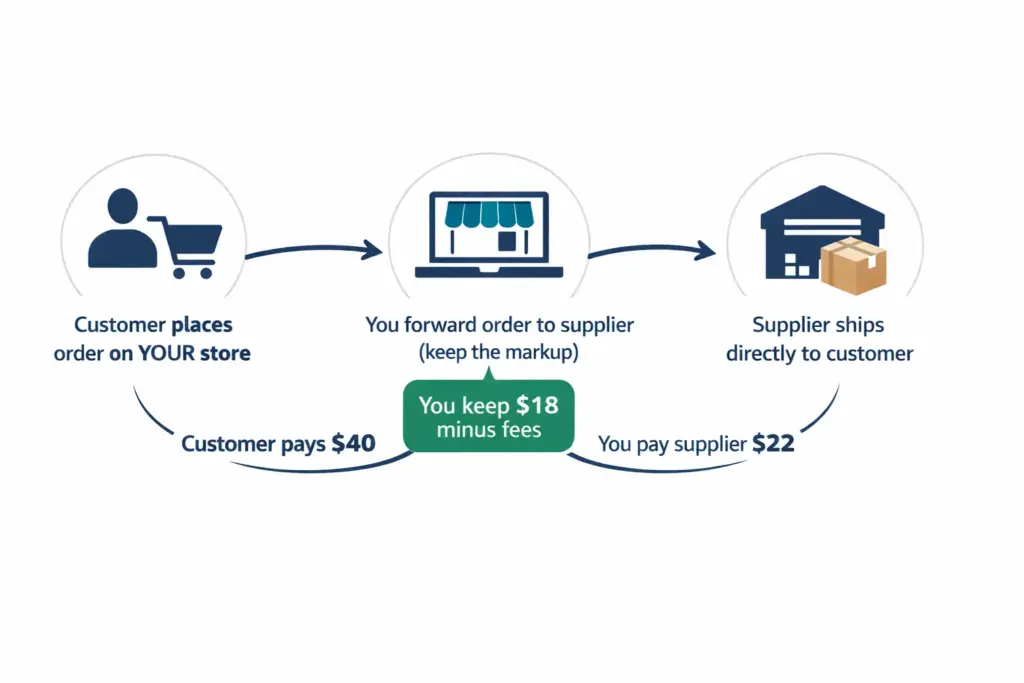
Dropshipping is a retail fulfillment method where you sell products through an online store without holding any inventory. When a customer places an order, you purchase the item from a third-party supplier who ships it directly to the customer. You never touch the product. Your profit is the gap between what the customer paid you and what you paid the supplier, minus platform fees and ad costs.
Is it a legitimate way to start an ecommerce business? Yes. Is it the goldmine that YouTube makes it seem? Almost never. I’ve watched hundreds of sellers go through the dropshipping journey, and the ones who succeed treat it very differently from what most guides teach. If you’re exploring different ways to start an ecommerce business, dropshipping deserves your consideration, but only with clear eyes about what you’re getting into.
Is Dropshipping Actually Worth It?
Let’s get the elephant out of the room before we talk about “how.” Because the “should I” matters more.
The global dropshipping market was valued at roughly $351 billion in 2024 and is projected to grow at 23.4% CAGR through 2030 (Grand View Research). So the market is massive and growing. But individual success rates tell a different story. Most industry estimates suggest only 10-20% of dropshipping stores become consistently profitable.
Here’s what nobody putting together “start dropshipping today!” content wants to tell you:
Margins are razor-thin. Typical dropshipping margins land between 15-30%. Sell a $40 product, pay $25 to the supplier, $5-8 in ad costs, $2 in platform/payment fees. You’re left with $5-8 profit per sale. That math only works at volume.
You’re competing with everyone. Because the barrier to entry is so low, thousands of stores sell the exact same products from the exact same suppliers. The products aren’t unique to you. Your only differentiators are marketing, branding, and customer experience.
Shipping times can kill you. If your supplier is in China, your customer waits 7-21 days. In a world where Amazon delivers in one day, that patience is running thin. US/EU-based suppliers fix this but eat into your margins further.
So why do it at all? Because it’s the cheapest way to learn ecommerce fundamentals, test product ideas with real money, and build marketing skills without risking thousands on inventory. The smart play isn’t to build a “dropshipping empire.” It’s to use dropshipping as a research and testing phase before graduating to higher-margin models like private label or wholesale.
What You Need Before You Start
Forget the “zero dollars” hype. Here’s what a realistic dropshipping launch actually costs:
| Expense | Cost | Notes |
|---|---|---|
| Ecommerce platform | $0-$39/month | Shopify $1/mo for 3 months (trial), WooCommerce free |
| Domain name | $10-$15/year | Don’t skip this. Free subdomains look amateur |
| Sample orders | $30-$100 | Order from your supplier before listing. Non-negotiable |
| Ad testing budget | $100-$300 | Facebook/TikTok/Google. You need traffic to learn |
| Apps/tools | $0-$30/month | DSers, Oberlo alternatives, email tool |
| Total realistic startup | $150-$500 |
You also need patience. Most profitable dropshipping stores didn’t hit their stride until month 2-3, after the store owner tested and killed multiple product ideas. Expecting profit in week one is fantasy.
Step 1: Pick a Niche (Not a Random Product)
The biggest rookie mistake in dropshipping: finding a “cool product” on AliExpress and building a store around it. That’s backwards. You pick a niche first, then find products that serve that audience.
Why? Because a niche gives you a brand. A random product gives you a one-hit wonder. A store called “CozyPetGear” selling premium dog accessories to millennial pet owners has a story. A store called “BestDealsShop” selling phone cases, yoga mats, and kitchen gadgets has nothing.
Good dropshipping niches share three traits: passionate buyers (they spend emotionally, not logically), repeat purchase potential (consumables or accessories, not one-time buys), and problem-solving products (something that fixes a specific frustration). Our profitable ecommerce niches guide covers this in depth.
Step 2: Find and Vet Suppliers
According to industry research cited by Wix, 84% of dropshipping merchants consider finding a good supplier the most significant obstacle when starting out. They’re right. A bad supplier will destroy your business faster than bad marketing ever could.
Your main sourcing options:
AliExpress/CJ Dropshipping/Spocket. AliExpress is where most beginners start. Massive product catalog, easy integration with Shopify via DSers. The catch: shipping from China takes 7-21 days. CJ Dropshipping offers faster options with US warehouses for some products. Spocket focuses on US/EU suppliers with 2-5 day shipping but higher product costs.
Domestic suppliers. US-based or EU-based suppliers solve the shipping time problem completely. Margins are tighter but customer satisfaction (and repeat purchase rates) go way up. Search industry-specific wholesale directories or contact manufacturers directly.
Print-on-demand suppliers. Printful, Printify, Gooten. Technically a form of dropshipping but for custom-designed products. Higher margins (30-50%) than traditional dropshipping because your designs add unique value.
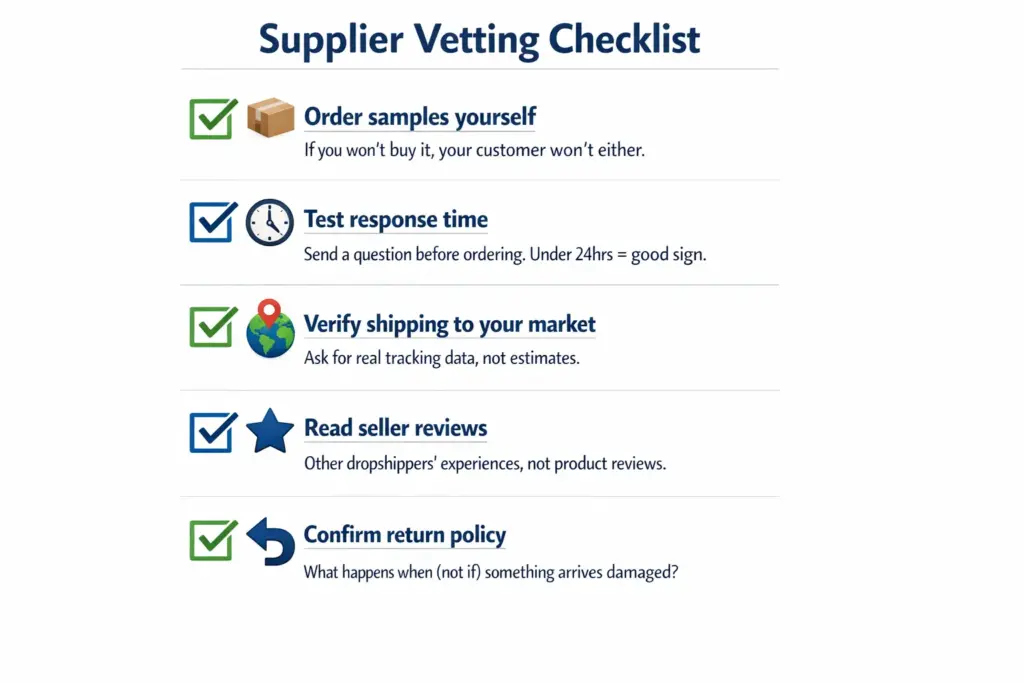
How to vet any supplier:
- Order samples yourself. If you won’t buy the product, why would your customer?
- Test communication speed. Send a question before ordering. If they take 3 days to reply, imagine handling a customer complaint through them
- Check shipping times to your target market. “7-15 business days” often means 21+ calendar days
- Read reviews from other sellers, not just the product page star ratings
- Ask about return/refund policies upfront. You need to know what happens when (not if) something goes wrong
Step 3: Build Your Store
Don’t overthink this part. I’ve seen people spend six weeks perfecting their store design before listing a single product. Your store needs to look trustworthy, load fast, and make buying easy. That’s it.
Platform choice. Shopify is the default for a reason: it integrates with every dropshipping app, has the most tutorials, and handles the technical side so you don’t have to. WooCommerce (WordPress) gives you more control but more headaches. For a full platform breakdown, see our ecommerce platform comparison.
Essential pages: Homepage with clear value proposition. Product pages with real-looking photos (use supplier images or order samples and shoot your own). About page that tells a story. Shipping policy that’s honest about delivery times. Return/refund policy. Contact page with actual email.
Trust signals that matter: Secure checkout badge. Clear shipping information (don’t hide 14-day shipping behind vague language). Real contact info. A professional-looking logo (Canva, 10 minutes, free). At least basic social media presence.
Step 4: Product Research That Actually Works
This is where 80% of your time should go. Not store design, not logo tweaking. Product research. The product IS the business in dropshipping.
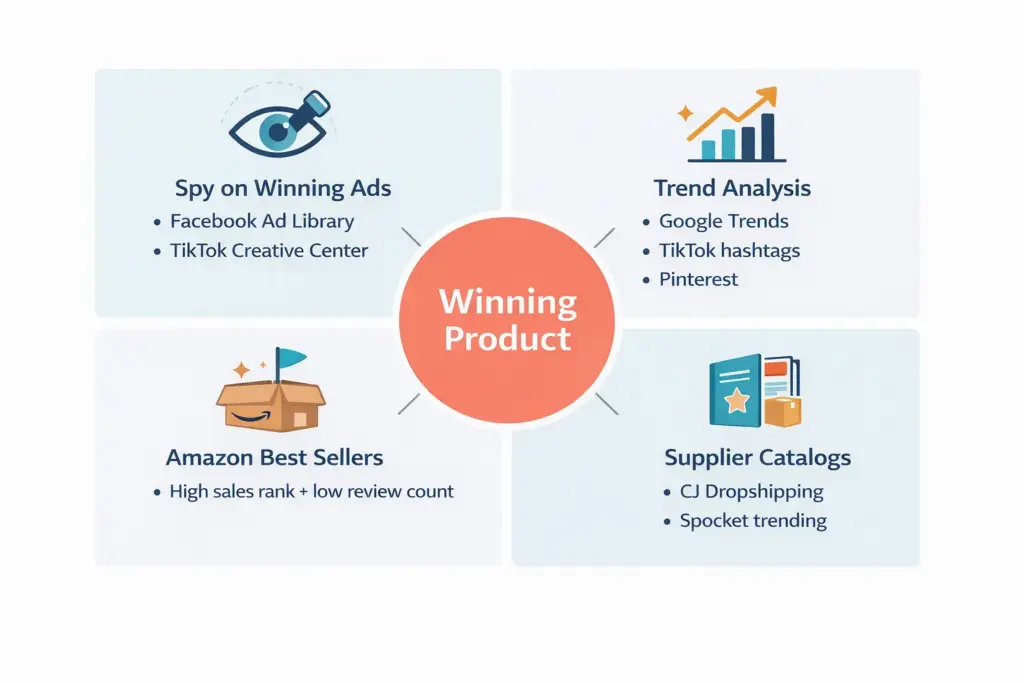
Method 1: Spy on winning ads. Facebook Ad Library (free) lets you search any brand’s active ads. TikTok Creative Center shows trending ad content. Find products getting heavy ad spend right now. If someone’s spending money to advertise it, it’s probably selling.
Method 2: Amazon Best Sellers + low review count. Browse Amazon’s Best Sellers and Movers & Shakers lists. Look for products with strong sales rank but relatively few reviews (under 500). That signals demand without entrenched competition.
Method 3: Google Trends + social signals. Check if interest in a product category is rising, flat, or declining. Cross-reference with TikTok hashtag views and Pinterest trending searches. Rising trends with consistent volume are ideal.
Method 4: Browse supplier catalogs with fresh eyes. Spend an hour scrolling CJ Dropshipping or Spocket’s catalog sorted by “trending” or “most popular.” Look for products that solve a clear problem and aren’t already everywhere on Instagram.
A winning dropshipping product usually has: a “wow” factor or clear problem-solving angle, a perceived value of $30-$70 (sweet spot for impulse purchases), healthy margins (you can sell for 2.5-3x the supplier price), and it’s hard to find at local retail stores.
Step 5: Get Traffic and Make Sales
A beautiful store with zero visitors makes zero dollars. Traffic is where most dropshippers actually fail, not on the product or the store. Your main options:
Paid ads (fastest). Facebook/Instagram Ads and TikTok Ads are the two primary channels. Start with $10-20/day testing different products and audiences. Kill ads that don’t convert within 3-4 days. Double down on what works. Expect to lose money during the testing phase. That’s normal and it’s the cost of gathering data.
TikTok organic (cheapest). Create short-form video content showing your product in action. You don’t need a huge following. TikTok’s algorithm serves content to interested audiences regardless of follower count. One viral video can generate hundreds of sales overnight. The downside: it’s unpredictable.
SEO and content (slowest but most sustainable). Write blog content targeting product-related keywords. Build backlinks. This takes months to pay off but creates free, ongoing traffic that doesn’t disappear when you stop paying for ads. Our ecommerce SEO guide covers this approach.
Influencer partnerships. Micro-influencers (5K-50K followers) in your niche can drive targeted traffic for $50-$300 per post, or for free product in exchange. The ROI is often better than paid ads because the audience trusts the creator.
Step 6: Manage Orders and Scale What Works
Once you get consistent sales, the operational side becomes critical. A few things that separate stores that scale from stores that burn out:
Automate order fulfillment. DSers (for AliExpress) or your supplier’s integration should handle order forwarding automatically. If you’re manually placing orders with your supplier for every sale, you’ll drown by the time you hit 20 orders/day.
Handle customer service proactively. Send tracking numbers immediately. Set expectations about shipping times on the product page AND in the order confirmation email. Most customer complaints in dropshipping are about shipping speed. If you’re upfront about it, complaint rates drop dramatically.
Track your numbers religiously. Cost per acquisition. Average order value. Profit per order (after ALL costs). Customer return rate. If you’re not tracking these weekly, you’re guessing. And guessing in thin-margin businesses is how you go broke.
The graduation play. Here’s what the best dropshippers do that nobody talks about: once they identify 2-3 products that sell consistently, they stop dropshipping those products. They order bulk inventory, negotiate direct with manufacturers, create custom packaging with their branding, and flip to a private label or wholesale model. Margins jump from 15-30% to 50-70%. That’s where the real money lives.
Is Dropshipping Legal?
Yes, dropshipping is legal in the US, EU, and most countries worldwide. It’s a standard retail fulfillment method, not a grey area scheme. However, you still need to operate legally:
- Register your business (LLC recommended). Our legal setup guide walks you through this
- Collect and remit sales tax in states where you have nexus
- Don’t sell trademarked or counterfeit products (this is where dropshippers get into actual legal trouble)
- Comply with advertising regulations. Don’t make claims your products can’t back up
- Follow platform-specific rules (Amazon, Shopify, and eBay each have dropshipping policies you need to read)
Frequently Asked Questions
How much money do I need to start dropshipping?
Realistically, $150-$500. That covers a platform subscription, domain, sample orders, and initial ad testing budget. You can start for less, but skipping ad budget means relying entirely on organic traffic, which takes months.
Is dropshipping still profitable in 2026?
It can be, but margins are thinner than ever. The dropshipping market is valued at $351 billion and growing, but individual store profitability depends heavily on niche selection, supplier quality, and marketing skills. Expect 15-30% margins on most products.
How long does it take to make money dropshipping?
Most profitable stores take 2-3 months of testing before seeing consistent revenue. The first few weeks are typically spent testing products and losing small amounts on ads. If you’re not profitable after 3 months of active work, reassess your niche and strategy.
What’s the best platform for dropshipping?
Shopify is the most popular due to its app ecosystem and ease of use. WooCommerce is a strong free alternative if you’re comfortable with WordPress. For marketplace selling, Amazon and eBay both allow dropshipping with specific policy restrictions.
Can you dropship on Amazon?
Yes, but Amazon has strict dropshipping rules. You must be the seller of record, products must ship with your business info (not the supplier’s), and you can’t purchase from another retailer to fulfill orders. Our Amazon dropshipping guide covers the specifics.
What’s better: dropshipping or private label?
Dropshipping is lower risk with lower margins. Private label is higher investment with higher margins and brand equity. The smartest approach: start with dropshipping to validate demand, then graduate winning products to private label for better margins and brand control.
Related reads: Complete Guide to Starting an Ecommerce Business | Profitable Ecommerce Niches | Best Dropshipping Products | Dropshipping Suppliers Directory | Dropshipping on Amazon | Private Label Products Guide | Ecommerce Business Models
Enjoying this? Get more like it every week.
One email per week with ecommerce strategies, tool picks, and seller insights. No spam.