
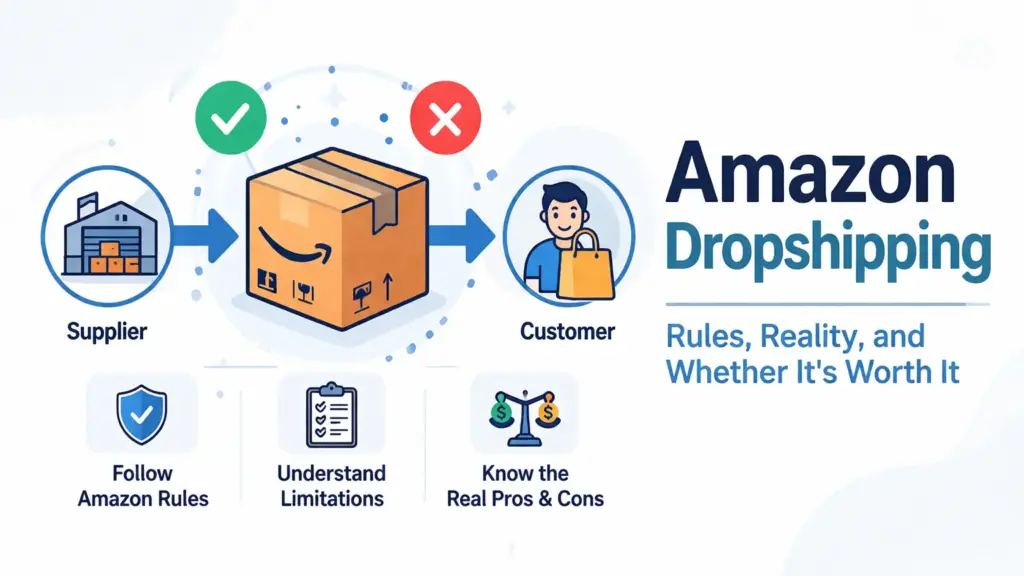
- Amazon dropshipping is allowed but only under strict policy rules: you must be the seller of record, remove all third-party branding from shipments, handle returns yourself, and never purchase from another retailer (like Walmart) to ship directly to Amazon customers.
- The global dropshipping market exceeded $464 billion in 2026 and is growing at 22% CAGR (Shopify). Amazon's share of that is significant since independent sellers account for over 60% of units sold on the platform.
- Realistic Amazon dropshipping margins are thin: 10-20% gross after Amazon's 8-15% referral fees, FBA or shipping costs, and supplier pricing. Compare that to 30-50% on your own Shopify store. Amazon gives you traffic but takes most of your margin.
- The honest recommendation: Amazon dropshipping works best as a testing ground or supplemental channel. For long-term profitability, most successful sellers either graduate to private label on Amazon or build their own store where margins are 2-3x higher.
Someone messaged me last month saying they got their Amazon seller account suspended. They’d been dropshipping for three weeks, buying from Walmart.com and shipping directly to Amazon customers. Walmart’s receipt was inside the package. Amazon shut them down the same day a customer complained.
Amazon dropshipping is the practice of listing products for sale on Amazon’s marketplace and having a third-party supplier ship orders directly to customers on your behalf, without holding inventory yourself. It’s allowed under Amazon’s Drop Shipping Policy, but with strict rules that differ significantly from dropshipping on your own website. The global dropshipping market exceeded $464 billion in 2026 and is growing at 22% annually (Shopify). Amazon is a massive piece of that because independent sellers account for over 60% of total units sold on the platform, and many of those sellers use some form of dropshipping.
If you’re new to dropshipping entirely, start with our complete dropshipping guide first. This article is specifically about doing it on Amazon – the rules, the economics, and whether it’s actually the right channel for you.
Amazon Dropshipping Policy: What’s Allowed and What Gets You Banned
This is the most important section of this article. Get the policy wrong and your account gets suspended. There’s no warning. No second chance on most violations.
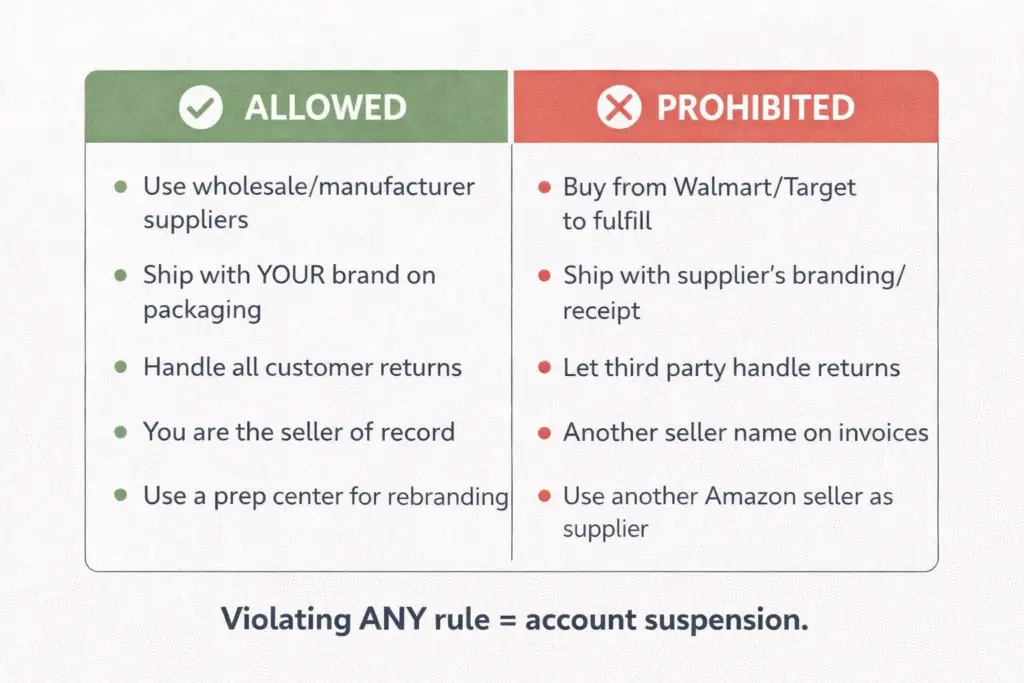
What Amazon dropshipping policy ALLOWS:
You CAN use a third-party supplier (manufacturer, wholesaler, or distributor) to fulfill orders as long as you are the seller of record. This means your business name appears on all invoices, packing slips, and external packaging. The customer must believe they bought from YOU, not from your supplier. You can work with wholesale suppliers, manufacturers, or dedicated dropshipping suppliers who agree to ship under your brand name.
What Amazon dropshipping policy PROHIBITS:
You CANNOT buy from another retailer (Walmart, Target, Home Depot, another Amazon seller, eBay) and have them ship directly to your Amazon customer. This is the rule most new sellers break. If a Walmart receipt, Target packing slip, or any third-party branding arrives in the customer’s package, Amazon suspends your account. You also cannot ship products with invoices, packaging, or any materials that identify anyone other than you as the seller.
The five non-negotiable rules:
1. You are the seller of record on all documentation. 2. All third-party supplier branding is removed before shipping. 3. You handle all customer returns and service. 4. You set the price, record the revenue, and handle sales tax. 5. You comply with Amazon’s seller agreement and all applicable policies.
Breaking any of these results in listing removal, account suspension, or permanent ban. Amazon does enforce this, especially when customers report receiving packages with another retailer’s branding.
How to Start Amazon Dropshipping (Step by Step)
Step 1: Create an Amazon seller account. The Professional plan costs $39.99/month and is required if you plan to sell more than 40 items per month. The Individual plan charges $0.99 per item sold. For serious amazon dropshipping, go Professional from the start because it unlocks advertising, Buy Box eligibility, and bulk listing tools.
Step 2: Find compliant suppliers. This is the hardest part. You need suppliers who will ship with YOUR branding (or neutral packaging), provide reliable quality, and have fast enough shipping to meet Amazon’s delivery expectations. Sources: wholesale directories (SaleHoo, Worldwide Brands), direct manufacturer outreach, trade shows, and dedicated dropshipping suppliers who specialize in Amazon-compliant fulfillment. Our wholesale suppliers guide covers how to find and vet them.
Step 3: List products on Amazon. Join existing product listings (if the product already exists on Amazon) or create new listings for unique products. Your listing title, images, and bullet points must be accurate and comply with Amazon’s product detail page rules. Don’t copy competitor listing text – Amazon penalizes duplicate content.
Step 4: Price competitively. Factor in: supplier cost + Amazon referral fee (8-15%) + shipping cost to customer + your profit margin. If you can’t price competitively and still profit after all fees, the product doesn’t work for Amazon dropshipping. Use Amazon’s Revenue Calculator to model your numbers before listing. Our pricing strategy guide covers the math in detail.
Step 5: Manage orders and customer service. When an order comes in, forward it to your supplier for fulfillment. Track shipment, upload tracking numbers to Amazon (critical for metrics), and handle any customer inquiries or returns. Keep your Order Defect Rate below 1%, late shipment rate below 4%, and pre-fulfillment cancel rate below 2.5%. Exceeding these thresholds triggers account warnings or suspension.
Is Amazon Dropshipping Profitable? The Real Math
Here’s where most guides get dishonest. They show a $30 product with a $10 supplier cost and say “you make $20 per sale!” They conveniently forget Amazon’s cut.
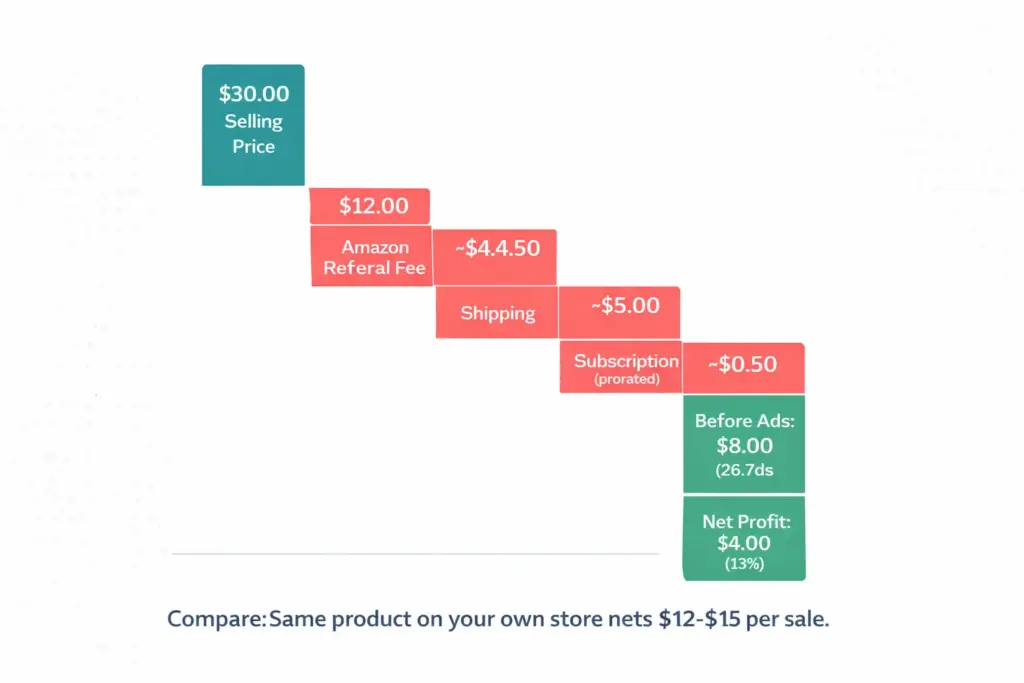
| Cost Component | Amount |
|---|---|
| Selling price on Amazon | $30.00 |
| Supplier cost | -$12.00 |
| Amazon referral fee (15%) | -$4.50 |
| Shipping to customer (if not FBA) | -$5.00 |
| Amazon monthly subscription (prorated) | -$0.50 |
| Net profit per sale | $8.00 (26.7%) |
| After returns (~5%) | ~$7.60 |
| After PPC advertising ($3-5/sale avg) | ~$3.60-$4.60 (12-15%) |
That’s the reality. On a $30 product, you’re netting $3.60-$4.60 per sale after advertising. Multiply by 200 sales/month and that’s $720-$920/month profit. It’s not nothing, but it’s thin. One price war, one supplier price increase, or one spike in ad costs can wipe out your margin entirely.
Compare that to dropshipping the same product on your own Shopify store where you’d keep roughly $12-$15 per sale (no referral fee, lower processing costs). The trade-off: Amazon gives you built-in traffic. Your own store requires you to drive every visitor yourself.
Amazon Dropshipping vs Amazon FBA: Which Is Better?
This is the question most sellers should be asking instead of “how do I dropship on Amazon?”
| Factor | Amazon Dropshipping | Amazon FBA |
|---|---|---|
| Upfront inventory cost | $0 (pay per order) | $500-$5,000+ |
| Shipping speed | 3-10 days (depends on supplier) | 1-2 days (Prime eligible) |
| Buy Box eligibility | Lower priority | Higher priority (Prime badge) |
| Customer trust | Lower (no Prime badge) | Higher (Fulfilled by Amazon) |
| Profit margins | 10-20% (thin) | 20-40% (better unit economics) |
| Risk | Low (no inventory risk) | Higher (unsold inventory) |
| Scalability | Limited by supplier capacity | Amazon handles fulfillment at scale |
| Best for | Testing products, low budget start | Building a brand, long-term business |
The honest take: Amazon dropshipping is a good entry point if you have limited capital and want to test products with zero inventory risk. But FBA with private label products is where the real money is on Amazon. The Prime badge, faster shipping, and Buy Box priority translate directly into more sales and better margins. Most successful Amazon sellers start with dropshipping to learn the platform, then transition to FBA once they’ve identified winning products. Our private label products guide covers the FBA path in detail.
Common Amazon Dropshipping Mistakes
Using retail suppliers. Buying from Walmart, Target, or AliExpress and shipping directly to Amazon customers is the fastest path to account suspension. Use wholesale suppliers or manufacturers only. If your supplier ships with their own branding, use a prep center that repackages under your brand.
Ignoring shipping speed. Amazon customers expect fast delivery. If your supplier takes 10-15 days to ship (common with overseas suppliers), your late shipment metrics will tank and Amazon will throttle or suspend your listings. Work with domestic suppliers or suppliers with US/EU warehouses.
Competing on price alone. Hundreds of dropshippers list the same generic products and undercut each other by pennies. This race to the bottom leaves everyone unprofitable. Differentiate through better listing content, bundled products, or niche targeting rather than lowest price.
Not tracking metrics. Amazon suspends accounts based on performance metrics, not just policy violations. Monitor your Order Defect Rate (must stay under 1%), Late Shipment Rate (under 4%), and Valid Tracking Rate (above 95%) religiously. One bad month can take weeks to recover from.
Skipping product research. Listing random products hoping something sticks wastes time and money on PPC. Research demand, competition, and fee structure before listing. Use Amazon’s Product Opportunity Explorer (free in Seller Central) to identify gaps. Our best dropshipping products guide covers how to find winners.
Should You Dropship on Amazon or Build Your Own Store?
The answer depends on where you are:
Choose Amazon dropshipping if: You have under $500 to start, you want access to Amazon’s massive buyer traffic without building an audience, you’re testing product ideas before committing to inventory, or you want to learn ecommerce fundamentals on a platform with built-in infrastructure.
Choose your own store (Shopify/WooCommerce) if: You want to build a brand, you want 2-3x higher margins per sale, you have an audience or can drive traffic through content and social media, or you want to own customer data and email lists for repeat marketing.
The smart play: Do both. Use Amazon for volume and product testing. Build your own store for brand and margin. Many sellers run Amazon dropshipping to identify which products have demand, then create a branded version and sell it on both Amazon (via FBA) and their own store. See our platform comparison for choosing the right setup.
Frequently Asked Questions
Can you dropship on Amazon?
Yes. Amazon allows dropshipping as long as you follow their Drop Shipping Policy. You must be the seller of record, remove all third-party branding from shipments, handle returns, and never purchase from another retailer to fulfill orders. Violating these rules results in account suspension.
Is Amazon dropshipping profitable in 2026?
It can be, but margins are thin. Expect 10-20% gross margin after Amazon’s referral fees (8-15%), shipping, and supplier costs. After advertising, net profit typically lands at 10-15% per sale. Profitable amazon dropshipping requires careful product selection, competitive pricing, and efficient operations.
How to start Amazon dropshipping?
Create an Amazon Professional seller account ($39.99/month). Find compliant wholesale suppliers who will ship under your brand. List products with optimized titles, images, and descriptions. Price to cover all fees plus profit. Manage orders, upload tracking, and maintain seller metrics above Amazon’s thresholds.
What is Amazon’s dropshipping policy?
Amazon requires you to be the seller of record on all documentation. All third-party supplier branding must be removed before shipping. You must handle returns and customer service. Purchasing from another retailer (Walmart, Target, eBay) and shipping directly to Amazon customers is strictly prohibited.
Amazon dropshipping vs FBA – which is better?
FBA is better for long-term profitability. It offers Prime eligibility, faster shipping, higher Buy Box priority, and better margins on branded products. Amazon dropshipping is better for testing products with zero inventory risk and minimal upfront investment. Most successful sellers start with dropshipping and graduate to FBA.
How much does it cost to start Amazon dropshipping?
Minimum: $39.99/month for the Professional seller account plus your first supplier order costs. Realistically, budget $200-$500 for the first month including the subscription, sample orders for quality testing, and initial PPC advertising to get visibility on your listings.
Related reads: How to Start Dropshipping | Best Dropshipping Products | Private Label Products Guide | Find Wholesale Suppliers | Ecommerce Pricing Strategy | Best Ecommerce Platform
Enjoying this? Get more like it every week.
One email per week with ecommerce strategies, tool picks, and seller insights. No spam.