
- You can start a dropshipping business with no money because you don't purchase inventory until a customer has already paid you. Free store platforms, free supplier apps, and organic marketing make the initial launch cost genuinely $0.
- The trade-off for zero budget is time. Organic marketing (TikTok, Instagram Reels, SEO) takes weeks to months to generate consistent traffic, while paid ads produce results in days but require budget.
- Beyond dropshipping, four other ecommerce models also cost nothing to start: digital products, print on demand, services, and affiliate marketing. Each has different margin profiles and time-to-first-sale timelines.
- "No money" doesn't mean no costs forever. Expect to reinvest your first profits into a proper domain ($12/year), paid platform plan ($29-39/month), and a small ad testing budget ($50-100) once you validate demand.
How to start a dropshipping business with no money comes down to three things: using a free or trial-period store platform, connecting with suppliers who don’t charge until you make a sale, and driving traffic through organic content instead of paid ads. You don’t buy inventory upfront because your supplier ships directly to the customer after they’ve already paid you. That’s why dropshipping is one of the only physical-product business models where $0 starting capital is genuinely possible.
But let me be honest about something most guides won’t tell you: starting with zero money is possible, but it’s harder and slower than starting with even a small budget. You’re replacing dollars with hours. Instead of running $50 in Facebook ads to test a product overnight, you’re creating TikTok videos for three weeks hoping one goes viral. Both paths work. One is faster. The other is free.
This guide covers the realistic path to launching an online store with nothing in your pocket. I’ll walk through dropshipping step by step, then cover four other zero-cost ecommerce models that most “no money” guides completely ignore. If you’re starting an ecommerce business on a tight budget, at least one of these five models fits your situation.
How to Start Dropshipping With No Money: Step by Step
Here’s the exact process for launching a dropshipping with no money store in 2026. Every tool and platform mentioned has a free tier or trial period.
Step 1: Find a Niche Using Free Research Tools
Product research doesn’t cost money. Use these free tools to find products with demand and manageable competition:
- Google Trends to validate that interest is steady or growing (not a dying fad)
- TikTok Shop trending products to see what’s selling through social commerce right now
- Amazon Best Sellers and Movers and Shakers pages to spot what people are actually buying
- eBay sold listings (filter by “Sold Items”) to see real transaction prices and volume
Pick a niche you’re interested in. Your existing knowledge makes content creation easier, and you’ll need to create a lot of content when your marketing budget is zero. Pet supplies, fitness accessories, phone accessories, and home organization are proven categories with steady demand. Our trending products guide covers what’s selling right now across all categories.
Step 2: Set Up a Free Store
You need a storefront, and several options cost nothing to start:
Shopify free trial gives you 3 days free, then $1/month for the first 3 months. That’s $3 total for three months of a fully functional store. It’s not technically free, but it’s close enough that budget isn’t a real barrier.
Facebook Marketplace and Instagram Shop are completely free selling channels with built-in audiences. You can list products and process sales without a website. This is the true $0 option for testing products.
TikTok Shop lets you sell directly within TikTok videos. If your products demonstrate well on video (gadgets, beauty tools, kitchen items), this is increasingly the fastest free channel to your first sale.
Etsy charges $0.20 per listing, which means you can start an Etsy shop with no money beyond a few cents per product. The built-in marketplace traffic means customers find you through Etsy’s search rather than you driving all the traffic yourself.
Step 3: Connect Free Supplier Apps
These dropshipping supplier apps offer free plans that let you import products and process orders without a subscription fee:
| Supplier App | Free Plan Limits | Supplier Region | Best For |
|---|---|---|---|
| DSers | 3,000 products | AliExpress (China) | Beginners, bulk testing |
| CJdropshipping | Unlimited (usage-based) | 16 countries | Quality control, custom products |
| Syncee | 25 products | US, EU, Asia | Multi-region sourcing |
| Printful | Pay per order only | US, EU, global | Custom-designed products |
DSers is the strongest free option because 3,000 products is genuinely generous. Most other apps cap free tiers at 25-50 products, which isn’t enough to test properly. Start with DSers, import 20-50 products across 2-3 categories, and see what gets traction before narrowing your focus.
Step 4: Drive Traffic With Organic Marketing (The Hard Part)
This is where the “no money” path gets real. Without ad budget, you’re building an audience through content. That means creating and posting consistently for weeks before seeing meaningful results.
TikTok and Instagram Reels are the fastest organic channels right now. Create short product demonstration videos showing your items in use. Before-and-after shots, unboxing content, and “problem solved” demonstrations perform best. Aim for 1-2 videos per day for at least 30 days before evaluating results.
Pinterest works well for home decor, fashion, beauty, and gift-oriented products. Create product pins linking back to your store. Pinterest traffic is slower to build but converts at higher rates than social media because people use Pinterest with purchase intent.
SEO and blog content is the long game. Write product guides, comparison articles, and how-to content targeting keywords your potential customers search for. This takes 2-6 months to generate meaningful traffic, but once it works, it’s free and compounds over time. SEO for ecommerce stores is covered in depth across our marketing guides.
Step 5: Fulfill Orders and Reinvest Profits
When your first orders come in, your supplier charges you the wholesale price plus shipping. The customer has already paid your retail price. The difference is your profit. Reinvest those first profits into:
- A custom domain ($12/year) to look professional
- Upgrading to a paid Shopify plan ($39/month) for full features
- A small ad testing budget ($50-100) to accelerate what’s already working organically
- Product samples to verify quality before scaling
The goal isn’t to stay at $0 forever. It’s to validate that people will buy your products before investing money. Once you have proof of demand, spending becomes investing, not gambling.
How to Start an Online Store With No Money: 4 More Models
Dropshipping isn’t the only way to start an online store with no money. These four models also cost nothing to launch and may fit your skills better than product reselling.
Digital Products (Best Margins, Zero Inventory)
Digital products deliver 80-95% margins because there’s nothing to manufacture, store, or ship. You create once and sell forever. Templates (Notion, spreadsheets, Canva), printable planners, ebooks, online courses, and design assets all sell consistently on platforms like Gumroad (free to start, they take a percentage per sale) and Etsy ($0.20 per listing).
If you have expertise in anything, cooking, fitness, finance, photography, marketing, you can package that knowledge into a digital product this weekend and list it for sale by Monday.
Print on Demand (Custom Products, No Inventory)
Print on demand connects your designs with physical products (t-shirts, mugs, posters, phone cases) without inventory. Printful and Printify charge nothing until a customer orders. You pay the production cost per item, the customer pays your retail price, and the difference is your margin (typically 20-40%).
This is the best zero-budget model if you’re a designer or artist. Your creativity is the product. The production partner handles everything physical.
Freelance Services Storefront
Selling your skills as packaged services requires zero investment. Writing, graphic design, web development, social media management, virtual assistance, and consulting can all be sold from a free website or directly through social media. Create fixed-price packages instead of billing hourly, and you’ve got a scalable online business that generates revenue in days, not months.
Affiliate Marketing
Build a niche content site reviewing and recommending products. When readers buy through your affiliate links, you earn a commission (typically 3-10% for physical products, 20-50% for digital products). The startup cost is just hosting and a domain ($50-100/year), or genuinely $0 if you publish on free platforms like YouTube, Medium, or a free WordPress.com blog.
Affiliate revenue takes 3-6 months to build because you need search traffic or a social audience first. But once the content ranks, it generates passive income with minimal maintenance.
How to Start an Online Boutique With No Money
If fashion is your niche, you can start an online boutique with no money using a combination of the models above:
Curated dropshipping boutique. Source clothing and accessories from wholesale dropshipping suppliers (Spocket and Syncee have fashion-focused catalogs). Your differentiation comes from curation, styling content, and brand aesthetic, not from manufacturing the clothes yourself.
Print on demand apparel. Design custom clothing (graphic tees, embroidered sweatshirts, custom accessories) through Printful or Printify. You control the designs and branding while they handle production and shipping.
Thrift-to-boutique reselling. Source unique and vintage pieces from thrift stores for $2-10 each and resell them for $20-60+ on Poshmark, Depop, or your own store. This requires a small sourcing budget ($20-50 to start) but the margins are enormous.
The key is positioning. A “boutique” isn’t defined by how you source products. It’s defined by how you present them. Strong branding, cohesive aesthetics, and a clear point of view make a dropshipping store look like a curated boutique.
The Honest Truth About Starting With $0
I want to be direct about the limitations because most “no money” guides sell a fantasy:
It’s slower. Organic marketing takes weeks to months. Paid ads take days. If speed matters, even $100 in ad budget dramatically accelerates your timeline.
Free tools have limits. Free plans restrict product counts, features, and support. You’ll hit walls that paid plans remove. That’s fine for testing. It’s frustrating for scaling.
Your competitors are spending money. If you’re competing in a niche where other sellers run ads, you’re fighting with one hand tied behind your back. You can still win through better content and niche targeting, but it’s harder.
Customer trust is harder to earn. A store on a free Shopify trial with no custom domain, no reviews, and no social proof has a higher barrier to conversion than one that looks established. Building trust takes time and effort when you can’t buy it through professional design and advertising.
“No money” really means “reinvest fast.” The goal is to get from $0 to your first few sales, then immediately reinvest those profits into the things that make your business look and function like a real operation. Understanding your startup costs helps you plan what to reinvest in first.
Free Tools Stack for Zero-Budget Ecommerce
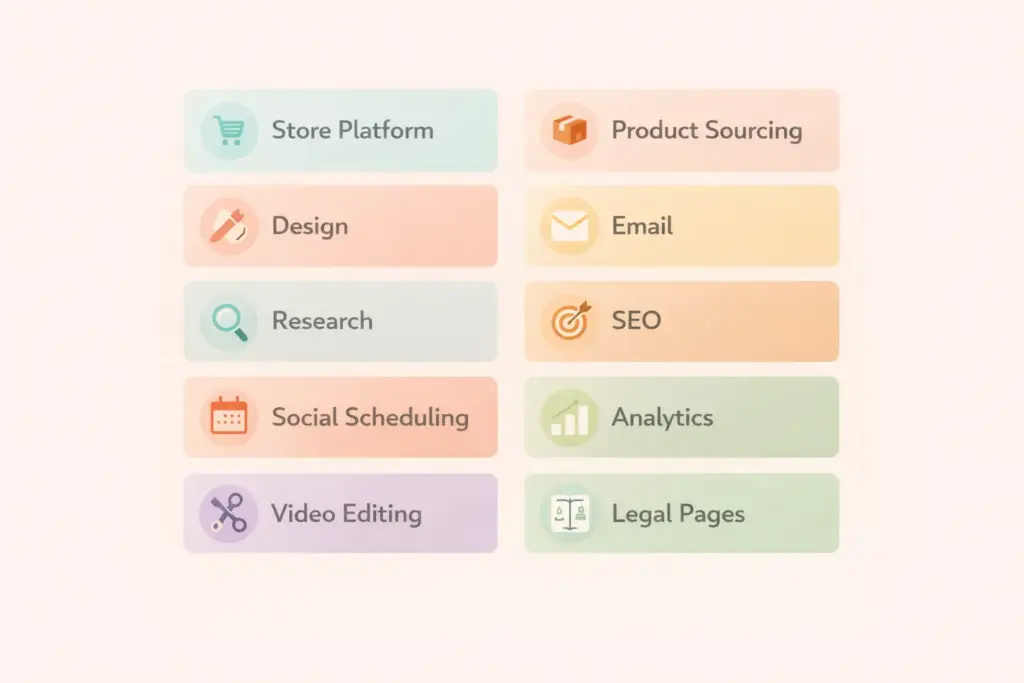
Here’s the complete ecommerce bootstrap toolkit for launching without spending:
| Function | Free Tool | What You Get |
|---|---|---|
| Store platform | Shopify ($1/mo trial) or Facebook/IG Shop | Fully functional storefront |
| Product sourcing | DSers (free tier) | 3,000 AliExpress products |
| Design/branding | Canva (free) | Logo, social graphics, product images |
| Email marketing | Mailchimp (free to 500 contacts) | Welcome emails, abandoned cart recovery |
| Product research | Google Trends + Amazon Best Sellers | Demand validation data |
| SEO | Google Search Console + Ubersuggest (free tier) | Keyword research, search visibility |
| Social media scheduling | Buffer (free tier) | Scheduled posts across platforms |
| Analytics | Google Analytics 4 | Traffic and conversion tracking |
| Video editing | CapCut (free) | TikTok/Reels video creation |
| Legal pages | Shopify policy generator (free) | Privacy policy, terms, return policy |
This stack gets you from idea to live store to first marketing content without spending a dollar. It won’t be perfect. Free tools never are. But it removes the “I can’t afford to start” excuse entirely.
When to Stop Being “Free” and Start Investing
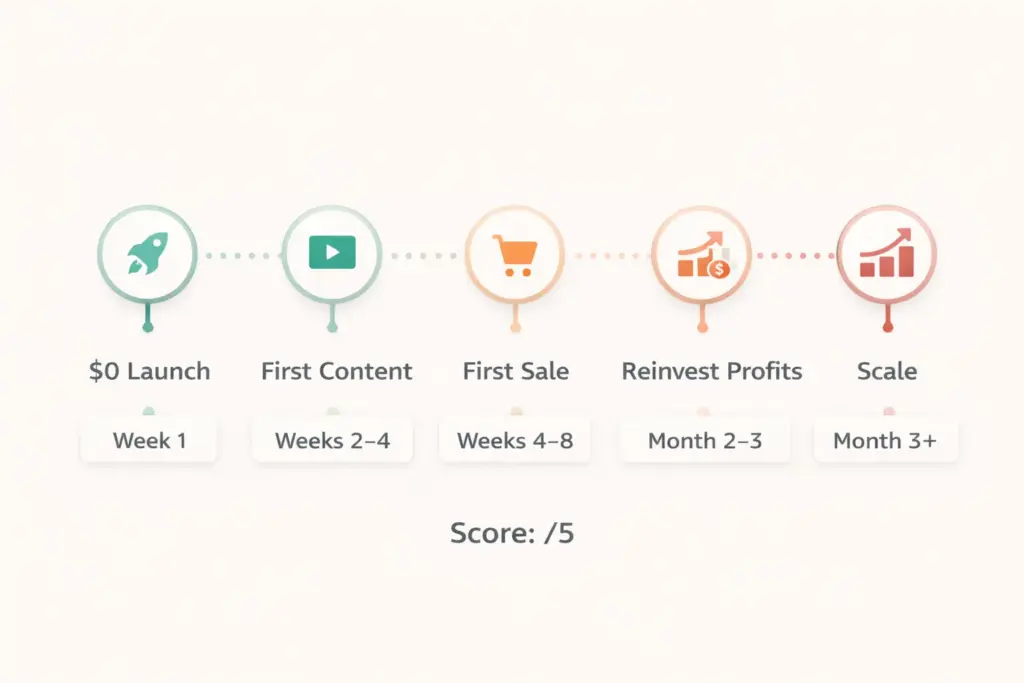
The moment you have proof that people will buy from you, stop operating on free tiers. Here’s the reinvestment priority order:
- Custom domain ($12/year). This is the cheapest thing that makes the biggest trust difference.
- Paid platform plan ($29-39/month). Removes limitations, unlocks features, and makes your store look professional.
- Product samples ($20-100). Verify quality before your customers do. One bad product review early on is devastating.
- Small ad budget ($50-100). Test the products that performed best organically with a small paid push to see if you can scale them.
- Platform upgrade or additional apps as order volume justifies the cost.
Most sellers reach this reinvestment point within 2-8 weeks if they’re consistent with content creation. The first sale might come from a friend or family member. The first sale from a stranger is the one that validates your business. Everything after that is optimization.
Frequently Asked Questions
How to start a dropshipping business with no money in 2026?
Use a free or trial-period store platform (Shopify $1/month trial, Facebook Marketplace, or TikTok Shop), connect free supplier apps like DSers (3,000 products free), and drive traffic through organic content on TikTok, Instagram Reels, and Pinterest. You don’t purchase inventory until a customer has paid you, making $0 startup genuinely possible.
Is it really possible to start dropshipping with no money?
Yes, but with caveats. You can launch and make first sales with $0 by using free tools and organic marketing. However, growth is significantly slower without ad budget, and free tool limitations will eventually hold you back. Plan to reinvest your first profits into a custom domain, paid platform plan, and small ad testing budget within the first 1-2 months.
How to start an online store with no money besides dropshipping?
Four other models cost nothing to start: digital products (templates, ebooks, courses on Gumroad), print on demand (custom designs on Printful), freelance service packages, and affiliate marketing through content sites. Digital products offer the highest margins (80-95%) while print on demand is best for creative sellers who want physical products without inventory.
How to start a dropshipping business with no money on Etsy?
Create an Etsy seller account (free), list products at $0.20 per listing, and connect with print on demand suppliers like Printful that integrate directly with Etsy. Etsy’s built-in search traffic means customers find you without paid ads. Focus on unique, niche products since Etsy’s audience values originality over commodity pricing.
How long does it take to make money dropshipping with no money?
With organic marketing only, expect 2-8 weeks to your first sale if you post content consistently (1-2 TikTok/Instagram videos daily). Some sellers get lucky with a viral video in week one. Most need 30+ pieces of content before seeing consistent traffic. Paid ads can generate sales within days but require budget, which defeats the no-money premise.
What’s the best free platform to start an online boutique with no money?
For fashion and boutique-style stores, Etsy ($0.20/listing) and TikTok Shop (free) are the best free platforms. Both have built-in audiences interested in fashion, accessories, and curated products. Facebook Marketplace also works for local selling. Shopify’s $1/month trial offer makes it nearly free for the first three months if you want your own branded storefront.
Related Reads
- How to Start Dropshipping: Complete Guide
- Ecommerce Business Ideas by Budget
- Digital Products to Sell Online
- Print on Demand Guide
- Ecommerce Startup Costs Breakdown
- Products to Sell from Home
Enjoying this? Get more like it every week.
One email per week with ecommerce strategies, tool picks, and seller insights. No spam.