
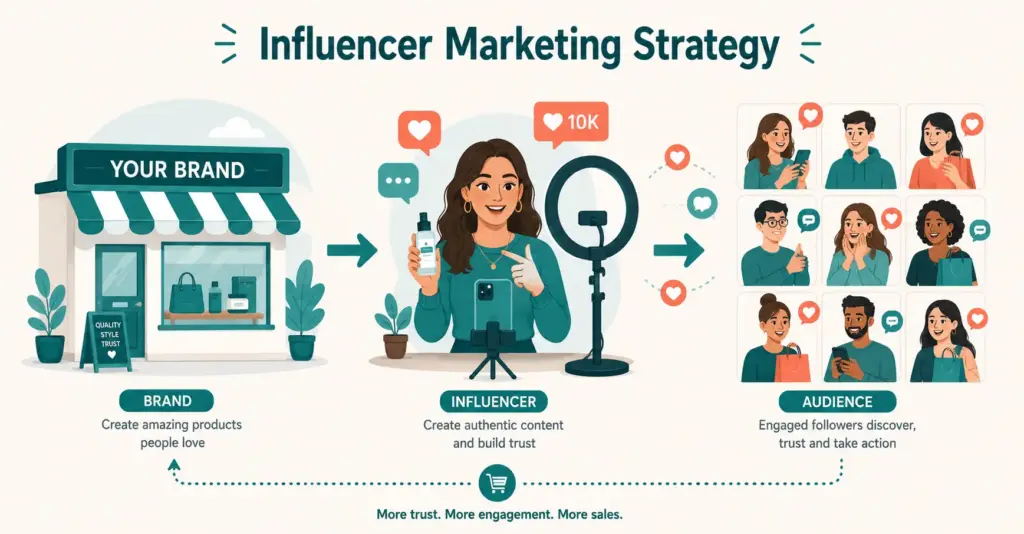
Influencer marketing strategy is the systematic process of partnering with social media creators to reach their audiences with sponsored content, product placements, or affiliate promotions. For ecommerce brands, it functions as paid amplification combined with social proof, since creator endorsements convert significantly higher than paid ads on the same audience. Industry benchmarks show influencer marketing returns $5.78 for every $1 spent across all categories, with top-quartile programs hitting $20 per $1.
The challenge is that 70% of brand-creator partnerships underperform because of mismatched audiences, inflated follower counts, weak briefs, or unclear measurement. The 30% that work generate disproportionate returns and become long-term flywheels. The difference is process, not luck. For broader marketing context, see our ecommerce marketing playbook.
This guide covers creator selection, rate negotiation, contract structure, FTC compliance, content briefs, and ROI measurement. Real numbers, real frameworks, and the operational details most brands miss.
What Influencer Marketing Actually Is (and Isn’t)
Influencer marketing is paid distribution through individual creators with established audiences. It includes:
- Sponsored posts: Paid content where a creator features your product
- Affiliate partnerships: Creators earn commission on sales they drive
- Brand ambassadors: Long-term retainer relationships with creator advocacy
- Product seeding: Free product sent without paid obligation, with hope creators post organically
- UGC campaigns: Paid creator content licensed for brand use in ads and on-site
- Creator storefronts: Creators run their own retail experience around your products (TikTok Shop affiliate model)
Influencer marketing is not the same as celebrity endorsement (which requires massive budgets and rarely generates measurable ecommerce lift) or social media management (which is your owned content strategy). It also isn’t inherently a brand awareness channel; with proper measurement and offer design, it’s a direct response channel for ecommerce.
Creator tiers and what each is good for
| Tier | Followers | Typical Rate (per post) | Best Use |
|---|---|---|---|
| Nano | 1k to 10k | Free product or $50 to $250 | Hyper-niche communities, UGC at scale |
| Micro | 10k to 100k | $100 to $1,500 | Highest engagement rates, niche conversion |
| Mid-tier | 100k to 500k | $1,500 to $5,000 | Brand awareness with engagement |
| Macro | 500k to 1M | $5,000 to $15,000 | Reach with category authority |
| Mega | 1M+ | $15,000 to $250,000+ | Mass awareness, brand campaigns |
Most ecommerce brands under $5M annual revenue should focus 80% of budget on micro and nano creators. The math works dramatically better there.
Creator Selection: The Vetting Framework
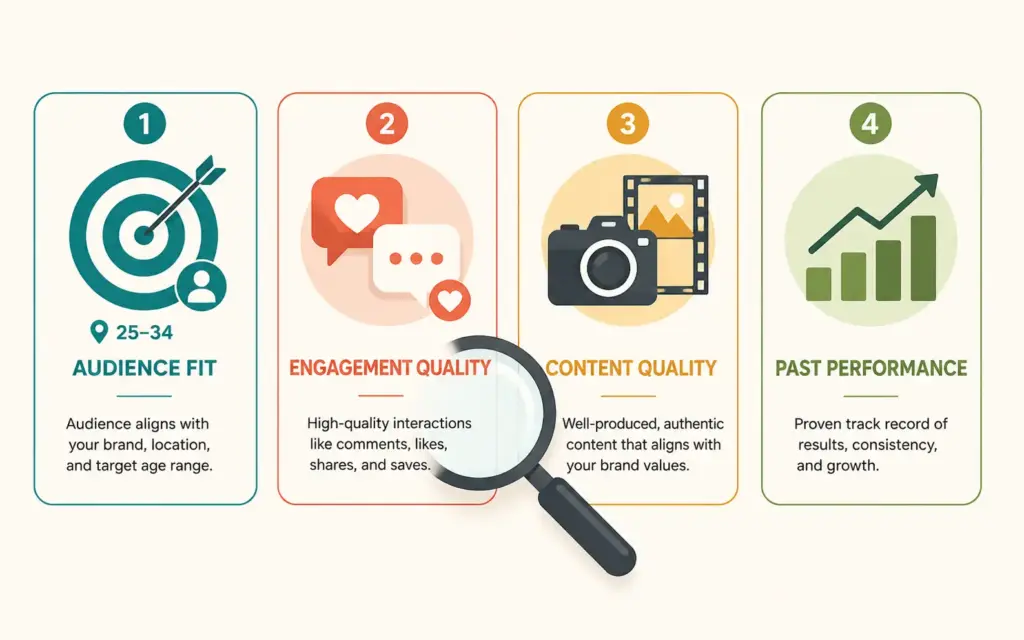
Selection is where 80% of campaign success or failure happens. Skip this and no rate negotiation, contract, or brief will rescue the campaign.
Audience fit (the biggest variable)
Pull engagement and audience data using tools like Modash, GRIN, or HypeAuditor. Look for:
- Geographic match: If you ship US-only, you need 70%+ US audience. Don’t pay for engagement that can’t convert.
- Age and gender match: A 28-year-old creator with a 14 to 17 audience won’t convert your premium skincare line.
- Audience interests overlap: The creator’s audience should care about your category before the post, not just respond to the creator’s recommendation.
- Audience authenticity: Bot followers and engagement pods inflate numbers. HypeAuditor flags accounts with under 60% authenticity scores. Skip those.
Engagement quality (not just rate)
Engagement rate alone is misleading. Look at:
- Comment quality: Real engagement looks like questions, opinions, and sharing experiences. Fake engagement looks like emoji strings and “🔥🔥🔥”.
- Comment-to-like ratio: Healthy creators run 1 to 5%. Engagement pods produce sub-1% comment ratios.
- Saves and shares: Instagram and TikTok now weight saves and shares heavily for algorithmic reach. High-save creators have audiences who treat their content as reference material, not just entertainment.
- Performance trend: Is engagement rising or declining over the last 12 months? Declining creators are usually losing audience trust.
Content quality and brand fit
Read 20 of the creator’s last 50 posts. Watch for:
- Production quality matches your brand standards
- Tone, humor, and voice align with how you want to be represented
- Past sponsorships didn’t compromise authenticity (some creators dilute their voice with too many partnerships)
- Comments don’t reveal political controversies or values misalignment
- Sponsorship density: under 1 in 4 posts paid is healthy. Over 1 in 2 means audience trust is eroding.
Past performance with comparable brands
Ask creators directly for case studies from past brand partnerships. Specifically:
- What was the discount code redemption rate?
- What ROAS did the brand report?
- Can you share screenshots of post analytics (saves, shares, link clicks)?
Creators who can’t or won’t share this data either don’t track it (red flag) or had poor results (bigger red flag). Top creators have media kits with this information ready.
Rate Negotiation and Pricing
Baseline pricing rule
Industry baseline is roughly $100 per 10,000 followers for a single-platform sponsored post. From that, apply modifiers:
- Category multiplier: B2B/finance 2 to 3x, beauty/luxury 1.5 to 2x, lifestyle/fitness 1x baseline, gaming/general 0.7 to 1x
- Engagement modifier: Top 10% engagement rate +50%, bottom 25% engagement -50%
- Platform modifier: TikTok rates run 0.7 to 0.9x of Instagram for equivalent reach. YouTube long-form runs 3 to 5x Instagram.
- Usage rights: “Whitelisting” or paid-ads usage adds 50 to 100% to base rate.
- Exclusivity: 30-day category exclusivity adds 30 to 50%.
What to actually pay
For micro-creators (10k to 100k followers):
- Single Instagram post + 3 stories: $200 to $1,200
- Single TikTok video: $150 to $1,000
- YouTube integration (60 to 90 seconds): $500 to $3,000
- YouTube dedicated video: $2,000 to $10,000
- UGC asset (no posting): $150 to $500 per asset
Negotiate down from the high end. Most creators have list prices that bake in 30 to 50% negotiation room. Bundle posts (multi-post deals get 20 to 30% discounts) and lock in performance bonuses for above-target results rather than raising base rates.
Contract Structure
Verbal agreements and DM negotiations create disasters. Every paid partnership needs a written contract covering:
- Scope of work: Specific deliverables (1 feed post, 3 stories, 1 reel) with exact dates and platforms
- Content approval rights: You review and approve content 48 to 72 hours before posting (most creators accept this; it’s standard)
- Posting requirements: Required hashtags, brand mentions, link placements, FTC disclosure language
- Usage rights: Where can you reuse the content (paid ads, website, email, organic social)? For how long? Default to 12 months across paid + organic for fair pricing.
- Exclusivity: Will the creator avoid competitors during and after the campaign? For how long?
- Payment terms: 50% upfront, 50% on completion is standard. Net-30 after posting works for established creators.
- Performance reporting: Creator provides screenshots of post analytics within 7 days of posting
- Kill fees: What happens if either party cancels? 50% kill fee is standard if content was created.
- Disclosure compliance: Creator agrees to FTC-compliant disclosure language and accepts liability for non-compliance
FTC Compliance: Don’t Skip This
The FTC requires clear and conspicuous disclosure on every sponsored post. The rules apply to creators and to brands; both can be fined.
What counts as compliant disclosure
- Clear: “#ad” or “#sponsored” placed at the start of the caption, not buried after 20 hashtags
- Conspicuous: Visible in feed without users tapping “more” to expand
- On every post: Reels, stories, TikToks, YouTube shorts, all individual posts in a series
- Stories: Use Instagram’s “Paid partnership” tag, plus a visible “#ad” overlay
- YouTube: Verbal disclosure in the first 30 seconds, plus a written tag in the description
What doesn’t count
- “Thanks to BrandX” without the word “ad,” “sponsored,” or “partnership”
- “#partner” by itself (FTC’s stance has hardened on this)
- “#ambassador” or “#collab” without supplementary “#ad”
- Disclosure only in profile bio, not on the specific post
- Affiliate-only relationships still require disclosure if creator received free product
Build the exact disclosure language into your contracts. Make compliance a deliverable. Audit posts within 24 hours of going live and require corrections immediately. The FTC fined creators and brands $5.6 million collectively in 2024 for disclosure failures, a number trending up year over year.
Writing the Creative Brief
The brief is your contract for what good content looks like. A bad brief produces generic content that doesn’t convert. A great brief gives creators enough freedom to make it their own while protecting non-negotiables.
Brief structure
- Brand background: 3 to 4 sentences on what you do, who you serve, what makes you different
- Campaign objective: Drive sales, generate UGC for ads, build awareness in new audience? One primary objective per campaign
- Key messages: 2 to 3 things the content must communicate (not exact wording, just the points)
- Hook examples: Reference 2 to 3 successful posts (yours or competitors) to set tone
- Deliverable specs: Format, length, captions, music guidelines, required tags
- Brand do’s: Words/values to lean into
- Brand don’ts: Words to avoid, competitors not to mention, claims you can’t make (FDA, FTC, drug equivalency claims, etc.)
- Call to action: Discount code, link in bio, swipe up, etc., with exact wording
- Disclosure requirements: Specific language and placement
- Approval process: Who reviews, turnaround time, revision rounds (cap at 2)
Keep the brief under 2 pages. Longer briefs constrain creators into producing branded content that performs like ads, which converts worse than authentic creator content. For broader content principles, see our content marketing guide and ad creative tips.
Measuring ROI
If you can’t measure it, you can’t improve it. Most influencer programs underperform because measurement is sloppy.
Required tracking infrastructure
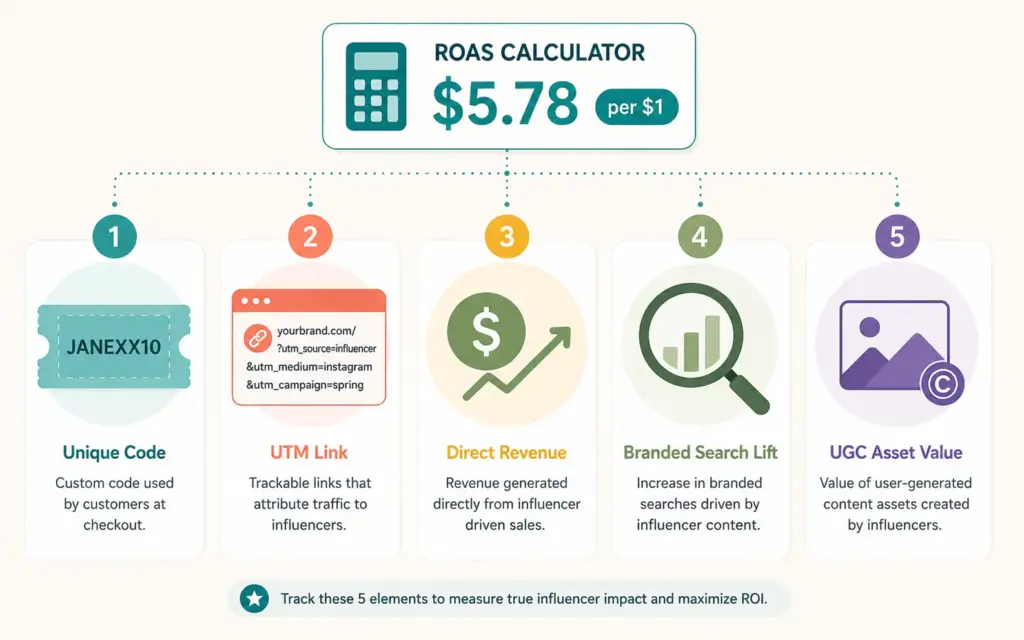
- Unique discount codes per creator: “JANEXX10” for Jane’s posts, “MIKEYY15” for Mike’s. Tracks redemptions exactly.
- UTM-tagged links: Custom UTM strings per creator, per campaign, per piece of content
- Branded search lift: Track Google search volume for your brand name during and 30 days after campaigns
- Direct traffic lift: People who saw the content but searched your brand later won’t show in UTM tracking. Direct traffic increase is the proxy.
- Email signups during campaign: Indicator of audience expansion beyond direct conversion
The honest ROI calculation
Many influencer reporting tools inflate numbers by attributing too liberally. Use this honest framework:
- Direct revenue: Sales from the creator’s discount code or UTM link
- Halo revenue: Lift in branded search/direct traffic in the 30 days after, attributed at 50% to the campaign
- UGC asset value: If you keep usage rights, value equals what comparable agency-produced UGC would cost
- Total revenue ÷ total spend = ROAS
For mature programs, $5.78 to $20 per $1 spent is the realistic range. Anything below $3 per $1 means the creator-product fit is wrong, the offer is too weak, or the audience can’t afford the product. Don’t keep funding programs that haven’t proven out by month 3. For deeper analytics framework context, see our attribution modeling guide and lifetime value calculation.
Common Influencer Marketing Mistakes
Paying for follower count instead of engagement
The 100k-follower creator with 1.5% engagement reaches roughly 1,500 engaged users. The 30k-follower creator with 8% engagement reaches 2,400. The smaller creator delivers more reach to people who actually care, often at one-third the cost.
Skipping the trial post
Before committing to a 5-post deal with any new creator, run a paid single-post trial first. Many creators look great on paper but underperform on conversion. The single-post trial costs less than the multi-post commitment by 80% and gives you real data.
No exclusivity, no impact
If your creator promotes 8 similar products in the same month, your post is one of many. Negotiate at minimum 30-day category exclusivity even with micro-creators. The cost is nominal; the conversion impact is significant.
Generic discount codes
“INFLUENCER10” works for nobody. “JANE10” makes the creator’s audience feel personally addressed and lifts redemption rates 40 to 80% versus generic codes.
Ignoring TikTok Shop
TikTok influencer marketing through TikTok Shop’s affiliate program creates closed-loop attribution: creators post, viewers buy in-app, you see the exact attribution. Unique to the platform. Most ecommerce brands underweight TikTok influencer programs given the conversion infrastructure now built into the platform. For a deeper TikTok Shop strategy, see our TikTok marketing guide.
Not capturing UGC rights
Every paid post should include 12-month usage rights for paid ads. The content typically performs 30 to 50% better in paid ads than agency-produced creative. Failing to lock usage rights leaves significant value on the table.
Tools and Platforms
The influencer tooling landscape has consolidated. Top picks by use case:
- Discovery and vetting: Modash (best for true engagement data), HypeAuditor (best for fraud detection), GRIN (best for established programs)
- Outreach and management: Aspire, Cohley, Insense (UGC-focused)
- Affiliate-only programs: ShareASale, Impact, Refersion (good for performance creator partnerships)
- TikTok specific: TikTok Creator Marketplace (free, official), Captiv8 (enterprise)
- Influencer marketing news and trend tracking: Influencer Marketing Hub, Modern Retail’s creator coverage
Most ecommerce brands under $10M annual don’t need an enterprise tool. A spreadsheet, Modash for discovery, and direct DMs work fine until you’re managing 20+ active relationships per month. For broader marketing tool context, see our AI tools for ecommerce.
Frequently Asked Questions
Influencer marketing strategy is the systematic approach to partnering with social media creators to promote products to their audiences. For ecommerce brands, it combines creator selection, rate negotiation, content briefing, FTC-compliant execution, and ROI measurement into a repeatable process. The strategy succeeds when audience-product fit drives selection, not follower count.
Industry baseline is roughly $100 per 10,000 followers for a single sponsored post, with category modifiers (B2B 2 to 3x, beauty 1.5 to 2x, lifestyle 1x). Micro-influencers cost $200 to $1,500 per post, mid-tier $1,500 to $5,000, macro $5,000 to $15,000. Bundles and exclusivity add 20 to 50% but improve negotiating room.
For most ecommerce brands under $5M annual revenue, yes. Micro-influencers (10k to 100k followers) deliver 60% better engagement rates and 5 to 10x lower cost per engagement than macro creators. They work especially well for niche categories where audience match matters more than reach. Macro creators win when broad awareness is the goal and budget is large.
Industry average is $5.78 earned per $1 spent. Top quartile programs reach $20+ per $1. Anything below $3 per $1 means creator selection is poor, the offer is weak, or audience-product fit is wrong. Track ROI through dedicated discount codes, UTM links, and lift in branded search and direct traffic during and 30 days after campaigns.
Yes. The FTC requires clear and conspicuous disclosure on every sponsored post using #ad, #sponsored, or platform-native paid partnership tags placed at the start of captions. Brands and creators both face liability for non-compliance. The FTC fined creators and brands $5.6 million collectively in 2024 for disclosure failures.
Use discovery tools like Modash, GRIN, or HypeAuditor to filter by audience demographics, engagement rate, and category. Search competitor mentions on Instagram and TikTok to find creators already working in your space. TikTok Creator Marketplace is free and official for TikTok-specific outreach. Always vet authenticity and audience fit before reaching out.
Related Reads
- TikTok Marketing for Ecommerce
- Instagram Ecommerce Strategy
- UGC Strategy Guide
- Ad Creative Tips
- Content Marketing for Ecommerce
- Attribution Modeling
Two external references for further reading: the FTC’s official disclosure guidelines for social media influencers covers the legal compliance requirements, and the U.S. Census Bureau’s retail ecommerce reports provide the underlying market data that contextualizes creator-driven sales channels.
Enjoying this? Get more like it every week.
One email per week with ecommerce strategies, tool picks, and seller insights. No spam.