
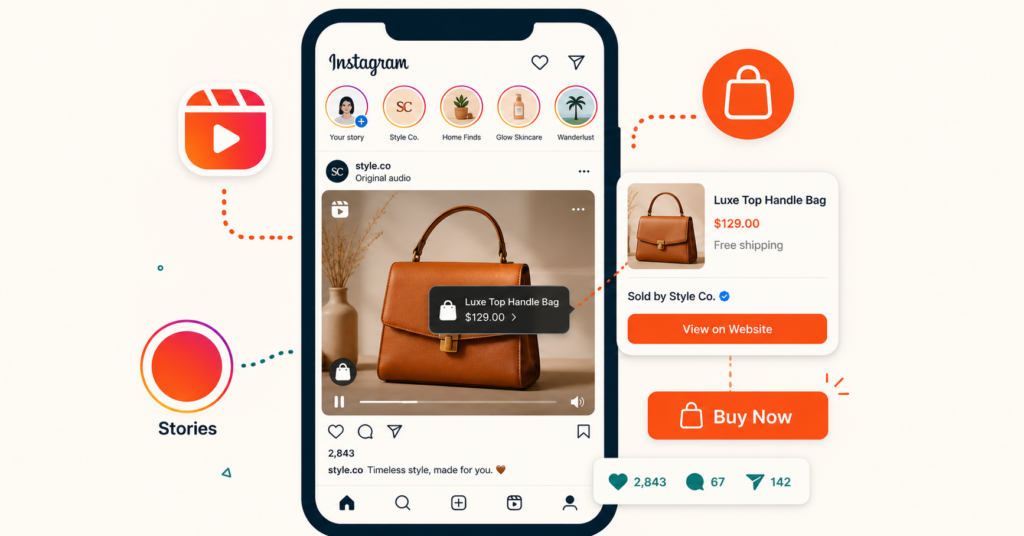
- Instagram for ecommerce combines organic content (Reels, Stories, feed posts), Instagram Shopping (in-app product tags and checkout), and paid advertising to drive product discovery and sales. With 2+ billion monthly active users and the highest purchase intent of any social platform after TikTok, Instagram remains essential for consumer product brands.
- Reels generate 2 to 3x the reach of static feed posts and are Instagram's primary organic distribution format in 2026. Product demo Reels, behind-the-scenes content, and UGC reposts perform best for ecommerce brands. Post 4 to 7 Reels per week for consistent algorithmic reach.
- Instagram Shopping tags let users tap a product in any post, view the price and details, and purchase without leaving the app. Brands with Shopping enabled see 130% higher engagement on product-tagged posts compared to non-tagged equivalents.
- The most common Instagram ecommerce mistake is optimizing for followers and likes instead of website clicks, product page visits, and purchases. A 5,000-follower account with 2% click-through to product pages outperforms a 50,000-follower account with 0.1% click-through on revenue contribution.
Instagram ecommerce is the strategy of using Instagram’s content formats (Reels, Stories, feed posts, Lives), shopping features (product tags, in-app checkout), and advertising tools to drive product discovery, engagement, and sales for online stores. With 2+ billion monthly active users, Instagram offers the unique combination of visual product discovery and in-app purchasing that makes it a natural fit for consumer brands. According to Instagram’s business platform data, 44% of Instagram users shop on the platform weekly, and product-tagged posts generate 130% higher engagement than non-tagged content.
The platform has shifted heavily toward short-form video (Reels) as the primary organic distribution format. Brands still posting primarily static photos are seeing declining reach while Reels-focused accounts grow. The winning approach in 2026 combines Reels for organic reach, Stories for community engagement, Shopping tags for frictionless purchase, and targeted ads for scalable acquisition. For broader social strategy, see our TikTok marketing guide.
How Does Instagram Shopping Work?
Instagram Shopping lets brands tag products directly in Reels, feed posts, Stories, and Live broadcasts. Users tap the tag, see the product name and price, and either visit your website or complete the purchase through Instagram Checkout (where available).
Setup requirements
- Business or Creator account: Switch from personal to Business in Settings
- Product catalog: Connect through Facebook Commerce Manager or Shopify’s Instagram sales channel (automatic sync)
- Domain verification: Verify your website domain in Commerce Manager
- Approval: Submit for Instagram Shopping review (typically 1 to 5 business days)
Once approved, product tags appear as tappable dots on images and video frames. Tag up to 5 products per single-image post or 20 per carousel. For your platform setup, see our Shopify setup guide.
What Content Formats Drive Sales on Instagram?
Reels (primary reach driver)
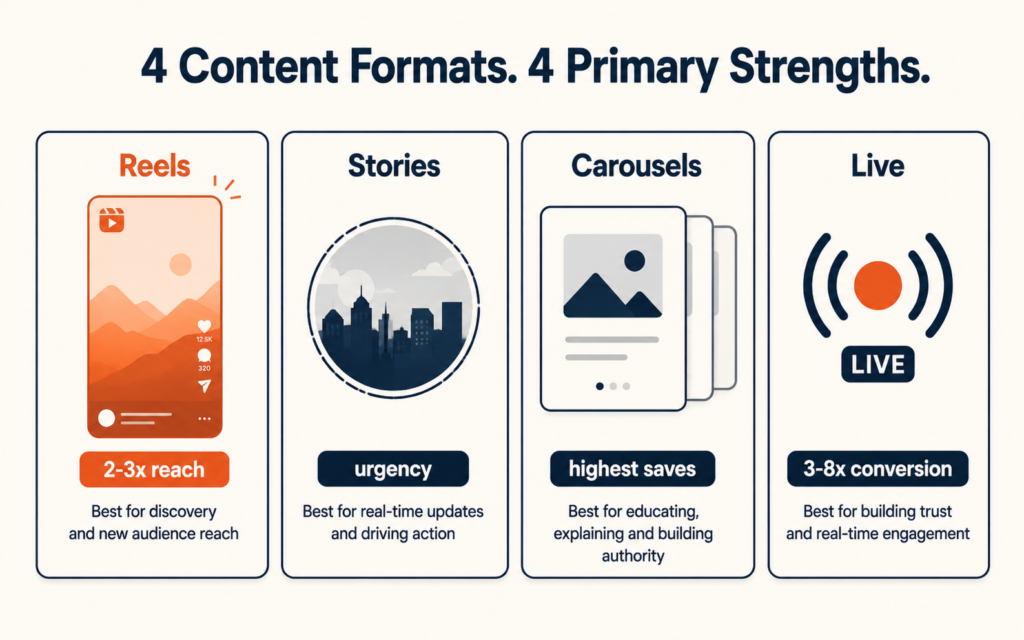
Reels generate 2 to 3x the organic reach of static posts. For ecommerce, the highest-performing Reel formats are product demonstrations (close-up, satisfying, showing the product working), before-and-after transformations, packing order videos (builds community and social proof), and trend-adapted content featuring your product. Keep Reels 15 to 30 seconds for maximum completion rate. Post 4 to 7 per week.
Stories (engagement and urgency)
Stories reach your existing followers (not algorithmic discovery like Reels). Use for flash sales with countdown stickers, polls and questions that drive engagement, behind-the-scenes content that humanizes the brand, product link stickers (available to all business accounts) for direct traffic. Stories have 24-hour lifespans, creating natural urgency for limited offers.
Carousel posts (education and comparison)
Multi-image carousels telling a story (problem to solution to product) generate the highest save rates of any format. Saved posts signal quality to the algorithm. Use carousels for product comparison guides, step-by-step tutorials, and “5 reasons to choose [product]” educational content. 4 to 6 slides per carousel. For product page content that mirrors carousel education, see our product descriptions guide.
Live Shopping
Instagram Live with pinned products enables real-time selling. Live viewers convert at 3 to 8x the rate of passive content viewers because the real-time interaction builds urgency and trust. Schedule Lives weekly at consistent times. Promote 24 hours ahead via Stories. For broader live selling context, see our TikTok marketing guide (TikTok Live Shopping follows similar principles).
How Do I Build an Instagram Content Strategy for Ecommerce?
The content mix
| Content Type | % of Posts | Goal | Format |
|---|---|---|---|
| Product showcase | 30% | Direct sales | Reels (demo), carousel (features), tagged posts |
| UGC and social proof | 25% | Trust building | Reels (customer videos), Stories (review reposts) |
| Educational / how-to | 20% | Value + authority | Carousels (guides), Reels (tips) |
| Behind-the-scenes | 15% | Community + brand | Stories, Reels (packing orders, team, process) |
| Promotional / offers | 10% | Conversion | Stories (flash sales), feed posts (launches) |
Posting cadence
- Reels: 4 to 7 per week (primary algorithm reach driver)
- Stories: 3 to 7 per day (existing follower engagement)
- Feed posts / carousels: 2 to 3 per week (evergreen content, saves)
- Lives: 1 per week (optional but high-converting)
Consistency matters more than perfection. Phone-shot content posted daily outperforms studio content posted twice a month because the algorithm rewards regular posting with sustained reach. For content production approach, see our ad creative tips guide.
How Do I Use Instagram Ads for Ecommerce?
Instagram ads run through Meta Ads Manager (same platform as Facebook ads). The campaign structure mirrors Meta’s:
- Prospecting (60 to 70% of budget): Advantage+ Shopping Campaigns or manual campaigns targeting broad or lookalike audiences. Use Reel-format video ads for highest engagement.
- Retargeting (15 to 25%): Dynamic product ads targeting Instagram profile visitors, website visitors, and cart abandoners. For retargeting depth, see our retargeting strategies guide.
- Engagement boost (10 to 15%): Promote top-performing organic Reels to wider audiences. This is Instagram’s equivalent of TikTok Spark Ads: amplifying content that already proved it resonates.
Instagram ad placements include feed, Stories, Reels, and Explore. Reels placement typically delivers the lowest CPA because it matches the native content experience. For the full Meta ads framework, see our Facebook ads ecommerce guide.
How Do I Drive Traffic from Instagram to My Store?
Product tags (highest-converting)
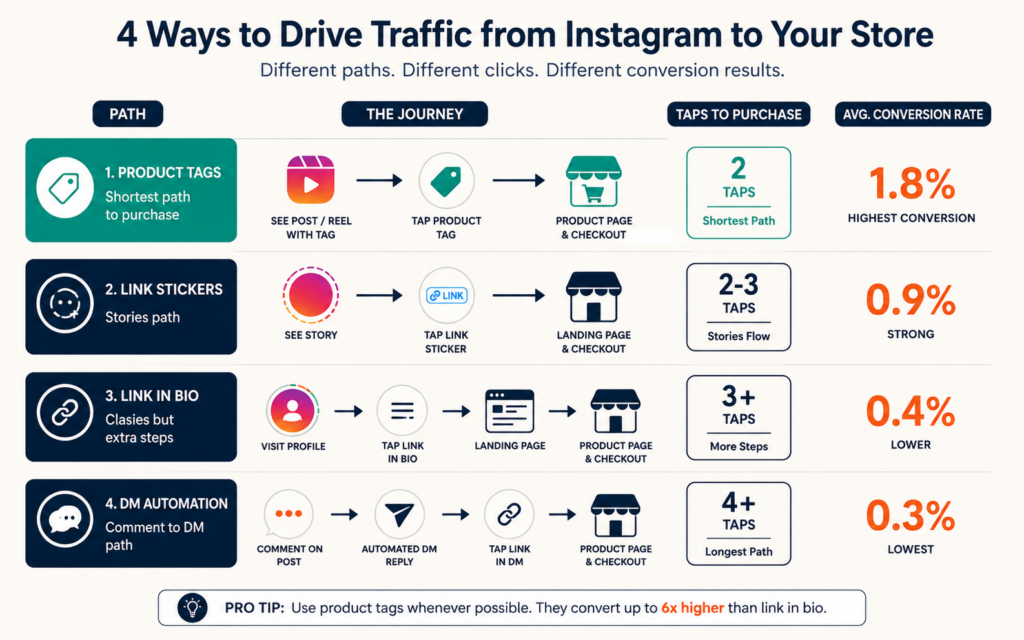
Tag products in every eligible post. Tagged posts convert 37% higher than posts with link-in-bio only because the purchase path is shorter (tap tag, view product, buy) versus navigating to bio, clicking link, browsing store.
Link stickers in Stories
Add product links to Stories using the link sticker. Available to all business accounts. Use on flash sales, new arrivals, and limited-stock notifications. Pair with countdown stickers for urgency.
Link in bio (organized hub)
Use Linktree, Shopify Linkpop, or a custom landing page as your bio link to organize multiple destinations: current sale, best sellers, new arrivals, blog content. A single URL linking to your homepage wastes the click because visitors land without direction.
DM automation
Tools like ManyChat automate DM responses to comments containing keywords. “Comment SALE to get the link” triggers an automatic DM with the product URL. DM automation converts 5 to 15% of commenters and works particularly well on Reels with viral reach. According to Hootsuite’s Social Media Trends report, Instagram remains the top platform for product discovery among consumers aged 25 to 44, with 62% of users researching products through the platform before purchasing. The combination of visual discovery, Shopping tags, and DM automation creates a purchase path that keeps the entire buying journey within the Instagram ecosystem. For checkout conversion once traffic arrives, see our checkout optimization guide.
How Do I Measure Instagram Ecommerce Performance?
Revenue metrics (what matters)
- Product page visits from Instagram: GA4 traffic filtered by source=instagram. Target 3 to 5% of impressions converting to site visits.
- Instagram-attributed revenue: Revenue from sessions originating from Instagram (GA4 or Shopify reports). For attribution methodology, see our attribution modeling guide.
- Instagram Shopping revenue: Sales through product tags and Instagram Checkout. Track in Commerce Manager.
- ROAS on Instagram ads: Revenue / ad spend for Instagram-specific placements. Benchmark: 3:1 to 6:1 blended. For ROAS context, see our ROAS benchmarks guide.
Engagement metrics (leading indicators)
- Saves rate: Saves / reach. The strongest algorithmic signal. Target 2 to 5%.
- Reel completion rate: Percentage watching to the end. Above 50% signals strong content.
- Story link clicks: Clicks / story views. Target 3 to 8%.
- Profile visits from content: New visitors discovering your profile from Reels or Explore. Leading indicator of follower and traffic growth.
For the complete ecommerce KPI framework, see our ecommerce KPIs guide.
Common Instagram Ecommerce Mistakes
Optimizing for vanity metrics
Followers, likes, and comments feel good but don’t pay bills. A 5,000-follower account generating 100 product page visits per week outperforms a 50,000-follower account generating 20. Focus on click-through to product pages, Shopping tag engagement, and attributed revenue. Every content decision should answer: “Does this drive product discovery or purchase intent?”
Posting only polished product photos
Instagram’s algorithm in 2026 prioritizes Reels and engagement-driven content. Static product photos on white backgrounds get minimal organic distribution. Mix product photos with Reels (60% of posts), UGC, behind-the-scenes, and educational content. Save polished photography for product pages and ads. For UGC strategy, see our UGC strategy guide.
Ignoring Instagram Shopping setup
Brands that haven’t enabled Shopping leave money on the table with every post. Product tags reduce the path-to-purchase from 5 clicks to 2 taps. The setup takes 1 to 2 hours and the conversion impact is immediate.
Inconsistent posting
The algorithm rewards consistency. Posting 10 Reels in one week then nothing for 3 weeks produces worse results than 3 Reels every week for a month. Build a sustainable cadence you can maintain for 6+ months. For broader content strategy, see our content marketing guide.
Frequently Asked Questions
Yes. With 2+ billion monthly active users and 44% shopping weekly on the platform, Instagram remains essential for consumer product brands. The platform has shifted to Reels-first distribution, but brands adapting to short-form video see strong organic reach and sales. Instagram Shopping enables in-app purchasing, and the advertising platform (through Meta Ads Manager) provides precise targeting for scaled acquisition.
Target 4 to 7 Reels per week (primary organic reach driver), 3 to 7 Stories per day (follower engagement), and 2 to 3 feed posts or carousels per week (evergreen saves). Consistency matters more than volume. A sustainable cadence maintained for 6+ months outperforms sporadic bursts. Phone-shot content posted daily beats studio content posted twice monthly for algorithmic reach.
Switch to a Business account, connect your product catalog through Facebook Commerce Manager or Shopify’s Instagram channel (auto-sync), verify your website domain, and submit for Shopping review (1 to 5 business days). Once approved, you can tag up to 5 products per post or 20 per carousel. Product tags appear as tappable dots that show price and product details with a direct purchase path.
Product demonstration Reels (15 to 30 seconds showing the product working), UGC customer videos reposted with Shopping tags, and carousel posts with educational product comparisons drive the most direct sales. Product-tagged content converts 37% higher than non-tagged. Reels reach 2 to 3x more users than static posts. Combine product showcase (30% of content) with UGC (25%), educational (20%), and behind-the-scenes (15%) for optimal mix.
Both serve different purposes and audiences. TikTok offers higher organic viral potential and stronger product discovery among younger audiences (18 to 34). Instagram provides better shopping infrastructure (Shopping tags, in-app checkout), stronger visual brand building, and broader age demographics (18 to 54). Most ecommerce brands should be active on both. Create content in 9:16 vertical format and cross-post between platforms with minor adaptation.
Track four revenue metrics: product page visits from Instagram (GA4, target 3 to 5% of impressions), Instagram-attributed revenue (GA4 or Shopify channel reports), Instagram Shopping revenue (Commerce Manager), and Instagram ad ROAS (Meta Ads Manager, benchmark 3:1 to 6:1). Engagement metrics (saves, completion rate, story clicks) are leading indicators but revenue metrics determine actual ROI.
Related Reads
- TikTok Marketing Guide
- UGC Strategy Guide
- Ad Creative Tips
- Facebook Ads for Ecommerce
- Retargeting Strategies
- ROAS Benchmarks
Enjoying this? Get more like it every week.
One email per week with ecommerce strategies, tool picks, and seller insights. No spam.