
- Facebook and Instagram ads (now under Meta's platform) remain the highest-volume paid acquisition channel for ecommerce in 2026, with 3+ billion daily active users across Meta's family of apps. The platform has shifted from manual audience targeting to AI-driven optimization via Advantage+ Shopping Campaigns (ASC).
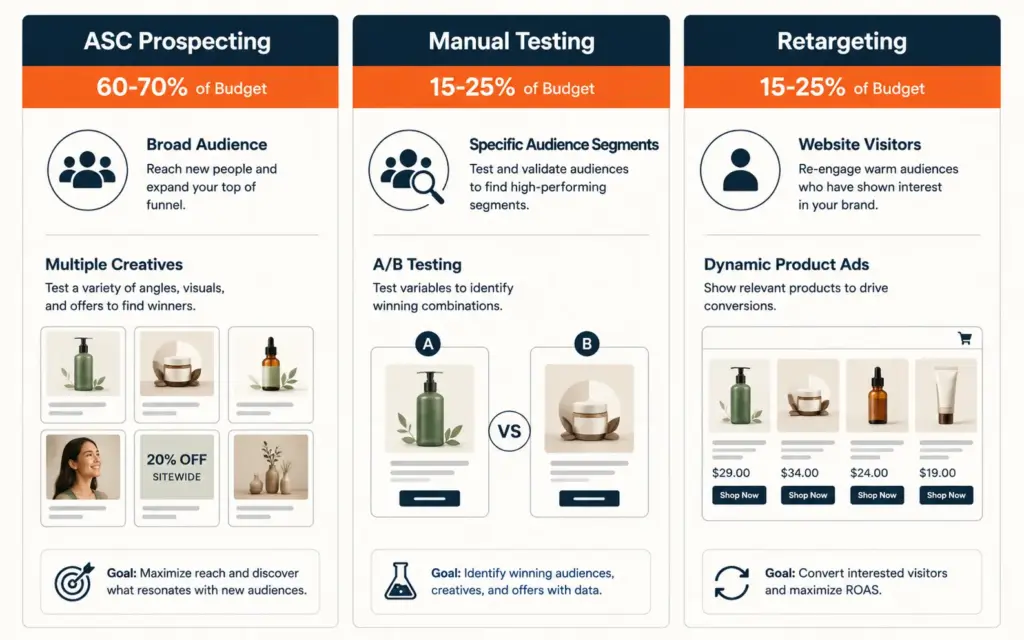
- The modern Meta ads structure uses 3 campaign types: Advantage+ Shopping for broad prospecting (60 to 70% of budget), manual campaigns for specific audience tests (15 to 25%), and retargeting campaigns with dynamic product ads (15 to 25%). This structure gives the algorithm room to optimize while maintaining strategic control.
- Creative is the primary performance lever. Audience targeting is largely automated. Budget and bidding are secondary. Stores producing 10 to 20 new creative variations monthly outperform those running the same 3 ads by 3 to 5x on ROAS at similar spend levels.
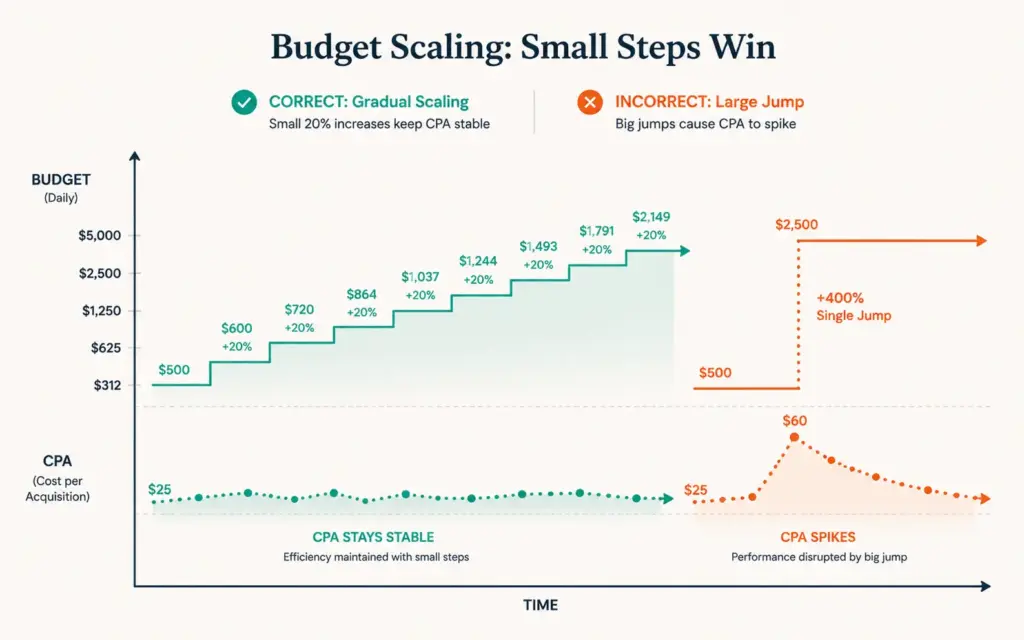
- The most common Facebook ads mistake is scaling budget too fast. Increasing daily budget more than 20% every 48 hours destabilizes campaign learning, causing CPA spikes. Scale by duplicating winning ad sets at higher budgets rather than increasing existing ones.
Facebook ads ecommerce brands rely on (now officially Meta ads, covering Facebook, Instagram, Messenger, and the Audience Network) remain the primary paid acquisition channel for online stores in 2026. With 3+ billion daily active users across Meta’s platforms, no other advertising ecosystem offers the same combination of reach, targeting precision, and conversion optimization for ecommerce products. According to Meta’s business platform data, ecommerce advertisers represent the largest advertiser category on the platform, with the average online store generating $4 to $8 in revenue for every $1 spent on Meta ads.
The platform has fundamentally changed since 2021. iOS 14.5 privacy changes, the deprecation of detailed interest targeting, and the rise of Advantage+ automation mean that the tactics from 2020 no longer work. The brands succeeding on Meta in 2026 have adopted a creative-first approach where ad quality drives performance more than audience selection, and campaign structure gives Meta’s algorithm maximum flexibility to find buyers. For broader ad strategy context, see our ad creative tips guide. Understanding your unit economics before scaling ad spend is critical; use our profit margin calculator to validate margins support your target ROAS.
This guide covers the campaign structure that scales profitably, the Advantage+ setup that outperforms manual campaigns, creative strategy for Meta specifically, budget allocation and scaling rules, and the measurement framework that accounts for attribution gaps.
How Should I Structure Meta Ad Campaigns for Ecommerce?
The modern Meta campaign structure uses 3 campaign types with specific roles:
Campaign 1: Advantage+ Shopping Campaign (ASC) for prospecting
Advantage+ Shopping Campaigns are Meta’s AI-driven campaign type that automatically optimizes audience targeting, placements, and creative delivery. ASC consistently outperforms manual prospecting campaigns by 15 to 30% on CPA because the algorithm tests more audience combinations than manual setup allows.
Setup: Sales objective > Advantage+ Shopping Campaign > upload 5 to 15 creative variations (mix of video and static) > set daily budget > set existing customer cap at 10 to 20% (prevents the algorithm from retargeting instead of prospecting). Allocate 60 to 70% of total Meta budget here.
Campaign 2: Manual campaigns for strategic tests
Manual campaigns target specific audiences, test specific creative concepts, or target specific products. Use for lookalike audience testing, interest-based targeting experiments, or creative concept isolation. Allocate 15 to 25% of budget.
Structure: Sales objective > manual targeting > 2 to 3 ad sets with different audiences > 2 to 3 creatives per ad set. Run for 5 to 7 days with $20 to $50/day per ad set. Promote winners to ASC creative pool.
Campaign 3: Retargeting with dynamic product ads
Dynamic product ads automatically show visitors the products they viewed on your site. Retargeting on Meta delivers 8:1 to 15:1 ROAS compared to 3:1 to 6:1 for prospecting. Allocate 15 to 25% of budget. For the full retargeting playbook, see our retargeting strategies guide.
Setup: Sales objective > Advantage+ catalog ads or manual retargeting > custom audiences (website visitors 1 to 7 days, cart abandoners 1 to 14 days, product viewers 1 to 14 days) > exclude purchasers from the past 14 days.
What Makes Good Facebook Ad Creative for Ecommerce?
Creative drives 50 to 70% of Facebook ad performance. In 2026, with audience targeting increasingly automated, creative is the primary competitive differentiator.
The 5 creative formats that convert on Meta
- UGC-style video (15 to 30 seconds): User-generated content or creator content that looks native to the feed. Outperforms polished studio content by 20 to 50% on CPA. Hook in the first 2 seconds, product demo or testimonial in the body, CTA with price at the end.
- Product demo video (15 to 60 seconds): Close-up footage showing the product in use. Works best for products where visual demonstration matters (skincare, kitchen tools, tech accessories).
- Static with social proof: Product image with overlaid review quotes, star ratings, and “10,000+ customers” badges. Best for retargeting and bottom-funnel audiences.
- Carousel storytelling: 4 to 6 slides telling a problem-solution narrative. Each slide advances the story. Final slide has the CTA with pricing. Carousels outperform single images by 20 to 30% on cost per landing page view.
- Founder talking head: 15 to 30 second phone-shot video of the founder explaining the product. Builds trust and authenticity. Outperforms generic content by 10 to 30% for DTC brands.
Creative production cadence
Produce 10 to 20 new creative variations per month. Creative fatigue hits Meta ads at 7 to 14 days at consistent spend. Winning brands treat creative like a pipeline, not a one-time shoot. Budget $300 to $800/month for UGC creators ($50 to $150/video), Canva statics ($13/month), and phone-shot founder content ($0). For creative production depth, see our ad creative tips guide.
How Do I Set Budgets and Scale Facebook Ads?
Starting budget framework
| Monthly Revenue | Suggested Meta Ad Budget | Daily Budget | Realistic ROAS Target |
|---|---|---|---|
| Under $10k/month | $1,000 to $3,000/month | $33 to $100/day | 3:1 to 5:1 |
| $10k to $50k/month | $3,000 to $10,000/month | $100 to $333/day | 3:1 to 4:1 |
| $50k to $200k/month | $10,000 to $40,000/month | $333 to $1,333/day | 2.5:1 to 3.5:1 |
| $200k+/month | $40,000+/month | $1,333+/day | 2:1 to 3:1 |
ROAS targets decrease as spend increases because higher budgets push the algorithm into less efficient audiences (diminishing returns). A store with 5:1 ROAS at $50/day should not expect 5:1 at $500/day. Expect 3:1 to 3.5:1 as you scale, and ensure your margins support that level.
The scaling rules
- Never increase daily budget more than 20% every 48 hours. Larger jumps destabilize the algorithm’s learning phase and cause CPA spikes that can take 3 to 5 days to recover.
- Scale by duplicating, not increasing. When a campaign hits consistent ROAS, duplicate the winning ad set at a higher budget rather than increasing the existing one. The duplicate starts a fresh learning phase optimized for the new budget level.
- Scale creative before budget. Adding more winning creatives to an ASC campaign scales reach more sustainably than increasing budget on existing creatives.
- Monitor CPA on a 3-day rolling average, not daily. Daily CPA fluctuates 30 to 50%. A single bad day doesn’t mean the campaign is broken. Three consecutive bad days does.
How Do I Handle Facebook Attribution and Measurement?
The attribution gap
Meta’s default attribution window is 7-day click and 1-day view. This means Meta claims credit for any purchase within 7 days of an ad click or 1 day of an ad impression (even without a click). Meta’s reported conversions typically exceed GA4-reported conversions from Meta by 20 to 40% due to view-through attribution and cross-device tracking differences.
The measurement framework
- Use Meta Ads Manager for within-Meta optimization: Which creative, audience, and placement performs best within Meta’s ecosystem. Trust Meta’s data for these decisions.
- Use GA4 for cross-channel budget allocation: How Meta compares to Google, TikTok, and organic channels. GA4 under-reports Meta conversions but provides consistent cross-channel comparison. For GA4 setup, see our GA4 ecommerce setup guide.
- Use actual Shopify revenue as ground truth: Total revenue from all platforms compared to the sum of all platform-claimed revenue reveals the double-counting gap (typically 30 to 60%).
- Consider Triple Whale or Northbeam ($100+/month): Third-party attribution tools that provide a single view across Meta, Google, TikTok, and email. Worth the investment above $5k/month ad spend. For attribution depth, see our attribution modeling guide.
Server-side tracking setup
Meta Conversions API (CAPI) sends conversion data from your server directly to Meta, bypassing iOS tracking restrictions and ad blockers. Without CAPI, Meta is missing 30 to 50% of conversion signals, degrading optimization quality. Install CAPI through Shopify’s native integration (one-click in Shopify > Settings > Apps > Meta) or through Google Tag Manager server-side container. For tracking architecture, see our tracking setup guide.
What Are the Most Common Facebook Ads Mistakes for Ecommerce?
Over-targeting instead of letting the algorithm work
In 2020, narrow interest targeting worked. In 2026, restricting audience size below 2 million limits the algorithm’s ability to find buyers. Advantage+ campaigns with broad targeting outperform narrow interest targeting by 15 to 30% on CPA. Let the creative do the targeting: a product-specific video naturally attracts the right audience without manual targeting restrictions.
Running too few creative variations
Stores running 3 ads for 3+ months wonder why CPA doubles. Every creative has a 7 to 14 day lifespan at consistent spend. Produce 10 to 20 new variations monthly. The ratio of tested creatives to winners is typically 5:1. You need volume to find winners.
Scaling budget too fast
Increasing daily budget from $50 to $200 overnight (300% increase) destabilizes learning and spikes CPA by 50 to 100% for 3 to 5 days. The 20% every 48 hours rule prevents algorithmic disruption. Patient scaling preserves efficiency.
Not excluding existing customers from prospecting
If your ASC campaign doesn’t cap existing customer percentage, the algorithm may spend 40 to 60% of “prospecting” budget retargeting existing customers because they convert easily. Set the existing customer cap at 10 to 20% in ASC settings to force the algorithm toward new customer acquisition. For customer measurement depth, see our customer acquisition cost guide. Understanding your startup cost structure helps set realistic ad budgets; see our ecommerce startup costs guide.
Ignoring Meta CAPI setup
Without Conversions API, Meta optimizes on 50 to 70% of actual conversion data. The algorithm makes worse decisions with incomplete data. CAPI setup takes 30 to 60 minutes through Shopify’s native integration and immediately improves event match quality by 20 to 40%. This is the highest-ROI 1-hour investment in Meta advertising according to Meta’s Conversions API documentation.
Optimizing for the wrong event
New stores often optimize for “link clicks” or “landing page views” instead of “purchase.” Click optimization attracts clickers, not buyers. Always optimize for the purchase event from day one. If Meta says you need 50 conversions per week per ad set for stable optimization and you can’t hit that with purchases, optimize for “add to cart” as the next-best proxy, never for clicks. For KPI framework, see our ecommerce KPIs guide.
Frequently Asked Questions
Start with $30 to $100 per day ($1,000 to $3,000/month) for stores under $10k monthly revenue. Allocate 60 to 70% to Advantage+ Shopping campaigns for prospecting, 15 to 25% to retargeting, and 15 to 25% to manual testing. Scale budget by no more than 20% every 48 hours to maintain campaign stability. ROAS targets range from 3:1 to 5:1 at lower budgets, decreasing to 2:1 to 3:1 at higher spend levels.
Advantage+ Shopping Campaign (ASC) is Meta’s AI-driven campaign type that automatically optimizes audience targeting, placements, and creative delivery. It consistently outperforms manual prospecting by 15 to 30% on CPA because the algorithm tests more combinations than manual setup allows. Yes, most ecommerce stores should use ASC as their primary prospecting campaign, allocating 60 to 70% of Meta budget there. Set the existing customer cap at 10 to 20% to keep it focused on acquisition.
Target ROAS depends on your gross margin. At 50% gross margin, 3:1 ROAS means you’re spending $1 to generate $3 in revenue ($1.50 gross profit minus $1 ad cost = $0.50 net). At lower margins, you need higher ROAS. Typical benchmarks: 3:1 to 5:1 at $30 to $100/day, 2.5:1 to 3.5:1 at $100 to $500/day, 2:1 to 3:1 at $500+/day. ROAS naturally decreases as you scale because larger budgets reach less efficient audiences.
Declining performance typically stems from creative fatigue (refresh with 5 to 10 new variations), audience saturation (expand to broader or new lookalike audiences), or tracking degradation (verify Meta Pixel and CAPI are firing correctly). Check the frequency metric first: if average frequency exceeds 3 per week, creative fatigue is likely. Check event match quality in Events Manager: below 6.0 means tracking data is incomplete and optimization is degraded.
Yes. Without CAPI, Meta is missing 30 to 50% of conversion signals due to iOS privacy restrictions and ad blockers. The algorithm optimizes on incomplete data, producing worse results. CAPI sends conversion data server-side, bypassing browser restrictions. Setup takes 30 to 60 minutes through Shopify’s native integration. Event match quality improves 20 to 40% immediately, which directly improves campaign optimization and reduces CPA.
Both, but they serve different purposes. Facebook (Meta) excels at demand generation: reaching people who don’t know they want your product yet through visual creative. Google excels at demand capture: reaching people already searching for your product category. Most ecommerce stores allocate 50 to 60% of ad budget to Meta for prospecting and 30 to 40% to Google for capturing search intent. Start with the channel that matches your product’s discovery pattern.
Related Reads
- Ad Creative Tips
- Retargeting Strategies
- Google Shopping Ads Guide
- Attribution Modeling
- Tracking Setup Guide
- Customer Acquisition Cost
Enjoying this? Get more like it every week.
One email per week with ecommerce strategies, tool picks, and seller insights. No spam.