
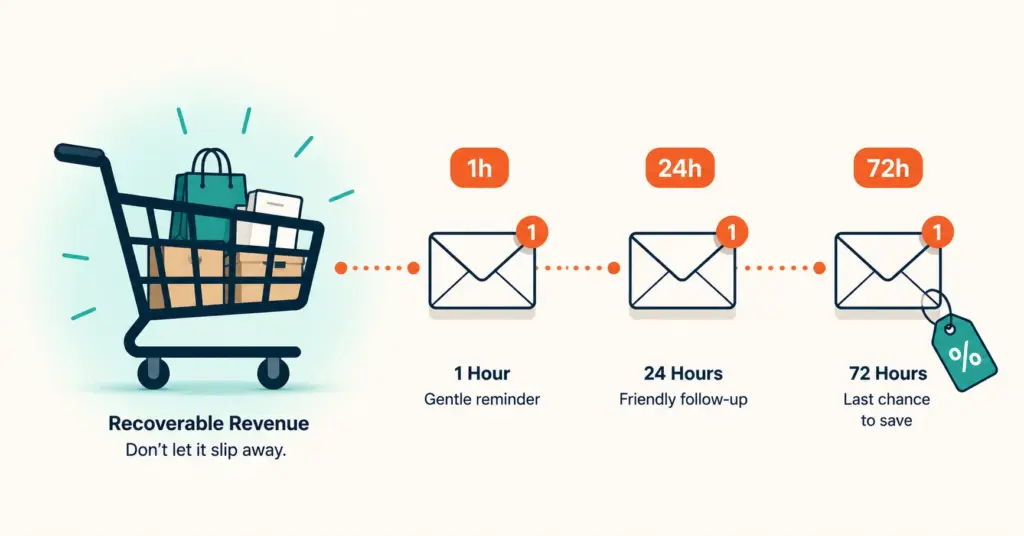
- 70% of ecommerce shopping carts are abandoned before checkout completes. A structured abandoned cart email sequence recovers 10 to 15% of those lost carts, translating directly into revenue that requires no additional ad spend or traffic. For a store losing $50,000/month to abandonment, that recovery is $5,000 to $7,500/month from a single automated flow.
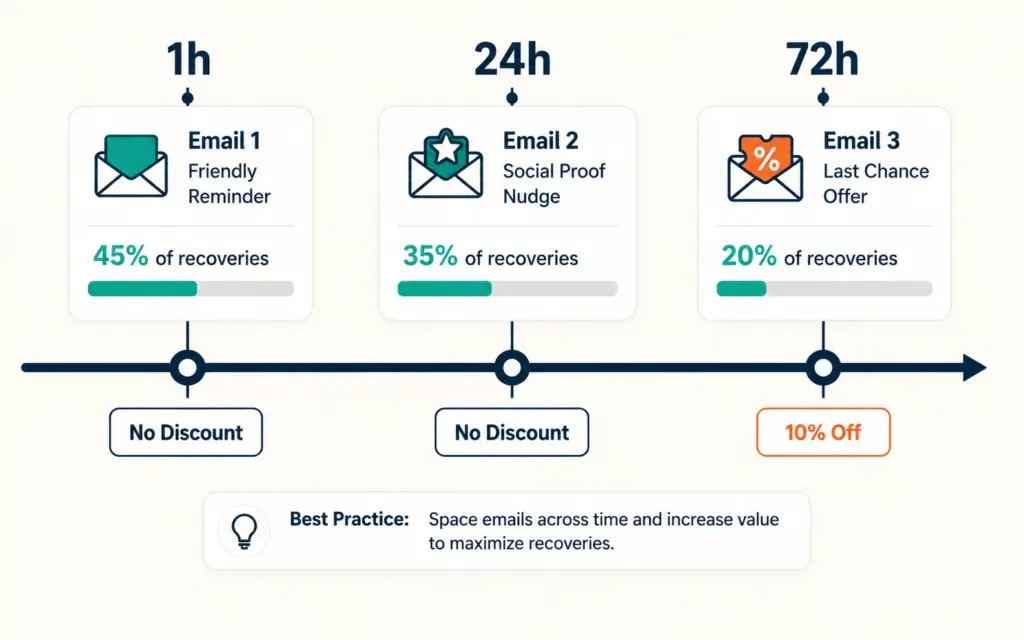
- The optimal sequence is 3 emails: Email 1 at 1 hour (reminder, no discount, 45% of total recoveries), Email 2 at 24 hours (social proof + urgency, 35% of recoveries), Email 3 at 72 hours (incentive offer, 20% of recoveries). Sending more than 3 emails produces diminishing returns and risks spam complaints.
- Subject lines make or break open rates. The highest-performing patterns: direct product reference ("You left [product name] behind"), urgency without aggression ("Your cart is waiting"), and question format ("Still thinking about it?"). Avoid clickbait, all-caps, and excessive exclamation marks that trigger spam filters.
- The discount question: don't lead with a discount in Email 1 or 2. Offering a discount immediately trains customers to abandon intentionally for the discount. Reserve the incentive for Email 3 (72 hours) when the shopper has demonstrated they need a nudge, not just a reminder.
Abandoned cart emails are automated messages sent to shoppers who add products to their cart but leave before completing checkout. The scale of the problem is enormous: 70% of online shopping carts are abandoned, meaning for every 10 customers who start checkout, only 3 finish. The reasons range from unexpected shipping costs (48%) to account creation requirements (24%) to payment method unavailability (13%). According to Baymard Institute’s checkout research, the average documented cart abandonment rate across 49 studies is 70.19%, making abandonment the single largest source of preventable revenue loss in ecommerce.
A well-structured abandoned cart email sequence recovers 10 to 15% of those abandoned carts automatically. No additional traffic required. No ad spend. The infrastructure runs once and generates revenue indefinitely. For a store with $100,000/month in revenue and a 70% abandonment rate, that means $233,000/month in abandoned carts, of which $23,000 to $35,000 is recoverable. The cart abandonment solutions strategy covers the broader prevention approach; this guide focuses specifically on the email recovery sequence that captures revenue after abandonment happens.
The 3-Email Recovery Sequence
Email 1: The reminder (1 hour after abandonment)
Timing: 1 hour after cart abandonment. This catches shoppers who got distracted, had a browser crash, or simply forgot. At 1 hour, the purchase intent is still fresh and the product memory is vivid.
Content: Simple, helpful, no pressure. Show the abandoned product with its image, name, price, and a direct “Complete Your Order” button that deep-links back to their populated cart. No discount. No urgency tactics. Just: “You left something behind. Here it is. Click to finish.” This email generates 45% of total sequence recoveries because most abandoned carts are distraction-driven, not decision-driven.
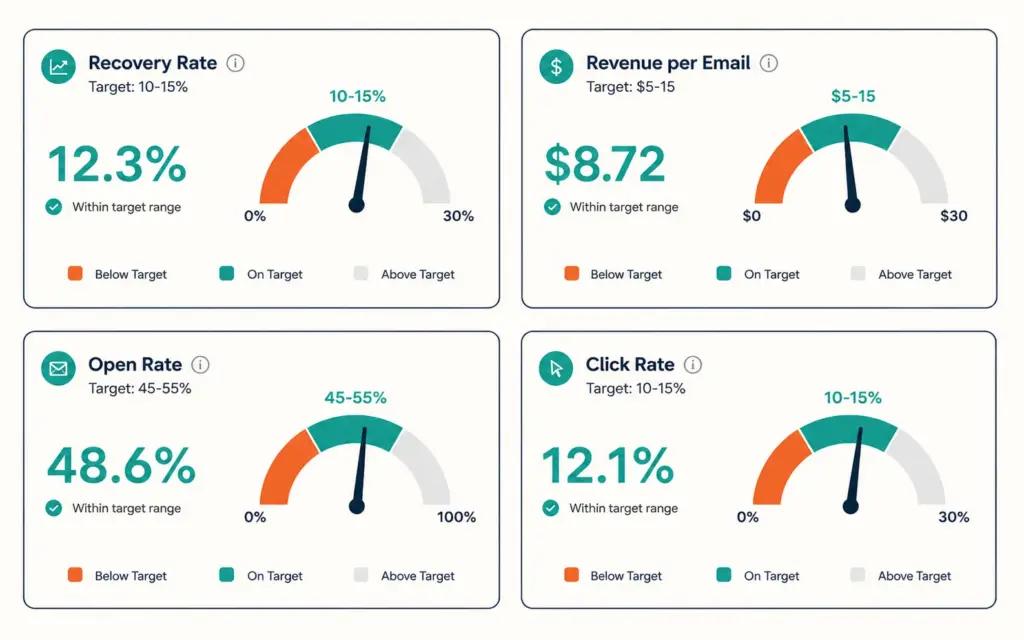
Subject line patterns that work: “You left something in your cart,” “Still want [product name]?,” “Your cart is saved.” Open rate target: 45 to 55%. Click rate target: 10 to 15%. The email marketing strategy fundamentals on deliverability and sender reputation apply to cart emails too: if your transactional emails land in spam, recovery emails will too.
Email 2: Social proof + mild urgency (24 hours)
Timing: 24 hours after abandonment. The shopper has had time to consider alternatives. This email needs to rebuild purchase confidence.
Content: Show the abandoned product again, but add social proof elements: star rating, review count, a 1-line customer quote. Add mild urgency: “Items in your cart aren’t reserved” or “This product is popular and stock is limited” (only if true). Still no discount. This email converts the shoppers who were comparison-shopping or hesitating on product quality.
The reviews and social proof assets you’ve built on product pages serve double duty in cart recovery emails. Products with 50+ reviews convert significantly better in abandonment sequences. According to Klaviyo’s cart recovery benchmarks, stores using product reviews in cart emails see 15 to 20% higher click-to-purchase rates than those using generic recovery copy because the email can reference specific social proof (“Rated 4.8 by 230+ customers”) that overcomes purchase hesitation.
Email 3: The incentive (72 hours)
Timing: 72 hours after abandonment. The shopper hasn’t purchased yet despite two reminders. They’re either not interested or need a financial nudge.
Content: Final reminder with an incentive. “Here’s 10% off to complete your order” or “Free shipping on your cart, today only.” Include an expiration (24 to 48 hours) to create genuine urgency. This email generates the final 20% of sequence recoveries from price-sensitive shoppers who needed the extra push.
The discount amount should balance recovery value against margin impact. 10% off is the most common cart recovery incentive. At 50% gross margin, a 10% discount reduces margin to 40% on recovered orders, but those orders would have generated zero revenue without the incentive. The discount strategy principles apply: the incentive should feel meaningful without training customers to expect discounts on every purchase.
Why Discount Timing Matters
Leading with a discount in Email 1 is the most common abandoned cart email mistake. It creates a perverse incentive: customers learn that abandoning their cart triggers a discount, so they abandon intentionally. Stores that offer discounts in the first cart email see abandonment rates increase 5 to 10% over 6 months as customers adapt their behavior.
The 3-email sequence solves this by making the discount the last resort, not the opening move. Most recoverable carts (45% of total) don’t need a discount at all; they need a reminder. The next tier (35%) needs social proof and urgency. Only the final tier (20%) needs a financial incentive. Offering the discount at 72 hours ensures only genuinely hesitant shoppers receive it, while distraction-driven and confidence-driven abandoners recover without eroding your margins.
For high-AOV products where a percentage discount is costly, consider alternative incentives: free shipping, a free gift with purchase, or bonus loyalty points. The loyalty programs point structure can integrate with cart recovery: “Complete your order and earn 2x points on this purchase” costs less than a percentage discount while leveraging existing program infrastructure.
Subject Line Optimization
Cart recovery email open rates live or die on the subject line. Patterns ranked by average open rate:
| Pattern | Example | Avg Open Rate |
|---|---|---|
| Product name reference | “Your [Product Name] is waiting” | 50 to 55% |
| Question format | “Forget something?” | 48 to 52% |
| Direct reminder | “You left items in your cart” | 45 to 50% |
| Urgency (genuine) | “Your cart expires soon” | 42 to 48% |
| Discount teaser (Email 3 only) | “10% off your cart, today only” | 40 to 45% |
Avoid: “WAIT! Don’t leave!” (aggressive), “You forgot about us” (guilt-tripping), excessive emojis (spam signals), and all-caps (spam filter triggers). A/B test subject lines on your first 1,000 sends before committing to a winner. The A/B testing ecommerce methodology ensures you’re comparing subject lines with statistical significance rather than gut feeling.
Cart Email Design Best Practices
Show the product visually. Include the product image, name, selected variant (size, color), and price. Shoppers should immediately recognize what they left behind without reading a paragraph. The product image is the primary conversion element; everything else is supporting.
Single primary CTA. One “Complete Your Order” or “Return to Cart” button, prominently styled. Don’t dilute with “Browse More” or “Shop Similar” buttons that take the shopper away from the abandoned cart. The goal is recovery, not discovery.
Mobile-first layout. 60 to 70% of cart recovery emails are opened on mobile. Single-column layout, large tap target on the CTA button (minimum 44×44 pixels), and product image that scales properly. The mobile CRO principles that apply to your site apply equally to your emails.
Trust elements below the fold. Below the main product and CTA, include: return policy reminder (“Free returns within 30 days”), security badge, and payment methods logos. These address the secondary abandonment reasons (risk, trust) without cluttering the primary recovery message.
Advanced Cart Recovery Tactics
Dynamic product recommendations in cart emails
If the shopper abandoned a $15 product, showing a “Customers also bought” section can lift the recovered order’s AOV. Klaviyo and Omnisend support dynamic product blocks that pull personalized recommendations into cart emails. The AI personalization recommendation engine feeds these blocks with relevant products specific to each shopper’s browse and purchase history.
SMS as a cart recovery channel
Cart recovery SMS (sent at the 1-hour mark alongside or instead of Email 1) produces 15 to 25% click rates, outperforming email. SMS works because it’s immediate, visible, and doesn’t compete with inbox clutter. The SMS marketing guide covers compliance requirements (TCPA consent) and best practices for transactional SMS. Use SMS for the first touch and email for follow-ups to maximize recovery without over-messaging.
Exit-intent prevention before abandonment
The best cart recovery email is the one you don’t need to send. Exit-intent popups on the checkout page (“Wait! Get 5% off if you complete your order now”) catch abandoners before they leave. These popups prevent 3 to 5% of abandonments. Combined with the email sequence, you’re addressing abandonment at two points: prevention (exit-intent) and recovery (email sequence). The checkout optimization improvements reduce the baseline abandonment rate that the email sequence then recovers from.
Measuring Cart Recovery Performance
Recovery rate: Percentage of abandoned carts that convert after receiving recovery emails. Target: 10 to 15%. Calculate: recovered orders / total abandoned carts in the same period. Track per-email to identify which email in the sequence does the heavy lifting.
Revenue recovered: Total revenue from orders attributed to cart recovery emails. This is the primary metric that justifies the program. Track monthly and compare against the cost of your email platform to calculate ROI.
Revenue per email sent: Total recovered revenue / total cart emails sent. Industry benchmark: $5 to $15 per cart email sent. Higher than any other automated email flow. The ecommerce KPIs dashboard should include cart recovery metrics alongside acquisition and retention metrics.
Unsubscribe rate: Monitor per-email. If Email 3’s unsubscribe rate exceeds 0.5%, the incentive email may be too aggressive or sending to shoppers who have clearly moved on. Adjust timing or suppress after the 72-hour window.
Frequently Asked Questions
Three emails is the optimal sequence: Email 1 at 1 hour (reminder), Email 2 at 24 hours (social proof + urgency), Email 3 at 72 hours (incentive). Three emails capture 95%+ of recoverable revenue. Sending 4 or 5 emails produces diminishing returns (under 2% additional recovery) while increasing unsubscribe rates and spam complaints.
1 hour after abandonment. This timing catches distraction-driven abandoners while purchase intent is still fresh. Sending immediately (under 30 minutes) feels intrusive. Waiting longer than 2 hours allows the shopper to forget the product or find an alternative. The 1-hour mark balances urgency with appropriateness and generates 45% of total sequence recoveries.
Only in the third and final email (72 hours after abandonment). Leading with discounts trains customers to abandon intentionally for the offer. Most recoverable carts (80% of total recoveries) convert from reminders and social proof alone, without needing a discount. Reserve 10% off or free shipping for the final email targeting genuinely hesitant shoppers who need a financial nudge.
10 to 15% recovery rate is the benchmark for a well-optimized sequence. Below 8% suggests timing, subject lines, or email content need improvement. Above 15% indicates strong execution. Recovery rate is calculated as recovered orders divided by total abandoned carts. Track per-email to identify which message drives the most conversions and optimize accordingly.
Klaviyo is the most common choice for Shopify stores: pre-built abandoned cart flows, dynamic product blocks, and strong analytics. Omnisend is a strong alternative with combined email and SMS cart recovery. Shopify’s built-in cart recovery is functional but limited (single email, no sequencing). Mailchimp handles basic cart emails for WooCommerce. Choose based on your platform and whether you need SMS recovery alongside email.
Yes, often better than for low-ticket items. High-ticket shoppers ($200+) take longer to decide, making the 24-hour and 72-hour follow-ups more valuable. Social proof in Email 2 is particularly effective for expensive products where purchase anxiety is higher. The incentive in Email 3 can be a smaller percentage (5% instead of 10%) since the dollar savings are still meaningful on a high AOV. Recovery rates for high-ticket items typically match or exceed overall benchmarks.
Related Reads
- Cart Abandonment Solutions
- Email Marketing Strategy
- Checkout Optimization
- SMS Marketing Guide
- Reviews and Social Proof
- Ecommerce KPIs
Enjoying this? Get more like it every week.
One email per week with ecommerce strategies, tool picks, and seller insights. No spam.