
- Industry consensus estimates that 50 to 60% of promotions fail to deliver positive returns. The failure mechanism is cannibalization: discounted orders that would have happened at full price anyway. Broad public coupons cannibalize 20 to 60% of orders. Targeted offers (abandoned cart codes, new-customer-only discounts) cannibalize only 10 to 25%. Targeting is the single biggest lever in discount profitability.
- Know your contribution margin before setting any discount depth. Gross margin minus variable costs (payment fees, shipping, packaging) is what a discount actually eats. A 20% discount on a product with 35% contribution margin gives away 57% of your per-unit profit. Most sellers calculate discounts against revenue instead of margin and discover the damage in their quarterly numbers.
- Match discount type to business goal: percentage-off for new customer acquisition, threshold discounts ("spend $100, save $20") for AOV growth (15 to 30% AOV lift), bundle discounts for inventory movement, loyalty-exclusive discounts for retention, and time-limited offers for urgency. A discount without a defined goal is margin donation.
- Always give a reason for the discount. Anniversary sale, seasonal clearance, first-order welcome, VIP exclusive. Unexplained discounts train shoppers to wait for the next one and make full-price buyers feel cheated. A reason preserves price integrity while the discount does its job.
A discount strategy is a set of rules for when you reduce prices, by how much, for whom, and with what goal. Without those rules, discounting becomes a reflex: sales are slow, so you run 20% off, revenue spikes for a week, margin quietly bleeds, and shoppers learn that your full price is negotiable. With rules, discounts become a precision tool: the right offer reaches the right customer at the right moment, moves the metric it was designed to move, and stops.
The stakes are higher than most sellers realize. According to DigitalApplied’s margin-aware discount analysis, the recurring industry estimate is that 50 to 60% of trade promotions fail to deliver positive returns, driven primarily by cannibalization: discounted orders that would have happened at full price anyway. Broad public coupon codes cannibalize 20 to 60% of orders. Targeted offers run at only 10 to 25%. The difference between a profitable discount program and a money-losing one is rarely the discount percentage. It’s who receives the offer. The ecommerce pricing strategy sets your baseline prices. This guide covers when and how to deviate from them profitably.
Know Your Margin Math Before Setting Any Discount Depth
Two numbers determine whether a discount is survivable: gross margin and contribution margin.
Gross margin is revenue minus cost of goods sold. A $50 product with $20 COGS has a $30 gross margin (60%).
Contribution margin subtracts variable costs from gross margin: payment processing (3%), shipping you absorb ($6), packaging ($1.50). That $30 gross margin becomes $21 contribution margin (42%). This is the number a discount actually eats.
Now run the discount against contribution margin, not revenue. A 20% discount on the $50 product removes $10. Your $21 contribution margin drops to $11. You gave away 48% of your per-unit profit for a 20% price reduction. To break even on that discount, the promotion needs to generate enough incremental volume (orders that would NOT have happened at full price) to replace the sacrificed margin. At 48% margin sacrifice, you need nearly double the volume just to stand still.
Use the profit margin calculator to compute contribution margin per product, then set a maximum discount depth per product line. Products below 30% contribution margin generally can’t support discounts beyond 10% without losing money. The ecommerce profit margins benchmarks by category show where your margin structure sits relative to your discount ambitions.
Cannibalization: The Silent Killer of Promotion ROI
Cannibalization is the share of discounted orders that would have occurred at full price. A shopper who was already going to buy your product this week, sees your 20% off banner, and uses it: that’s not a new sale. That’s the same sale at 20% less revenue.
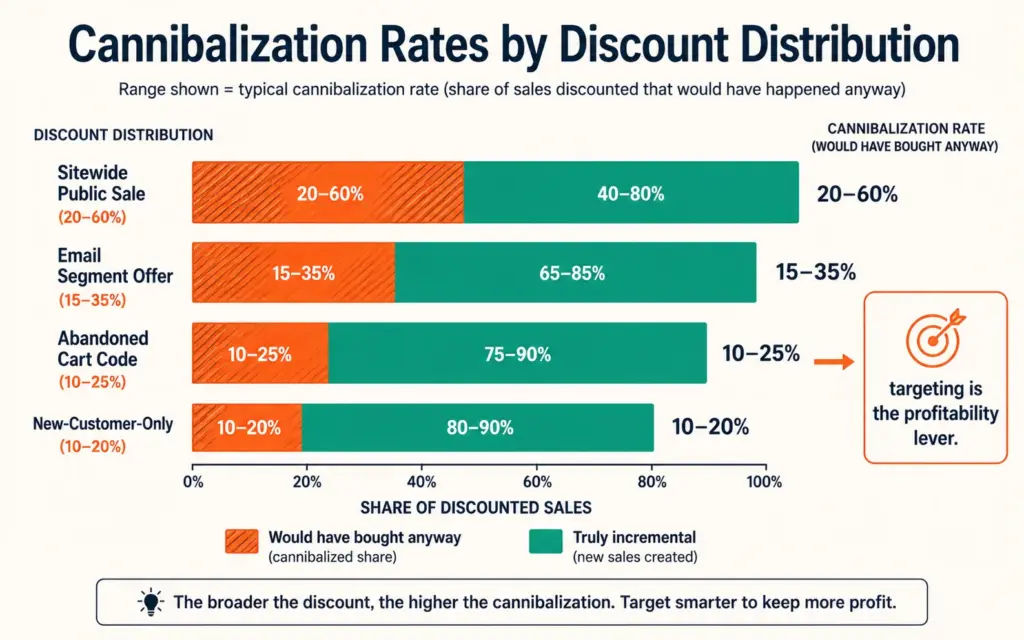
The width of your discount distribution determines your cannibalization rate:
- Sitewide public sale (20 to 60% cannibalization): Every visitor sees it, including the ones who were buying anyway. Highest revenue spike, worst margin efficiency.
- Email-only segment offer (15 to 35%): Reaches subscribers, excludes walk-in full-price buyers. Better.
- Behavioral triggers like abandoned cart codes (10 to 25%): Reaches only shoppers who demonstrated hesitation. The discount changes an outcome instead of subsidizing one. The abandoned cart emails sequence is the archetypal low-cannibalization discount placement.
- New-customer-only codes (10 to 20%): Existing customers can’t use them, so repeat purchases stay at full price. The welcome email series delivers this offer to exactly the audience it’s designed for.
The operational takeaway: default to targeted, gated discounts. Reserve sitewide sales for 2 to 3 strategic moments per year (Black Friday, anniversary, seasonal clearance) where the volume spike and list growth justify the cannibalization cost.
Match the Discount Type to the Business Goal It Serves
Percentage-Off Codes for New Customer Acquisition
10 to 15% off first order, delivered through your signup popup and welcome flow. The goal: reduce the risk of trying an unknown brand. Gate it strictly to first orders so it can’t cannibalize repeat purchases. Track whether welcome-discount customers return at full price. If their repeat rate is dramatically lower than organic customers, the discount is attracting deal-hunters, not future loyalists, and the offer needs restructuring (smaller discount, or value-add like free shipping instead).
Threshold Discounts for Average Order Value Growth
“Spend $100, save $20.” Threshold-based discounts increase AOV by 15 to 30% because shoppers add items to reach the qualifying level. Set the threshold 20 to 30% above your current AOV. The incremental items added usually carry enough margin to fund the discount. The AOV optimization guide covers tier math: model each tier so the marginal discount stays below the contribution margin on the incremental spend.
Bundle Discounts for Inventory Movement and Perceived Value
10 to 15% off when buying the set versus individual items. Bundles move slow inventory alongside bestsellers and raise per-transaction revenue even after the discount. Dollar-off framing (“Save $12 on the set”) often outperforms percentage framing on bundles because the absolute number feels more tangible on multi-item purchases. The bundling strategies guide covers the 6 bundle structures and when each applies.
Loyalty-Exclusive Discounts for Retention Without Public Price Erosion
Member-only pricing, early sale access, or points-multiplier events reward your best customers without advertising a lower price to the general market. Because the discount is framed as a membership benefit, it strengthens the loyalty program’s value proposition instead of weakening price integrity. The loyalty programs structure gives these offers a home that public promotions can’t provide.
Time-Limited Offers for Urgency at Decision Points
48 to 72 hour expiration windows convert the undecided by creating a decision deadline. Time-limited offers work best at behavioral moments: cart abandonment, welcome series email 4, or win-back campaigns. Calm urgency (“Your code expires Friday”) outperforms aggressive urgency (“LAST CHANCE!!!”). Fake countdown timers that reset destroy trust permanently when discovered.
Discount Guardrails That Protect Margin and Brand Value
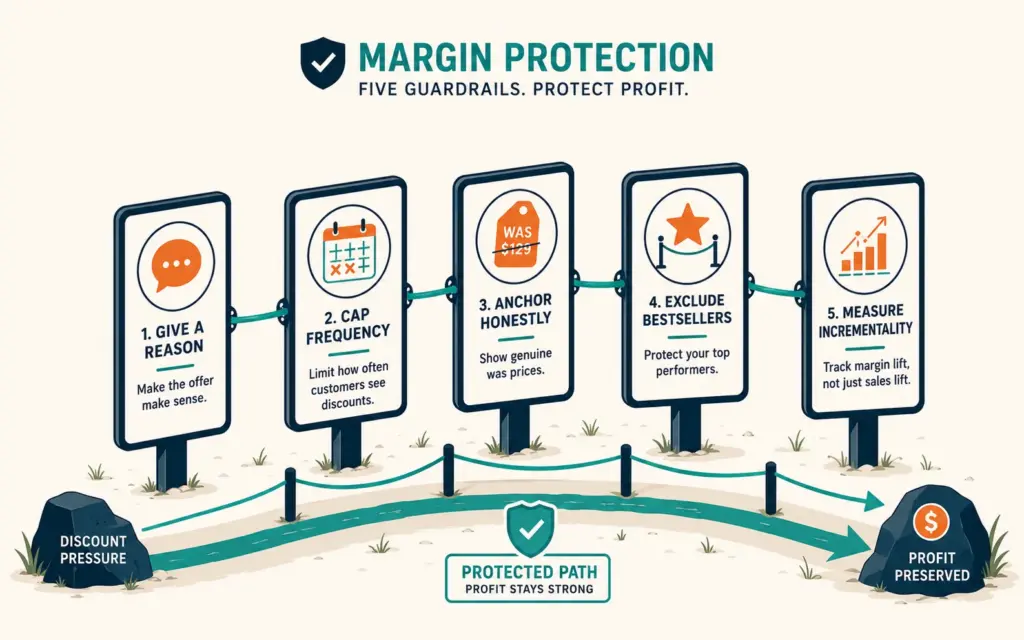
Always give a reason. Anniversary, seasonal, first-order, VIP, clearance. According to Wisepops’ discount pricing research, customers who bought at full price and then discover an unexplained discount feel cheated and either switch brands or learn to wait for the next sale. A stated reason signals that the discount is an event, not the new normal.
Cap frequency. Maximum 2 to 3 sitewide promotions per year. Brands that discount monthly train their audience to never pay full price. Check your own data: if the share of full-price orders declines quarter over quarter, your promotion cadence is conditioning wait-for-sale behavior.
Anchor honestly. An inflated “was” price manufactures the perception of a deal without a real one, and pricing regulators in the US, UK, and EU actively pursue fake reference pricing. Only show a “was” price that the product genuinely sold at.
Exclude your bestsellers. Products that sell at full price don’t need discount support. Every discount on a bestseller is nearly pure cannibalization. Discount the products that need demand help: new launches, slow movers, seasonal clearance.
Measure incrementality, not revenue spikes. The success metric for a promotion is incremental contribution margin: (total promo-period margin) minus (baseline margin you would have earned anyway). A sale that doubles revenue but halves margin per order can net out negative. The ecommerce KPIs dashboard should track full-price order share and blended margin alongside revenue during every promotion. The A/B testing ecommerce methodology applies: hold out a control segment that doesn’t receive the offer and compare purchase behavior between groups.
When Not to Discount at All
When the conversion problem is trust, not price. A store with 3 reviews, stock photos, and a confusing checkout doesn’t have a pricing problem. Discounting an untrusted store just makes it a cheaper untrusted store. Fix reviews and social proof first.
When your brand position is premium. Luxury and premium brands protect price integrity because the price is part of the value signal. Alternatives to discounting: free gift with purchase, complimentary shipping upgrades, extended warranties, or exclusive access. These add value without lowering the price anchor.
When margins can’t support it. Below 30% contribution margin, a meaningful discount eliminates profit. The alternative is value-adds with low hard cost: free shipping thresholds, loyalty points, or bundled digital content.
When you’re discounting to fix a traffic problem. Discounts convert existing traffic. They don’t create traffic. If visitors aren’t arriving, the fix lives in your acquisition channels, not your pricing.
Frequently Asked Questions
Calculate from your contribution margin, not from what competitors do. Set maximum discount depth so you keep at least half your contribution margin per order. At 50% contribution margin, discounts up to 20% are workable. At 35%, cap at 10 to 12%. First-order welcome offers typically run 10 to 15%. Threshold discounts (“spend $100, save $20”) effectively run 15 to 20% but fund themselves through AOV lift. Anything above 25% should be reserved for genuine clearance where recovering cash beats holding inventory.
Frequent, unexplained, sitewide discounts do. They condition shoppers to wait for sales, erode perceived value, and make full-price buyers feel cheated. Targeted, reasoned, capped discounts don’t. The difference is discipline: 2 to 3 stated-reason sitewide events per year plus always-on targeted offers (welcome, cart recovery, loyalty-exclusive) preserves price integrity while still capturing the conversion benefits of promotional pricing.
Cannibalization is the share of discounted orders that would have happened at full price anyway. Broad public coupons cannibalize 20 to 60% of orders. Reduce it by targeting: gate offers to specific segments (new customers only, cart abandoners, lapsed buyers), deliver codes through private channels (email, SMS) instead of public banners, and exclude bestsellers that already sell at full price. Targeted offers cut cannibalization to 10 to 25%.
The “rule of 100” is the standard heuristic: for products under $100, percentage-off feels bigger (25% off a $40 item sounds better than $10 off). For products over $100, dollar-off feels bigger ($50 off a $300 item sounds better than 17% off). On bundles and thresholds, dollar-off framing (“Save $20 on the set”) tends to outperform because the absolute savings is tangible on multi-item purchases. Test both framings on your own audience.
2 to 3 sitewide promotional events per year (Black Friday/Cyber Monday, one seasonal event, one brand moment like an anniversary). Beyond that cadence, shoppers learn to wait and full-price sales decline. Targeted always-on offers (welcome discount, abandoned cart recovery, loyalty exclusives) can run continuously because they’re gated to specific behaviors and don’t advertise a lower price to the general market.
Measure incremental contribution margin, not revenue. Formula: (promo-period contribution margin) minus (baseline margin you would have earned without the promotion, estimated from prior weeks or a holdout control group). Track full-price order share during and after the promotion to detect conditioning effects. A campaign that spikes revenue 80% but drops blended margin per order 45% while pulling forward demand from next month can easily net negative. Revenue spikes feel good. Margin math tells the truth.
Related Reads
- Ecommerce Pricing Strategy
- AOV Optimization
- Bundling Strategies
- Loyalty Programs
- Abandoned Cart Emails
- Ecommerce Profit Margins
Enjoying this? Get more like it every week.
One email per week with ecommerce strategies, tool picks, and seller insights. No spam.