
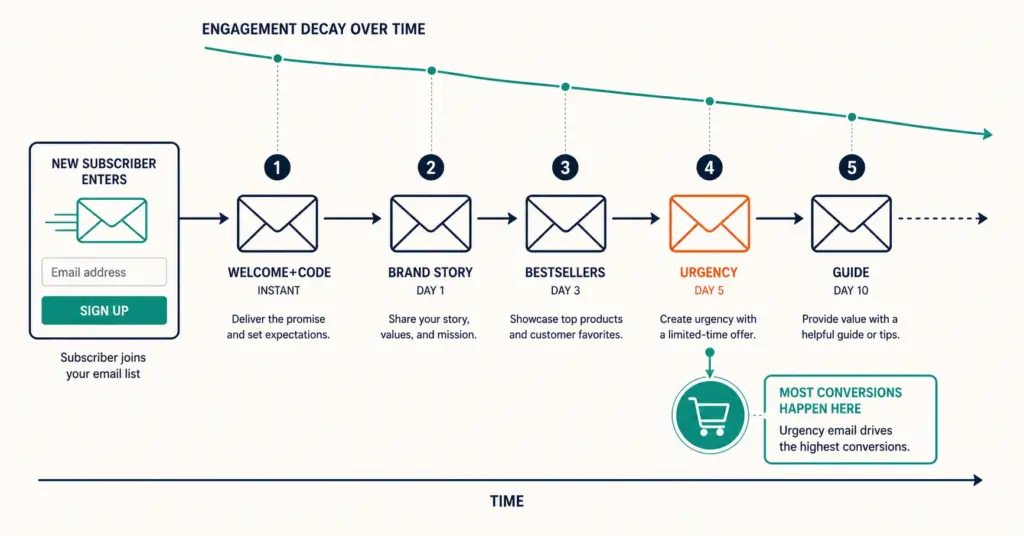
- Welcome emails generate 320% more revenue per email than standard promotional campaigns. The moment someone subscribes is the highest-intent window you'll ever get. They just told you they want to hear from you. A single "Thanks, here's 10% off" email captures a fraction of that intent. A structured 4 to 5 email sequence captures significantly more.
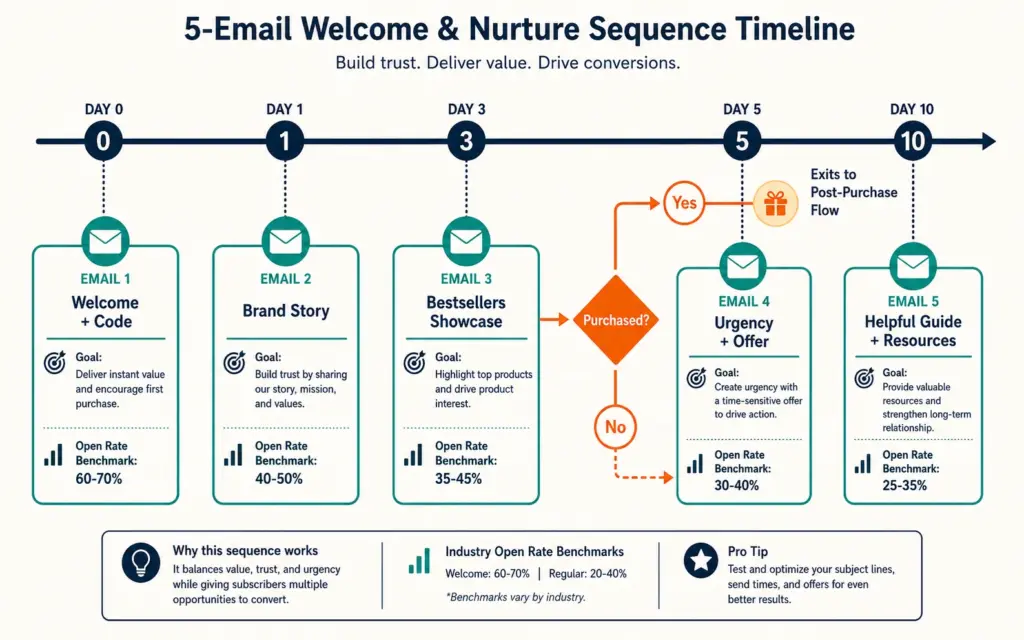
- The optimal welcome series for ecommerce: Email 1 (instant, welcome + incentive delivery), Email 2 (day 1 to 2, brand story + values), Email 3 (day 3 to 4, bestsellers + social proof), Email 4 (day 5 to 7, incentive reminder with urgency), Email 5 (day 10 to 14, educational content or category guide). This sequence moves a subscriber from curiosity to purchase within 7 to 14 days.
- The discount timing debate is settled: deliver the promised discount in Email 1 (if you offered one at signup). Don't withhold it. 74% of subscribers expect a welcome email immediately after signing up, and if they subscribed for a discount, delaying it feels like a bait-and-switch. The reminder in Email 4 creates urgency without training shoppers to wait for deeper discounts.
- Nearly 48% of flow-driven email revenue comes from new buyer conversion. The welcome series is the primary automation driving that number. Getting this flow right before scaling list growth means every new subscriber enters a system designed to convert them, not just collect them.
A welcome email series is the automated email sequence a new subscriber receives in the first 7 to 14 days after signing up. It is the single highest-performing email flow in ecommerce, and it’s the one most stores get wrong by treating it as a single email instead of a structured conversion path.
The numbers make the case clearly. Welcome emails generate roughly 320% more revenue per email than promotional campaigns. They post open rates around 50 to 83% (compared to 15 to 25% for regular campaigns). And according to Klaviyo’s welcome email data, 48% of all flow-driven revenue comes from new buyer conversion, with the welcome series as the primary automation driving those first purchases. The window right after someone subscribes is when their attention and interest peak. Every day that passes without a structured follow-up, that interest decays. A 5-email series captures the peak. A single email captures a sliver of it.
The 5-Email Welcome Sequence
Email 1: Welcome + incentive delivery (immediate)
Send within 60 seconds of signup. This is the email the subscriber is literally waiting for. If you promised 10% off or free shipping in your signup popup, deliver it here. Subject line: “Here’s your [discount]” or “Welcome to [Brand] + your code inside.” Open rate benchmark: 60 to 80%.
Content: Thank them for subscribing. Deliver the discount code prominently (large, bold, impossible to miss). Include 2 to 3 of your best-selling products with images and links. Add a single “Shop Now” CTA. Keep it short. This isn’t the email for your life story. It’s the email that gets the first click.
If you didn’t offer a discount at signup (some brands don’t), Email 1 still goes immediately. Replace the code delivery with a warm welcome, your unique value proposition in one sentence, and a curated product selection. The ecommerce pricing strategy determines whether a welcome discount fits your margin structure or whether you should lead with value instead of price reduction.
Email 2: Brand story + values (day 1 to 2)
The subscriber clicked your welcome email. Maybe they browsed. Maybe they bought. Either way, Email 2 builds the relationship beyond the transaction. Share your founder story in 3 to 4 sentences (not paragraphs). Why does your brand exist? What problem does it solve? What makes you different from the 20 other stores selling similar products?
According to Omnisend’s welcome email research, 42% of consumers say brand values influence where they shop. This number is higher among millennials (49%) and Gen Z (53%). If your brand has a genuine differentiator (sustainability practices, charitable component, artisan production, local sourcing), Email 2 is where it earns attention. Show it visually. A photo of your production process or your team beats a paragraph about your mission statement.
Email 3: Bestsellers + social proof (day 3 to 4)
Curate your 3 to 6 best-selling products with review ratings displayed below each image. “Rated 4.9 by 800+ customers” does more conversion work than any copy you can write. This email serves subscribers who are interested but haven’t committed. They need social validation that other people bought these products and liked them.
Include at least one customer quote or photo review alongside the product grid. Real customer words outperform brand copy for building purchase confidence. The reviews and social proof assets you’ve collected on your product pages do double duty here. Pull your strongest 5-star review quotes into this email.
Email 4: Urgency + incentive reminder (day 5 to 7)
If the subscriber hasn’t purchased yet, remind them their discount is expiring. “Your 10% off expires in 48 hours.” This is the email that converts the undecided. Subject line: “Your [discount] is about to expire” or “Last chance: [discount code] expires tomorrow.”
Urgency works because it creates a decision point. Without a deadline, “I’ll buy later” turns into “I forgot.” With a deadline, the subscriber has to decide now. Not aggressive urgency (“YOU’RE MISSING OUT!!!”). Calm urgency. “We set this aside for you. It expires Friday. Here’s the link.” The abandoned cart emails use the same urgency psychology at a later stage. The welcome series uses it earlier, before the subscriber has even added anything to cart.
Email 5: Content + category guide (day 10 to 14)
The subscriber who hasn’t bought after 4 emails may not be ready to purchase. That doesn’t mean they’re uninterested. Email 5 shifts from sales to education. Send a buying guide, a how-to article, or a product comparison that helps them make a decision. “Not sure which [product type] is right for you? Here’s our guide.” Link to a blog post or landing page that provides genuine value.
This email reframes your relationship from “brand pushing products” to “brand helping me decide.” It builds trust for a future purchase even if it doesn’t convert today. The content marketing assets you’ve published (guides, comparisons, how-tos) serve as Email 5 content. One email linking to one genuinely helpful article is enough.
Subject Lines That Get Opened
Your welcome series open rates should significantly exceed your regular campaign averages. If they don’t, your subject lines aren’t earning the click. Patterns ranked by performance:
| Subject Line Pattern | Benchmark Open Rate | |
|---|---|---|
| Email 1 | “Welcome to [Brand] + your [discount] inside” | 60 to 80% |
| Email 2 | “Why we started [Brand]” or “The story behind [Brand]” | 35 to 50% |
| Email 3 | “Our customers’ favorites” or “See what everyone’s buying” | 30 to 45% |
| Email 4 | “Your [discount] expires tomorrow” | 35 to 50% |
| Email 5 | “[Guide title]” or “How to choose the right [product]” | 25 to 35% |
Notice the engagement decay across the sequence. Email 1 gets the highest opens because the subscriber just signed up. Each subsequent email gets lower opens, which is normal. Don’t panic about declining open rates across the series. A 30% open on Email 4 is healthy. A 30% open on Email 1 is a deliverability problem.
Setting Up the Flow in Klaviyo
Klaviyo is the most common platform for Shopify welcome series, so here’s the specific setup:
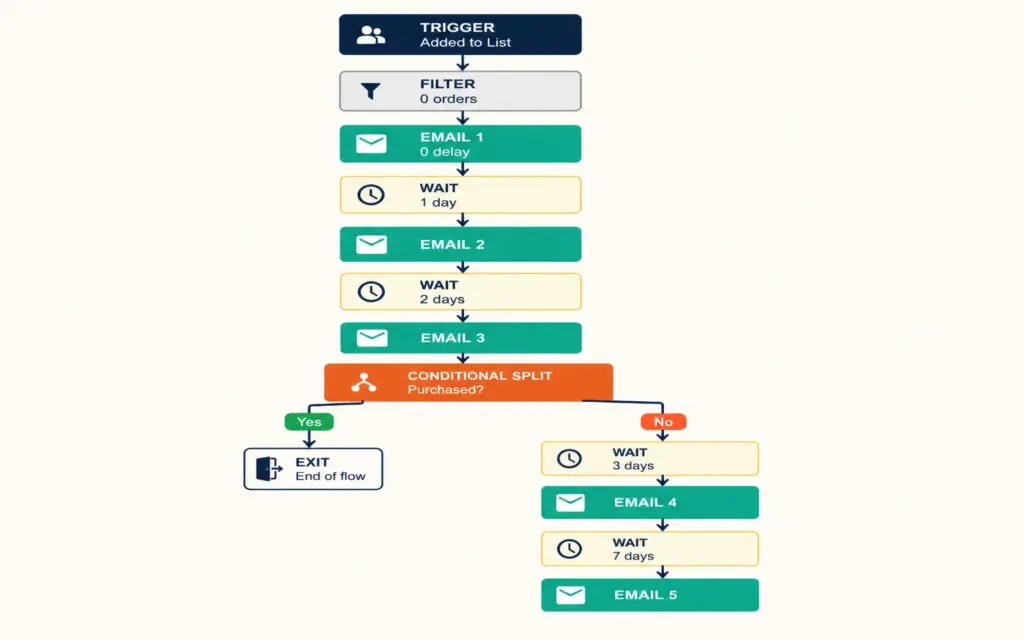
- Create a Flow. Go to Flows > Create Flow > select “Welcome Series” template (or build from scratch using the “Subscribed to List” trigger).
- Set the trigger. Trigger: “When someone is added to [your main email list].” Add a filter: “Has placed order zero times” so existing customers entering the list skip the welcome flow and receive a different sequence.
- Build the emails. Add 5 email actions with time delays between them: 0 delay (Email 1), 1 day (Email 2), 2 days (Email 3), 3 days (Email 4), 7 days (Email 5). Adjust timing based on your purchase cycle length.
- Add a conditional split after Email 3. Split: “Has placed order at least once since starting this flow.” Subscribers who’ve purchased skip Emails 4 and 5 (no urgency or educational content needed for converted subscribers). Route purchasers to your post-purchase flow instead.
- Enable Smart Sending. Prevents the welcome flow from sending if another Klaviyo email was sent within the past 16 hours. Prevents inbox overload from overlapping flows.
The email marketing strategy guide covers Klaviyo flow architecture beyond the welcome series, including post-purchase, browse abandonment, and win-back flows. The welcome series should be the first flow you build and the last one you stop optimizing.
Measuring Welcome Series Performance
Revenue per recipient: The primary metric. Total revenue generated by the welcome flow / total subscribers who entered it. Benchmark: $2 to $8 per recipient for healthy ecommerce welcome series. Below $1 suggests your emails aren’t converting. Above $10 means your flow is performing exceptionally.
First-purchase conversion rate: Percentage of new subscribers who make their first purchase within the welcome series window (typically 14 days). Target: 5 to 15%. Below 3% means the offer, timing, or content isn’t compelling enough. Track this in Klaviyo’s Flow Analytics alongside the standard email metrics.
Unsubscribe rate per email: Monitor each email individually. If Email 4 (urgency) has a 1%+ unsubscribe rate, the messaging may be too aggressive. Scale back the urgency language. Welcome series unsubscribe rate should stay below 0.3% per email. Higher than that signals you’re sending too frequently or the content doesn’t match what the subscriber expected when they signed up.
The ecommerce KPIs dashboard should include welcome series revenue alongside total email revenue. It’s the single flow most responsible for new customer acquisition via email. The lifetime value calculation benefits from knowing which subscribers converted through the welcome series, because those customers’ LTV benchmarks inform how much you should spend on list growth.
Common Welcome Series Mistakes
Sending one email and calling it a series. A single “Thanks for subscribing, here’s 10% off” email captures maybe 20% of the revenue a 5-email series would generate. The subscribers who don’t buy from Email 1 aren’t lost. They’re undecided. Emails 2 through 5 convert the undecided.
Withholding the discount. If your popup promised 10% off for subscribing, deliver it in Email 1. Making subscribers wait until Email 3 or 4 to receive what they signed up for feels dishonest. It damages trust at the exact moment you’re trying to build it. Deliver the promise immediately. Use Email 4 as a reminder, not a reveal.
Sending identical product grids in every email. If Emails 1, 3, and 4 all show the same 6 products, the subscriber sees repetitive content. Curate different product selections: bestsellers in Email 1, new arrivals in Email 3, category-specific picks in Email 5. Klaviyo’s dynamic product blocks can personalize these based on the subscriber’s browse history if they’ve visited your site. The AI personalization capabilities in modern email tools make per-subscriber product selection possible without manual curation.
Not suppressing purchasers from later emails. A subscriber who buys after Email 2 should not receive Email 4’s “Your discount expires!” message. That feels tone-deaf. Use conditional splits in your flow to route purchasers to a post-purchase sequence instead of continuing the welcome series. The segmentation logic here is simple: purchased = exit welcome, enter post-purchase.
Frequently Asked Questions
4 to 5 emails over 7 to 14 days is the sweet spot for most ecommerce brands. Fewer than 3 leaves the brand story and social proof undone. More than 6 risks fatiguing subscribers who haven’t bought yet. Start with 3 emails if you’re launching your first flow. Add Email 4 and 5 once the first three are running and you can see the engagement data.
Immediately. Within 60 seconds of signup. 74% of subscribers expect a welcome email the moment they sign up. If you promised a discount code, they’re waiting for it right now. Any delay beyond a few minutes risks the subscriber checking out from a competitor while waiting for your code. Set your email platform to trigger instantly on list addition, not on a timed delay.
If your signup popup promises one, yes. Deliver exactly what was promised. If you didn’t promise a discount, you don’t need one. Some premium brands deliberately avoid welcome discounts to protect brand positioning and instead lead with value (free guide, exclusive access, brand story). The decision depends on your pricing strategy and competitive positioning. Either approach works. What doesn’t work is promising a discount and not delivering it immediately.
5 to 15% first-purchase conversion rate within the welcome series window (14 days). Revenue per recipient benchmark: $2 to $8. Below $1/recipient suggests the offer or content needs improvement. These benchmarks assume an ecommerce welcome flow with a discount incentive. Non-discount flows may convert at 3 to 8% with higher AOV per conversion. Measure in Klaviyo’s Flow Analytics, filtering by first-time purchasers only.
No. Add a filter to your welcome flow trigger: “Has placed order zero times.” Existing customers who subscribe to your email list should enter a separate flow (a “thank you for subscribing” email acknowledging they’re already a customer, without a first-purchase discount). Sending a “Welcome! Here’s 10% off your first order” to someone who bought last week feels impersonal and undermines the relationship.
Klaviyo for Shopify stores (deepest integration, best flow builder, free up to 250 contacts). Omnisend as a simpler alternative with combined email and SMS. Mailchimp for WooCommerce stores. Shopify Email handles basic welcome emails but lacks the conditional splits, dynamic product blocks, and behavioral triggers that make a sophisticated welcome series effective. For a 5-email welcome flow with proper segmentation, Klaviyo or Omnisend are the practical choices.
Related Reads
- Email Marketing Strategy
- Abandoned Cart Emails
- Segmentation
- Reviews and Social Proof
- AI Personalization
- Content Marketing
Enjoying this? Get more like it every week.
One email per week with ecommerce strategies, tool picks, and seller insights. No spam.