
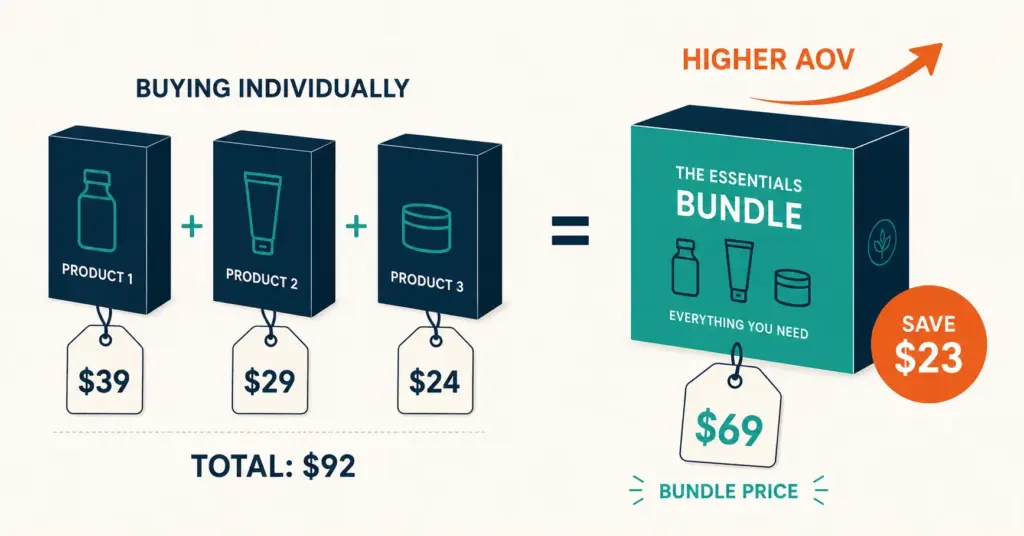
- Product bundling is the strategy of combining two or more products into a single purchase at a combined price lower than buying each item separately. Effective bundles lift average order value 20 to 40% while giving customers perceived savings, creating a win for both margin and satisfaction.
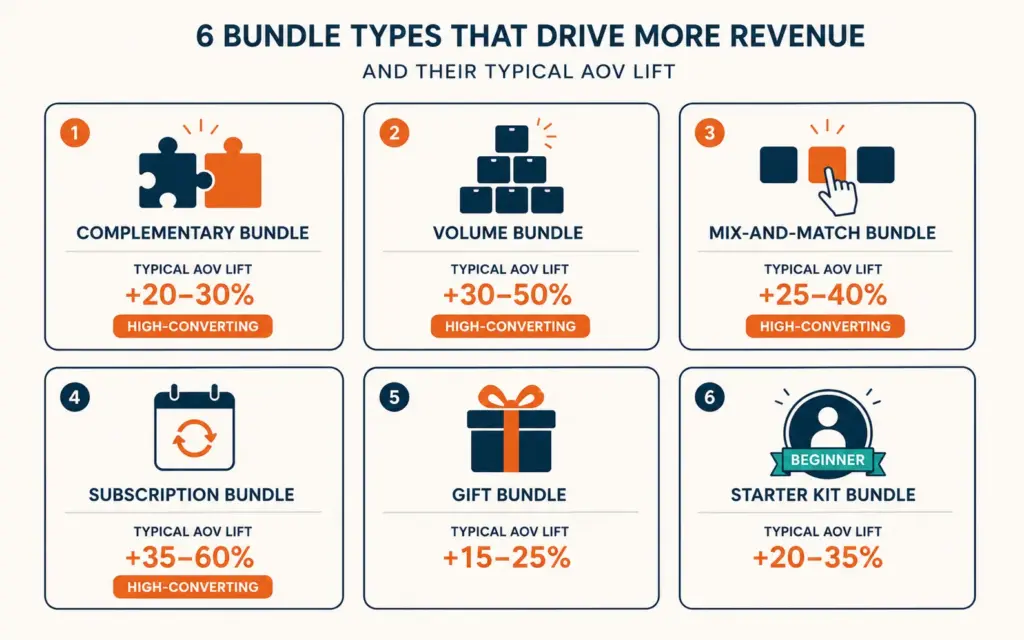
- The 6 bundle types: complementary bundles (products used together), volume bundles (multiples of the same product), mix-and-match (customer chooses from a selection), subscription bundles (recurring shipments), gift bundles (pre-curated for occasions), and starter kit bundles (everything needed to begin).
- Bundle pricing psychology follows the "rule of 3": offer 3 options (single item, small bundle, value bundle) with the middle option highlighted as "most popular." The middle option captures 50 to 60% of purchases because it feels like the rational compromise between too little and too much.
- The most common bundling mistake is combining products that don't logically belong together. A "phone case + kitchen timer" bundle confuses customers and signals inventory clearing rather than value creation. Every bundle needs a narrative that explains why these products go together.
Bundling strategies for ecommerce combine two or more products into a single purchase at a price lower than buying each item separately, creating perceived value for the customer while increasing average order value and units per transaction for the seller. The math is straightforward: a customer who intended to buy one $30 product purchases a $45 bundle instead, lifting AOV 50% while the customer saves $15 versus buying the 3 items individually at $20 each. According to McKinsey’s product strategy research, product bundling drives 35% of Amazon’s total revenue through “Frequently Bought Together” and “Buy it with” recommendations, making it the single most effective AOV tactic in ecommerce.
Bundling works because it shifts the customer’s decision from “should I buy?” to “which bundle is the best deal?” The anchoring effect of the individual item prices makes the bundle discount feel significant, even when the actual margin impact is minimal. A well-designed bundle strategy lifts AOV 20 to 40% while maintaining or improving gross margin through increased volume. For broader AOV tactics beyond bundling, see our upsell and cross-sell guide.
What Are the 6 Types of Ecommerce Bundles?
1. Complementary bundles
Products that are naturally used together. A camera with a memory card and carrying case. A skincare cleanser with toner and moisturizer. Running shoes with performance socks. Complementary bundles have the highest conversion rate (15 to 25% of eligible product page visitors) because the combination makes intuitive sense. The customer was likely going to buy the complementary items eventually; the bundle accelerates the decision.
How to identify: analyze your order data for products frequently purchased together within 30 days. If 20%+ of customers who buy Product A also buy Product B within a month, they belong in a bundle. For product page optimization where bundles display, see our product page design guide.
2. Volume bundles (buy-more-save-more)
“Buy 2 save 10%, Buy 3 save 15%, Buy 5 save 25%.” Volume bundles work for consumable and replenishable products: supplements, coffee, pet food, skincare, cleaning supplies. The customer gets a lower per-unit price; you get a larger order and longer repurchase cycle (they won’t need to reorder as quickly). Volume bundles lift AOV 25 to 50% on qualifying products. For subscription alternatives that achieve similar results, see our customer retention guide.
3. Mix-and-match bundles
“Choose any 3 for $X.” The customer selects from a curated range of eligible products. Mix-and-match bundles combine the perceived value of bundling with the freedom of choice. They work well for fashion (pick 3 t-shirts for $60), food (build your own snack box), and beauty (choose 3 products from the collection). Conversion rates run 10 to 20% on eligible categories because the customization element increases engagement.
4. Subscription bundles
Recurring bundles delivered on a schedule: monthly coffee box, quarterly skincare routine, bi-weekly supplement pack. Subscription bundles combine the AOV lift of bundling with the LTV extension of subscriptions. Customers who subscribe to bundles have 2 to 4x higher LTV than single-product single-purchase customers. Tools: Recharge, Skio, or Bold Subscriptions on Shopify. For LTV depth, see our lifetime value calculation guide.
5. Gift bundles
Pre-curated bundles positioned for gifting occasions: “Holiday Gift Set,” “New Parent Bundle,” “Self-Care Package.” Gift bundles convert seasonal traffic into larger orders and attract buyers who don’t know individual products well enough to choose. The curation removes decision fatigue. Gift bundles peak during holiday season (Q4), Valentine’s Day, Mother’s Day, and Father’s Day. Seasonal gift bundles should launch 4 to 6 weeks before the occasion for SEO ranking and awareness.
6. Starter kit bundles
“Everything you need to start [activity].” A home brewing starter kit, a beginner watercolor set, a first-time puppy owner pack. Starter kits target new-to-category customers who don’t know what they need. The bundle eliminates the research and compatibility guesswork that deters beginners. Starter kits convert first-time buyers at 2 to 3x the rate of individual products because they solve the “I don’t know what to buy” problem. For product research that identifies starter kit opportunities, see our best selling products research guide.
How Do I Price Bundles for Maximum Conversion?
The discount sweet spot
Bundle discounts of 10 to 25% off the combined individual prices hit the conversion sweet spot. Under 10%, the savings don’t feel meaningful enough to motivate the bundle purchase. Over 25%, customers question product quality or suspect you’re clearing inventory. The discount should feel like a genuine deal without undermining perceived product value.
The rule of 3
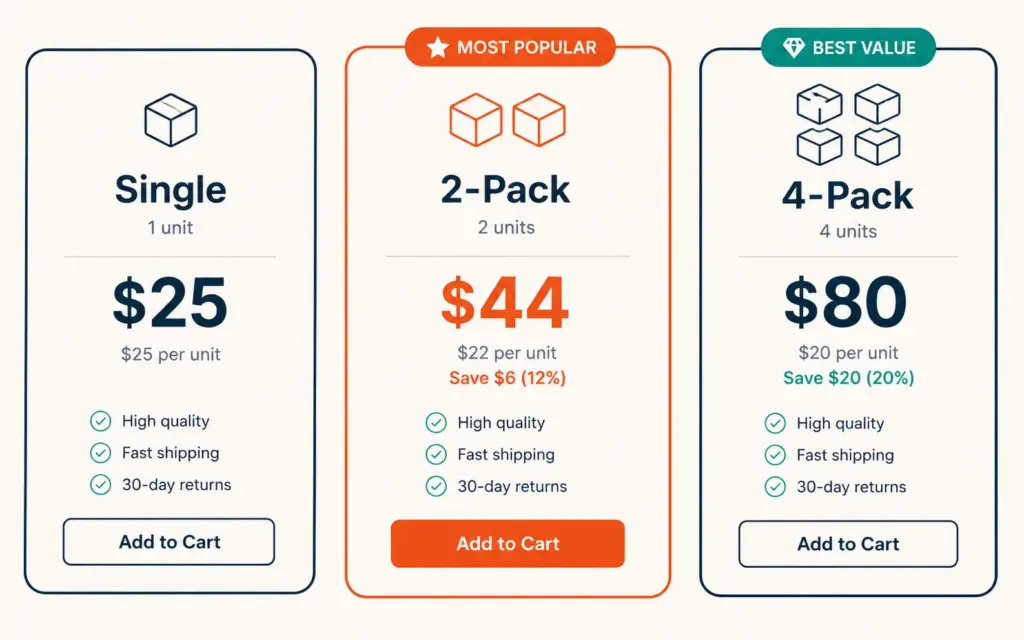
Offer three purchase options: single item (highest per-unit price), small bundle (moderate savings), and value bundle (best per-unit price, highlighted as “most popular” or “best value”). The middle option captures 50 to 60% of purchases. The premium option makes the middle look reasonable. The single-item option makes both bundles look like good deals.
Example: Single jar: $25. 2-pack: $44 (save 12%). 4-pack: $80 (save 20%, “Best Value” badge). Most customers choose the 2-pack because it feels like the rational middle ground. For pricing psychology depth, see our ecommerce pricing strategy guide.
Margin-protecting pricing
The bundle discount comes from reduced per-unit costs (packaging efficiency, reduced picking time, single shipping cost) rather than pure margin sacrifice. A bundle of 3 products shipped in one package saves $4 to $8 in shipping versus 3 individual orders. The “discount” to the customer comes from operational savings you’d capture anyway. Structure bundle pricing so gross margin stays within 2 to 5% of individual-item margin. For margin analysis, use our profit margin calculator.
How Do I Create Bundles on Shopify and WooCommerce?
Shopify bundle tools
| Tool | Bundle Type | Cost | Key Feature |
|---|---|---|---|
| Shopify Bundles (native) | Fixed bundles | Free | Simple bundle creation, inventory sync |
| Bold Bundles | All types including mix-and-match | $19.99/month | Volume discounts, BOGO, custom bundles |
| Bundler | Fixed and volume bundles | Free to $9.99/month | Automatic discounts, bundle widgets |
| ReConvert | Post-purchase bundles | $7.99/month | Thank-you page bundle upsells |
WooCommerce bundle tools
- WooCommerce Product Bundles ($49/year): Create fixed and dynamic bundles with per-item pricing or combined pricing. Handles inventory for individual items within the bundle.
- YITH Product Bundles ($79.99/year): Fixed bundles with optional item quantities. Volume discount tiers. For broader WooCommerce plugin recommendations, see our best WooCommerce plugins guide.
Bundle page setup best practices
- Show individual prices with strikethrough: “$25 + $20 + $15 = ~~$60~~ Bundle price: $47” makes the savings immediately visible
- Include “You save $X” callout: Dollar savings are more motivating than percentage discounts for bundles under $100
- Display bundle contents with individual images: Customers want to see exactly what’s included before committing
- Add a “Buy individual items” option: Paradoxically, showing the more expensive individual option increases bundle conversion because the comparison is unfavorable to buying separately. For checkout optimization context, see our checkout optimization guide.
How Do I Identify Which Products to Bundle?
Data-driven bundle selection
- Frequently bought together analysis: Pull your order data and identify product pairs purchased within the same order or within 30 days. If 15%+ of Product A buyers also buy Product B, they’re bundle candidates.
- Browse-to-buy path analysis: Use GA4 to identify products frequently viewed in the same session. Even if they’re not bought together, the browsing pattern suggests interest overlap. For analytics setup, see our GA4 ecommerce setup guide.
- Customer survey: Ask your top 100 customers: “What other products do you use alongside [your product]?” Their answers reveal complementary needs your catalog may or may not address.
- Margin-based selection: Include at least one high-margin item in every bundle. If Product A has 60% margin and Product B has 30%, the blended margin of the bundle (approximately 45%) supports a generous discount while staying profitable. For margin calculation, see our ecommerce profit margins guide.
The bundle narrative test
Every bundle needs a one-sentence explanation of why these products belong together. “Everything you need for your morning coffee routine” works. “These are three products we want to move” doesn’t. If you can’t articulate why the customer benefits from buying these items together, the bundle won’t convert well. For product description approaches that support bundle narrative, see our product descriptions guide.
How Do I Measure Bundle Performance?
The 5 bundle metrics
- Bundle take rate: Bundle purchases / total purchases on pages where bundles are offered. Target 15 to 25% for complementary bundles, 10 to 20% for mix-and-match. Below 5% signals poor product fit or pricing.
- AOV lift from bundles: Average order value for bundle orders vs non-bundle orders. Target 20 to 40% higher AOV on bundle purchases.
- Bundle margin vs individual margin: Gross margin on the bundle vs combined margin of items sold individually. The bundle margin should be within 5% of individual margin; larger gaps signal over-discounting.
- Revenue per visitor (RPV) impact: Does the bundle page produce higher RPV than individual product pages? If not, the bundle may be cannibalizing higher-margin individual sales. For A/B testing bundle impact, see our A/B testing guide.
- Bundle return rate: Returns on bundle orders vs individual orders. Higher return rates on bundles suggest one or more items in the bundle aren’t meeting expectations.
Common Bundling Mistakes
Bundling unrelated products
Combining products without logical connection (“phone case + kitchen timer”) signals inventory clearing, not value creation. Customers see through forced bundles and avoid them. Every item in the bundle should answer: “Why would someone use this alongside the other items?” According to Shopify’s bundling research, logically complementary bundles convert 3 to 5x higher than random product groupings.
Over-discounting bundles
Discounting bundles 30 to 40% to drive volume destroys margin. If individual gross margin is 50% and you discount 35%, bundle margin drops to 15%, which likely doesn’t cover operating costs and marketing per sale. Keep bundle discounts at 10 to 25% and ensure the operational savings (combined shipping, efficient picking) offset most of the discount. For discount strategy depth, see our discount strategy guide.
Not testing bundle configurations
The first bundle configuration you create is rarely the optimal one. A/B test 2 to 3 bundle combinations (different product pairings, different price points, different discount levels) before committing. A bundle that looks logical from a product perspective may underperform a less obvious combination that data reveals customers actually prefer.
Making bundles the only purchase option
Forcing customers into bundles when they want individual items creates frustration and cart abandonment. Always offer both individual products and bundles. The individual prices serve as anchors that make the bundle look valuable. Removing the individual option removes the comparison that drives bundle conversion.
Frequently Asked Questions
Product bundling combines two or more products into a single purchase at a combined price lower than buying each item separately. The strategy lifts average order value 20 to 40% by giving customers perceived savings while increasing revenue per transaction. Six bundle types exist: complementary (products used together), volume (buy-more-save-more), mix-and-match (customer chooses), subscription (recurring), gift (occasion-based), and starter kits (everything to begin).
Discount bundles 10 to 25% off the combined individual prices. Under 10%, the savings don’t motivate the bundle purchase. Over 25%, customers question product quality or assume you’re clearing inventory. Structure the discount so gross margin stays within 2 to 5% of individual-item margin. Operational savings (combined shipping, efficient picking) should offset most of the customer-facing discount.
Use data: analyze orders for products frequently purchased together (15%+ co-purchase rate qualifies), check GA4 for products viewed in the same session, and survey top customers about complementary product usage. Include at least one high-margin item in every bundle to protect profitability. Apply the narrative test: if you can’t explain in one sentence why these products belong together, the bundle won’t convert well.
Shopify Bundles (native, free) handles basic fixed bundles with inventory tracking. Bold Bundles ($19.99/month) supports all bundle types including mix-and-match, BOGO, and volume tiers. Bundler (free to $9.99/month) covers simple bundles with automatic discounts. ReConvert ($7.99/month) specializes in post-purchase bundle upsells on the thank-you page. Start with native Bundles and upgrade to Bold when you need mix-and-match or volume tiers.
Effective bundles lift AOV 20 to 40%. Complementary bundles (products used together) deliver the highest lift because the combination feels natural. Volume bundles (buy-more-save-more) on consumables lift units per order 25 to 50%. Gift bundles and starter kits can produce 40%+ AOV lift during relevant seasons. The compounding effect of bundling plus other AOV tactics (upsells, free shipping thresholds) can double revenue per visitor.
Well-designed bundles increase total revenue even if some individual sales shift to bundle purchases, because the higher order value more than compensates. Always offer individual products alongside bundles so customers who want a single item aren’t forced into a larger purchase. Monitor RPV (revenue per visitor) on bundled product pages versus individual pages. If RPV is higher with bundles, total revenue is growing even if individual unit counts shift.
Related Reads
- Upsell and Cross-Sell Guide
- Product Page Design
- Discount Strategy Guide
- Product Descriptions
- Ecommerce Pricing Strategy
- Lifetime Value Calculation
Enjoying this? Get more like it every week.
One email per week with ecommerce strategies, tool picks, and seller insights. No spam.