
- Ecommerce loyalty programs reward repeat purchases with points, discounts, exclusive access, or tier-based benefits. Members spend 67% more than non-members and repeat purchase at 15 to 25% higher rates. The strategic purpose isn't generosity; it's increasing switching costs so customers choose you over competitors out of accumulated value, not just product preference.
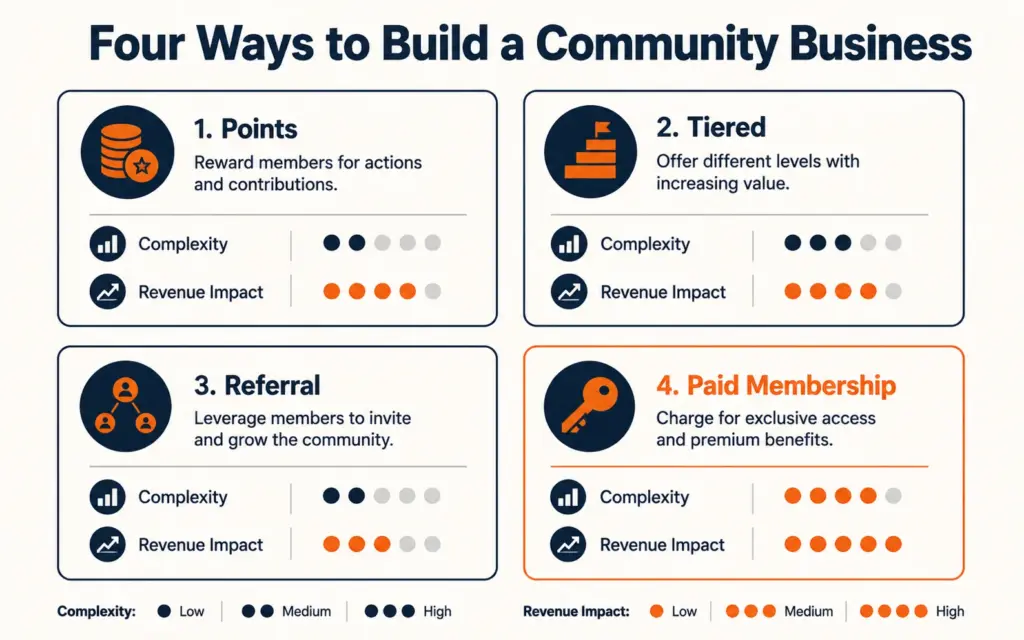
- Four loyalty program models: points-based (earn and redeem, most common), tiered (Bronze/Silver/Gold with escalating benefits), referral-integrated (reward both referrer and new customer), and paid membership (annual fee for premium benefits like Amazon Prime). Most ecommerce stores start with points-based and add tiers at 1,000+ active members.
- The profitability math: a points program offering 5% back in points costs you 3 to 4% of revenue (not all points get redeemed). If loyalty members purchase 25% more frequently, the incremental revenue far exceeds the 3 to 4% reward cost. The program pays for itself within 2 to 3 months for most product categories.
- The biggest loyalty program mistake is making rewards too hard to earn. A program requiring $500 in purchases before earning a $5 reward feels worthless. The first reward should be achievable within 1 to 2 purchases to create early momentum and prove the program's value.
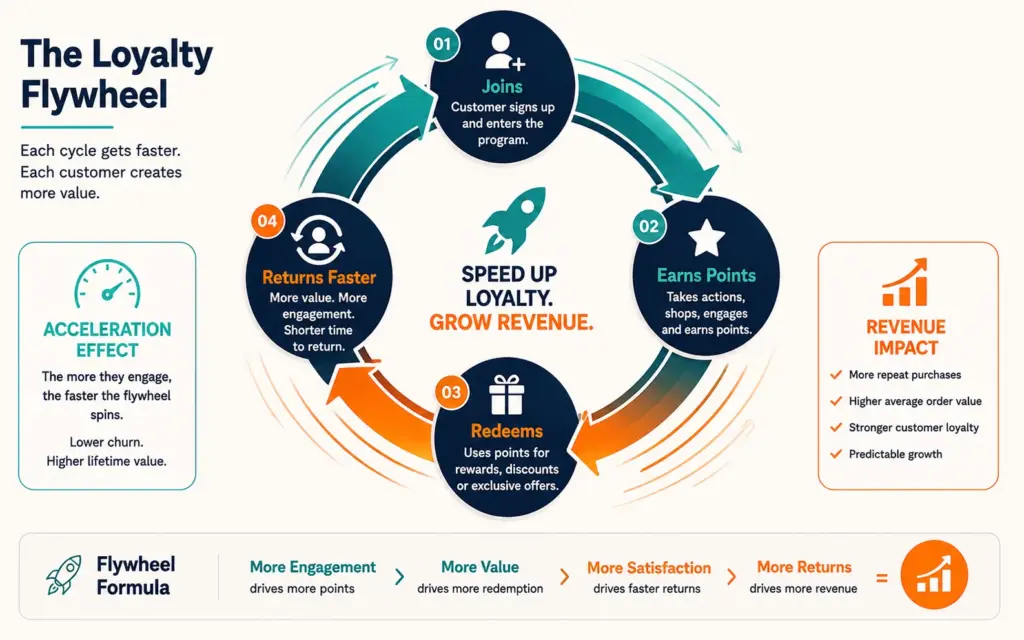
Ecommerce loyalty programs create a structured reason for customers to buy from you again instead of comparing alternatives every time they need your product category. Without a loyalty program, each purchase decision starts from zero: the customer evaluates you against every competitor based on price, convenience, and product quality alone. With a program, they carry accumulated value (points, tier status, history) that creates an economic incentive to return. According to Yotpo’s loyalty research, loyalty program members spend 67% more per order than non-members and purchase 33% more frequently, making loyalty programs one of the highest-ROI retention investments in ecommerce.
The tension in loyalty program design is between generosity (making rewards attractive enough to influence behavior) and profitability (not giving away so much value that the program costs more than the incremental revenue it generates). This guide walks through the four program models, the profitability math behind each, and the design decisions that make programs feel valuable to customers while remaining profitable for the business. The lifetime value calculation framework provides the baseline numbers that determine how much you can afford to invest in loyalty rewards.
Four Loyalty Program Models
Points-based programs (start here)
Customers earn points per dollar spent and redeem them for discounts, free products, or other rewards. The most common ecommerce loyalty model because it’s simple to understand, flexible to configure, and directly ties rewards to purchase behavior.
Standard point structure: 1 point per $1 spent. Redemption: 100 points = $5 off (5% effective reward rate). Adjust the earn/redeem ratio based on your margins. High-margin products (60%+) can sustain 8 to 10% reward rates. Lower-margin products (30 to 40%) should target 3 to 5% to remain profitable.
Bonus point opportunities beyond purchases: account creation (50 points), birthday bonus (100 points), social media follow (25 points), product review (50 points for text, 100 for photo/video). These non-purchase earning methods drive engagement behaviors that benefit your business beyond the direct revenue. Review points directly feed your reviews and social proof accumulation.
Tiered programs
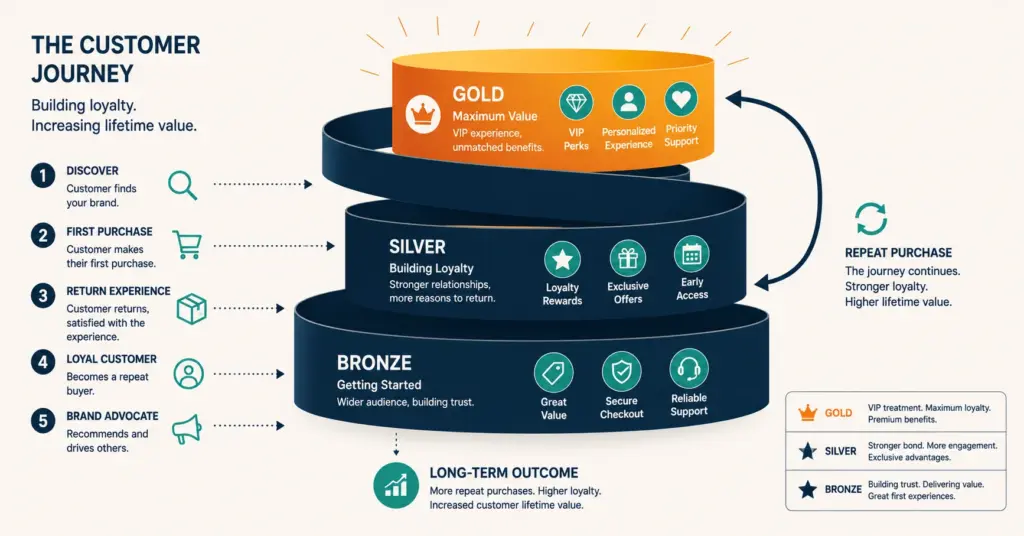
Layer escalating benefits on top of base points: Bronze (default), Silver (after $200 annual spend), Gold (after $500). Each tier unlocks additional benefits: free shipping, early access to sales, higher point earning rates, exclusive products, or dedicated support.
Tiers work because they create aspiration and switching cost simultaneously. A Silver member who’s $50 away from Gold has strong motivation to make their next purchase with you rather than a competitor. The segmentation approach should align with loyalty tiers: your VIP segment likely maps to your top loyalty tier, enabling consistent treatment across email, ads, and the loyalty program.
Referral-integrated programs
Reward existing customers for bringing new customers. “Give $15, Get $15”: the referrer earns $15 credit when their friend completes a first purchase, and the friend gets $15 off their order. Dual-incentive referral converts 3 to 5x better than one-sided referral because both parties benefit.
Referral economics: if your CAC through paid channels is $30, a $15 referral reward acquires customers at 50% the cost. Referred customers also retain 18 to 25% better than ad-acquired customers because the trust transfer from the referrer lowers purchase hesitation. The customer acquisition cost comparison by channel should include referral as a distinct, measurable channel.
Paid membership programs
Customers pay an annual fee ($49 to $99/year) for premium benefits: free shipping on all orders, member-only pricing (10 to 15% off), exclusive products, and priority support. The Amazon Prime model applied to DTC ecommerce.
Paid programs work when the benefits deliver clear, quantifiable value exceeding the fee. If members save $120/year on shipping by paying a $49 membership fee, the value proposition is obvious. They work poorly when benefits are vague (“exclusive access to our community”) or when the customer’s purchase frequency doesn’t justify the annual fee. Minimum viable: the customer should save 2x the membership fee in annual benefits to perceive fair value. According to McKinsey’s paid loyalty research, members of paid programs spend 60% more than free program members because the sunk cost of the membership fee motivates maximizing its value.
The Profitability Math
Does a 5% points reward actually cost 5%?
No. Three factors reduce the actual cost below the stated reward rate:
- Breakage (unredeemed points): 20 to 40% of earned points are never redeemed. This means 5% stated reward rate costs 3 to 4% in actual redemptions.
- Incremental revenue: Members who wouldn’t have purchased without the points incentive generate revenue that wouldn’t exist without the program. Even at reduced margin, incremental revenue is profitable.
- Higher AOV: Customers close to a point threshold (“You’re 50 points from a $10 reward”) add items to reach it, lifting average order value 8 to 15%. The upsell and cross-sell tactics compound with loyalty threshold psychology.
When does the program break even?
If loyalty members purchase 25% more frequently at 3 to 4% actual reward cost, the break-even is immediate. Example: a customer who buys 4x/year at $50 AOV generates $200 annually. As a loyalty member buying 5x/year: $250 revenue. Reward cost at 4%: $10. Net incremental revenue: $40. The program generates $40 in additional revenue for every $10 in rewards. The ecommerce profit margins per product category determines the maximum sustainable reward rate for each product line.
Designing a Program That Feels Valuable
First reward within 1 to 2 purchases
The single most important design decision. A program where the first reward takes 6+ purchases to earn feels like a scam. A program where the first reward arrives after the second purchase creates immediate positive reinforcement. Set your earning rate so a typical order ($40 to $60) earns enough points that 2 to 3 orders unlock the first reward. Example: 2 points per $1, 100 points = $5 reward. Two $50 orders = 200 points = $10 reward. The customer feels the program working and comes back for the third purchase.
Communicate progress proactively
“You’re 35 points from your next reward!” in post-purchase emails, on the account page, and at checkout. Progress visibility is what turns a passive program into an active behavior driver. The email marketing strategy post-purchase sequence should include a points balance update in every transactional email.
Rewards beyond discounts
- Early access to new products: Loyalty members shop new launches 24 to 48 hours before the public. Zero cost to offer; creates exclusivity and drives launch-day revenue from your most engaged customers.
- Free shipping unlocks: Gold tier members get free shipping on all orders. The average shipping cost ($5 to $8/order) is less than the incremental revenue Gold members generate.
- Birthday rewards: Automatic points bonus or percentage discount during the member’s birthday month. 40 to 60% redemption rate on birthday rewards, which means revenue from purchases that might not have happened otherwise.
- Exclusive products: Members-only colorways, bundles, or early editions. Zero additional COGS if the exclusive is a variant of existing inventory. Creates collector mentality in passionate customer bases.
Loyalty Program Tools
| Tool | Best For | Key Features | Cost |
|---|---|---|---|
| Smile.io | Shopify, starting programs | Points, referrals, VIP tiers | Free to $599/month |
| Yotpo Loyalty | Combined reviews + loyalty | Points, tiers, referrals, reviews integration | $199+/month |
| LoyaltyLion | Mid-market, advanced segmentation | Custom rewards, API access, analytics | $399+/month |
| Stamped Loyalty | Budget combined platform | Points, reviews, NPS in one | $59+/month |
Smile.io’s free tier covers points and referral programs for up to 200 orders/month, making it the natural starting point. Graduate to Yotpo or LoyaltyLion when your program exceeds 1,000 members and you need advanced tier management, custom reward types, or deeper analytics. The ecommerce tools and tech stack should integrate the loyalty platform with your email tool (Klaviyo syncs natively with Smile.io and Yotpo) for automated points-triggered communications.
Measuring Program Performance
Enrollment rate: Percentage of customers who join the program. Target 20 to 40% of total customers enrolled. Below 15% suggests the program isn’t visible enough at checkout or the perceived value is too low.
Redemption rate: Percentage of earned points that get redeemed. Target 40 to 60%. Below 30% means rewards are too hard to earn (adjust the earn rate). Above 70% means your reward rate might be too generous (check margin impact).
Member vs non-member metrics: Compare AOV, purchase frequency, and 12-month retention between members and non-members. The gap quantifies the program’s revenue impact. Members should show 15 to 25% higher frequency and 10 to 20% higher AOV. Track these in your cohort analysis by segmenting member and non-member cohorts separately.
Program ROI: (Incremental revenue from members – program costs) / program costs. Program costs include: platform fees, reward redemption value, and marketing costs specific to the program. Target 3:1+ ROI. The ecommerce KPIs dashboard should track loyalty metrics alongside standard revenue metrics monthly.
Common Loyalty Program Mistakes
Making rewards too hard to earn. If a customer needs to spend $500 before their first $5 reward, the program feels like a trick. First reward within 2 to 3 purchases or the program won’t influence behavior. Generosity early builds habit; austerity early kills enrollment.
Launching without email integration. A loyalty program that exists only on the website is invisible between purchases. Points balance updates, reward notifications, and tier-up celebrations need to reach customers via email and SMS marketing where they’ll actually see them. Without lifecycle communications, 60% of members forget the program exists within 90 days.
Identical rewards across all tiers. If Gold members get 10% off and Silver members get 8% off, the tier difference doesn’t feel meaningful enough to pursue advancement. Create exclusive benefits at each tier that aren’t available at lower tiers: free shipping for Gold, early access for Silver, points-only for Bronze. The exclusivity of higher-tier benefits creates the aspiration that drives spending toward tier thresholds.
Not promoting the program actively. A loyalty program that’s buried in the footer menu won’t get enrollments. Promote at: checkout (pre-purchase), order confirmation (post-purchase), pop-up for returning visitors (mid-browse), and product page design (“Earn 100 points with this purchase”). Active promotion converts 3 to 5x more members than passive navigation-based discovery.
Frequently Asked Questions
Yes, starting with free tools. Smile.io’s free tier covers points and referral programs for up to 200 orders/month at zero cost. The program increases repeat purchase rate 15 to 25% and AOV 10 to 20% among members. Even a 100-customer program generating 2 to 3 additional repeat purchases per month pays for itself immediately when using a free platform. Start simple (points-only), add tiers and referrals once you have 500+ members.
Points-based programs are the best starting point because they’re simple to understand, directly tie rewards to purchase behavior, and work across all product categories. Start with 1 to 2 points per $1 spent and 100 points = $5 to $10 reward. Add tiers once you have 1,000+ active members. Add referral integration once the program is established. Paid membership programs work best for stores with high purchase frequency (4+ orders/year per customer) where shipping savings alone justify the fee.
Three cost components: platform fees (free with Smile.io basic to $599/month for enterprise), reward redemption cost (3 to 4% of member revenue at a 5% stated reward rate due to unredeemed points), and promotional costs (email and SMS communications about the program). Total cost for a 1,000-member program: $50 to $200/month in platform fees plus 3 to 4% of member revenue in rewards. The incremental revenue from higher member frequency and AOV typically exceeds total program costs within 2 to 3 months.
Five enrollment tactics: prompt at checkout with an instant bonus (“Join and earn 100 points today”), post-purchase email invitation with first-purchase points retroactively applied, pop-up for returning visitors (“Welcome back! Join and earn rewards on every order”), product page callouts showing points earned with purchase, and birthday incentive enrollment (“Join to get a birthday surprise”). Target 20 to 40% of customers enrolled. Active promotion at checkout converts 3 to 5x more members than passive footer links.
Set the earn rate so the first reward is achievable within 2 to 3 purchases at your average order value. If AOV is $50 and your first reward is $5 off at 100 points, set earning at 1 point per $1 (first reward after $100 in purchases, roughly 2 orders). High-margin stores (60%+) can offer 2 to 3 points per dollar for faster reward achievement. Lower-margin stores (30 to 40%) should stay at 1 point per dollar to protect profitability.
Partially. Loyalty rewards replace some promotional discounting because members feel rewarded through the program rather than needing a sale event to purchase. Stores with active loyalty programs typically reduce sitewide promotional frequency by 20 to 30% while maintaining or increasing revenue from the member base. However, loyalty programs complement rather than fully replace strategic promotions for seasonal events, inventory clearance, and new customer acquisition.
Related Reads
- Ecommerce Customer Retention
- Email Marketing Strategy
- Lifetime Value Calculation
- Cohort Analysis
- Customer Segmentation
- Upsell and Cross-Sell
Enjoying this? Get more like it every week.
One email per week with ecommerce strategies, tool picks, and seller insights. No spam.