
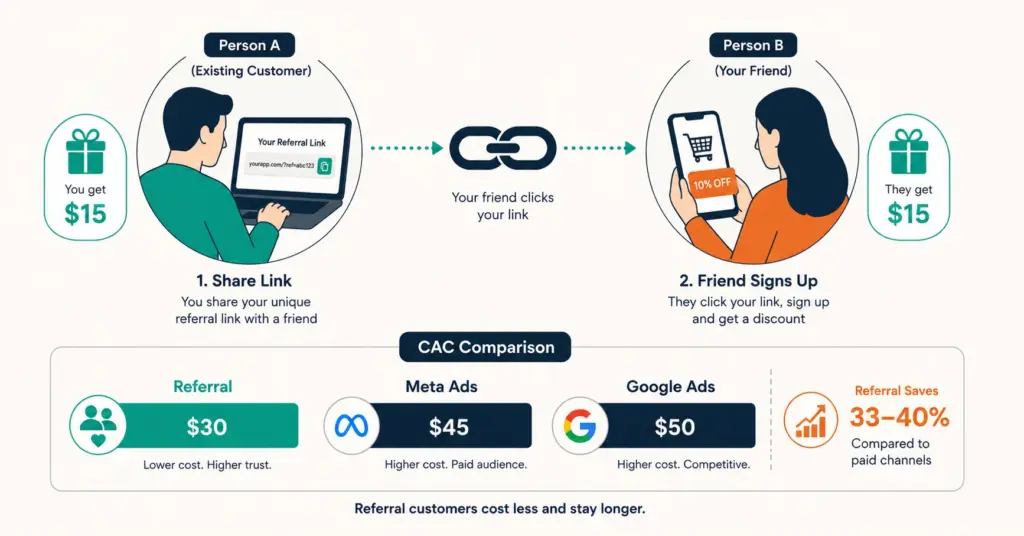
- Referred customers carry 16 to 25% higher lifetime value and retain 37% longer than customers acquired through paid channels. With Meta CPMs up 26% and Google Shopping CPCs up 19% in 2026, referral programs offer a path to sustainable growth at a fraction of paid acquisition cost.
- The dual-incentive structure ("Give $15, Get $15") converts 3 to 5x better than one-sided rewards because both parties benefit. The referrer earns credit for sharing something they genuinely like. The friend gets a discount that reduces the hesitation of buying from an unfamiliar store for the first time. Trust transfers from the referrer to the brand, which is why referred customers convert at higher rates than cold traffic from ads. Set the reward value at 10 to 20% of your AOV for the sweet spot between attractive and margin-safe.
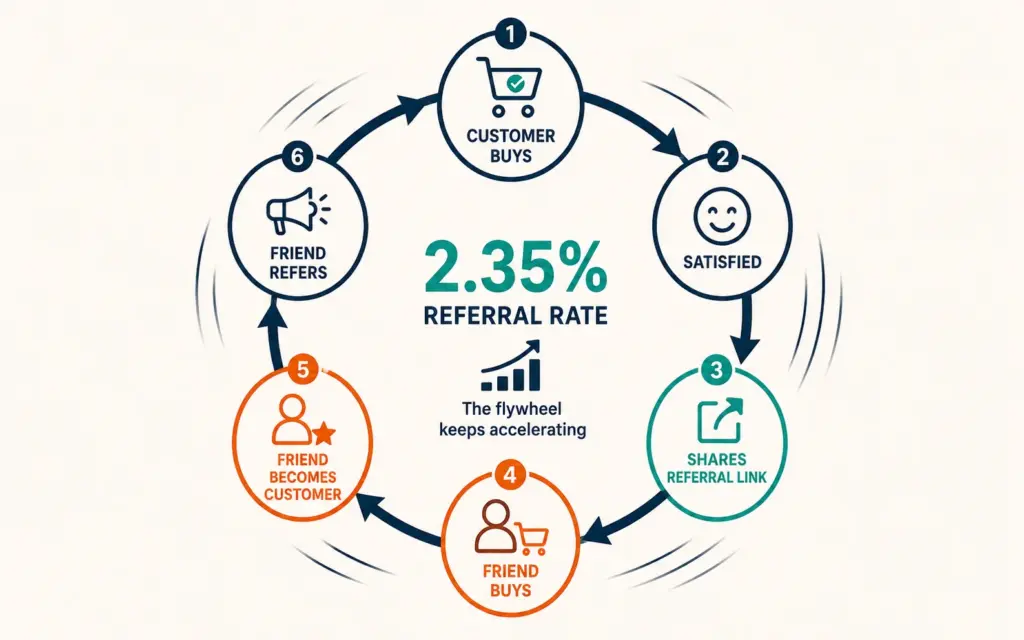
- The average ecommerce referral rate is 2.35% (percentage of customers who successfully refer). That sounds low, but the math compounds: 10,000 customers at 2.35% referral rate = 235 new customers acquired at near-zero marginal cost. Those 235 customers then enter the referral loop themselves.
- Referral fraud is real and destroys program economics if you don't plan for it. Self-referral across accounts, disposable email addresses, and fake signups account for 5 to 10% of reward costs without controls. Device fingerprinting, email domain blocking, and purchase-verified reward release are the three minimum fraud prevention controls to implement before launching.
Ecommerce referral programs give your existing customers a structured reason to tell their friends about your store, with a reward for both sides when the friend actually buys. It’s word-of-mouth marketing with a system behind it. Without the system, satisfied customers might mention you to someone, someday, maybe. With the system, they share a specific link, the friend gets a specific incentive, and you get a trackable new customer at a known acquisition cost.
The economics are hard to argue with. Paid acquisition costs crossed a tipping point in 2026. According to DigitalApplied’s referral program data, referred customers carry 16 to 25% higher lifetime value and retain longer than paid-acquisition buyers. That higher LTV means you can afford to invest in the program because each referred customer is worth more over time than a customer you bought through Meta or Google. The lifetime value calculation for your business should separate referred customers from ad-acquired customers to quantify this premium.
Program Design: The Structure That Works
Dual-incentive (“Give X, Get X”)
The referrer shares a unique link. When their friend uses the link and makes a purchase, both people get a reward. The referrer gets store credit, a discount on their next order, or cash. The friend gets a discount on their first purchase. Both sides win. This dual structure converts 3 to 5x better than single-sided referrals (where only the referrer is rewarded) because the friend has an incentive to use the link rather than just buying directly.
Set reward values at 10 to 20% of your AOV. If AOV is $60, offer “Give $10, Get $10.” If AOV is $100, offer “Give $15, Get $15.” Below 10% of AOV and the reward doesn’t feel meaningful. Above 20% and it eats into margins too aggressively. The ecommerce pricing strategy should include referral reward costs as a standard acquisition expense alongside ad spend.
Reward types ranked by effectiveness
Store credit (most effective for repeat-purchase products). “$15 credit toward your next order” drives repeat purchases because the referrer has to come back to use it. This creates a double revenue event: the referred customer’s first order plus the referrer’s next order.
Percentage discount (most effective for first-purchase conversion). “Give 15% off, Get 15% off” is easy to understand and works across varying cart sizes. The referred friend sees an immediate price reduction on their first order.
Free product (most effective for low-cost, high-margin items). “Refer 3 friends, get a free [product]” works when the product cost is low enough to absorb. Skincare samples, coffee bags, and accessories with $3 to $8 COGS make effective free product rewards.
Cash/gift card (least margin-friendly but highest perceived value). Cash rewards drive the highest referral rates but are the most expensive because there’s no guaranteed repeat purchase. Use cash only when referral acquisition economics clearly beat paid channel CAC.
Referral Program Economics
Compare referral cost per acquisition against your paid channels:
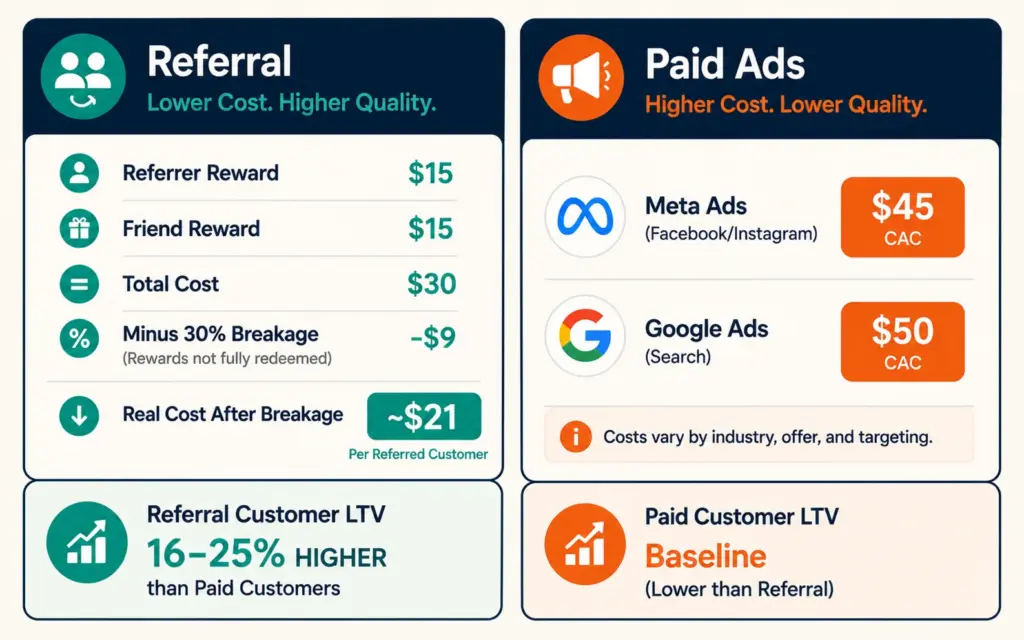
A “Give $15, Get $15” program on a $60 AOV product costs $30 per referred customer ($15 to the referrer + $15 discount to the friend). If your Meta ads CAC is $45 and your Google CAC is $50, referral at $30 is 33 to 40% cheaper per customer. And the referred customer has 16 to 25% higher LTV.
Not all of the $30 cost is real cash out. The $15 referrer credit only costs you when they redeem it, and 20 to 30% of store credits expire unused (breakage). The $15 friend discount is a revenue reduction, not a cash expense. Real cost per referral is typically 60 to 70% of the stated reward values. The customer acquisition cost comparison should include referral as a distinct channel with its own CAC calculation.
According to OpenLoyalty’s ecommerce referral benchmark, the average ecommerce referral rate is 2.35%. Set your expectations here. Not every customer refers. But the ones who do bring in customers who are pre-qualified by personal trust, which is why they convert and retain better.
When to Ask for Referrals
Timing the referral ask determines whether 1% or 5% of customers participate.
Post-purchase (highest conversion moment). The thank-you page and order confirmation email are the peak satisfaction moments. The customer just bought. They feel good about their decision. Ask now: “Share [Brand] with a friend and you both get $15.” Place the referral prompt on the order confirmation page and in the confirmation email. The email marketing strategy post-purchase sequence should include a referral ask in the second or third email after delivery.
Post-delivery (highest satisfaction moment). 7 to 14 days after delivery, the customer has used the product and (hopefully) loves it. The review request email and referral ask can be combined or sent sequentially. “Loving your [product]? Share with friends and you both save.” The reviews and social proof collection and referral asks work in sequence: ask for a review first, then ask for a referral.
Milestone triggers. After a customer’s 3rd purchase, after they reach VIP status in your loyalty programs system, or on their account anniversary. Milestone-triggered referral asks convert 2 to 3x higher than generic asks because the customer has demonstrated sustained engagement.
Referral Program Tools
| Tool | Best For | Cost |
|---|---|---|
| ReferralCandy | Shopify stores, automated workflows | $59/month + commission |
| Smile.io | Combined referral + loyalty program | Free to $599/month |
| Yotpo Referrals | Combined reviews + referrals + loyalty | $199+/month |
| Friendbuy | Mid-market to enterprise, advanced A/B testing | $249+/month |
If you already use Smile.io for loyalty (as recommended in the loyalty programs guide), its referral feature avoids adding another tool. If referrals are your primary growth channel and you need dedicated analytics and A/B testing on referral mechanics, ReferralCandy or Friendbuy provide more depth. The ecommerce tools and tech stack should avoid stacking referral, loyalty, and review tools from 3 different vendors when one platform (Yotpo or Smile.io) can handle 2 or 3 of those functions.
Fraud Prevention: Build It In Before Launch
Referral fraud is the part every launch guide skips and every program operator regrets not addressing. Without controls, 5 to 10% of your reward spend goes to self-referral schemes, fake accounts, and people gaming your system.
Three minimum controls:
- Device fingerprinting. Detect when the same device creates multiple accounts to self-refer. Most referral platforms include this natively. Enable it.
- Disposable email blocking. Block domains like mailinator.com, guerrillamail.com, and similar temporary email services. A real friend uses their real email. A fraudster uses a throwaway.
- Purchase-verified reward release. Don’t credit the referrer’s reward until the referred friend’s order clears your return window (14 to 30 days). This prevents credit farming through fake purchases that get refunded. If the friend returns the product, the referrer’s reward is voided.
These three controls eliminate 80% of referral fraud without adding friction for legitimate referrers. Configure them before launch, not after you’ve already paid out $2,000 in fraudulent rewards.
Promoting Your Referral Program
A referral program buried in a footer link gets 0.5% participation. A referral program promoted at every touchpoint gets 3 to 5%.
- Thank-you page: Dedicated referral section immediately after purchase. “Your order is confirmed. Now share [Brand] and earn $15.”
- Account dashboard: Persistent referral widget showing the customer’s unique link, their referral count, and their earned rewards.
- Email sequences: Include a referral CTA in post-purchase emails, review request emails, and loyalty milestone emails. Not in every email. In the ones where satisfaction is highest.
- Package insert: A physical card in the shipment: “Love your order? Share with friends” with a QR code linking to their referral page. Physical reminders convert because they arrive at the moment of unboxing excitement.
- Social sharing: Make the referral link shareable via text message, WhatsApp, Instagram DM, and email. The easier it is to share, the more shares happen. Mobile-first share experience matters because most sharing happens on phones.
The segmentation approach should identify your most engaged customers (highest LTV, most repeat purchases, best review scores) and promote the referral program more heavily to them. Your top 10% of customers generate a disproportionate share of successful referrals.
Frequently Asked Questions
10 to 20% of your average order value for both sides of the dual incentive. At $60 AOV, offer $10 to $12 each for referrer and friend. Below 10% doesn’t motivate sharing. Above 20% erodes margins without proportional referral rate increase. Test different reward amounts over 4 to 6 week periods and compare referral rates against margin impact to find your optimal level.
The average ecommerce referral rate (percentage of customers who successfully refer at least one person) is 2.35% according to 2026 benchmark data across 3,200 Shopify and WooCommerce stores. Above 3% is strong. Above 5% is exceptional and typically indicates a product with natural word-of-mouth appeal (unique, gift-worthy, or community-driven). Below 1.5% suggests either low program visibility or insufficient reward incentive.
Store credit for most ecommerce stores. It drives repeat purchases (the referrer has to come back to use it) and costs less than cash because 20 to 30% of credits expire unused. Cash or gift cards have the highest perceived value and generate more referrals, but at higher cost and without the repeat-purchase benefit. Use cash rewards only when your CAC math clearly supports it and your product doesn’t have natural repeat-purchase potential.
Three minimum controls: device fingerprinting to catch self-referral across accounts, disposable email domain blocking, and purchase-verified reward release (don’t credit the referrer until the friend’s order clears your return window). These three controls eliminate 80% of fraud without adding friction for legitimate referrers. Configure them before launch, not retroactively.
Post-purchase (thank-you page and order confirmation email) and post-delivery (7 to 14 days after the product arrives). These are peak satisfaction moments when customers are most willing to share. Milestone triggers (3rd purchase, VIP status, account anniversary) also perform well. Don’t ask for referrals before the customer has received and used the product. Premature asks feel transactional and produce lower participation rates.
Yes, but the absolute numbers are small until your customer base grows. A store with 200 customers and a 2.35% referral rate generates about 5 referrals per month. Still worth setting up because: it costs nothing to run on Smile.io’s free tier, it establishes the system early, and those 5 referred customers enter the referral loop themselves. The program compounds over time. Start it alongside your first sales, not after you hit some arbitrary scale threshold. The compound effect of even a small referral program over 12 months is meaningful: 5 referrals per month becomes 60 new customers per year at near-zero acquisition cost, each with higher LTV than an ad-acquired customer.
Related Reads
- Loyalty Programs
- Customer Acquisition Cost
- Lifetime Value Calculation
- Email Marketing Strategy
- Segmentation
- Ecommerce Customer Retention
Enjoying this? Get more like it every week.
One email per week with ecommerce strategies, tool picks, and seller insights. No spam.