
- Shopify is the best ecommerce platform for dropshipping for most sellers because of its 8,000+ app ecosystem, native integrations with DSers, Spocket, and CJdropshipping, and the fastest path from zero to live store (under 24 hours).
- WooCommerce is the best free option for dropshippers who already use WordPress and want maximum customization. BigCommerce wins for sellers who plan to scale across multiple sales channels without stacking app fees.
- The platform matters less than most beginners think. Your product selection, supplier reliability, and marketing execution determine whether you make money. The platform is just the infrastructure that holds it together.
- Avoid platforms that lock you into annual contracts before you've validated demand. Free trials and monthly billing let you test without financial risk. Every platform below offers trial or free-tier access.
The best ecommerce platform for dropshipping is the one that connects you to reliable suppliers, processes orders efficiently, and doesn’t eat your thin margins with excessive fees, all while being simple enough that you spend your time marketing products instead of fighting your tech stack. For most sellers, that’s Shopify. But “most” doesn’t mean “all,” and the right platform depends on your budget, technical skills, and growth plans.
I’ve ranked seven platforms based on the four things that actually matter for dropshipping: supplier app availability (can you connect the suppliers you need?), total cost per sale (platform fee + transaction fee + app fees), ease of setup and daily operations, and scalability when you grow from 10 orders a week to 100.
If you’re still deciding whether dropshipping is the right model for you, read that first. If you’ve decided on dropshipping and need to pick a platform, this comparison gives you the answer. For the full platform landscape beyond dropshipping, our ecommerce platform comparison covers all business models.
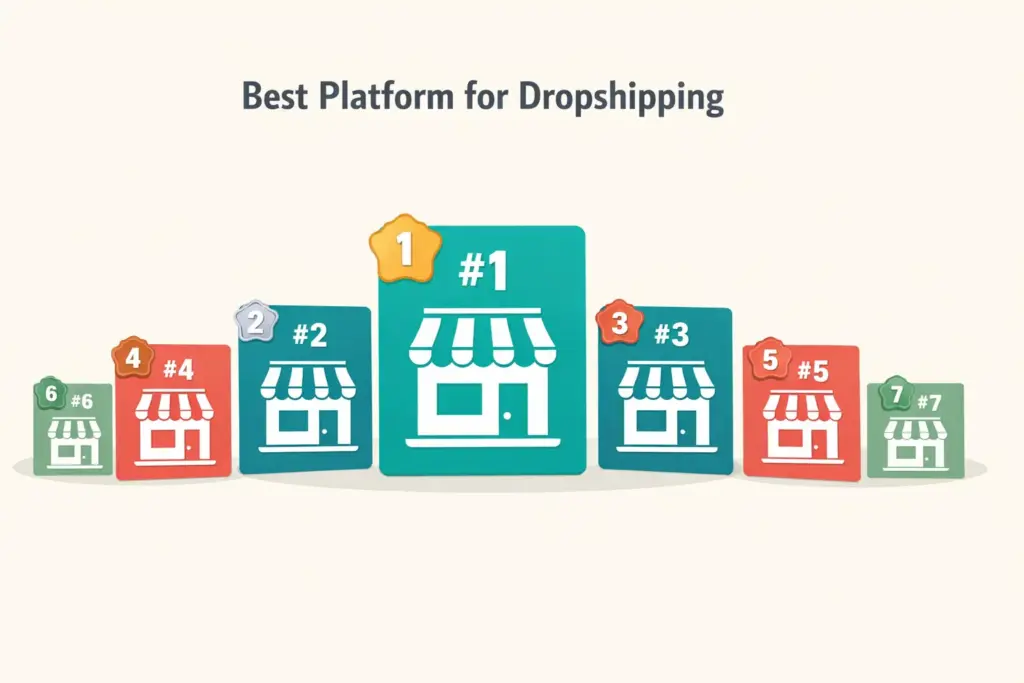
Quick Comparison: 7 Dropshipping Platforms Ranked
| Rank | Platform | Monthly Cost | Transaction Fee | Dropship Apps | Best For |
|---|---|---|---|---|---|
| 1 | Shopify | $39/mo | 2.9% + $0.30 | 500+ | Most dropshippers, beginners to advanced |
| 2 | WooCommerce | $0 (hosting $10-30/mo) | 2.9% + $0.30 (Stripe) | 200+ | WordPress users, budget-conscious sellers |
| 3 | BigCommerce | $39/mo | 0% (no extra fees) | 50+ | Multi-channel sellers, SEO-focused stores |
| 4 | Wix | $27/mo | 0% (payment processor only) | 30+ | Design-focused stores, small catalogs |
| 5 | Squarespace | $33/mo | 3% (Basic) / 0% (Business+) | 15+ | Brand-focused stores, visual products |
| 6 | Ecwid | $0-82/mo | Payment processor only | 20+ | Adding dropshipping to existing website |
| 7 | Big Cartel | $0-28/mo | Payment processor only | 5+ | Artists, micro-stores under 50 products |
1. Shopify: The Default Choice for Dropshipping
Shopify dominates dropshipping for one reason: ecosystem. Over 500 dropshipping-specific apps in the Shopify App Store connect you to suppliers worldwide. DSers (free tier, 3,000 products from AliExpress), Spocket (US/EU suppliers), CJdropshipping (warehousing and custom packaging), and Printful (print on demand) all integrate natively.
Why it wins for dropshipping:
- One-click product import from suppliers directly into your store
- Automated order fulfillment (customer orders, supplier ships, tracking updates automatically)
- Built-in abandoned cart recovery, discount codes, and shipping calculations
- 3-day free trial + $1/month for first 3 months makes testing nearly free. See current Shopify trial details.
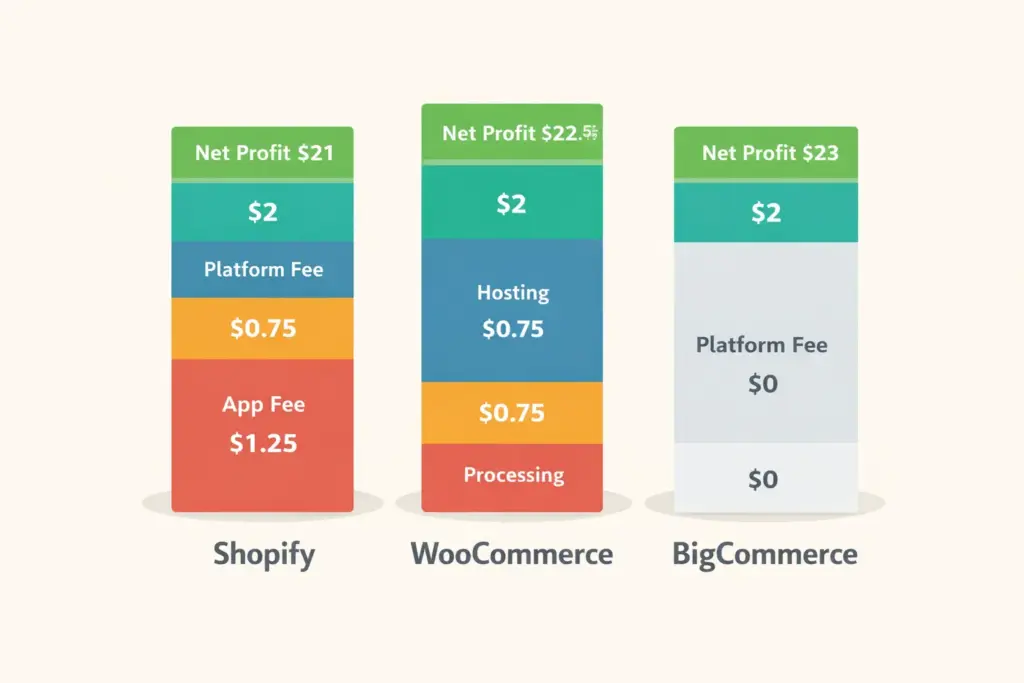
Where it falls short: The 2.9% + $0.30 transaction fee (via Shopify Payments) plus the 2% surcharge if you use a third-party gateway adds up on low-margin dropshipping products. On a $25 product with a $7 margin, Shopify takes about $1.03, leaving you $5.97. That’s manageable but tighter than platforms with zero transaction fees.
Monthly cost for dropshippers: $39 (Basic) + $0-30 in apps = $39-69/month total.
2. WooCommerce: Best Free Dropshipping Platform
WooCommerce is a free WordPress plugin that turns any WordPress site into an online store. For dropshippers who already have a WordPress site or want maximum control over their store, WooCommerce provides flexibility that hosted platforms can’t match.
Why it works for dropshipping:
- Zero platform fees. You only pay for hosting ($10-30/month) and payment processing
- AliDropship plugin ($89 one-time) automates AliExpress product imports and order fulfillment
- Full control over every aspect of your store, from URL structure to checkout flow
- WordPress’s plugin ecosystem (59,000+) offers solutions for any need
Where it falls short: Setup requires more technical knowledge than Shopify. You’re responsible for hosting, security, updates, and backups. Things that Shopify handles automatically require manual attention on WooCommerce. For beginners with no WordPress experience, the learning curve adds weeks to your launch timeline.
Monthly cost for dropshippers: Hosting $10-30 + AliDropship $89 one-time + Stripe processing 2.9% + $0.30.
3. BigCommerce: Best for Multi-Channel Dropshipping
BigCommerce charges zero transaction fees on all plans, which gives it a margin advantage over Shopify for every sale. Its built-in multi-channel selling connects your store to Amazon, eBay, Walmart, Facebook, Instagram, and Google Shopping without additional app fees.
Why it works for dropshipping:
- Zero transaction fees on every plan (Shopify charges 0.5-2% on non-Shopify Payments)
- Native multi-channel selling included (Shopify requires paid apps for some channels)
- Strongest built-in SEO features of any hosted platform
- Inventory Source and Spocket integrate for dropshipping supplier connections
Where it falls short: Smaller dropshipping app ecosystem (50+ vs Shopify’s 500+). Fewer AliExpress-specific integrations. The admin panel is more complex than Shopify’s, which matters when you’re managing dozens of products daily.
Monthly cost for dropshippers: $39 (Standard) + $0-30 in apps = $39-69/month, but zero transaction fees save money at scale.
4. Wix: Best for Design-First Dropshippers
Wix’s drag-and-drop editor creates visually stunning stores without design skills. For dropshippers selling products where brand aesthetics drive purchasing decisions (fashion, home decor, beauty), Wix lets you build a store that looks custom-designed.
Why it works: Beautiful templates, intuitive editor, Modalyst integration for dropshipping, and zero transaction fees on Business plans. Where it falls short: Limited dropshipping app selection, weaker SEO than Shopify or BigCommerce, and less scalable for stores above 500 products.
Monthly cost: $27 (Business Basic) with zero extra transaction fees.
5. Squarespace: Best for Brand-Focused Dropshipping
Squarespace produces the most visually polished stores of any platform. For dropshippers building a lifestyle brand rather than a high-volume commodity store, Squarespace’s design quality creates trust and justifies premium pricing.
Why it works: Award-winning templates, built-in analytics, and Printful integration for print on demand. Where it falls short: Very limited dropshipping integrations (Printful, Spocket, and a handful of others). Not viable for AliExpress-based dropshipping. The 3% transaction fee on the Basic Commerce plan hurts margins.
Monthly cost: $33 (Business) or $36 (Basic Commerce, removes Squarespace branding).
6-7. Ecwid and Big Cartel: Niche Options
Ecwid adds ecommerce to an existing website. If you already have a blog or portfolio and want to add dropshipping products, Ecwid embeds a store widget without rebuilding your site. Free plan supports 5 products. Best for testing dropshipping as a side channel.
Big Cartel is built for artists and makers with small catalogs. Free plan supports 5 products. Useful for print-on-demand sellers with a handful of designs, but too limited for serious dropshipping operations.
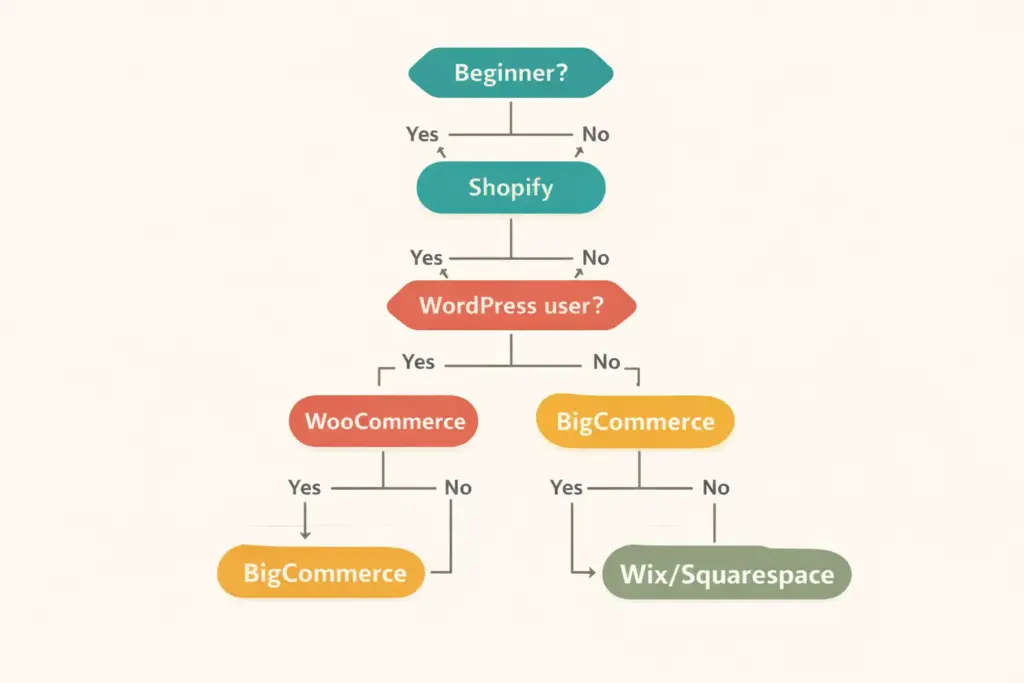
How to Choose: The Decision Framework
Answer these questions and the right platform becomes obvious:
Are you a complete beginner? Shopify. The ecosystem, support community, and guided setup remove every barrier. You’ll be selling before you finish reading comparison articles about other platforms.
Do you already use WordPress? WooCommerce. Adding the free plugin to your existing site is cheaper and faster than starting on a new platform.
Are you selling on Amazon, eBay, AND your own store? BigCommerce. Built-in multi-channel selling without app fees saves hundreds per month at scale.
Is visual branding your primary differentiator? Wix or Squarespace. Both produce more beautiful stores than Shopify’s default themes, though with fewer dropshipping integrations.
Are you testing dropshipping alongside an existing business? Ecwid. It adds ecommerce to what you already have without rebuilding.
The honest truth: platform choice accounts for maybe 10% of your success. Product selection, supplier quality, and marketing execution account for the other 90%. Don’t spend three weeks comparing platforms when you could spend three days setting up Shopify and three weeks testing products. Understanding your full startup costs matters more than saving $10/month on a platform fee.
What Matters More Than Platform Choice
Supplier reliability. A fast, reliable supplier on any platform beats a slow, unreliable supplier on the “best” platform. Vet suppliers by ordering samples, checking processing times, and reading recent reviews. Our supplier directory covers verification methods.
Product selection. The right product on the wrong platform still sells. The wrong product on the right platform still fails. Spend more time on product research than platform research.
Marketing skills. Every platform gives you a storefront. None of them give you customers. Traffic comes from TikTok content, Instagram Reels, Facebook ads, Google Shopping, and SEO. The platform that makes marketing easiest for YOUR skill set is the right choice.
Margin math. Before choosing any platform, calculate your real profit per sale: selling price minus product cost, minus shipping, minus platform fees, minus payment processing, minus estimated ad spend per sale. If the number is negative or under $5, the platform isn’t the problem. Your pricing is. Our business model comparison covers margin benchmarks across models.
Frequently Asked Questions
Shopify is the best ecommerce platform for dropshipping for most sellers due to its 500+ dropshipping apps, one-click supplier integrations (DSers, Spocket, CJdropshipping), fastest setup time, and $1/month introductory pricing. WooCommerce is the best free alternative for WordPress users, and BigCommerce wins for multi-channel sellers.
WooCommerce is free to install (you pay only for hosting at $10-30/month). Shopify offers $1/month for 3 months. Ecwid and Big Cartel have free tiers supporting 5 products each. You can also dropship for free on marketplaces like Facebook Marketplace, TikTok Shop, and Etsy with per-sale fees only. Our guide covers starting with no money in detail.
BigCommerce charges zero transaction fees on all plans, making it cheapest per sale at scale. WooCommerce has no platform fees (only hosting and payment processing). Shopify charges 2.9% + $0.30 through Shopify Payments. On a $25 product, BigCommerce saves about $0.73 per sale versus Shopify, which adds up across hundreds of monthly orders.
Shopify is better for beginners because setup takes hours instead of days, the admin is intuitive, and the app ecosystem handles every dropshipping task without technical configuration. WooCommerce is better for people who already know WordPress and want lower monthly costs. The learning curve difference is significant for true beginners.
DSers (AliExpress) works on Shopify, WooCommerce, and Wix. Spocket (US/EU suppliers) works on Shopify, BigCommerce, WooCommerce, Wix, and Squarespace. Printful (print on demand) works on nearly every platform. CJdropshipping primarily integrates with Shopify and WooCommerce. Check each app’s integration list before committing to a platform.
Yes. BigCommerce has the strongest built-in SEO (custom URLs, native schema). Shopify has good SEO with apps but forces URL prefixes. WooCommerce offers maximum SEO flexibility through WordPress plugins. Squarespace and Wix have adequate but limited SEO tools. For dropshippers who plan to rely on organic search traffic, platform SEO capabilities matter significantly.
Related Reads
- Best Ecommerce Platform Comparison
- How to Sell on Shopify Guide
- BigCommerce SEO Review
- How to Start Dropshipping
- Dropshipping Suppliers Directory
- Start Dropshipping With No Money
Enjoying this? Get more like it every week.
One email per week with ecommerce strategies, tool picks, and seller insights. No spam.