
- AI automation for ecommerce isn't about replacing you. It's about eliminating the repetitive tasks that consume 10-20 hours per week: writing product descriptions, answering the same customer questions, adjusting prices, segmenting email lists, and generating ad variations. AI handles these faster and at lower cost than any human can.
- The highest-ROI AI automations for ecommerce: AI-generated product descriptions (saves 15-30 min per product), chatbot customer service (handles 60-80% of routine inquiries), dynamic pricing (adjusts prices based on demand and competition in real-time), and personalized email campaigns (increases revenue per email 20-40%).
- You don't need enterprise budgets. Most AI ecommerce tools cost $0-100/month and integrate directly with Shopify, WooCommerce, and BigCommerce. Many have free tiers that handle small store volumes.
- Start with one AI automation that solves your biggest time drain. Master it. Then add the next one. Implementing five AI tools simultaneously creates more chaos than it eliminates.
AI automation ecommerce refers to using artificial intelligence tools to handle repetitive, data-heavy, or time-consuming tasks in your online store operations, from writing product descriptions and answering customer questions to optimizing ad spend and predicting inventory needs. The technology has matured past the hype phase into genuinely useful tools that save real hours every week for store owners willing to implement them properly.
The key word is “properly.” Most sellers either ignore AI entirely or try to automate everything at once and end up with worse results than doing it manually. The approach that works: identify your single biggest time drain, find the AI tool that solves it, implement and refine until it runs smoothly, then move to the next one.
This guide covers the ai tools for ecommerce that deliver measurable ROI, organized by business function. If you’re building your tech stack from scratch, our tools guide covers the full non-AI stack these integrate with.
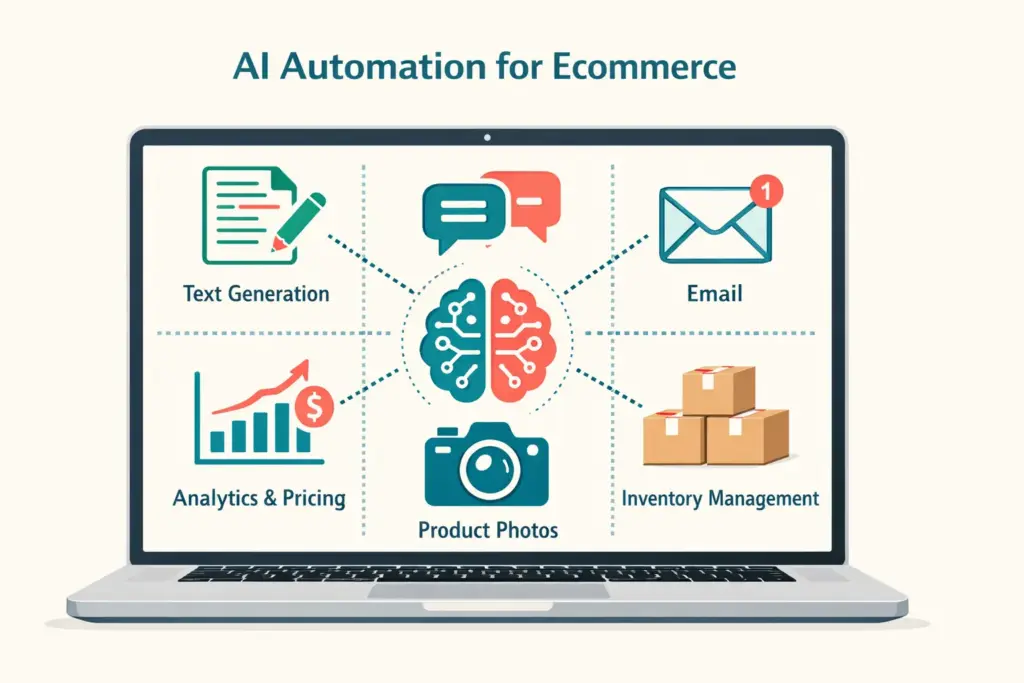
Where AI Creates the Most Value in Ecommerce
| Function | Time Saved | AI Tool Examples | Monthly Cost |
|---|---|---|---|
| Product descriptions | 15-30 min per product | ChatGPT, Jasper, Copy.ai | $0-49/mo |
| Customer service | 10-15 hrs/week | Tidio, Gorgias AI, Zendesk AI | $29-300/mo |
| Email marketing | 5-8 hrs/week | Klaviyo AI, Omnisend | $0-100/mo |
| Ad optimization | 3-5 hrs/week | Google Performance Max, Meta Advantage+ | Part of ad spend |
| Dynamic pricing | 2-4 hrs/week | Prisync, Intelligence Node | $59-299/mo |
| Product photography | 1-2 hrs per product | Photoroom, Pebblely | $0-24/mo |
| Inventory forecasting | 3-5 hrs/week | Inventory Planner, Flieber | $99-299/mo |
| Personalization | Ongoing (automated) | Nosto, LimeSpot, Rebuy | $99-500/mo |
AI for Product Content
Product Descriptions at Scale
Writing unique descriptions for 500 products takes a full-time writer two months. AI generates first drafts in seconds. The workflow that produces quality results:
- Feed AI the product specs, target audience, brand voice guidelines, and 2-3 example descriptions you’ve written and approved
- Generate descriptions in bulk (ChatGPT API, Jasper, or Copy.ai handle batch generation)
- Human review and edit every description for accuracy, brand voice, and unique selling points the AI missed
- Publish the edited versions (never publish raw AI output without review)
The result: 10-15 minutes per product (AI draft + human edit) versus 30-45 minutes writing from scratch. At 500 products, that’s 125-250 hours saved. The quality is 80-90% of fully human-written copy when you provide good inputs and edit the output.
AI Product Photography
Photoroom and Pebblely remove backgrounds, generate lifestyle settings, and create professional product images from a single phone photo. A product shot on your kitchen table becomes a product on a marble countertop with studio lighting in 30 seconds. Not a replacement for professional photography on hero products, but excellent for secondary images and social media content.
AI for Customer Service
Chatbots That Actually Help
Modern AI chatbots (Tidio, Gorgias AI, Zendesk AI) handle 60-80% of customer inquiries without human intervention. They answer shipping status questions, process return requests, provide product recommendations, and handle FAQs using your store’s data.
The key difference from older chatbots: these tools understand natural language, not just keyword matching. A customer typing “where’s my stuff” gets the same accurate response as one typing “order tracking status update.” They pull real order data from your ecommerce platform to give specific answers rather than generic responses.
Implementation priority: Start by training the chatbot on your top 20 customer questions (check your email inbox for the most common). Add order tracking integration so it can pull live shipping data. Set it to hand off to a human agent for anything it can’t confidently answer. The goal is handling routine questions automatically so you only deal with complex issues that need human judgment.
This directly supports customer retention because fast, accurate responses keep buyers happy without burning your time.
AI for Marketing
Email Marketing Automation
Klaviyo’s AI features (included in paid plans) generate subject lines, predict optimal send times per subscriber, auto-segment your list based on purchase behavior, and suggest product recommendations personalized to each recipient’s browsing history. The AI-generated subject lines consistently outperform human-written ones in A/B tests because they’re trained on billions of email performance data points.
The ecommerce automation ai workflow for email: set up your core flows (welcome, abandoned cart, post-purchase, win-back) with AI-assisted content. Let the AI optimize send times and subject lines. Review performance weekly and adjust the flows based on data. Manual intervention drops from 5-8 hours per week to 1-2 hours of review and strategy.
Ad Creative and Optimization
Google’s Performance Max and Meta’s Advantage+ campaigns use AI to optimize ad creative, targeting, and bidding simultaneously. You provide product feeds, creative assets, and conversion goals. The AI tests thousands of combinations to find what converts best.
For ad creative generation, tools like AdCreative.ai generate dozens of ad variations from your product images and copy. Instead of manually designing 10 ad versions and guessing which works, generate 50 variations and let platform AI determine the winners through real performance data.
AI for Pricing and Inventory
Dynamic Pricing
AI pricing tools (Prisync, Intelligence Node, Competera) monitor competitor prices, demand patterns, and margin targets to adjust your prices automatically. When a competitor drops their price on a product you both sell, the tool adjusts yours within minutes based on rules you set: match the competitor, undercut by 5%, or hold price if your reviews and brand justify it.
Dynamic pricing makes the most difference for stores selling 200+ products across competitive categories. For smaller catalogs, manual price monitoring is still feasible. Our pricing strategy guide covers the fundamentals these tools build on.
Inventory Demand Forecasting
AI forecasting tools (Inventory Planner, Flieber, Cogsy) analyze your sales history, seasonality patterns, marketing calendar, and external factors to predict how much stock you’ll need and when to reorder. They replace the spreadsheet-based reorder point calculations from our inventory management guide with continuously learning models that get more accurate over time.
The ROI is concrete: fewer stockouts (lost sales), less overstock (dead capital), and optimized cash flow. Stores using AI forecasting typically reduce stockout rates by 30-50% while simultaneously reducing excess inventory by 20-30%.
AI for Personalization
Artificial intelligence ecommerce personalization means showing each visitor products, content, and offers tailored to their behavior rather than the same experience for everyone. Tools like Nosto, LimeSpot, and Rebuy analyze browsing patterns, purchase history, and similar-customer behavior to generate recommendations that convert 3-5x better than generic “bestseller” displays.
Implementation on Shopify or WooCommerce takes under an hour: install the app, connect your product catalog, and the AI starts learning from visitor behavior immediately. Meaningful personalization results appear after 2-4 weeks of data collection. The “customers who bought this also bought” section on Amazon drives 35% of their revenue. You can replicate this effect on your own store with these tools.
What NOT to Automate With AI
Brand voice and strategy decisions. AI generates content. Humans define what the brand sounds like, what it stands for, and which direction to take. Using AI to set strategy is like using GPS to choose your destination. It’s a tool for execution, not decision-making.
Complex customer complaints. An angry customer who received a damaged product needs empathy and a real solution, not a chatbot response. Set clear handoff triggers so AI routes emotional or complex issues to human agents immediately.
Product quality decisions. AI can analyze review sentiment to flag quality trends, but the decision to change suppliers, reformulate products, or pull items from your catalog requires human judgment informed by context the AI doesn’t have.
Financial and legal decisions. AI can surface data for tax and legal compliance, but interpreting regulations and making compliance decisions requires professional human judgment. AI-generated legal policies are a starting point, not a finished product.
Implementation Roadmap
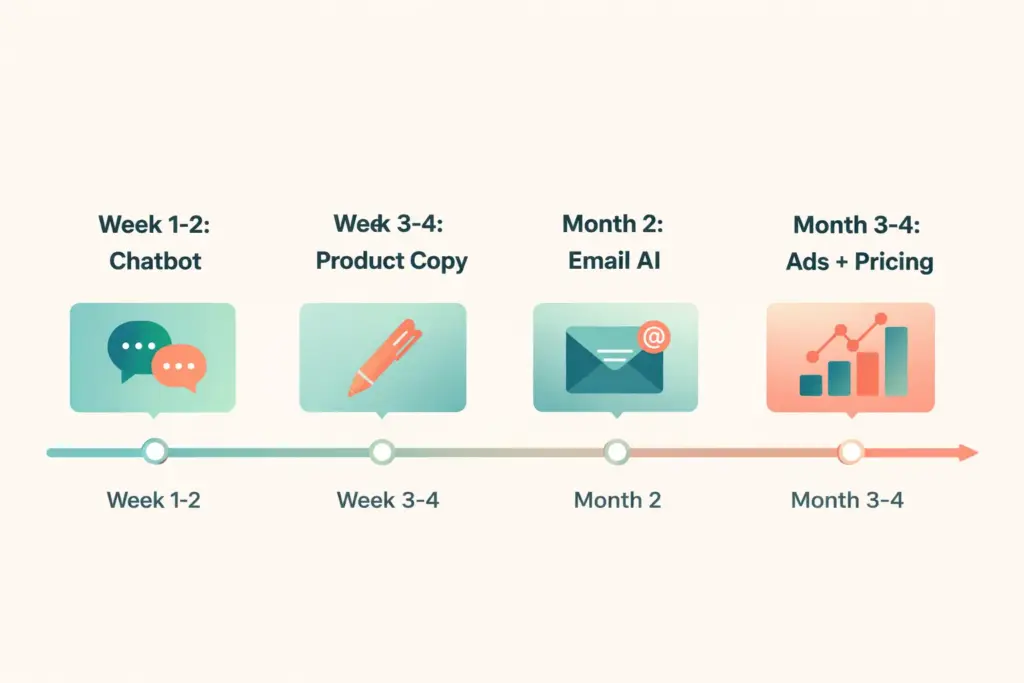
Don’t automate everything at once. Follow this priority order based on time saved per dollar spent:
- Week 1-2: AI customer service chatbot. Highest immediate time savings. Handles 60-80% of routine questions from day one. Start with Tidio (free tier available).
- Week 3-4: AI product descriptions. Generate drafts for your catalog backlog. Use ChatGPT or Copy.ai with your brand voice guidelines.
- Month 2: AI email optimization. If using Klaviyo, enable AI features for subject lines, send times, and segmentation. If not, this is a reason to switch from basic email tools.
- Month 3: AI ad optimization. Switch to Google Performance Max or Meta Advantage+ for your paid campaigns. Let AI handle bidding and creative testing.
- Month 4+: Personalization and dynamic pricing. These require more data (3+ months of traffic and sales) to work effectively. Add once your store has consistent daily traffic.
Each addition should be stable before adding the next. An ai for online stores strategy that works is one that’s implemented carefully, not one that’s implemented all at once. Choose the right ecommerce platform and apps that support the AI integrations you plan to use.
Frequently Asked Questions
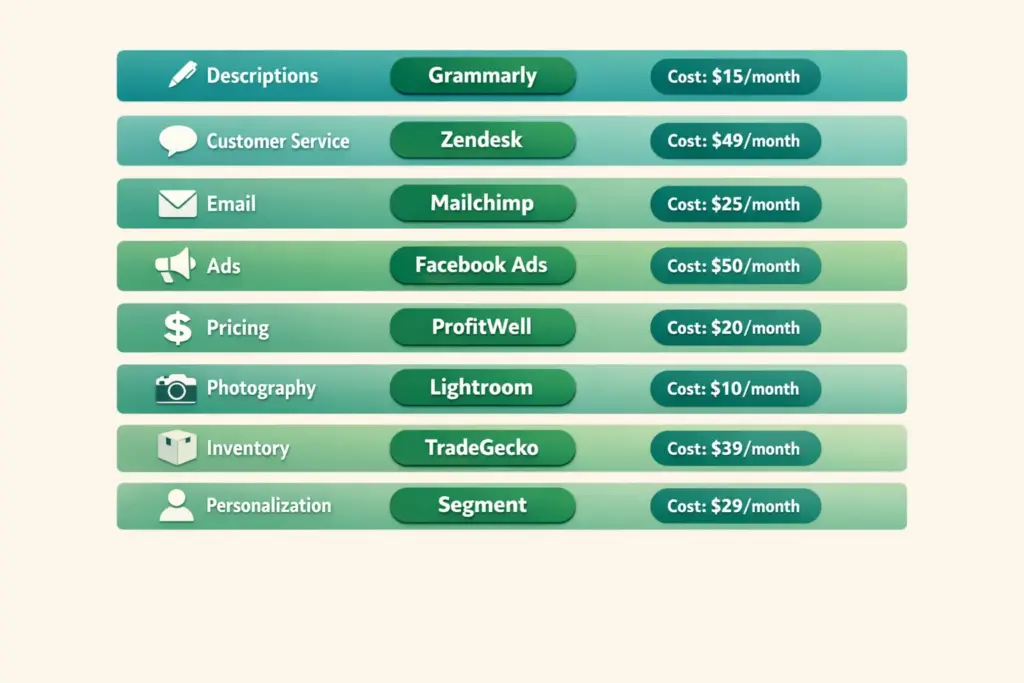
By function: ChatGPT or Copy.ai for product descriptions ($0-49/mo), Tidio or Gorgias for AI customer service ($29-300/mo), Klaviyo for AI-powered email marketing ($0-100/mo), Google Performance Max for ad optimization (included in ad spend), Prisync for dynamic pricing ($59-299/mo), and Nosto or LimeSpot for personalization ($99-500/mo). Start with the function that consumes the most of your time.
Basic AI automation (chatbot + product descriptions + email AI) costs $30-150/month using free tiers and affordable tools. Mid-level automation adding pricing and personalization runs $200-500/month. Enterprise-level automation with forecasting, full personalization, and advanced analytics costs $500-2,000/month. Most small stores get 80% of the value from the basic tier.
AI generates 80-90% quality first drafts when given proper inputs (specs, target audience, brand voice, example descriptions). The key is human editing: review every AI description for accuracy, add unique selling points the AI missed, and ensure brand voice consistency. Never publish raw AI output. The time savings come from editing a draft (10-15 min) versus writing from scratch (30-45 min).
Modern AI chatbots improve customer experience for routine inquiries by providing instant accurate answers (shipping status, return policies, product questions) 24/7 instead of making customers wait hours for email responses. They hurt experience when they can’t handle complex issues, so always set clear handoff triggers to route emotional or complicated situations to human agents immediately.
Start with AI customer service (chatbot). It delivers the highest immediate time savings by handling 60-80% of routine inquiries automatically. Second priority: AI product descriptions for any catalog backlog. Third: AI email optimization for subject lines and send times. Add pricing and personalization AI after 3+ months when you have enough data for the algorithms to learn effectively.
Yes, especially for solo operators and small teams. A solo store owner spending 15 hours per week on customer emails, product descriptions, and manual tasks can reclaim 8-10 of those hours with basic AI automation ($30-150/month). That time gets reinvested in marketing, product development, or simply reducing burnout. The ROI is strongest when you’re the bottleneck in your own business.
Related Reads
- Ecommerce Tools and Tech Stack
- Inventory Management Guide
- Customer Retention Strategies
- Ecommerce SEO Guide
- Best Shopify Apps
- Ecommerce Startup Costs
Enjoying this? Get more like it every week.
One email per week with ecommerce strategies, tool picks, and seller insights. No spam.