
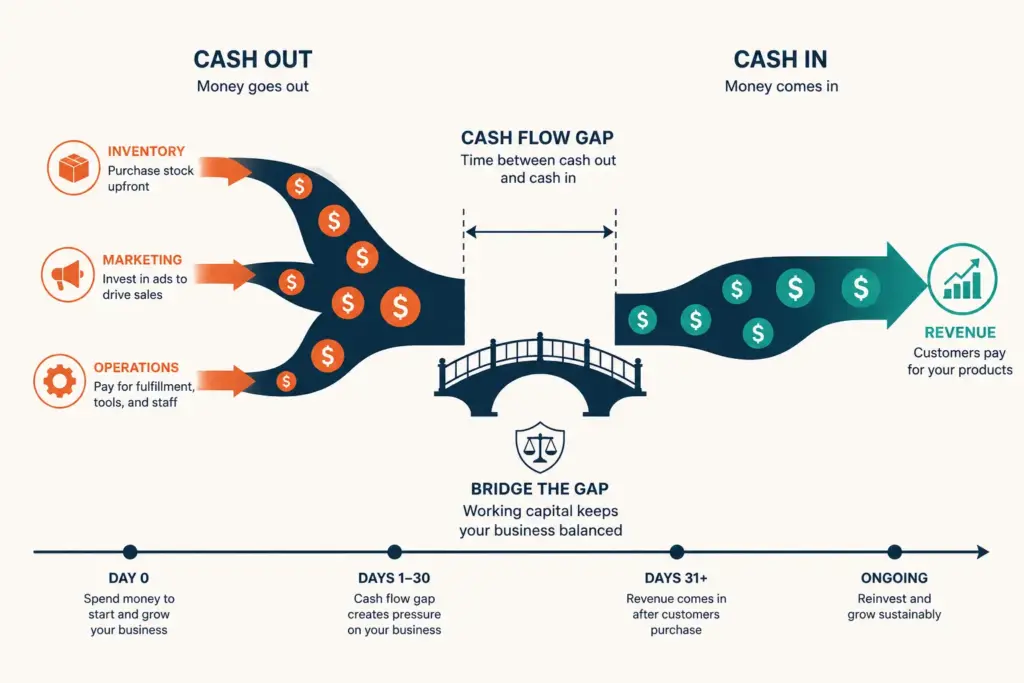
- Cash flow management for ecommerce is the practice of tracking, forecasting, and optimizing the timing of money entering and leaving your business. Profitable ecommerce stores fail when cash outflows (inventory, marketing, operations) consistently precede cash inflows (customer payments), creating gaps that compound during growth.
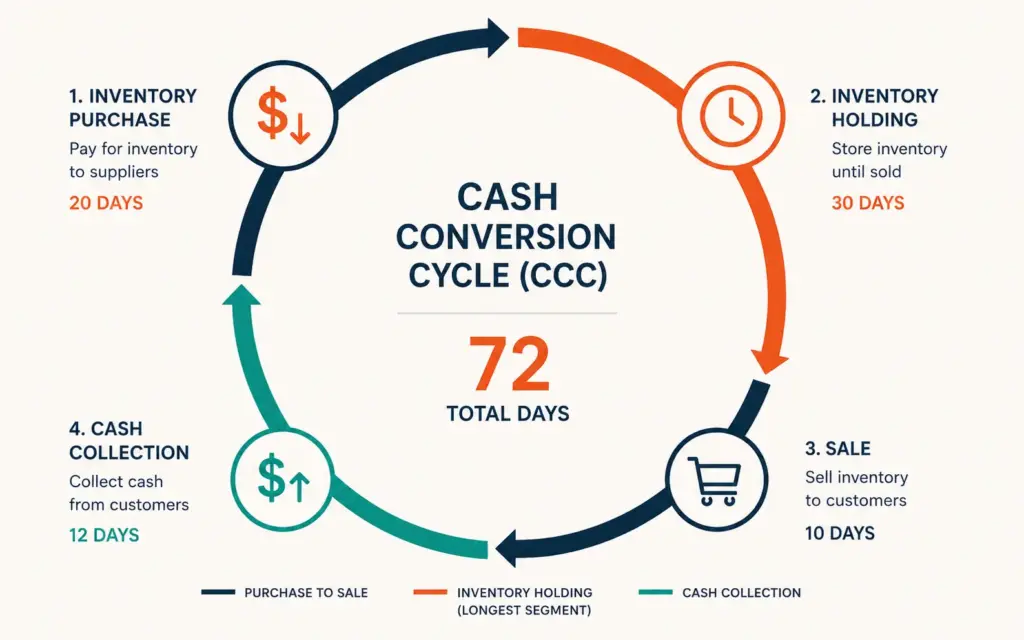
- The cash conversion cycle is the core metric: days between paying suppliers and collecting customer payment. Average ecommerce CCC runs 30 to 90 days. Shortening CCC by even 15 days can free $30,000 to $100,000 in working capital for a $500k annual revenue business.
- The 7 cash flow optimization tactics: negotiate extended supplier terms (Net 60 to Net 90), reduce inventory holding days, use revenue-based financing for inventory purchases, accelerate payment collection (offer early-pay discounts to B2B customers), cut unused SaaS subscriptions, time marketing spend to revenue patterns, and maintain a 2 to 3 month emergency reserve.
- The most dangerous cash flow mistake is confusing profit with cash. A store showing $10,000 monthly profit on the income statement can simultaneously have negative cash flow if $40,000 is locked in inventory and $15,000 in accounts receivable.
Cash flow management for ecommerce is the discipline of ensuring your business always has enough cash available to pay obligations when they’re due, even when revenue and expenses arrive on different schedules. Cash flow is not the same as profit. A store can be profitable on paper while running out of cash because inventory purchases, marketing spend, and operational costs are paid weeks or months before customer revenue arrives. According to SCORE’s small business research, 82% of business failures involve cash flow problems, and ecommerce businesses with inventory-heavy models are particularly vulnerable because inventory is cash sitting on a shelf.
The fundamental challenge is timing. You pay your supplier $15,000 for inventory in January. The inventory arrives in February. You sell it through February, March, and April. The cash from those sales collects over 0 to 30 days depending on payment method and marketplace payout schedules. For 60 to 90 days, your $15,000 is locked up before it returns as revenue. Scale that to $100,000 monthly purchases and the cash gap becomes existential. For the deeper financial planning framework, see our financial planning guide.
How Does Ecommerce Cash Flow Work?
Cash inflows
- DTC store payments (Shopify, WooCommerce): Cash arrives within 1 to 3 business days through Stripe or Shopify Payments. The fastest cash conversion in ecommerce.
- Amazon payouts: Every 14 days on a rolling schedule. Amazon holds a reserve (typically 3 to 7 days of sales) as a buffer against returns and chargebacks. Cash delay: 14 to 21 days from sale to deposit.
- Walmart, Etsy, and other marketplaces: 14 to 30 day payout cycles depending on the platform and your seller tier.
- Wholesale / B2B invoices: Net 30 to Net 60 terms are standard. Cash delay: 30 to 75 days from shipment to payment.
Cash outflows
- Inventory purchases: The largest single cash outflow. Paid 30 to 90 days before the inventory generates revenue. For inventory planning, see our inventory management guide.
- Marketing spend: Continuous daily or weekly billing. Meta and Google charge when campaigns are active. Returns arrive 7 to 30+ days later through customer purchases.
- Fixed operations: Rent, payroll, software subscriptions, insurance. Paid monthly regardless of revenue.
- Shipping and fulfillment: Paid at time of shipment. Cost scales with order volume.
- Taxes: Sales tax remitted monthly or quarterly depending on jurisdiction. Income tax estimated quarterly. Large lump-sum outflows that catch unprepared stores off guard.
The cash conversion cycle (CCC)
CCC = Days Inventory Outstanding + Days Sales Outstanding – Days Payable Outstanding
Example: 60 days inventory + 7 days marketplace payout – 30 days supplier terms = 37-day CCC. Every dollar of working capital is locked up for 37 days on average. At $50,000 monthly inventory spend, that’s $61,600 constantly tied up in the cash cycle.
| Business Model | Typical CCC | Cash Pressure |
|---|---|---|
| Dropshipping | 0 to 5 days | Very low (no inventory) |
| DTC (Shopify, own inventory) | 30 to 60 days | Moderate |
| Amazon FBA | 45 to 90 days | High (storage + payout delay) |
| Wholesale + DTC | 60 to 120 days | Very high (B2B payment terms) |
What Are the 7 Tactics to Improve Ecommerce Cash Flow?
1. Negotiate extended supplier payment terms
Moving from Net 30 to Net 60 terms on $50,000 monthly inventory purchases frees $50,000 in working capital immediately. Suppliers extend terms once you’ve established 3 to 6 months of consistent ordering. The conversation: “We’re growing steadily and want to increase order frequency. Can we move to Net 60 terms?” Most suppliers prefer larger, reliable customers on extended terms over losing the account. For sourcing context, see our Alibaba sourcing guide.
2. Reduce inventory holding days
Every day of excess inventory is cash sitting on a shelf. Reduce holding from 90 to 60 days and free 33% of inventory capital. Tactics: more frequent smaller orders (weekly instead of monthly), pre-order models for new products, just-in-time replenishment for fast-moving SKUs, and aggressive clearance on slow-moving inventory (cash today is worth more than profit tomorrow on dead stock).
3. Use revenue-based financing for inventory
Revenue-based financing (Shopify Capital, Clearco, Wayflyer) advances cash for inventory purchases, repaid through a percentage of daily revenue (6 to 12%). The cost (6 to 12% factor rate) is offset by the ability to purchase inventory without depleting operating cash. Best for seasonal inventory purchases or scaling periods where cash demand spikes. According to Clearco’s ecommerce funding research, revenue-based financing is the fastest-growing non-dilutive capital source for DTC brands, with average payback periods of 4 to 8 months.
4. Accelerate payment collection
For B2B customers: offer 2% discount for payment within 10 days (“2/10 Net 30”). Most B2B customers will take the discount, converting your 30-day receivable into a 10-day receivable at a small cost. For DTC: ensure payment processor payouts are set to daily (not weekly). For Amazon: request accelerated payouts once you qualify through seller performance metrics.
5. Cut unused SaaS subscriptions
Run a quarterly tool audit. Most ecommerce stores carry 2 to 5 unused subscriptions totaling $100 to $500/month. That’s $1,200 to $6,000 per year in cash outflow for zero value. Check each tool’s last login date. If nobody used it in 30 days, cancel it. For tech stack optimization, see our ecommerce tech stack guide.
6. Time marketing spend to revenue patterns
Increase ad spend 4 to 6 weeks before peak revenue periods (holiday, back-to-school) when the cash invested in marketing returns quickly. Reduce ad spend during slow periods when the cash conversion from ad spend to revenue takes longer. Aligning marketing investment with revenue velocity shortens the effective cash cycle on marketing spend. For ad strategy, see our Facebook ads ecommerce guide.
7. Maintain a 2 to 3 month emergency reserve
Calculate your monthly fixed costs (rent, payroll, subscriptions, minimum inventory replenishment). Set aside 2 to 3 months of that amount in an accessible savings account. This reserve absorbs supply chain disruptions, ad account bans, marketplace suspensions, and seasonal dips without forcing desperate measures (fire-sale pricing, layoffs, or high-interest emergency loans). For margin protection, see our ecommerce profit margins guide.
How Do I Build a Cash Flow Forecast?
The 13-week cash flow model
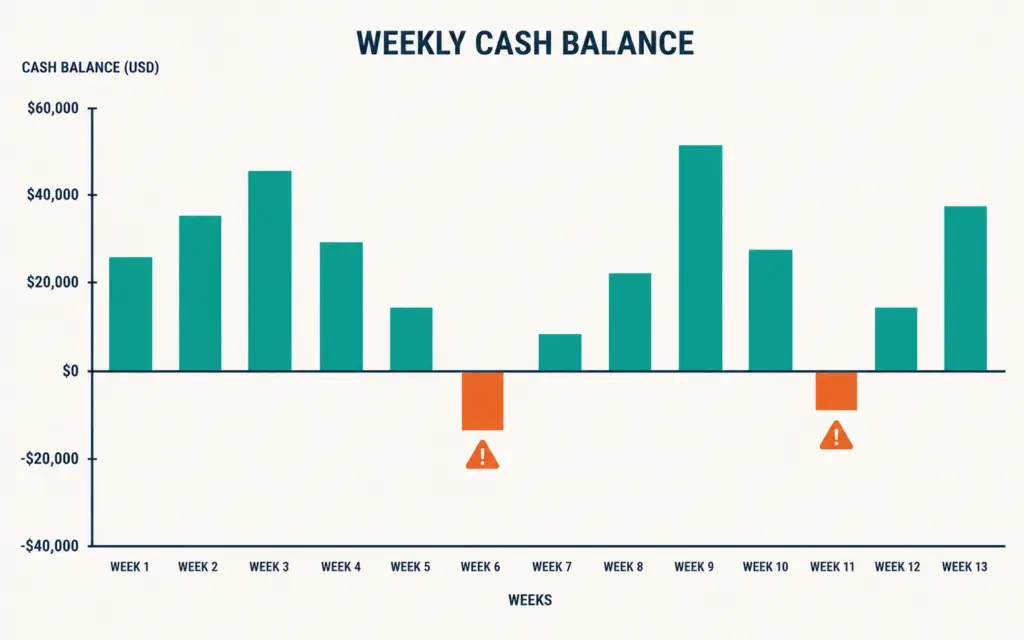
A rolling 13-week (quarterly) forecast is the most practical cash management tool for ecommerce. Update weekly with actual numbers.
- Starting cash balance: Cash in bank accounts right now
- Weekly cash inflows: Projected DTC revenue, marketplace payouts, B2B invoice collections
- Weekly cash outflows: Scheduled inventory payments, marketing spend, payroll, rent, subscriptions, tax payments, loan payments
- Net weekly cash flow: Inflows minus outflows
- Ending cash balance: Starting balance plus net cash flow. If any week shows negative ending balance, you need to arrange cash before that week arrives.
Use a simple spreadsheet. Don’t over-engineer with complex software until you exceed $500k monthly revenue. The goal is visibility into when cash gets tight so you can act 4 to 8 weeks before the crisis rather than the week of. For analytics context, see our ecommerce KPIs guide.
How Do I Handle Seasonal Cash Flow Swings?
Pre-season preparation (8 to 12 weeks before peak)
- Secure inventory financing before you need it. Apply for revenue-based financing or lines of credit during strong months, not desperate ones. Lenders offer better terms when you don’t urgently need the money.
- Pre-order inventory 90 to 120 days before peak season. Supplier lead times extend during peak periods as everyone orders simultaneously. Late orders mean late delivery, missed sales, and expedited shipping costs. For shipping logistics, see our shipping strategies guide.
- Build the cash reserve during the 3 to 4 months preceding peak season. Set aside 10 to 15% of monthly revenue specifically for seasonal cash buffer.
Post-season cash recovery
- Clear excess inventory immediately. January markdowns recover cash faster than holding unsold seasonal inventory for 11 months. 30% margin on a January clearance sale beats 0% margin on dead stock in October.
- Reduce ad spend to maintenance levels. January through February are low-conversion months for most ecommerce. Scale back to retargeting-only while maintaining brand presence. For retargeting efficiency, see our retargeting strategies guide.
- Renegotiate supplier terms after demonstrating peak-season volume. Your Q4 order sizes strengthen your negotiating position for better terms in Q1.
Common Cash Flow Mistakes
Confusing profit with cash
A store showing $10,000 monthly profit can have negative cash flow if $40,000 is locked in inventory and $15,000 in receivables. Profit is an accounting concept; cash is what pays bills. Track cash balance separately from profit margin. Both matter, but only one keeps the lights on.
Growing faster than cash supports
Doubling revenue requires doubling inventory investment, marketing spend, and operational capacity, all before the revenue arrives. Plan cash needs 90 days ahead of projected growth. If cash won’t cover the growth, slow the growth to a sustainable pace or secure financing first. For growth planning, see our financial planning guide.
No cash forecast
Flying blind on cash position leads to surprise shortfalls. A 13-week rolling forecast takes 30 minutes per week to update and prevents 100% of “I didn’t see this coming” cash crises. The time investment is negligible compared to the cost of an emergency.
Over-investing in inventory for one product
Concentrating 60%+ of available cash in a single product bet creates existential risk. If the product underperforms, you can’t replenish other SKUs, fund marketing, or pay operations. Limit any single product to 25 to 30% of total inventory investment. Diversify risk across 3 to 5 products. For product research, see our best selling products research guide.
Ignoring sales tax obligations
Sales tax collected belongs to the state, not you. Spending collected sales tax as operating cash creates a liability that compounds monthly. Set up a separate account for sales tax deposits and remit on schedule. A $50k/month store collecting 7% sales tax holds $3,500/month that isn’t yours. Over 6 months of neglect, that’s $21,000 owed plus penalties and interest. For CAC and spending context, see our customer acquisition cost guide.
Frequently Asked Questions
Cash flow management is the practice of tracking and optimizing the timing of money entering and leaving your business. For ecommerce, cash outflows (inventory, marketing, operations) consistently precede cash inflows (customer payments), creating timing gaps that can bankrupt profitable businesses. Effective cash flow management involves forecasting, extending supplier terms, reducing inventory holding periods, and maintaining emergency reserves.
The cash conversion cycle (CCC) measures days between paying for inventory and collecting customer payment. Formula: Days Inventory Outstanding plus Days Sales Outstanding minus Days Payable Outstanding. Average ecommerce CCC ranges from 30 to 90 days. A shorter CCC means cash returns faster. Reducing CCC by 15 days on $50,000 monthly inventory frees approximately $25,000 in working capital.
Maintain 2 to 3 months of fixed operating expenses in accessible cash. Calculate your monthly fixed costs (rent, payroll, subscriptions, minimum inventory replenishment) and multiply by 2 to 3. This reserve absorbs supply chain disruptions, ad account bans, marketplace suspensions, and seasonal revenue dips without requiring emergency measures like fire-sale pricing or high-interest loans.
Build a rolling 13-week cash flow forecast in a spreadsheet. Track weekly: starting cash balance, projected cash inflows (DTC revenue, marketplace payouts, B2B collections), projected cash outflows (inventory, marketing, payroll, rent, taxes), and ending cash balance. Update weekly with actual numbers. If any future week shows a negative ending balance, arrange financing or adjust spending before that week arrives.
Profit is revenue minus expenses measured over time (monthly, annually). Cash flow is the actual movement of cash in and out of your bank account. A business can be profitable while having negative cash flow: $10,000 monthly profit on the income statement with $40,000 locked in unsold inventory and $15,000 in unpaid invoices. Profit is an accounting concept; cash flow is operational reality. Both matter, but only cash pays bills.
Seven tactics that improve cash flow at current revenue: negotiate extended supplier terms (Net 30 to Net 60 frees one month of inventory capital), reduce inventory holding days (order smaller quantities more frequently), offer early-payment discounts to B2B customers (2/10 Net 30 converts 30-day receivables to 10-day), cut unused SaaS subscriptions (typical savings $100 to $500/month), time marketing spend to revenue patterns, accelerate payment processor payouts to daily, and separate sales tax into a dedicated account.
Related Reads
- Financial Planning for Scaling
- Ecommerce Profit Margins
- Inventory Management Guide
- Shipping Strategies
- Ecommerce KPIs Guide
- Customer Acquisition Cost
Enjoying this? Get more like it every week.
One email per week with ecommerce strategies, tool picks, and seller insights. No spam.