
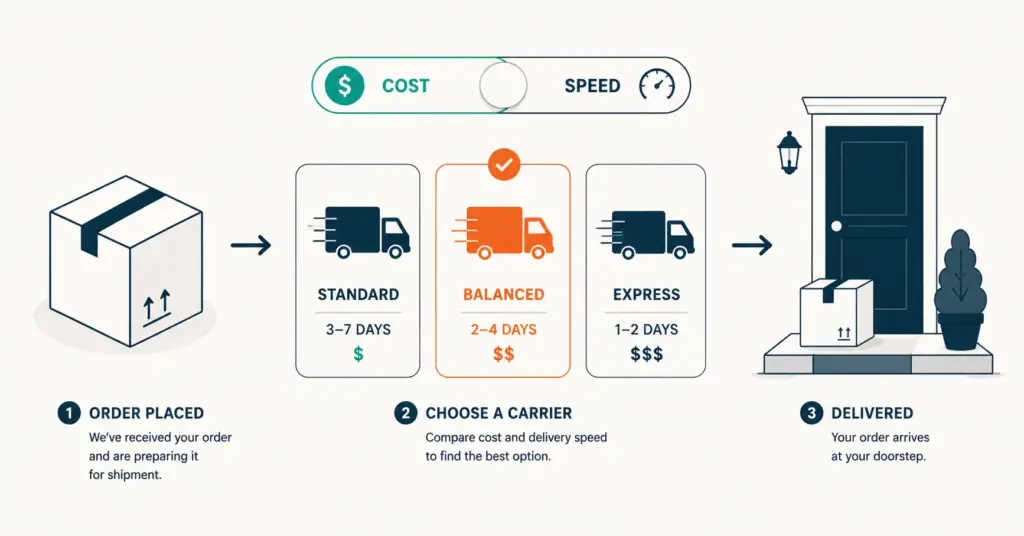
- Ecommerce shipping strategy is the set of decisions covering carrier selection, rate negotiation, packaging, speed options, and pricing (free vs flat rate vs real-time) that balance delivery cost against customer expectations. Shipping costs average 8 to 15% of revenue for most online stores.
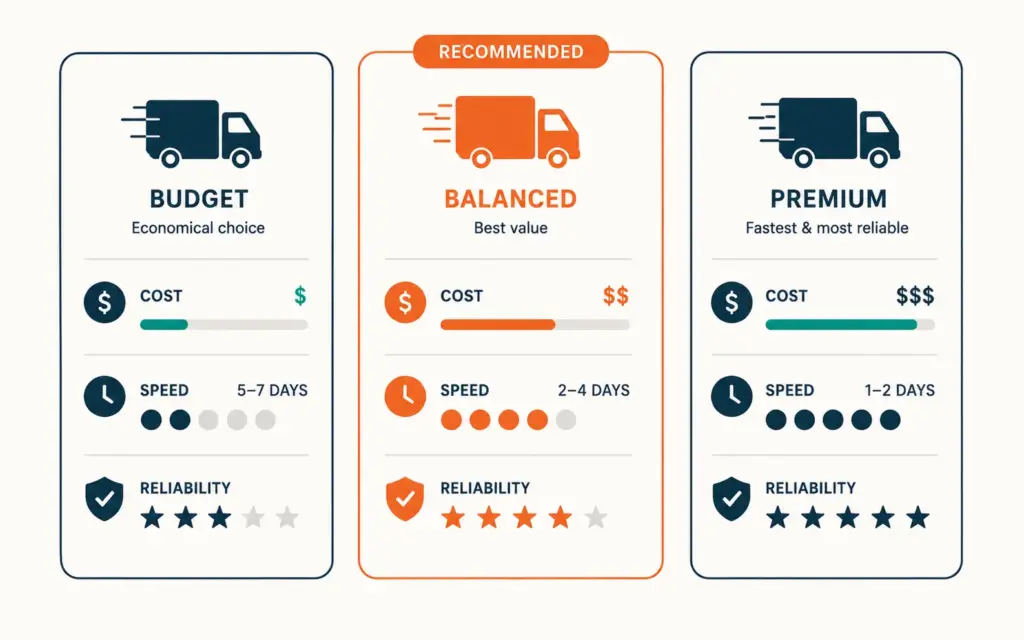
- The 3 carrier comparison factors that matter: delivered cost per package (not just label rate), average transit time to your top 10 destination zip codes, and claims resolution speed for lost or damaged packages. Price alone misleads because a cheaper carrier with 5% damage rate costs more than a premium carrier with 0.5% damage rate.
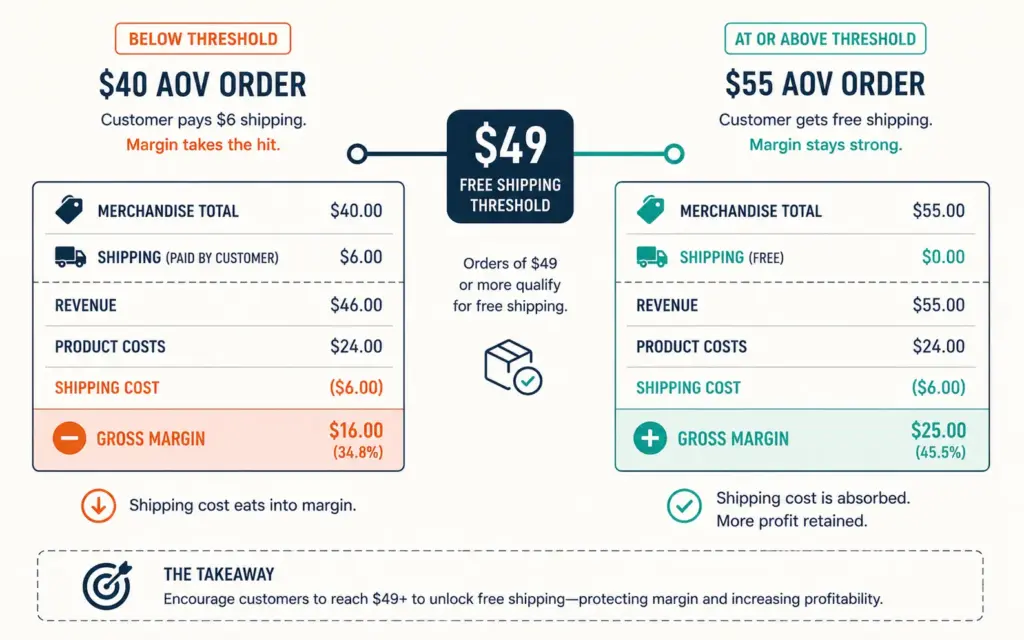
- Free shipping with a threshold 15 to 25% above average order value lifts AOV 8 to 15% while subsidizing delivery costs through larger orders. The math works when the incremental margin from higher AOV exceeds the shipping cost absorbed.
- Packaging optimization (right-size boxes, poly mailers for non-fragile items, dimensional weight awareness) reduces shipping costs 10 to 20% without carrier negotiation or rate changes.
Shipping strategies for ecommerce cover every decision between the moment an order is placed and the moment it arrives at a customer’s door: which carrier delivers it, how fast, in what packaging, at what cost to you, and at what price (or free) to the customer. Shipping typically costs 8 to 15% of revenue for ecommerce stores, making it the second or third largest expense after product cost and marketing. According to Pitney Bowes Shipping Index data, US ecommerce parcel volume exceeded 20 billion packages annually by 2024, and carrier pricing has increased 5 to 8% per year since 2020. Every percentage point saved on shipping drops directly to net margin.
The challenge is that shipping strategy involves tradeoffs that affect conversion, margin, and customer satisfaction simultaneously. Free shipping lifts conversion but costs margin. Faster delivery costs more but reduces returns and increases repeat purchases. Cheaper carriers save money but risk damage and tracking failures. The right strategy balances these tradeoffs for your specific product, price point, and customer expectations. For broader fulfillment context, see our inventory management guide.
This guide covers carrier selection, rate negotiation tactics, packaging optimization, the free shipping math, speed-tier decisions, and the measurement framework that prevents shipping from quietly eating your profit margin.
How Do I Choose the Right Shipping Carrier?
Carrier selection is the highest-impact shipping decision because it sets the baseline cost for every package you ship. The three major US carriers (USPS, UPS, FedEx) plus regional and consolidator options each fit different product and volume profiles.
Carrier comparison by product profile
| Carrier | Best For | Typical Cost Range | Speed |
|---|---|---|---|
| USPS (First Class / Priority) | Under 1 lb, low value, residential | $3.50 to $8.00 | 2 to 5 days |
| UPS Ground | 1 to 20 lb, higher value, reliability | $7.00 to $15.00 | 1 to 5 days |
| FedEx Ground | 1 to 20 lb, time-definite delivery | $7.00 to $14.00 | 1 to 5 days |
| USPS Priority Mail | Under 5 lb, flat rate options | $8.00 to $15.00 | 1 to 3 days |
| Regional carriers (OnTrac, LSO) | High volume, specific regions | 15 to 30% below UPS/FedEx | 1 to 3 days regional |
| DHL eCommerce | International, lightweight | Varies by destination | 5 to 15 days intl |
The 3-factor carrier evaluation
- Delivered cost per package: Total cost including fuel surcharges, residential surcharges, dimensional weight adjustments, and insurance. The published rate is 30 to 50% lower than the actual billed cost after surcharges.
- Transit time to your top 10 zip codes: Pull your order data, identify your top 10 destination zip codes by volume, and compare carrier transit times for those specific routes. A carrier that’s 1 day faster to your top destinations is worth 5 to 10% more in cost because speed reduces “where is my order” support tickets and return rates.
- Claims resolution: When packages are lost or damaged, how fast does the carrier process claims? USPS averages 30 to 60 days for claim resolution. UPS and FedEx average 7 to 14 days. At 1 to 3% damage or loss rate, faster resolution directly impacts customer satisfaction and cash flow.
Multi-carrier strategy
Most stores above 200 orders/month benefit from using 2 to 3 carriers. Route by package characteristics: USPS for under 1 lb, UPS or FedEx for 1 to 20 lb, regional carriers for high-density zones. Rate-shopping tools (ShipStation, Pirate Ship, EasyPost) automatically select the cheapest option per package. Multi-carrier routing saves 10 to 20% compared to single-carrier shipping.
How Do I Negotiate Lower Shipping Rates?
Carrier rates are negotiable above 50 to 100 packages per month. The negotiation process:
When to negotiate
- 50 to 200 packages/month: Request Shopify Shipping, Pirate Ship, or ShipStation pre-negotiated rates. These aggregators pool volume from thousands of merchants for discounts you can’t get individually. Typical savings: 15 to 30% off retail rates.
- 200 to 1,000 packages/month: Contact UPS and FedEx account reps directly for custom pricing. Provide 3 months of shipping data (package count, weights, dimensions, destinations). Typical savings: 25 to 40% off retail.
- 1,000+ packages/month: Negotiate annually with multiple carriers bidding against each other. Share competitor quotes. Typical savings: 35 to 55% off retail.
What to negotiate beyond rate
- Fuel surcharge caps: Fuel surcharges add 5 to 15% to every shipment. Negotiate a cap (e.g., “fuel surcharge never exceeds 8%”) or a reduced surcharge percentage.
- Dimensional weight divisor: UPS and FedEx use dimensional weight (L x W x H / divisor) when it exceeds actual weight. The standard divisor is 139. Negotiating a divisor of 166 or 200 reduces dimensional weight charges 15 to 30% on larger packages.
- Residential surcharge reduction: Residential delivery surcharges add $3 to $5 per package. Negotiate reduced or waived residential surcharges if 80%+ of your deliveries are residential (most DTC brands).
- Free pickup: Daily carrier pickup saves time vs drop-off. Most carriers provide free pickup above 5 packages/day.
Should I Offer Free Shipping?
Free shipping is the most powerful conversion lever in ecommerce, but the math must work or it destroys margin.
The free shipping threshold model
“Free shipping on orders over $X” is the highest-ROI approach. Set the threshold 15 to 25% above your current average order value. If AOV is $40, set free shipping at $49 or $55. Customers add items to reach the threshold, lifting AOV 8 to 15% while the higher order value subsidizes the shipping cost you absorb.
The free shipping math
Example: Your average shipping cost is $6. Your gross margin is 50%. A $40 AOV produces $20 gross margin. Absorbing $6 shipping cuts margin to $14 (35% net of shipping). Not sustainable. A $55 AOV (from the free shipping threshold) produces $27.50 gross margin minus $6 shipping = $21.50 (39% net). The threshold model makes free shipping profitable. For margin calculation depth, use our profit margin calculator.
When flat-rate shipping wins
Flat-rate shipping ($4.99 or $5.99 flat) works when your products vary significantly in weight and size, making free shipping economically impossible on heavy items. Flat rate is psychologically better than variable real-time rates because customers know the cost before adding to cart. The perceived fairness of flat rate reduces checkout abandonment compared to surprise calculated rates at checkout. For checkout optimization depth, see our checkout optimization guide.
When real-time calculated rates work
Real-time carrier-calculated rates work for B2B stores, heavy/oversize products, and international shipping where the range of possible shipping costs is too wide for flat rate or free thresholds. Always show the calculated rate on the cart page, not first at checkout, to avoid cost-shock abandonment.
How Does Packaging Optimization Reduce Costs?
Packaging is the overlooked shipping cost lever. Right-sizing packages reduces dimensional weight charges, cuts material costs, and lowers damage rates.
Dimensional weight awareness
Carriers charge whichever is higher: actual weight or dimensional weight (L x W x H / 139 for UPS/FedEx). A 1 lb product in a 12x12x12″ box has a dimensional weight of 12.4 lbs. You’re billed for 12.4 lbs, not 1 lb. Switching to a 8x6x4″ box drops dimensional weight to 1.4 lbs. The packaging change saves $3 to $8 per shipment on the exact same product.
Packaging optimization tactics
- Stock 3 to 5 box sizes: Most stores ship everything in 1 to 2 box sizes. Adding 2 to 3 smaller options reduces average dimensional weight 15 to 25%.
- Use poly mailers for non-fragile items: Apparel, accessories, and soft goods ship in poly mailers at First Class or Ground rates without dimensional weight surcharges. Poly mailers cost $0.10 to $0.30 vs $0.50 to $1.50 for boxes.
- Eliminate excess void fill: Air pillows and packing peanuts add weight and increase box size requirements. Form-fitting inserts or right-sized boxes eliminate the need for void fill entirely.
- Consider branded packaging ROI: Custom branded boxes ($1.50 to $4.00 each) create unboxing experiences that drive UGC and repeat purchases. Justified for products above $30 AOV where the packaging becomes part of the brand experience.
What Shipping Speed Should I Offer?
Shipping speed expectations have shifted. According to Shopify’s ecommerce shipping research, 62% of US online shoppers expect free shipping to arrive within 3 to 5 business days, and 25% expect 2-day delivery. The speed-cost tradeoff:
| Speed Tier | Customer Expectation | Cost Impact | When to Offer |
|---|---|---|---|
| Standard (5 to 7 days) | Acceptable for free shipping | Lowest cost | Default free/threshold option |
| Expedited (3 to 4 days) | Expected for $5 to $8 paid | 20 to 40% above standard | Mid-tier paid option |
| 2-Day | Amazon Prime baseline | 2 to 3x standard cost | Premium paid option or loyalty perk |
| Next-day | Urgency purchases only | 3 to 5x standard cost | Paid option for time-sensitive products |
The speed recommendation
Offer 2 to 3 tiers: free standard shipping (with threshold), paid expedited ($5 to $8), and paid 2-day ($12 to $15). Most customers choose free standard, but the presence of faster paid options captures urgency buyers and provides a comparison anchor that makes standard shipping feel like good value. For broader conversion strategy, see our cart abandonment solutions guide.
How Do I Handle International Shipping?
Start with 3 to 5 target countries
Don’t launch international shipping to 195 countries simultaneously. Start with Canada, UK, Australia, and 1 to 2 EU countries where you have existing demand signals (GA4 traffic by country). Expand after validating logistics, customs, and return processes in the initial markets.
Duties and taxes strategy
Two approaches: DDP (Delivered Duty Paid, you pay duties upfront) or DDU (Delivered Duty Unpaid, customer pays at delivery). DDP provides a better customer experience and reduces delivery refusals. DDU is cheaper for you but causes surprise charges and 10 to 20% delivery rejection rates in some countries. For international expansion depth, see our selling internationally guide.
International carrier options
DHL Express dominates international small-parcel. FedEx International Economy is competitive for larger packages. USPS International is cheapest for lightweight items under 4 lbs but has no reliable tracking in many countries. Use a consolidator (Passport, GlobalE, or Shopify Markets) to manage duties, taxes, and landed cost calculation automatically.
How Do I Measure Shipping Performance?
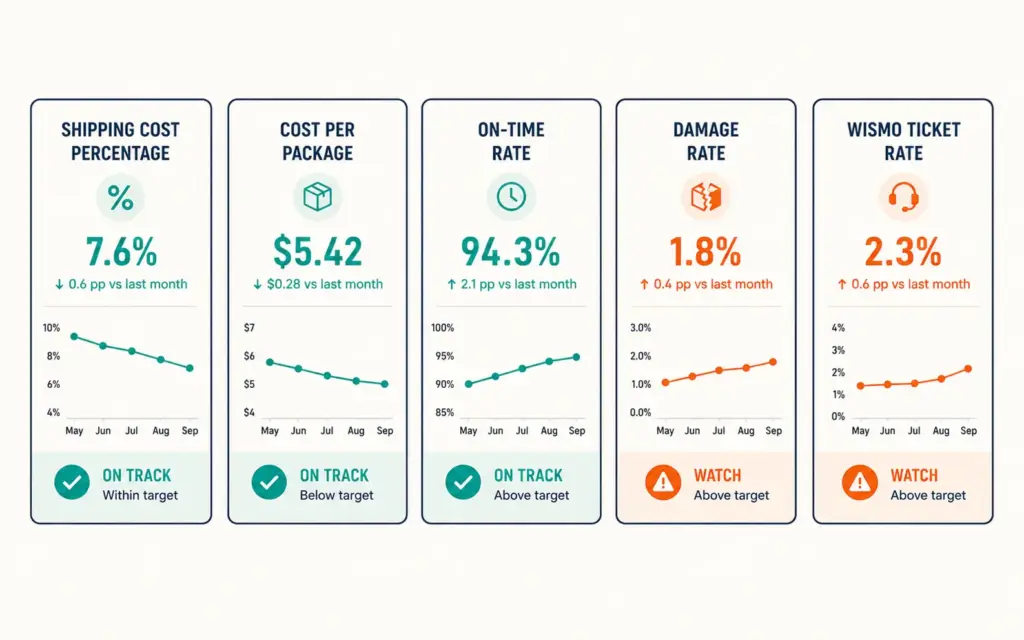
The 5 shipping metrics
- Shipping cost as % of revenue: Target 6 to 12%. Above 15% signals carrier, packaging, or pricing issues.
- Average cost per package: Track monthly. Compare against carrier benchmarks and renegotiate when above target.
- On-time delivery rate: Target 95%+. Below 90% means your carrier is underperforming or your ship-by commitments are unrealistic.
- Damage and loss rate: Target below 1%. Above 2% signals packaging issues (damage) or carrier reliability problems (loss).
- “Where is my order” ticket rate: Track support tickets about shipping as a % of orders. Target below 3%. Above 5% means tracking communication is inadequate or transit times exceed promises.
Review metrics monthly. Compare quarter over quarter to identify trends. Carrier performance can degrade gradually; monthly reviews catch problems before they compound. For broader operations metrics, see our ecommerce profit margins guide.
Common Shipping Strategy Mistakes
Offering free shipping without the margin math
Free shipping on all orders regardless of value is unsustainable for most ecommerce stores. A $15 order with $6 shipping and 50% gross margin produces $1.50 net margin (10%). Scale that and you’re running a charity. Use thresholds, build shipping into product pricing, or offer free shipping only on products with 40%+ margin.
Using one carrier for everything
A single carrier can’t be cheapest for every package type and destination. Multi-carrier routing with rate shopping saves 10 to 20% by automatically selecting the cheapest option per package. Even 2 carriers (USPS for lightweight, UPS for heavy) improves cost efficiency.
Ignoring dimensional weight
Shipping a small product in a large box costs 2 to 5x more than shipping it in a right-sized box or poly mailer. Audit your top 10 shipped products and ensure packaging matches product dimensions within 1 to 2 inches on each side. This single change often saves more than carrier rate negotiation.
Not showing shipping cost until checkout
Surprising customers with shipping costs at the final checkout step causes 48% of cart abandonment. Show estimated shipping on the product page or cart page. Even “Shipping calculated at checkout” is better than silence, but estimated ranges (“$4.99 to $7.99 shipping”) are best. For the full checkout playbook, see our checkout optimization guide.
Frequently Asked Questions
Start with USPS for packages under 1 lb and UPS or FedEx Ground for heavier items, using a rate-shopping tool (Pirate Ship or Shopify Shipping) to get pre-negotiated discounts. Offer free shipping with a threshold 15 to 25% above your current average order value plus one paid expedited option. Stock 3 box sizes and use poly mailers for non-fragile items. This setup covers 90% of domestic shipping needs at competitive rates.
The four fastest cost reductions: switch to right-sized packaging (saves 10 to 20% on dimensional weight), use multi-carrier rate shopping (saves 10 to 20% by picking the cheapest option per package), negotiate rates directly with carriers above 200 packages/month (saves 25 to 40%), and use poly mailers instead of boxes for non-fragile items. Combined, these tactics reduce shipping costs 25 to 45% without changing carriers or reducing speed.
Yes, but with a threshold, not on all orders. Set the free shipping threshold 15 to 25% above your current average order value. This lifts AOV 8 to 15% as customers add items to qualify, and the higher order value subsidizes the shipping cost. Free shipping on all orders regardless of value is unsustainable for most stores. Products with under 30% gross margin typically can’t absorb free shipping without pricing adjustments.
Shipping cost depends on package weight, dimensions, origin zip code, destination zip code, carrier, and service level. Use carrier rate calculators (USPS, UPS, FedEx websites) or shipping platforms (Pirate Ship, ShipStation) to get exact quotes. Key: calculate dimensional weight (L x W x H / 139) alongside actual weight because carriers bill whichever is higher. For light, bulky products, dimensional weight often exceeds actual weight by 3 to 10x.
Dimensional weight (DIM weight) is a pricing method carriers use when a package is large but light. Formula: length x width x height divided by 139 (UPS/FedEx divisor). Carriers charge whichever is higher: actual weight or dimensional weight. A 1 lb product in a 12x12x12 inch box has a DIM weight of 12.4 lbs, and you pay for 12.4 lbs. Right-sizing packaging is the fastest way to reduce DIM weight charges by 50 to 80%.
Evaluate 3PL providers when self-fulfillment exceeds 200 orders per day, when shipping operations require more than 20 hours per week of labor, or when you need multi-warehouse distribution for faster delivery to distant regions. 3PLs (ShipBob, Deliverr, Red Stag) typically charge $3 to $7 per order for pick, pack, and ship. The transition makes financial sense when the per-order cost is less than your internal labor and facility costs.
Related Reads
- Inventory Management Guide
- Ecommerce Profit Margins
- Selling Internationally
- Warehouse Optimization
- Checkout Optimization
- Cart Abandonment Solutions
Enjoying this? Get more like it every week.
One email per week with ecommerce strategies, tool picks, and seller insights. No spam.