
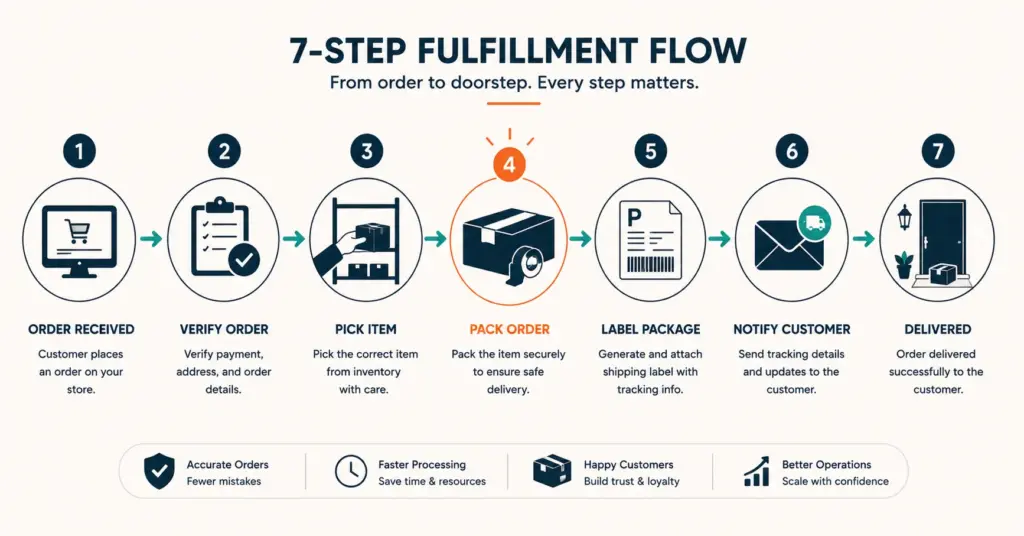
- The order fulfillment process is the complete workflow from the moment a customer clicks "Buy" to the moment their package arrives at their door. The 7 steps: order received, payment verified, pick, pack, label and ship, tracking notification, and delivery. Each step is a potential failure point that creates delays, errors, or customer dissatisfaction.
- The 3 fulfillment models for ecommerce: self-fulfillment (full control, labor-intensive, best under 100 orders/day), 3PL (outsourced pick-pack-ship, best at 100 to 500+ orders/day), and dropshipping (supplier ships directly, zero inventory risk but zero quality control).
- Fulfillment speed directly impacts conversion, repeat purchase rate, and return rate. Stores that ship same-day or next-day report 15 to 20% higher repeat purchase rates than stores shipping in 3+ days. Speed is a competitive advantage that compounds through customer satisfaction.
- The most common fulfillment error is wrong-item shipments, which cost $15 to $30 per occurrence (return shipping + re-ship + customer service time). Reducing error rate from 2% to 0.5% on 1,000 monthly orders saves $225 to $450/month in direct costs alone.
The order fulfillment process is the operational backbone of every ecommerce business: the complete workflow from the moment a customer places an order to the moment the package arrives at their door. Fulfillment touches every aspect of the customer experience, from the confirmation email they receive in seconds to the packaging they open days later. According to Shopify’s fulfillment research, 73% of online shoppers say delivery experience directly influences whether they’ll buy from a brand again, and 24% have abandoned an order specifically because the estimated delivery time was too long.
The process sounds simple (pick the product, put it in a box, ship it), but at scale, every step becomes a potential failure point. Wrong items get shipped. Labels print incorrectly. Packages get damaged in transit. Tracking numbers don’t update. Each failure costs $15 to $30 in direct costs (returns, re-ships, support time) and immeasurable damage to customer trust. Building a fulfillment process that’s fast, accurate, and scalable is the operational foundation for growth. For the shipping strategy that feeds into fulfillment, see our shipping strategies guide.
What Are the 7 Steps of the Order Fulfillment Process?
Step 1: Order received
When a customer completes checkout, the order enters your system (Shopify, WooCommerce, Amazon Seller Central). The order includes items, quantities, shipping address, payment confirmation, and selected shipping speed. Multi-channel sellers receive orders from multiple platforms simultaneously, requiring a centralized order management system or OMS to prevent duplicate processing or missed orders. For tech stack context, see our ecommerce tech stack guide.
Step 2: Payment verification
Payment processors (Stripe, PayPal, Shopify Payments) verify payment authorization before fulfillment begins. Most DTC orders verify instantly. Marketplace orders (Amazon, Walmart) are pre-verified by the platform. High-value orders ($200+) and flagged transactions should trigger manual fraud review before fulfillment to prevent shipping products on stolen cards. Fraud review adds 1 to 4 hours but prevents $200+ losses per fraudulent order.
Step 3: Pick
Warehouse staff locate and retrieve the ordered items from storage. Picking accuracy determines fulfillment quality. Three picking methods:
- Single-order picking: One order at a time. Simplest, slowest. Works under 50 orders/day.
- Batch picking: Multiple orders picked simultaneously, sorted after. 2 to 3x faster than single-order. Works for 50 to 200 orders/day.
- Zone picking: Warehouse divided into zones, each picker handles their zone only. Most efficient for 200+ orders/day with large warehouses.
Pick accuracy target: 99.5%+ (fewer than 5 errors per 1,000 orders). Use barcode scanning (phone app or dedicated scanner) to verify items during picking. Visual-only verification has 2 to 3% error rates; barcode-verified picking drops to 0.1 to 0.3%. For warehouse organization, see our warehouse optimization guide.
Step 4: Pack
Items are packed into appropriate packaging with protective materials, branded inserts (if applicable), packing slips, and any promotional materials (discount card for next purchase, review request card). Packaging selection impacts shipping cost through dimensional weight, damage rate through protection quality, and brand perception through unboxing experience.
Packaging guidelines: right-size boxes to minimize dimensional weight charges (every extra inch costs money), use poly mailers for non-fragile items ($0.10 to $0.30 vs $0.50 to $1.50 for boxes), and include sufficient protection for fragile items (air pillows, foam inserts, corrugated dividers). For packaging cost impact, see our shipping strategies guide.
Step 5: Label and ship
Generate shipping labels through your platform (Shopify Shipping), rate-shopping tool (ShipStation, Pirate Ship), or 3PL system. The label includes carrier, service level, tracking number, destination address, and return address. Verify the address matches the order before applying the label; wrong-address shipments cost $8 to $20 to redirect or redeliver.
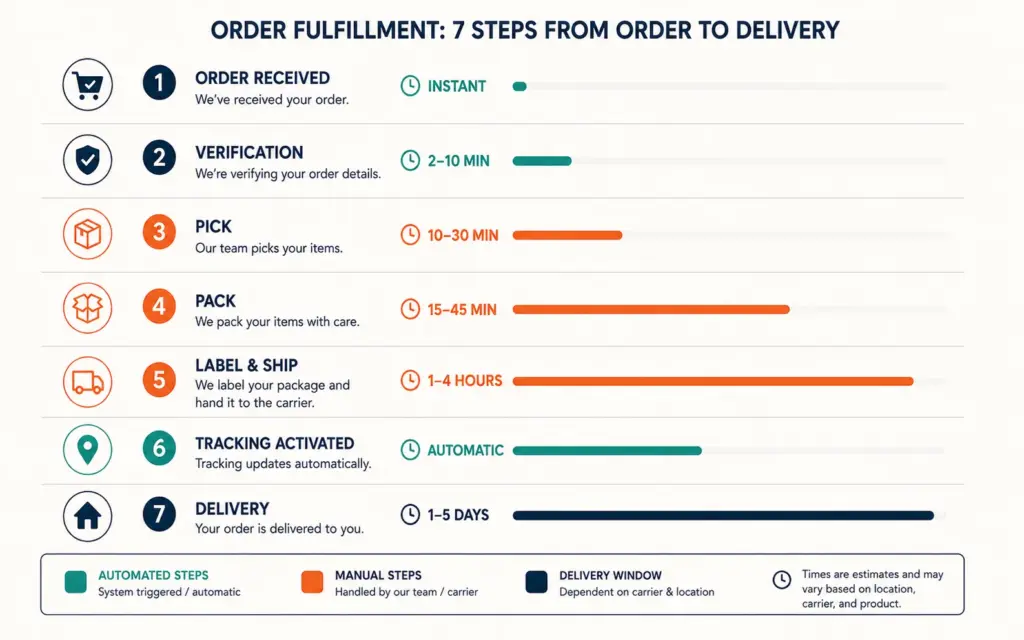
Hand packages to the carrier (scheduled pickup or drop-off). Same-day shipping cutoff is typically 2 to 4 PM local time for next-day carrier pickup. Orders received after the cutoff ship the following business day.
Step 6: Tracking notification
Send the customer a shipping confirmation email with tracking number and estimated delivery date. Automate this through your ecommerce platform (Shopify does this automatically) or email tool (Klaviyo, Omnisend). Include a direct tracking link. Proactive tracking communication reduces “where is my order” support tickets 30 to 50%. For email automation, see our email marketing strategy guide.
Step 7: Delivery and post-delivery
The carrier delivers the package. Post-delivery triggers: delivery confirmation email (automatic through carrier API), review request email (5 to 7 days after delivery), and cross-sell recommendation (7 to 14 days after delivery). Post-delivery engagement turns a transaction into a relationship. According to Narvar’s consumer research, 95% of customers who have a satisfactory delivery experience will buy again from the same retailer.
What Are the Fulfillment Model Options?
| Model | Best For | Cost per Order | Control | Scalability |
|---|---|---|---|---|
| Self-fulfillment | Under 100 orders/day, custom packaging | $2 to $5 (labor + materials) | Full | Limited by space and labor |
| 3PL | 100 to 500+ orders/day, standard products | $3 to $8 (all-in) | Moderate | High (provider scales) |
| Dropshipping | Testing products, zero inventory risk | Included in product cost | None | Unlimited (supplier scales) |
| FBA (Amazon) | Amazon-primary sellers | $3.22+ per unit | Low | High (Amazon scales) |
| Hybrid | Multi-channel, custom + standard mix | Varies | Mixed | High |
Most stores start with self-fulfillment, transition to 3PL between 100 and 300 daily orders, and maintain hybrid models (self-fulfill custom orders, 3PL for standard). For the complete 3PL evaluation, see our 3PL guide. For Amazon-specific fulfillment, see our Amazon FBA guide.
How Do I Speed Up Fulfillment?
Same-day shipping tactics
- Set a clear shipping cutoff time: “Orders placed by 2 PM ship today.” Publish this on product pages and the cart page. Customers who know the cutoff time order earlier, spreading volume across the day instead of clustering at close of business.
- Pre-stage popular items: Keep top 20% of SKUs (by volume) in a fast-pick zone near the packing station. Pre-stage packaging materials for your most common order configurations.
- Batch pick and pack: Process orders in batches of 10 to 20 rather than individually. Batch processing is 2 to 3x more efficient because it reduces walking time between picks.
- Pre-print labels: Generate shipping labels in batch every 2 to 3 hours instead of per-order. Apply labels during the pack step in one continuous workflow.
Speed benchmarks
| Metric | Good | Average | Needs Improvement |
|---|---|---|---|
| Order-to-ship time | Same day | Next business day | 2+ business days |
| Minutes per order (self-fulfill) | 3 to 5 minutes | 5 to 8 minutes | 10+ minutes |
| Ship-to-delivery (domestic) | 2 to 3 days | 3 to 5 days | 5+ days |
How Do I Reduce Fulfillment Errors?
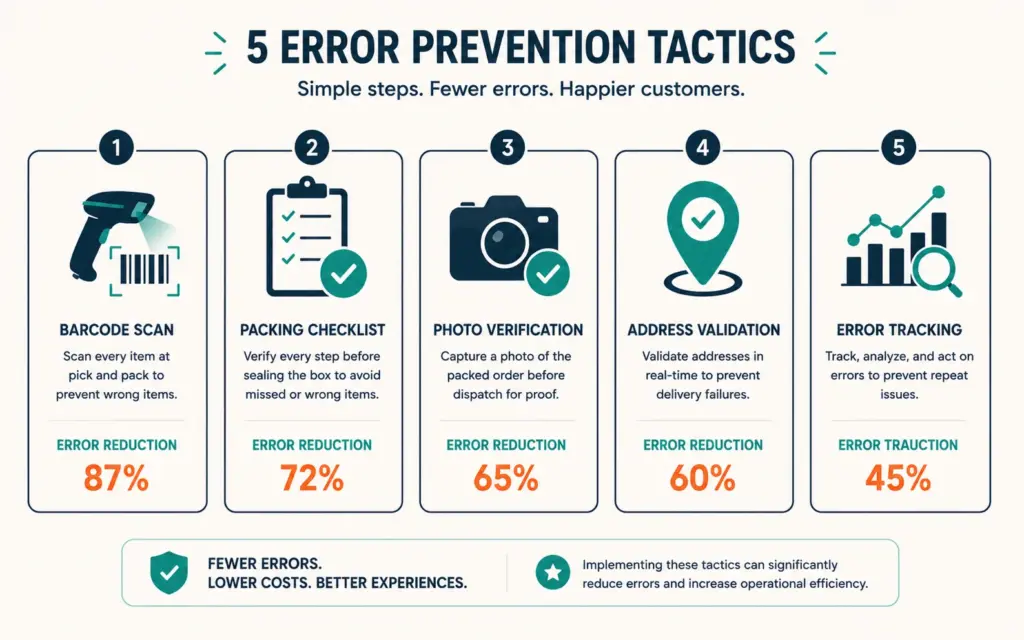
The 5 error prevention tactics
- Barcode verification: Scan every item during picking and packing. Barcode matching reduces wrong-item errors from 2 to 3% to 0.1 to 0.3%. Use Shopify’s barcode scanning feature or a dedicated app like Stocky.
- Packing checklists: Print a packing checklist with every order showing items, quantities, and special instructions. The packer checks each item against the list before sealing. For SOP documentation on packing procedures, see our standard operating procedures guide.
- Photo verification for high-value orders: Photograph the contents of orders above $100 before sealing. The photo serves as proof in damage or missing-item disputes.
- Address validation: Use address verification APIs (USPS Address Validation, Google Address API) to catch typos and incomplete addresses before label generation. Invalid addresses cost $8 to $20 per failed delivery.
- Daily error tracking: Log every error type (wrong item, missing item, wrong address, damaged in transit, late shipment) in a spreadsheet. Review weekly to identify patterns. If 60% of errors are wrong-item picks, the storage labeling system needs improvement, not the packing process.
How Do I Measure Fulfillment Performance?
The 6 fulfillment metrics
- Order accuracy rate: Correctly fulfilled orders / total orders. Target 99.5%+. Below 99% requires immediate process investigation.
- Order-to-ship time: Hours between order placement and carrier handoff. Target same-day for orders before cutoff. Track the 90th percentile, not the average (average hides outliers).
- Cost per order: Total fulfillment cost (labor + packaging + shipping) / total orders. Compare against 3PL quotes to evaluate self-fulfill vs outsource decision. For cost analysis, see our ecommerce profit margins guide.
- On-time delivery rate: Orders delivered by promised date / total orders. Target 95%+. Below 90% signals carrier issues or unrealistic delivery promises.
- Return rate by reason: Returns from fulfillment errors (wrong item, damaged) vs product issues (doesn’t fit, didn’t like). Fulfillment-caused returns should be under 1% of total orders.
- WISMO ticket rate: “Where is my order” support tickets / total orders. Target below 3%. Above 5% means tracking communication is inadequate. For analytics framework, see our ecommerce KPIs guide.
Common Fulfillment Process Mistakes
No defined cutoff time for same-day shipping
Without a cutoff, orders trickle in until close of business and some always miss same-day ship. Set a clear 2 PM cutoff, communicate it to customers, and enforce it operationally. Orders after cutoff ship next business day. Consistent expectations beat inconsistent attempts at speed.
Using one box size for everything
Shipping a small product in a large box costs 2 to 5x more due to dimensional weight pricing. Stock 3 to 5 box sizes plus poly mailers. Match packaging to product dimensions. This single change saves 10 to 20% on shipping costs with zero impact on delivery speed. For packaging cost optimization, see our shipping strategies guide.
Not separating picking from packing
When one person picks and packs each order individually, they walk the warehouse repeatedly for each order. Separating picking (batch retrieval) from packing (assembly and label) is 2 to 3x more efficient because it eliminates redundant warehouse traversals. For cash flow impact of fulfillment efficiency, see our cash flow management guide.
Skipping quality verification
The 2 minutes spent verifying each order (barcode scan, visual check, address confirmation) prevents the 20 minutes spent fixing each error (customer contact, return processing, re-ship). Prevention is 10x cheaper than correction. For broader process documentation, see our standard operating procedures guide.
Frequently Asked Questions
The order fulfillment process is the complete 7-step workflow from customer purchase to package delivery: order received, payment verified, items picked from storage, items packed with appropriate packaging and materials, shipping label generated and applied, tracking notification sent to customer, and delivery with post-delivery follow-up. Each step is a potential failure point that impacts customer satisfaction and operational cost.
Best practice is same-day shipping for orders placed before a defined cutoff time (typically 2 PM). Self-fulfillment should take 3 to 5 minutes per order using batch picking. 3PL providers typically guarantee same-day or next-business-day shipping. Total order-to-delivery time of 2 to 5 days meets customer expectations for standard shipping. Any fulfillment process consistently exceeding next-business-day shipping needs process improvement.
Target 99.5% or higher (fewer than 5 errors per 1,000 orders). Average ecommerce fulfillment accuracy is 97 to 98% without barcode verification. With barcode scanning, accuracy reaches 99.7 to 99.9%. Below 99% accuracy requires immediate process investigation. Each fulfillment error costs $15 to $30 in return shipping, re-ship, and customer service time, making accuracy directly tied to profitability.
Evaluate 3PL when daily orders consistently exceed 100 to 300, fulfillment consumes 20+ hours of weekly labor, error rates rise above 1%, or seasonal peaks overwhelm your capacity. Calculate your fully loaded self-fulfillment cost per order (labor + rent + materials + opportunity cost) and compare against 3PL quotes ($3 to $8 per order all-in). The switch typically saves money when 3PL cost is lower than internal cost.
Five tactics: implement barcode scanning during picking and packing (reduces errors from 2 to 3% to 0.1 to 0.3%), print packing checklists with every order, photograph high-value order contents before sealing, use address validation APIs to catch typos, and track error types daily to identify patterns. Prevention costs 2 minutes per order; correction costs 20 minutes plus $15 to $30 in direct expenses per error.
Fulfillment is the entire process from order received to package delivered: picking, packing, labeling, and handing off to the carrier. Shipping is one step within fulfillment: the carrier’s transportation of the package from your warehouse (or 3PL) to the customer’s address. Fulfillment is your responsibility. Shipping is the carrier’s responsibility once they accept the package. Both impact customer experience, but fulfillment errors (wrong item, late ship) are within your control while transit delays often aren’t.
Related Reads
- Shipping Strategies
- 3PL Guide
- Warehouse Optimization
- Standard Operating Procedures
- Ecommerce Profit Margins
- Cash Flow Management
Enjoying this? Get more like it every week.
One email per week with ecommerce strategies, tool picks, and seller insights. No spam.