
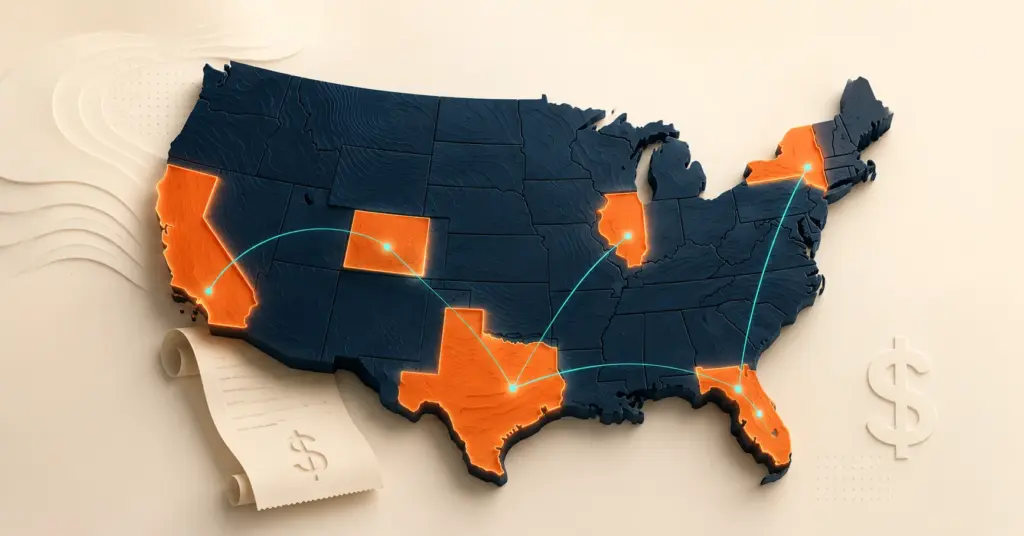
- Sales tax nexus is the connection that obligates you to collect and remit sales tax in a state. Two types: physical nexus (a store, office, employees, or inventory in a state) and economic nexus (crossing a sales or transaction threshold). The 2018 South Dakota v. Wayfair Supreme Court ruling created economic nexus, letting states require out-of-state sellers to collect tax based on sales volume alone, with no physical presence needed.
- The common economic nexus threshold is $100,000 in sales or 200 transactions in a state, but thresholds vary widely (Nevada $100,000, California $500,000, Alabama $250,000) and the 200-transaction half is disappearing fast. Utah removed its transaction threshold in mid-2025, Illinois at the start of 2026, leaving roughly 18 states that still count transactions at all.
- Every state with a sales tax now has a marketplace facilitator law, meaning platforms like Amazon, Etsy, and eBay calculate, collect, and remit sales tax on your behalf for orders placed through them. That work is off your plate for marketplace orders. But several states still count your marketplace sales toward your economic nexus total, so you can cross a threshold on Amazon volume and owe registration for your direct sales without realizing it.
- Inventory stored in a marketplace's fulfillment warehouses (like Amazon FBA) can create physical nexus in states you've never visited. This is one of the most overlooked nexus triggers. The single most useful habit is watching your sales by state so you see thresholds approaching before you cross them.
This tax guide ecommerce sellers need covers the part of selling online that blindsides more otherwise-healthy businesses than any other: sales tax. You can perfect your product, your marketing, and your margins and still get hit with a tax bill from a state you’ve never set foot in. Ecommerce sales tax is genuinely more complicated than the taxes a local business faces because you’re potentially collecting across dozens of states, each with its own thresholds, rates, and rules. Understanding how nexus works, when you’re obligated to register, and how marketplace facilitator laws change the picture is what keeps a growing store out of compliance trouble.
This is educational information, not tax or legal advice. Sales tax situations vary by business, and a qualified tax professional or CPA should review your specific obligations. That said, understanding the framework helps you know what questions to ask and when to seek help. The foundation starts with the concept that changed everything in 2018: economic nexus. The ecommerce legal setup guide covers business entity formation; this guide covers the sales tax obligations that follow.
Understanding Nexus: Physical and Economic
Nexus is the connection or presence in a state that obligates you to track, collect, and remit sales tax there. There are two types, and you need to understand both.
Physical Nexus: Presence You Can Point To
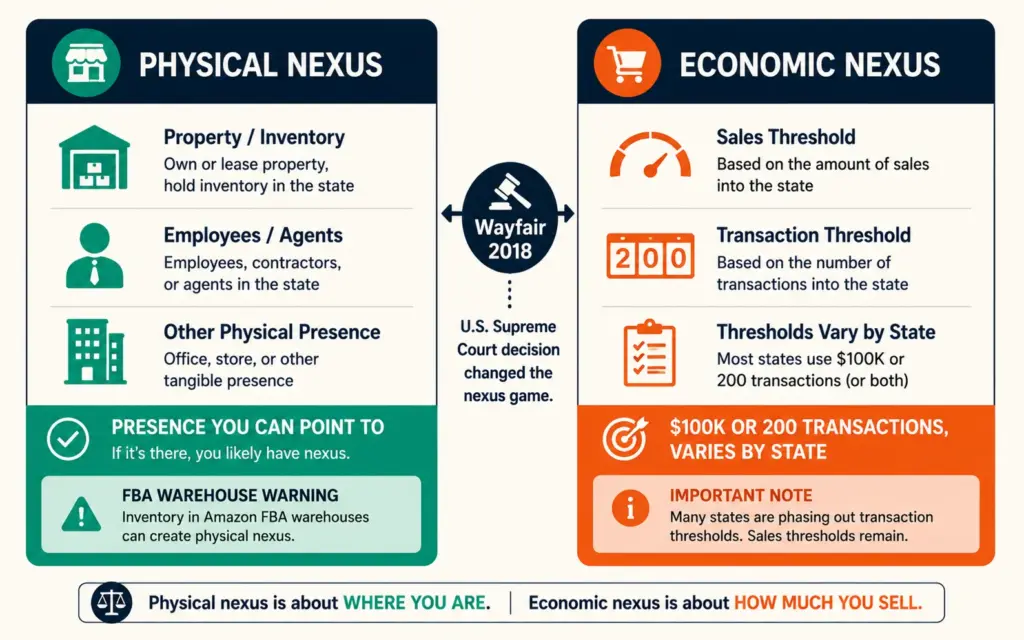
Physical nexus is a tangible connection to a state: a store, an office, employees or representatives, or inventory stored in the state. This was the only type of nexus that mattered before 2018. According to Numeral’s ecommerce sales tax guide, having a store, office, inventory, or employees in a state will likely establish physical nexus there.
The overlooked trap: inventory held in a marketplace’s fulfillment warehouses. If you use Amazon FBA and Amazon stores your inventory in warehouses across multiple states, that inventory can create physical nexus in states you’ve never visited. Many FBA sellers unknowingly have physical nexus in a dozen or more states because of where Amazon distributes their stock. The inventory management reality of using third-party fulfillment directly affects your tax obligations.
Economic Nexus: Selling Enough to Trigger Obligation
Economic nexus has nothing to do with physical presence. You create it purely by selling enough into a state. The 2018 South Dakota v. Wayfair Supreme Court decision let states require out-of-state sellers to collect sales tax based on economic activity alone. Within a couple of years, nearly every state with a sales tax adopted an economic nexus rule.
The mechanics are consistent even when the numbers aren’t: a state sets a threshold, and once your sales into that state cross it during the current or prior calendar year, you have economic nexus and the clock starts on registering and collecting. This is the standard that turned multi-state sales tax into a problem every growing online store eventually faces. According to UltraCart’s nexus guide, once your sales into a state cross its threshold during the current or prior calendar year, the clock starts on registering and collecting.
Economic Nexus Thresholds Vary Widely by State
The commonly cited threshold is $100,000 in sales or 200 transactions, but the actual numbers differ significantly from state to state. Nevada’s threshold is $100,000. Next door, California’s is $500,000. Alabama’s is $250,000. Some states use sales only, some use sales or transactions, some use both.
A major trend: the 200-transaction half of the rule is disappearing. Utah removed its transaction threshold in mid-2025. Illinois removed its threshold at the start of 2026. That leaves roughly 18 states that still count transactions at all. The trend matters because transaction-count thresholds could trap low-price, high-volume sellers: 200 sales of a $15 product is only $3,000 in revenue but could once trigger nexus in states counting transactions. As states drop transaction counts, the pure-revenue thresholds become the primary trigger.
Rates compound the complexity. Sales tax rates vary by state, and within many states, local jurisdictions (counties, cities) set their own rates on top. Texas has a 6.25% statewide rate, but some cities and counties add their own, pushing the total as high as 8.25% depending on where the buyer lives. This is why manual tax calculation is impractical at scale and why tax automation software exists. The ecommerce tools and tech stack should include tax automation once you approach nexus in multiple states.
Marketplace Facilitator Laws Change the Picture
Every state with a sales tax plus Washington D.C. now has a marketplace facilitator law. These laws require the platform (Amazon, Etsy, eBay, Walmart) to calculate, collect, and remit sales tax on your behalf for orders placed through it. For your marketplace sales, that tax work is off your plate entirely.
But there’s a critical catch that trips up sellers who use both marketplaces and their own store. Several states still count your marketplace sales toward your economic nexus total for your direct sales. So you can cross a state’s threshold on the strength of your Amazon volume, owe a sales tax registration in that state for your own website’s direct sales, and never realize it because the marketplace was quietly handling its own collection the whole time.
If you sell through both a marketplace and your own store, you have to look at the combined picture. Your Shopify or WooCommerce direct sales might be modest in a given state, but combined with your Amazon sales there, you may have crossed the economic threshold, creating an obligation to register and collect on your direct sales. The multichannel selling approach requires tracking your combined sales by state, not just per-channel totals.
When and How to Register for Sales Tax Permits
Once you determine you have nexus in a state (physical or economic), you must register for a sales tax permit before collecting. Registration timing rules vary: some states require registration when the threshold is crossed, before your next sale. Others, like Colorado, allow more time (up to 90 days after economic nexus is established).
To register: visit the state’s Department of Revenue website, follow the registration steps, and provide your EIN and business information. Once registered, set up sales tax collection on your website or marketplace. Most ecommerce platforms (Shopify, WooCommerce, BigCommerce) integrate with tax software like Avalara, TaxJar, TaxCloud, or Vertex, which automatically calculates and charges the correct tax based on the buyer’s location.
Critical warning: never collect sales tax in a state where you’re not registered. Collecting tax you’re not authorized to collect creates its own legal problems. Register first, then collect. The financial planning and scaling process should budget for tax compliance costs (software, possibly a tax professional) as you approach nexus in multiple states, since the compliance burden grows with your multi-state footprint.
Building a Sales Tax Compliance Habit
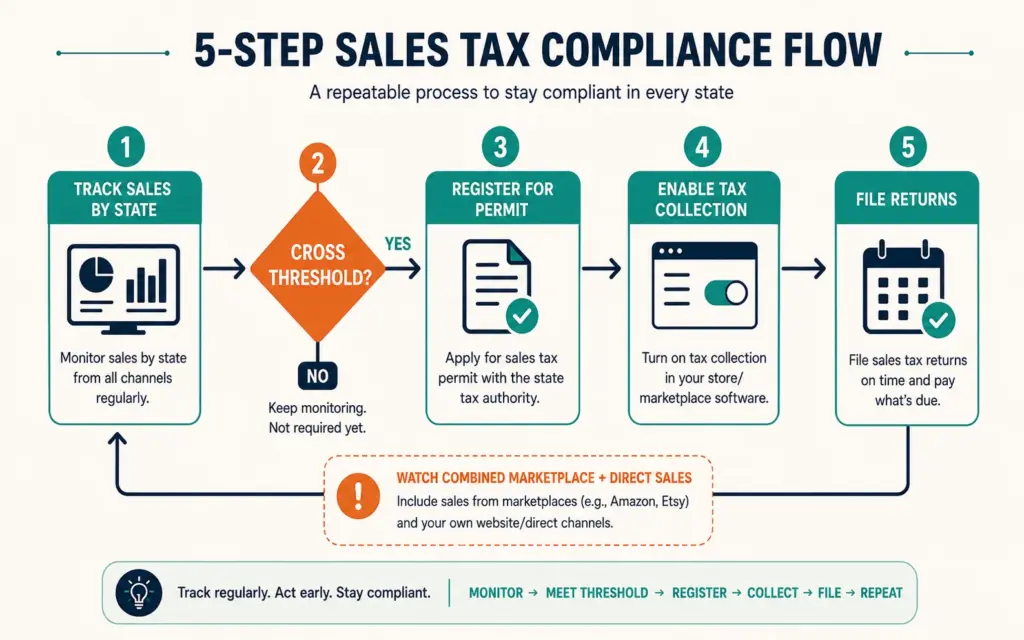
The single most useful habit is watching your sales by state. You cannot manage nexus you cannot see. Set up a monthly review of your sales broken down by state (across all channels combined) so you see thresholds approaching before you cross them. This gives you time to register proactively rather than discovering a missed obligation months later with accumulated liability.
A practical compliance rhythm: track combined sales by state monthly, flag states where you’re approaching 80% of the threshold, register in states where you’ve crossed nexus, enable tax collection through your platform’s tax software, and file returns on the schedule each state requires (monthly, quarterly, or annually depending on volume). The ecommerce KPIs dashboard should include a sales-by-state view specifically for nexus monitoring. As your store grows across more states, a tax professional or automated service like Avalara or TaxJar becomes worth the cost to manage the growing complexity. Beyond sales tax, remember you’ll also handle income tax on profit, potential 1099-K forms from platforms, and inventory as a tracked asset, all of which a ecommerce bookkeeping system should capture.
Frequently Asked Questions
No. You collect sales tax only in states where you have nexus (physical presence or crossing an economic threshold). For states where you have no nexus, you have no collection obligation. For marketplace sales (Amazon, Etsy, eBay), the platform collects and remits on your behalf under marketplace facilitator laws. Your obligation applies to your direct sales (your own website) in states where you’ve established nexus. This is educational information, not tax advice; consult a tax professional for your situation.
Economic nexus is a sales tax obligation created by selling enough into a state, with no physical presence required. The 2018 South Dakota v. Wayfair Supreme Court ruling let states establish it. Once your sales into a state cross that state’s threshold (commonly $100,000, but ranging from $100,000 to $500,000) during the current or prior year, you have economic nexus and must register, collect, and remit sales tax there. Thresholds vary by state, so you must track your sales per state.
It can. If you use Amazon FBA and Amazon stores your inventory in fulfillment warehouses across multiple states, that stored inventory can create physical nexus in each of those states, even ones you’ve never visited. Many FBA sellers unknowingly have physical nexus in numerous states because of where Amazon distributes their stock. Amazon collects and remits marketplace sales tax for FBA orders, but the physical nexus can still create obligations for your direct (non-Amazon) sales in those states.
In several states, yes. Even though the marketplace (Amazon, Etsy) collects and remits tax on those orders, some states count your marketplace sales toward your economic nexus total. This means you can cross a state’s threshold on marketplace volume and owe a registration for your own direct sales in that state. If you sell through both a marketplace and your own store, track your combined sales by state, not just per-channel, to catch these obligations.
Common options integrated with ecommerce platforms include Avalara, TaxJar, TaxCloud, and Vertex. These automatically calculate the correct tax based on the buyer’s location (accounting for state plus local rates), track your nexus across states, and can automate filing. Most platforms (Shopify, WooCommerce, BigCommerce) support integration with at least one. For a single-state seller, your platform’s built-in tax settings may suffice. For multi-state sellers, dedicated tax software becomes worth the cost as complexity grows.
Once you establish nexus in a state (physical or economic), you must register for a sales tax permit before collecting tax there. Timing rules vary: some states require registration when you cross the threshold, before your next sale; others (like Colorado) allow up to 90 days. Register through the state’s Department of Revenue website with your EIN and business information. Never collect sales tax in a state where you’re not registered, as that creates its own legal problems.
Related Reads
- Ecommerce Legal Setup
- Ecommerce Bookkeeping
- Inventory Management
- Multichannel Selling
- Financial Planning and Scaling
- Ecommerce KPIs
Enjoying this? Get more like it every week.
One email per week with ecommerce strategies, tool picks, and seller insights. No spam.