
- Cross-border ecommerce expands your addressable market from one country to dozens, but adds layers of operational complexity: customs declarations, import duties, VAT/GST collection, currency conversion, international shipping logistics, and country-specific consumer protection laws. Each layer can be solved. None of them should be ignored.
- Start with one country, not "international." Pick the market with the highest demand signal (where are your international visitors already coming from?), the simplest regulatory environment (English-speaking countries for US sellers, EU countries for EU sellers), and the most manageable shipping logistics (Canada or UK before Australia or Japan).
- The two approaches: ship from your home country (DDP or DAP international shipping) or use international fulfillment centers (3PL warehouses in target countries). Shipping from home is simpler for testing. Local fulfillment reduces delivery times and duties but requires minimum volume to justify.
- The three biggest international selling mistakes: not displaying prices in local currency (drops conversion 30 to 50%), not clearly communicating who pays import duties (creates angry customers and chargebacks), and underestimating international return logistics (returns from abroad cost 3 to 5x domestic return cost).
Cross-border ecommerce is selling to customers outside your home country. It sounds like a growth strategy, and it is. But operationally, it’s a series of specific problems to solve: how to ship a package from the US to Germany without it getting stuck in customs for 3 weeks, how to collect and remit VAT to the UK government, how to display prices in euros without confusing your checkout, and how to handle a return from a customer 5,000 miles away. Each problem has a known solution. The challenge is implementing them in the right order so international sales add revenue without adding proportional headaches.
The opportunity is real. Ecommerce without borders gives a US store access to 4.4 billion online shoppers worldwide instead of 250 million domestic ones. According to Shopify’s international selling data, merchants who sell internationally generate 1.5 to 2x the revenue of domestic-only sellers in the same product categories. The international shipping guide covers carrier selection and rate optimization for cross-border shipments. This guide covers the broader operational strategy: which markets to enter, how to handle compliance, and how to set up your store for international buyers.
How to Choose Your First International Market With Data
Don’t pick a country because it feels exciting. Pick the one where demand already exists for your products and the operational barriers are lowest.
Check Where International Traffic Already Comes From
Open GA4 > Reports > Demographics > Geographic > Countries. If 5% of your traffic comes from Canada and 3% from the UK, those buyers are already finding your store and trying to buy. They’re the lowest-friction international market because demand is proven. The tracking setup for GA4 should include geographic reporting as a standard dashboard component.
Evaluate Operational Complexity by Country Before Committing
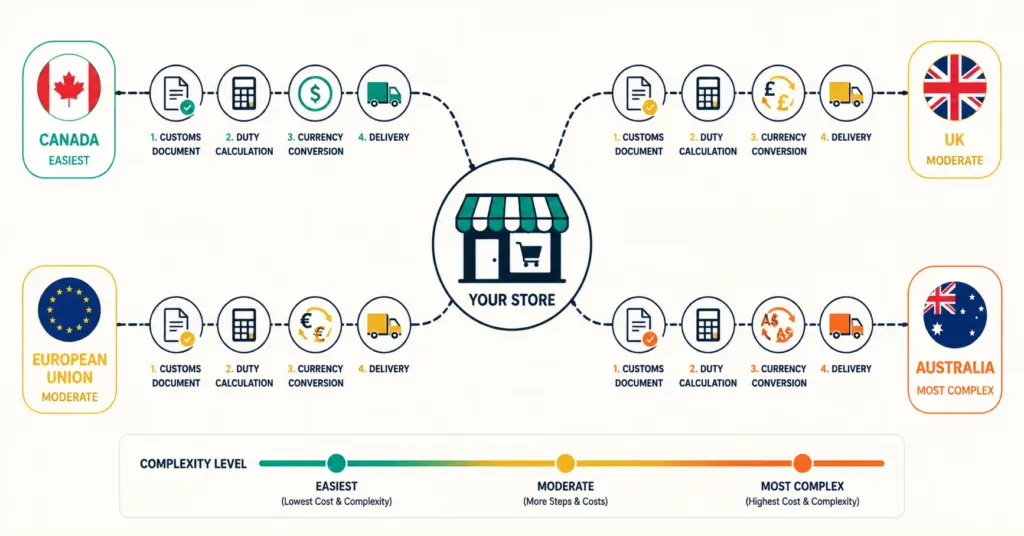
Low complexity (start here): Canada (shared language, USMCA trade agreement, simple customs), UK (English-speaking, established ecommerce market, straightforward VAT rules), Australia (English-speaking, high ecommerce adoption, bilateral trade agreements).
Medium complexity (second phase): EU countries (single market but VAT IOSS registration required above thresholds, GDPR compliance, multiple languages), Japan (large ecommerce market but language barrier and strict consumer protection laws).
High complexity (only with proven demand): Brazil (complex tax system, slow customs clearance), India (duties up to 100% on some categories, cash-on-delivery preference), China (regulatory barriers, local platform dominance). The financial planning and scaling model should include country-specific cost projections before entering any market.
International Shipping: DDP vs DAP and Why It Matters
How you handle customs duties determines whether your international customers love you or hate you.
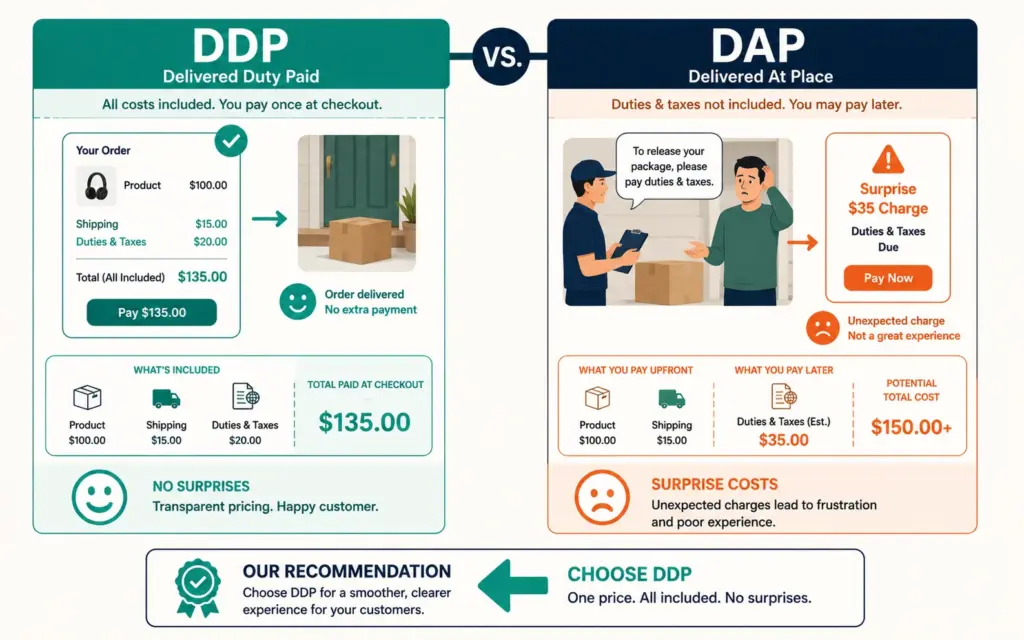
DDP (Delivered Duty Paid) Means You Pay Duties at Checkout
The customer pays a total price at checkout that includes the product, shipping, and import duties/taxes. No surprise charges at delivery. The package clears customs without the buyer being contacted for additional payment. This is the premium experience. Amazon, Apple, and major DTC brands use DDP because surprise duty charges are the #1 source of international customer complaints and chargebacks.
To implement DDP, you need a shipping provider that calculates duties at checkout (Zonos, Global-e, or Shopify Markets Pro) and pre-pays them on your behalf. The duty cost is built into the total the customer pays. You pay the duties, the customer gets a clean delivery. More complex to set up. Far better customer experience.
DAP (Delivered At Place) Means the Customer Pays Duties at Delivery
You ship the package. It arrives at the destination country’s customs. The carrier contacts the buyer and requests duty payment before delivering. The customer didn’t expect a $15 to $40 additional charge, feels blindsided, and sometimes refuses the package entirely. You eat the shipping cost both ways.
DAP is simpler to implement (just ship it, let customs sort it out) but creates friction. If you use DAP, clearly state on your shipping policy page and at checkout: “International orders may be subject to import duties and taxes payable upon delivery. These charges are the responsibility of the buyer.” Transparency prevents chargebacks. The shipping strategies guide covers carrier-specific international shipping options.
Currency, Language, and Localization That Convert International Buyers
Display Prices in the Customer’s Local Currency
A UK shopper seeing “$49.99” has to mentally convert to pounds, wonder about exchange rate fees, and question whether the final charge will be different from the displayed price. A UK shopper seeing “£39.99” knows exactly what they’re paying. Not displaying local currency drops international conversion rates 30 to 50%.
Shopify Markets handles multi-currency pricing natively: automatic conversion with rounding to local price points (so $49.99 becomes £39.99, not £38.73). WooCommerce requires a multi-currency plugin (Currency Switcher, WPML, or WOOCS). The ecommerce pricing strategy for international markets should include currency-specific pricing that accounts for purchasing power differences, not just exchange rate conversion.
Translate at Least Your Product Pages and Checkout for Non-English Markets
English-speaking markets (UK, Canada, Australia) don’t need translation. EU markets benefit significantly from translated product pages and checkout. A German buyer encountering an English-only checkout is 3x more likely to abandon than one who sees German. Shopify Translate & Adapt and WooCommerce WPML handle multi-language content. Machine translation (DeepL, Google Translate) provides a functional starting point that should be human-reviewed for product-specific terminology.
Tax and Compliance for International Ecommerce Sales
VAT/GST Collection and Remittance Is Non-Optional
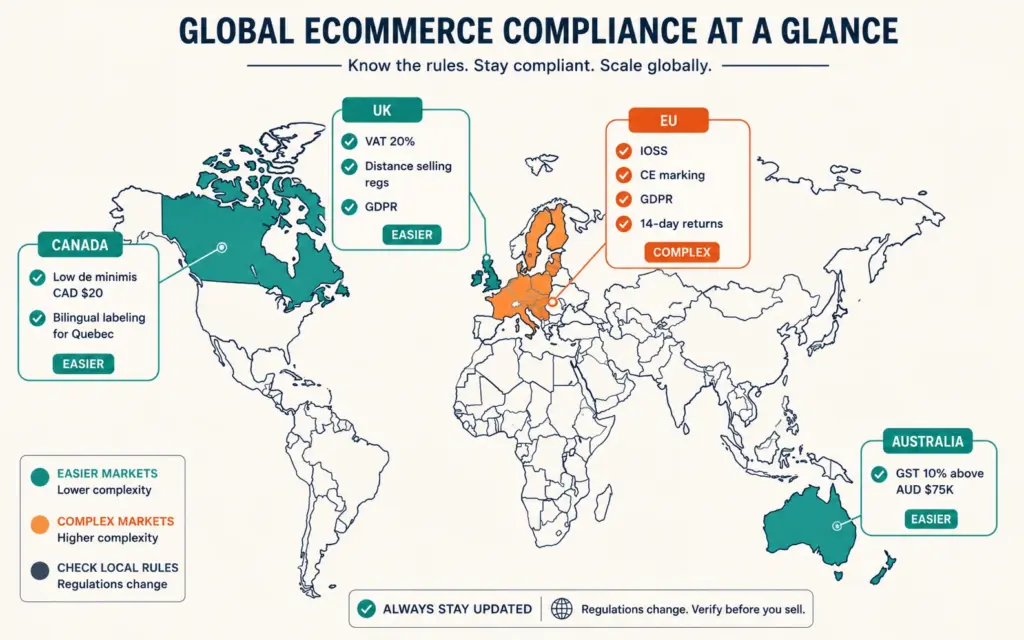
The UK requires VAT registration and collection on all B2C sales to UK consumers (20% VAT). The EU requires IOSS (Import One-Stop Shop) registration for B2C shipments valued under €150 (VAT collected at checkout, remitted through a single EU filing). Australia requires GST collection (10%) on goods sold to Australian consumers by overseas sellers exceeding AUD $75,000 annual sales to Australia. Canada’s de minimis threshold is CAD $20 for duties and CAD $40 for taxes, meaning most shipments incur charges.
Don’t ignore international tax obligations. Countries actively enforce collection requirements on overseas ecommerce sellers. Shopify Markets Pro and tools like Avalara handle multi-country tax calculation and filing. The ecommerce profit margins on international orders must account for VAT/GST as a cost layer that doesn’t exist on domestic sales.
GDPR, Consumer Protection, and Product Compliance by Market
Selling to EU customers requires GDPR compliance (cookie consent, data processing transparency, right to deletion). Selling to the UK and EU requires compliance with their distance selling regulations (14-day cooling-off return period regardless of your stated return policy). Some product categories require country-specific certifications: CE marking for electronics sold in the EU, for example.
According to BigCommerce’s cross-border ecommerce analysis, compliance requirements vary significantly by country and product category, making it essential to research the specific regulations for each target market before selling into it. The standard operating procedures for international operations should document country-specific compliance requirements as a reference checklist updated annually.
International Returns: The Cost Most Sellers Don’t Model
International returns cost 3 to 5x domestic returns. A domestic return might cost $7 in return shipping. An international return can cost $25 to $60 in return shipping, plus customs documentation, potential duty refunds, and 2 to 4 week processing time. At a 10% return rate on international orders, these costs compound quickly.
Three approaches to international returns:
- Refund without return: For products under $30, it’s often cheaper to refund the customer and let them keep the item than to pay $40 in return shipping. This is common practice among major international sellers.
- Local return addresses: If you have a 3PL in the target country, use their address for returns. The customer ships domestically (cheap), and you consolidate and restock or dispose of returns locally.
- Return shipping borne by customer: Clearly state that international return shipping is the buyer’s responsibility. This reduces return rates by 30 to 40% (customers are more selective when they pay return postage) but may reduce initial purchase conversion in markets where free returns are expected.
The cart abandonment solutions for international buyers should address return policy concerns explicitly during checkout. Unclear return policies for international orders are a significant abandonment driver.
Local Fulfillment vs Shipping From Home for International Orders
Ship from home (start here): All international orders ship from your domestic warehouse or 3PL. Simpler operations, no international warehouse management. Delivery times: 7 to 21 days depending on carrier and destination. Best for testing international demand before committing to local infrastructure.
Local fulfillment (scale into this): Stock inventory in a 3PL warehouse in the target country. Orders ship domestically within that country. Delivery times: 2 to 5 days. No customs clearance for the buyer. Dramatically better customer experience. Requires minimum order volume (50 to 100 orders/month per country) to justify the cost. The 3PL guide covers partner evaluation for both domestic and international fulfillment.
Frequently Asked Questions
Cross-border ecommerce means selling products to customers in countries other than your home country. It involves international shipping, customs declarations, import duty handling, multi-currency pricing, tax compliance (VAT/GST), and potentially local fulfillment. The operational complexity is higher than domestic selling, but it expands your addressable market from one country to dozens. Start with one low-complexity market before expanding.
Start with the country that already shows demand in your analytics (check GA4 geographic data for international traffic) and has the lowest operational barriers. For US sellers: Canada first (shared language, USMCA trade agreement, easy shipping), then UK (English-speaking, large ecommerce market), then Australia. Avoid high-complexity markets (Brazil, India, China) until you’ve proven international operations in simpler markets.
DDP (Delivered Duty Paid) is the better customer experience. The buyer pays one total price at checkout including duties. No surprise charges at delivery. DAP (Delivered At Place) is simpler to implement but creates friction: the buyer gets hit with unexpected duty charges that cause complaints and chargebacks. Use DDP if your average order value justifies the setup complexity. Use DAP only if you clearly communicate duty responsibility to buyers before purchase.
Depends on the destination country and your sales volume. UK: VAT registration and collection required on all B2C sales (20%). EU: IOSS registration for shipments under €150 (VAT collected at checkout). Australia: GST collection (10%) required above AUD $75,000 annual sales. Canada: most shipments incur duties above CAD $20. Use Shopify Markets Pro or Avalara for automated multi-country tax calculation. Ignoring international tax obligations creates legal liability.
Three approaches: refund without return for items under $30 (cheaper than paying $40+ return shipping), use a local 3PL return address in the target country (customer ships domestically), or have the customer pay return shipping (reduces returns 30 to 40% but may reduce initial purchase conversion). International returns cost 3 to 5x domestic. Model this cost into your international pricing before expanding.
Yes. Not displaying local currency drops international conversion 30 to 50%. A UK shopper seeing “$49.99” has to mentally convert and worry about exchange rate fees. Seeing “£39.99” removes that friction. Shopify Markets handles multi-currency natively. WooCommerce requires a currency switcher plugin. Round converted prices to local price points (£39.99 not £38.73) for a professional appearance.
Related Reads
- International Shipping
- 3PL Guide
- Shipping Strategies
- Ecommerce Profit Margins
- Ecommerce Pricing Strategy
- Financial Planning and Scaling
Enjoying this? Get more like it every week.
One email per week with ecommerce strategies, tool picks, and seller insights. No spam.