
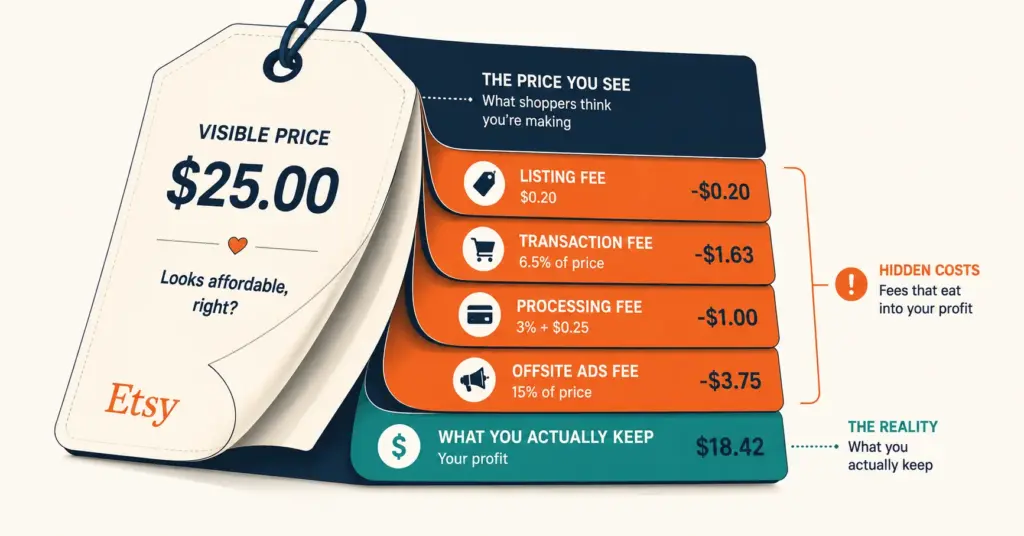
- Etsy's fee stack is deeper than most sellers realize: $0.20 listing fee + 6.5% transaction fee + 3% + $0.25 payment processing + 15% Offsite Ads fee (if applicable) + shipping costs. On a $30 product, Etsy takes $4.70 to $9.20 before you account for materials, labor, or shipping. Pricing without calculating the full fee stack is how Etsy sellers lose money on every sale.
- The Etsy pricing formula: (Materials + Labor + Overhead) / (1 - Total Fee %) = Minimum viable price. This ensures your price covers costs AND fees, rather than the common mistake of adding a markup to costs and then losing the markup to fees you forgot to include.
- Etsy buyers have different price sensitivity than DTC shoppers. They expect to pay more for handmade, vintage, and unique items but compare heavily within Etsy search results. Your pricing needs to be competitive within Etsy's marketplace while remaining profitable, not competitive with mass-market alternatives outside Etsy.
- Free shipping on Etsy isn't free for sellers, but Etsy's search algorithm boosts listings that offer it. Sellers who absorb shipping into product price and offer "free shipping" see 10 to 20% more impressions. The math works when shipping cost is under 15% of product price.
An Etsy pricing strategy differs from pricing on any other ecommerce platform because Etsy’s fee structure is uniquely layered and its buyer expectations are uniquely specific. Etsy charges a listing fee, a transaction fee, a payment processing fee, and potentially an Offsite Ads fee on every sale, stacking 12 to 25% in total platform costs on top of your product costs. Most new Etsy sellers price by doubling their material cost (the “2x markup” approach), discover they’re barely breaking even after Etsy takes its cut, and either raise prices reactively or accept thin margins indefinitely. According to Etsy’s official fee documentation, the combined fee impact surprises sellers because each fee seems small individually but compounds significantly in total.
The platform also creates a pricing context that doesn’t exist on your own Shopify store: direct side-by-side comparison with competing sellers. Every Etsy search result page displays 40+ products with visible prices. Your listing appears next to sellers offering similar items at varying prices, making competitive positioning part of the pricing equation in a way that standalone store pricing doesn’t face. Pricing too high relative to Etsy competitors loses clicks. Pricing too low signals low quality to Etsy’s handmade-focused buyer base.
The Complete Etsy Fee Breakdown
Every Etsy sale incurs multiple fees that reduce your take-home revenue:
- Listing fee: $0.20 per listing. Charged when you create or renew a listing. Each listing lasts 4 months. Multi-quantity listings charge $0.20 per unit sold (not per listing). Selling 10 units from one listing costs $2.00 in listing fees.
- Transaction fee: 6.5% of total sale price (product price + shipping charged to buyer). This is Etsy’s primary revenue cut and the fee most sellers underestimate because it applies to the shipping amount too.
- Payment processing: 3% + $0.25 per transaction. Similar to Stripe or PayPal processing on any other platform. Non-negotiable.
- Offsite Ads fee: 15% of sale price (12% for sellers exceeding $10,000 annual revenue). Etsy runs ads for your products on Google, Facebook, and Pinterest. If a customer clicks an Etsy Offsite Ad and purchases within 30 days, you pay this fee. Sellers under $10,000 annual revenue can opt out; above $10,000, it’s mandatory.
- Etsy Ads (optional): cost-per-click. Promoted listings within Etsy search. You set a daily budget ($1 to $25+/day). Average CPC runs $0.20 to $0.80 depending on category competition.
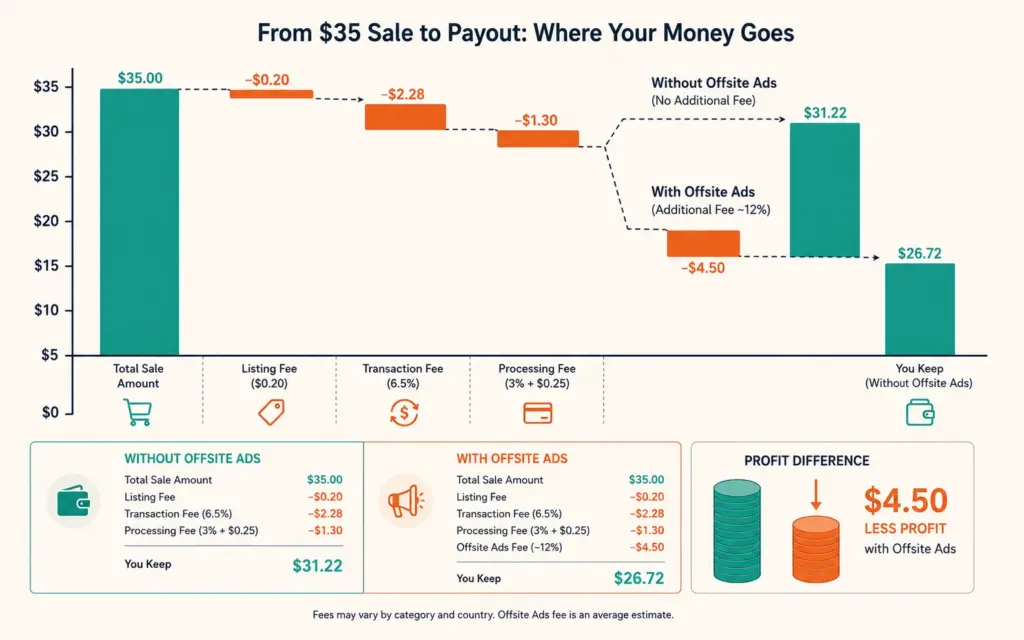
Total fee impact on a $30 product
Scenario: $30 product with $5 shipping charged to buyer. Without Offsite Ads: $0.20 (listing) + $2.28 (6.5% of $35) + $1.30 (3% of $35 + $0.25) = $3.78 in fees (10.8% of sale). With Offsite Ads: add $4.50 (15% of $30) = $8.28 total (23.7% of sale). That 13-point swing from Offsite Ads dramatically changes whether a product is profitable. Factor this into every pricing calculation.
The Etsy Pricing Formula
Most pricing guides teach: Cost x 2 = Price. This fails on Etsy because it ignores fees. A $10 cost item priced at $20 leaves $10 gross profit before fees. After Etsy takes $3.50 to $5.50, actual profit drops to $4.50 to $6.50. The margin you thought was 50% is actually 22 to 32%.
The fee-inclusive formula:
Minimum Price = Total Cost / (1 – Total Fee %)
Where Total Cost = materials + labor + packaging + shipping (if offering free shipping). And Total Fee % = 0.10 to 0.24 depending on Offsite Ads eligibility.
Example: $12 total cost, 15% total fee rate. Minimum Price = $12 / (1 – 0.15) = $14.12. This is the floor where you break even. Your selling price should be $14.12 + your target profit per unit. At $5 target profit: sell at $19.12, round to $19.99. The margin calculator handles this math instantly across your entire catalog.
Labor costing for handmade sellers
Handmade products require including your labor time at a fair hourly rate. If a product takes 45 minutes and you value your time at $20/hour, labor cost is $15. Materials of $8 + labor of $15 + packaging of $2 = $25 total cost. At 15% fees: minimum price = $25 / 0.85 = $29.41. Selling at $29 means you’re working below your target rate. Selling at $35 gives you $4.75 profit after costs and fees. Sellers who don’t cost their labor treat their time as free and wonder why the business feels unsustainable.
Competitive Positioning on Etsy
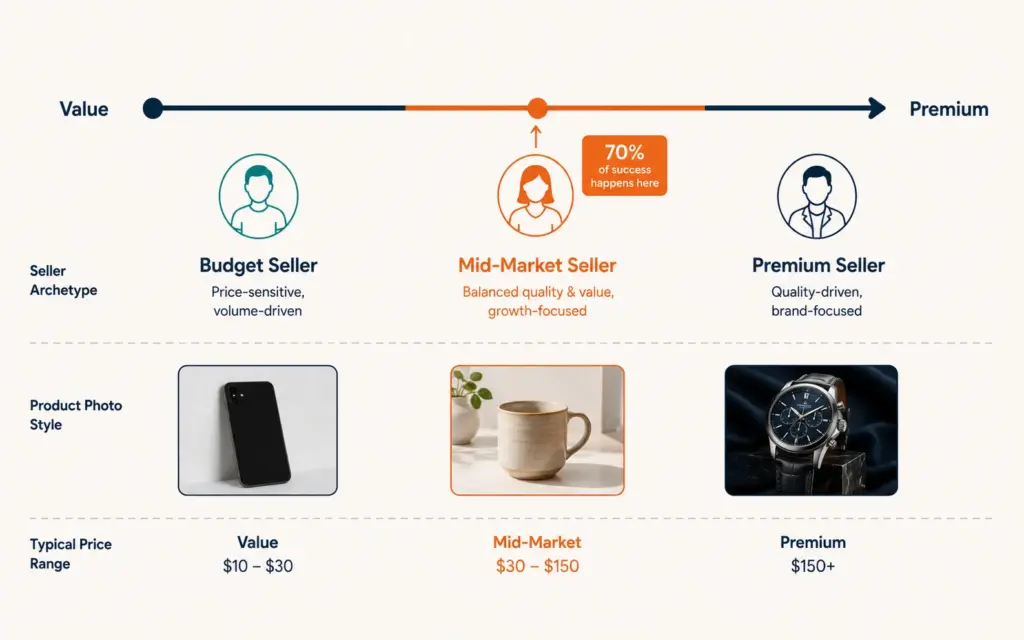
Etsy search results create direct price comparison that standalone stores avoid. Three positioning strategies work:
Value positioning (lowest viable price). Compete primarily on price within your category. Works for supplies, digital downloads, and commoditized items where differentiation is minimal. Risk: race to the bottom if multiple sellers adopt this approach. Only sustainable with low material costs and efficient production.
Mid-market positioning (competitive with differentiation). Price within the middle range for your category but differentiate through better photos, more customization options, faster shipping, or stronger reviews. This is where 70% of successful Etsy sellers operate. Your listing copy quality and review accumulation justify the price relative to lower-priced competitors.
Premium positioning (highest price, premium quality signals). Price 30 to 50% above category average. Justify through professional photography, luxury packaging, brand storytelling, and curated shop aesthetic. Works for artisan goods, luxury handmade, and products where craftsmanship is the value proposition. Requires 50+ five-star reviews to credibly sustain premium pricing on Etsy.
The Free Shipping Decision
Etsy’s search algorithm gives a ranking boost to listings with free shipping, particularly for US orders. Sellers offering free shipping report 10 to 20% more search impressions. But “free” shipping isn’t free for you, so the math must work.
When to offer free shipping: When shipping cost is under 15% of product price. A $40 product with $5 shipping can absorb the cost at $45 with “free shipping” and gain algorithmic benefit. A $12 product with $5 shipping cannot absorb it at $17 without destroying margins.
How to implement: Add your average shipping cost to the product price. Round to an attractive price point. Enable “free shipping” in the listing settings. Etsy adds a “FREE shipping” badge to search results. The carrier rate optimization directly impacts whether free shipping math works for your weight/size category.
For international orders, consider offering free domestic shipping and charging actual cost for international. According to Etsy community seller data, this hybrid approach captures the domestic search boost without absorbing $15 to $40 international shipping costs.
Etsy Ads and Promoted Listings ROI
Etsy Ads (promoted listings within Etsy search) are worth running only when your per-click economics are positive. The calculation:
Maximum CPC = Profit per sale x Conversion rate
If your profit per sale (after all costs and fees) is $8 and your listing converts at 3% of clicks, your maximum CPC is $8 x 0.03 = $0.24. Any CPC above $0.24 loses money. Etsy category average CPCs run $0.20 to $0.80, so promoted listings only work for products with sufficient profit margin and conversion rate.
Start with a $1/day budget on your top 5 listings. After 14 days, check each listing’s ROAS in Etsy Stats. Pause any listing with ROAS below 2:1. Scale winners to $3 to $5/day. The channel-specific ROAS expectations differ for marketplace ads versus Meta or Google because marketplace traffic carries higher purchase intent.
Price Testing on Etsy
Etsy doesn’t offer native A/B testing, but you can test prices sequentially:
- Run your current price for 2 weeks. Track: views, favorites, conversion rate, revenue.
- Raise the price 10 to 15%. Run for 2 weeks. Track the same metrics.
- Compare revenue (not just conversion rate). Higher price at slightly lower conversion often produces more total revenue.
- If revenue increased or held steady at the higher price, test another 10% increase. If revenue dropped significantly, revert.
Most Etsy sellers underprice. Testing a 15% increase on your top 10 listings takes zero investment and frequently reveals that buyers’ willingness to pay exceeds seller assumptions. The testing methodology principles apply even without native split-test functionality.
Common Etsy Pricing Mistakes
Forgetting the transaction fee applies to shipping charges. Etsy’s 6.5% transaction fee applies to the total order amount including the shipping price you charge. Charging $5 shipping means Etsy takes $0.33 of your shipping fee. Factor this into every shipping charge or it erodes your shipping cost recovery.
Not accounting for Offsite Ads. If you exceed $10,000 annual Etsy revenue, Offsite Ads become mandatory. That 12 to 15% fee on ad-attributed sales can swing a product from profitable to unprofitable overnight. Price your products to remain profitable even with the Offsite Ads fee applied. The margin math for marketplace sellers must include this as a variable cost.
Pricing based on material cost alone. Ignoring labor, packaging, shipping materials, and overhead means you’re subsidizing every sale with unpaid work. A product with $5 in materials but 2 hours of labor is not a $10 product; it’s a $45+ product.
Matching the cheapest competitor’s price. The cheapest listing isn’t always the most successful. Etsy buyers expect to pay fair prices for handmade and unique items. Competing on price alone attracts the least loyal customers who’ll switch to any seller offering $0.50 less. Compete on quality, reviews, and customer experience instead. The strategic approach to discounting should be reserved for seasonal promotions, not permanent price undercutting.
Never raising prices. Your material costs, shipping rates, and Etsy fees all increase over time. Sellers who set prices once and never adjust lose margin progressively. Review pricing quarterly using the fee-inclusive formula. Even a $1 to $2 increase across 50 listings compounds into meaningful annual profit improvement.
Frequently Asked Questions
Etsy charges $0.20 listing fee + 6.5% transaction fee (on product price plus shipping) + 3% + $0.25 payment processing. Total platform fees run 10 to 13% without Offsite Ads. With Offsite Ads (mandatory above $10,000 annual revenue), add 12 to 15% on ad-attributed sales, bringing total fees to 22 to 25% on those orders. On a $30 product, Etsy takes $3.78 to $8.28 depending on whether an Offsite Ad triggered the sale.
Use the fee-inclusive formula: Minimum Price = Total Cost / (1 – Total Fee %). Total cost includes materials, labor (at a fair hourly rate), packaging, and shipping if offering free shipping. Total fee percentage ranges from 10 to 24%. Add your target profit per unit on top of the minimum price. This approach ensures your price covers costs AND fees, unlike markup-based formulas that ignore platform fees.
Offer free shipping when shipping cost is under 15% of product price. Etsy’s search algorithm boosts free-shipping listings with 10 to 20% more impressions. Absorb shipping cost into the product price and enable the free shipping badge. For products where shipping exceeds 15% of price, consider free domestic shipping with actual-cost international shipping. This captures the search boost without destroying margins on heavy or large items.
Only when per-click economics are positive. Calculate your maximum CPC: profit per sale times listing conversion rate. If profit is $8 and conversion is 3%, max CPC is $0.24. Etsy category CPCs average $0.20 to $0.80, so Ads work for high-margin, high-converting listings and fail for low-margin or low-converting ones. Start at $1/day on your top 5 listings, pause anything below 2:1 ROAS after 14 days, and scale winners.
Include labor at a fair hourly rate. If a product takes 45 minutes and you value your time at $20/hour, labor cost is $15. Add materials, packaging, and overhead. Apply the fee-inclusive pricing formula to the total. Handmade sellers who don’t cost their labor treat their time as free and operate at below minimum wage without realizing it. Etsy buyers expect and accept higher prices for handmade items when craftsmanship is visible in photos and descriptions.
Review pricing quarterly using the fee-inclusive formula with updated material costs, shipping rates, and current Etsy fee percentages. Test 10 to 15% price increases on your top 10 listings for 2-week periods. Most sellers underprice, and a 15% increase rarely produces a proportional drop in conversion. Even small increases of $1 to $2 across 50 listings compound into meaningful annual profit improvement as material and fee costs rise.
Related Reads
- Building a Pricing Strategy From Scratch
- Selling on Walmart Marketplace
- Optimizing Amazon Listings for Visibility
- Understanding Your Real Margins
- Building Trust Through Reviews
- What Good Ad Returns Look Like
Enjoying this? Get more like it every week.
One email per week with ecommerce strategies, tool picks, and seller insights. No spam.