
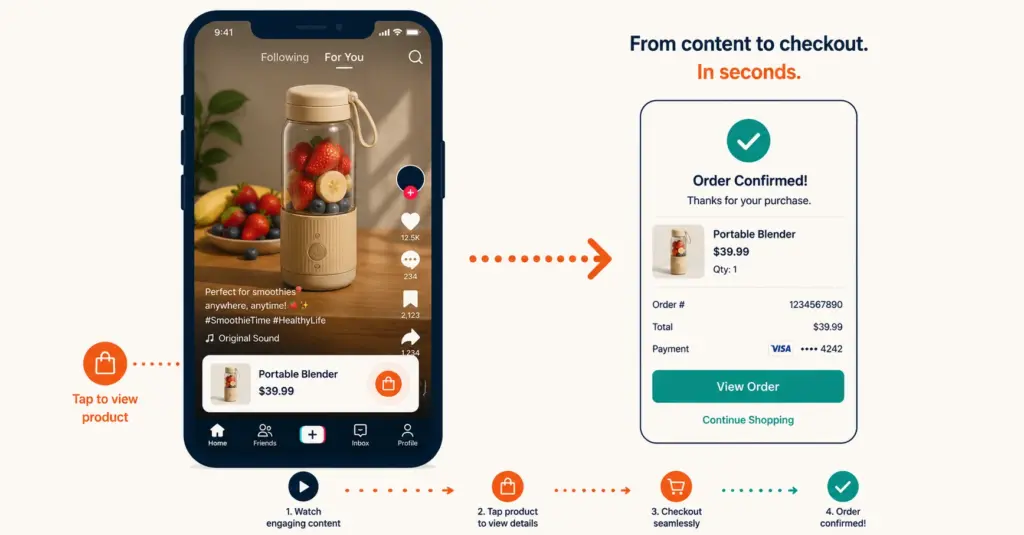
- TikTok Shop is a native marketplace within TikTok where sellers list products that users purchase without leaving the app. Products appear in shoppable videos, live streams, and the Shop tab. The integration of content discovery and instant purchasing creates a conversion path that doesn't exist on traditional marketplaces: a viewer watches a product demo, taps the product link, and buys within 30 seconds.
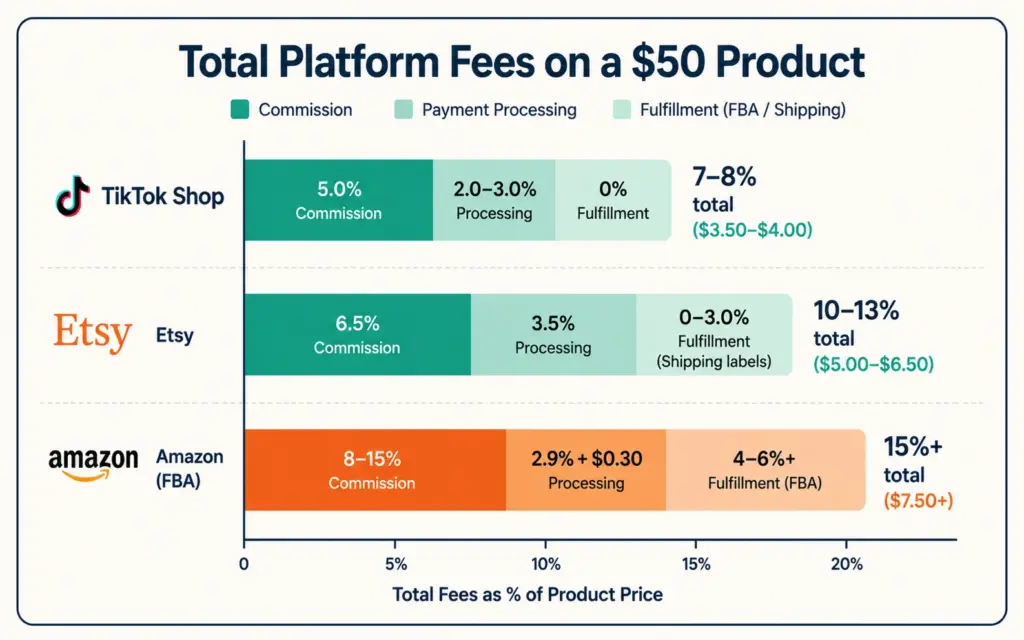
- TikTok Shop commission is 5% of each sale (reduced promotional rates may apply during onboarding). Plus standard payment processing. Total platform take: approximately 7 to 8% of sale price, significantly lower than Amazon's 15% referral fee or Etsy's stacked fees.
- Fulfillment requirements: ship within 3 calendar days of order, provide tracking within 24 hours. Late shipment rate above 4% triggers account penalties. Sellers can self-fulfill or use TikTok's Fulfilled by TikTok (FBT) program for warehousing and shipping.
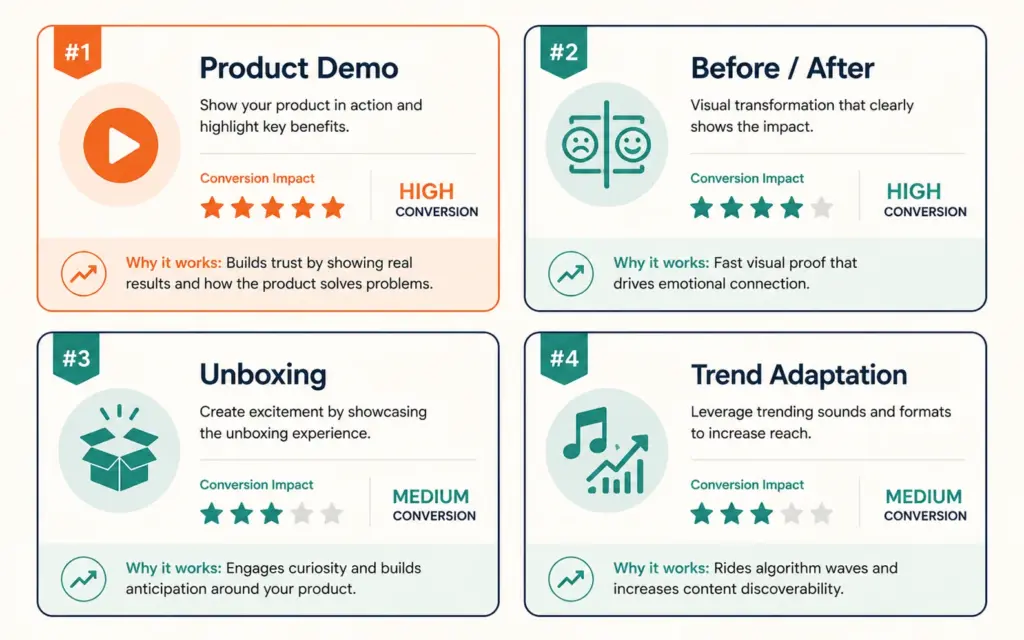
- The content-to-commerce model requires consistent video creation: 3 to 5 shoppable videos per week minimum. Product demos, unboxings, before/after comparisons, and trending audio format adaptations perform best. Affiliate program partnerships with TikTok creators are the primary growth lever for sellers without large followings.
A TikTok Shop seller lists products directly within the TikTok platform, enabling in-app purchases from shoppable videos, live streams, and the dedicated Shop tab. Unlike traditional marketplaces where shoppers search with purchase intent, TikTok Shop discovers products through content: a user scrolling their For You page encounters a product demonstration video, taps the embedded product link, and completes the purchase without leaving TikTok. According to TikTok Shop’s seller portal, this content-driven discovery model converts viewers into buyers at rates 2 to 3x higher than traditional product listing formats because the content serves as both advertising and product demonstration simultaneously.
TikTok Shop represents a fundamentally different selling channel from Amazon, Etsy, or your own DTC store. Success requires video content creation capability alongside standard ecommerce operations. Sellers who treat TikTok Shop as “list products and wait for orders” see minimal results. Sellers who combine strong product listings with consistent shoppable content and creator affiliate partnerships generate meaningful revenue from a channel that traditional competitors largely ignore. The TikTok marketing strategy covers organic content and advertising on TikTok broadly; this guide focuses specifically on selling through TikTok Shop as a marketplace.
Setting Up Your TikTok Shop Account
Registration requirements
- Business documentation: US passport or driver’s license for identity verification. EIN or SSN for tax reporting. Business registration (LLC or sole proprietorship accepted). A US phone number and email address.
- Product compliance: TikTok prohibits certain categories (alcohol, tobacco, weapons, pharmaceuticals, adult content). Product listings must comply with FTC guidelines for advertising claims. Products requiring age verification have additional restrictions.
- Bank account: US bank account for payout deposits. Payouts process every 15 days after orders are delivered and the return window closes.
Registration approval takes 1 to 5 business days. During review, prepare your product catalog: photos, descriptions, pricing, and inventory quantities. Once approved, you can list products and begin creating shoppable content immediately.
Account setup checklist
After approval: complete your shop profile (logo, banner, description), set up your shipping templates (standard, expedited), configure return policy settings, and connect your TikTok content account to your seller account. The seller account and content account can be different (brand account creates content, seller account manages orders), enabling team-based workflows. The first store checklist fundamentals of payment configuration, shipping setup, and policy creation apply equally to TikTok Shop.
TikTok Shop Fee Structure
| Fee Type | Rate | Notes |
|---|---|---|
| Commission (referral fee) | 5% of sale price | Promotional rates (as low as 1.8%) during onboarding periods |
| Payment processing | ~2.9% + $0.30 | Standard card processing |
| Affiliate commission | 5 to 20% (seller sets) | Paid to creators who promote your products |
| TikTok Ads (optional) | CPC/CPM variable | Promoted product videos in feed |
Total platform take on a direct sale (no affiliate): approximately 7 to 8%. This is significantly lower than Amazon’s 15% referral fee plus FBA fees or Etsy’s 10 to 13% stacked fees. The lower commission makes TikTok Shop particularly attractive for products with margins that can’t absorb Amazon-level fees. Compare the per-unit economics across platforms using the profit margin calculator with each marketplace’s fee structure.
Affiliate commissions are the variable cost to manage carefully. Setting a 15% affiliate commission on top of TikTok’s 5% commission means 20% of the sale goes to platform costs before product costs. The ecommerce profit margins analysis should model affiliate-driven sales as a separate margin tier from direct sales.
Product Listing Optimization
TikTok Shop product listings function differently from Amazon or Etsy listings. The listing is secondary to the video content that drives discovery. But listings must convert the traffic that content generates.
Title and description
Keep titles under 80 characters. Lead with the product benefit, not the brand name: “Ultra-Soft Microfiber Bed Sheets (Queen, 4-Piece Set)” outperforms “BrandName Premium Sheets Collection” because TikTok shoppers discover products through content, not brand search. Include the primary keyword, size/variant, and key differentiator in the title. The product descriptions approach of benefit-first copywriting applies, but TikTok descriptions should be shorter (150 to 250 words) because the video content does the heavy selling.
Images and video
Minimum 5 product images: white-background main image, lifestyle shots, close-up details, and size reference. TikTok Shop also supports a product video directly on the listing (15 to 60 seconds). Listings with a product video convert 30 to 50% higher than image-only listings because the video format matches TikTok’s native content experience.
Pricing strategy
TikTok Shop buyers are price-sensitive and comparison-conscious. The “Shop” tab displays products with visible prices alongside competitors. Price competitively within TikTok Shop (check the Shop tab for comparable products), not against your DTC store. Running a slight discount on TikTok Shop versus your website (5 to 10%) creates a platform-specific incentive that drives TikTok conversions. The ecommerce pricing strategy should include a channel-specific pricing tier for marketplace presence.
The Content-to-Commerce Strategy
Shoppable video formats that convert
Product demonstration: Show the product in use. 15 to 30 seconds of genuine usage with results visible. “Watch me clean this stain in 10 seconds” outperforms “This cleaner is amazing and you should buy it.” Demonstration builds credibility and addresses the “does it actually work?” objection in real-time.
Before/after: Split-screen or sequential before/after comparison. Skincare, cleaning products, organization tools, and home improvement products excel in this format. The visual proof eliminates the need for persuasive copy.
Unboxing and first impression: Film opening the product, examining it, and using it for the first time. Authentic reactions generate trust. Overly scripted or polished unboxings feel like ads; genuine surprise and commentary feel like peer recommendations.
Trend adaptation: Apply trending TikTok audio or video formats to your product. A trending sound overlaid on a product demonstration reaches broader audiences through the algorithm’s trend amplification. Check TikTok’s Creative Center for current trending formats. According to TikTok’s Creative Center data, product demonstration videos with trending audio generate 40 to 60% more engagement than silent product showcases, making sound selection a meaningful conversion lever.
Posting frequency: 3 to 5 shoppable videos per week minimum. The TikTok algorithm rewards consistency. Posting daily (if quality can be maintained) accelerates product discovery. Each video should tag the product link so viewers can purchase directly from the video. The UGC strategy principles of authentic, unpolished content apply more strongly on TikTok than any other platform.
TikTok Shop Affiliate Program
The affiliate program is TikTok Shop’s primary growth mechanism for sellers without large followings. You set a commission rate (5 to 20%) and creators browse your products in the affiliate marketplace. Creators who select your products create shoppable content featuring them, and you pay the commission only on completed sales.
Two affiliate approaches: Open collaboration (any creator can promote your products at your listed commission rate) and Targeted collaboration (you invite specific creators with relevant audiences and negotiate custom commission rates). Targeted collaboration converts better because you control creator-product fit, but requires outreach effort. Start with open collaboration at 10 to 15% commission, then shift to targeted as you identify which creator types drive the highest-converting traffic.
Affiliate economics: if your gross margin is 60% and you set a 15% affiliate commission plus 5% TikTok commission, your margin on affiliate-driven sales is 40%. This is lower than direct sales but the affiliate does the marketing work. Compare against your customer acquisition cost on Meta or Google: if CAC through paid ads is $25 on a $50 product (50% of revenue), an affiliate commission of 20% ($10) is cheaper acquisition.
Fulfillment and Operations
Shipping requirements
TikTok Shop enforces strict shipping timelines: ship within 3 calendar days of order placement with tracking information uploaded within 24 hours of shipment. Late shipment rate above 4% triggers account warnings. Above 10% risks account suspension. These requirements are stricter than Amazon’s typical 2-day handling time for merchant-fulfilled orders.
Self-fulfillment works for low to moderate volume (under 50 orders/day). Above that, consider TikTok’s Fulfilled by TikTok (FBT) program or a 3PL guide provider that integrates with TikTok Shop. FBT handles warehousing, picking, packing, and shipping, similar to Amazon FBA. Products fulfilled through FBT receive a “Shipped by TikTok” badge that builds buyer trust.
Returns and customer service
TikTok Shop default return window is 30 days. Sellers handle returns directly (or through FBT). Respond to customer messages within 24 hours; response rate below 90% affects shop scoring. Proactively request reviews from satisfied customers by including a thank you card with a QR code linking to your TikTok Shop listing. Positive reviews and high ratings improve your shop’s visibility in the Shop tab search results. TikTok monitors seller performance metrics: order defect rate, late shipment rate, and response rate. Maintaining good scores unlocks promotional opportunities and higher search placement within the Shop tab.
Frequently Asked Questions
TikTok Shop charges 5% commission on each sale plus approximately 2.9% + $0.30 payment processing. Total platform take: 7 to 8% on direct sales. If using affiliates, add your set commission (5 to 20%) on affiliate-driven sales. No monthly subscription fee. No listing fees. Promotional commission rates as low as 1.8% may apply during onboarding. This is significantly cheaper than Amazon (15%+ fees) or Etsy (10 to 13%).
No. The affiliate program allows creators with established audiences to promote your products for a commission. Many successful TikTok Shop sellers have small personal followings but generate significant sales through affiliate creators. Start with open affiliate collaboration at 10 to 15% commission. Additionally, TikTok’s algorithm surfaces content based on engagement quality, not follower count, so even small accounts can have videos reach millions of viewers.
Ship within 3 calendar days with tracking uploaded within 24 hours of shipment. Late shipment rate above 4% triggers warnings; above 10% risks suspension. These are stricter than most marketplace requirements. For high-volume sellers, Fulfilled by TikTok (FBT) or a third-party fulfillment provider handles shipping compliance automatically.
Products that demonstrate well in short video: beauty and skincare (visible results), cleaning products (before/after), kitchen gadgets (live demos), fashion accessories (styling), and home organization (transformations). Price point sweet spot: $15 to $60. Under $15, margins struggle after fees. Above $60, impulse purchase behavior decreases. Products requiring detailed research or comparison shopping perform less well because TikTok’s discovery model favors impulse conversion.
Minimum 3 to 5 shoppable videos per week. Daily posting accelerates discovery if quality can be maintained. Each video should tag the product link for direct purchasing. Mix formats: product demonstrations, before/after, unboxings, and trend adaptations. The algorithm rewards consistency over virality, so steady daily posting outperforms sporadic high-effort content.
Yes. TikTok Shop operates as an additional sales channel alongside Amazon, Etsy, and your own store. Manage inventory across channels to prevent overselling. Channel-specific pricing is acceptable (TikTok buyers don’t typically comparison-shop across platforms). Many sellers use TikTok Shop as a customer acquisition channel and redirect repeat customers to their own DTC store where margins are higher.
Related Reads
- TikTok Marketing
- UGC Strategy
- Amazon Listing Optimization
- 3PL Guide
- Customer Acquisition Cost
- Ecommerce Pricing Strategy
Enjoying this? Get more like it every week.
One email per week with ecommerce strategies, tool picks, and seller insights. No spam.