
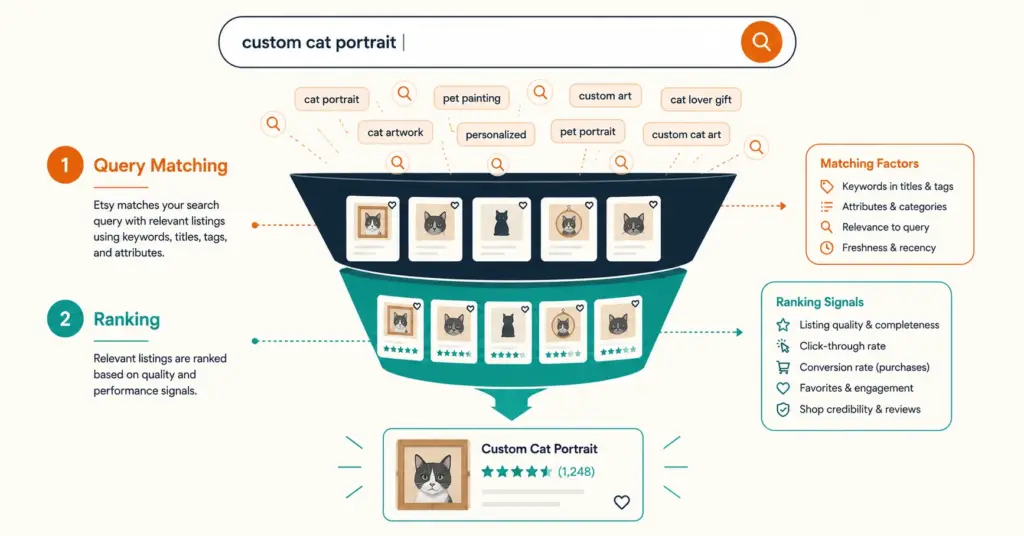
- Etsy search works in two phases. First, it matches your listing keywords (title, tags, description, attributes, categories) to what a buyer typed. Then it ranks those matches using listing quality score, conversion rate, review history, and shop performance. Getting found is about keywords. Staying at the top is about selling.
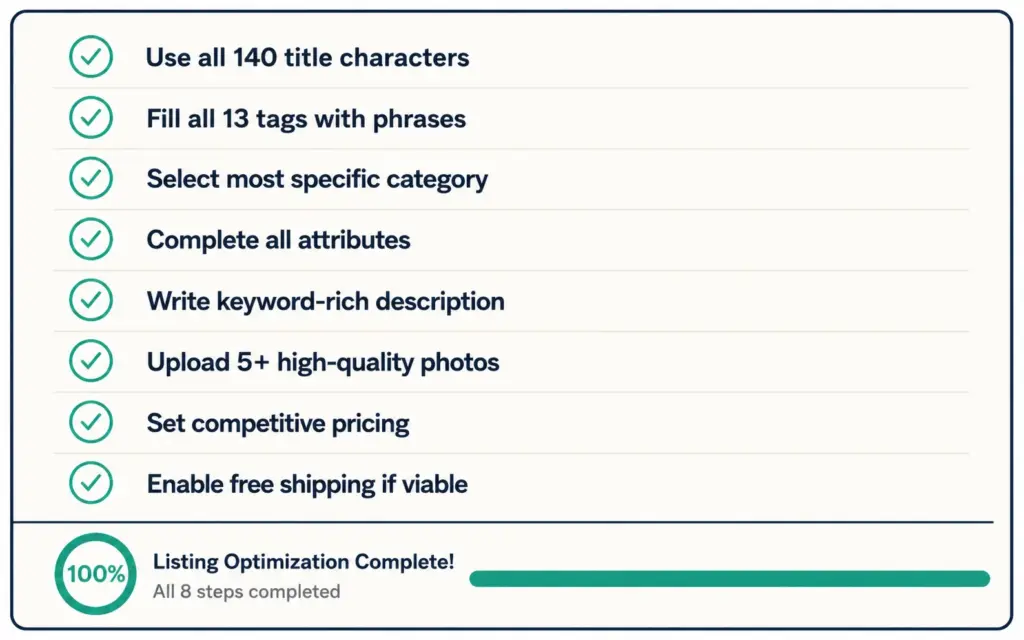
- Titles carry the most SEO weight. Lead with your primary keyword in the first 40 characters. Use all 140 characters. Structure them as: [Primary Keyword] | [Secondary Keyword + Modifier] | [Occasion or Recipient]. Write for shoppers scanning mobile results, not for the algorithm alone.
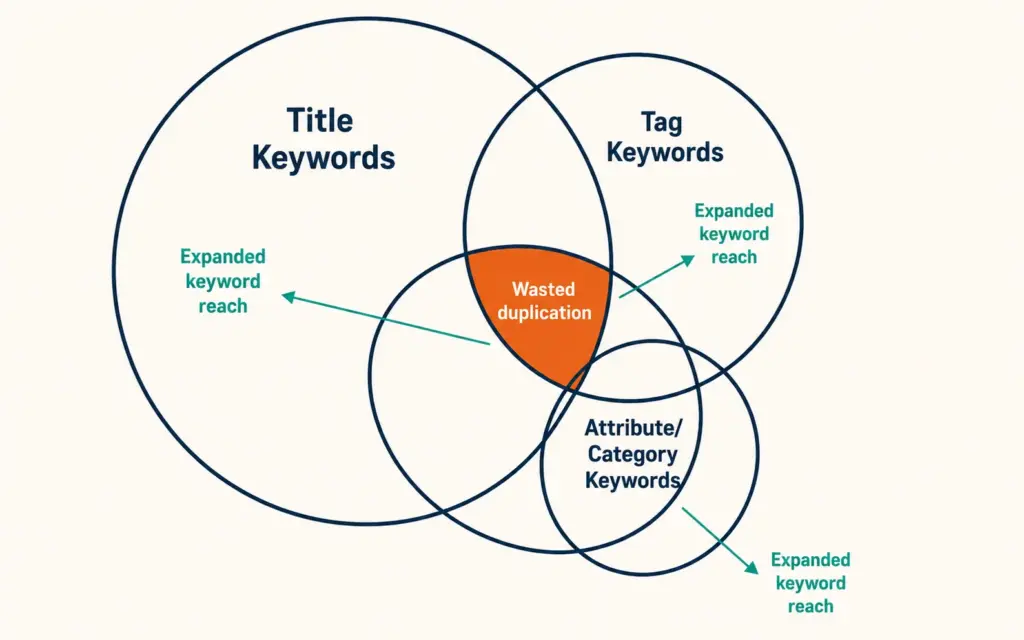
- Your 13 tags should expand your keyword reach, not repeat your title. If your title already says "personalized dog mom mug," your tags should cover "custom pet lover gift," "funny coffee cup," "dog owner birthday present." Each tag is a separate search opportunity you either use or waste.
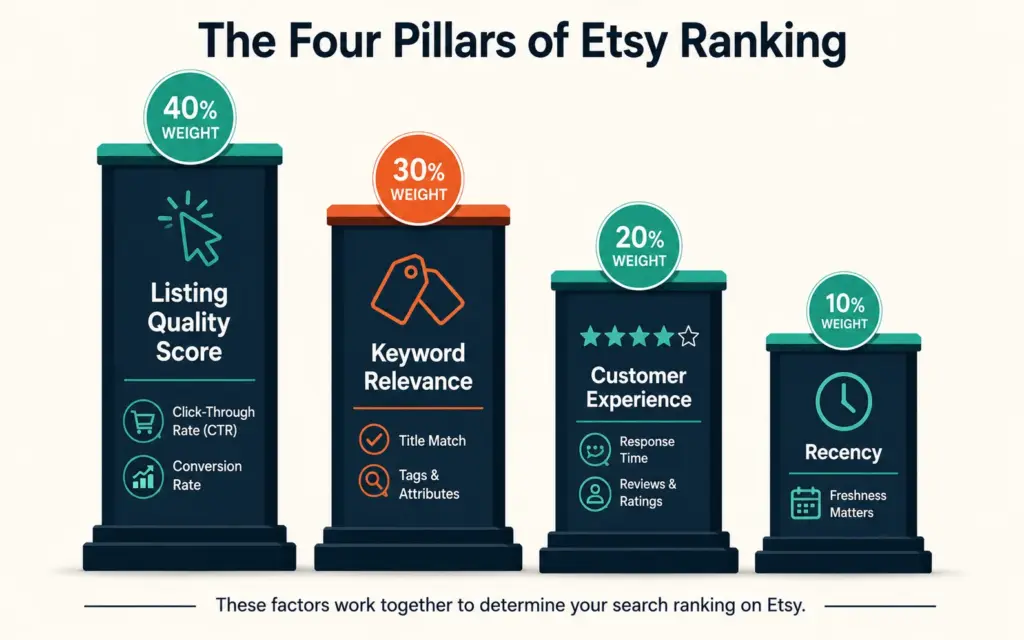
- Listing quality score is the ranking factor most sellers underestimate. Etsy tracks how often shoppers click your listing, how many of those clicks become purchases, and how recent your reviews are. Two listings with identical keywords will rank differently based on which one converts better. Photography and pricing affect SEO more than most sellers realize.
This Etsy SEO guide covers how Etsy’s search algorithm actually decides which listings show up first, and what you can do about it. Not the vague “use good keywords” advice that fills most guides. The specific mechanics: where keywords go, how Etsy weighs them, why some perfectly optimized listings still sit on page 12, and what separates sellers getting 500 views a day from those stuck at 5.
Etsy is a search engine. It works differently from Google, and it works differently from Amazon. The algorithm has its own rules. Sellers who come in with general SEO knowledge often struggle because they’re optimizing for a system that doesn’t exist on this platform. Etsy confirmed in their Seller Handbook that search has two distinct phases: query matching (finding listings that contain the shopper’s keywords) and ranking (sorting those matches by which ones are most likely to result in a purchase). Understanding both phases is the entire game.
How Etsy Search Actually Works
Phase 1: Query matching
A shopper types “personalized dog mom coffee mug” into the search bar. Etsy scans every listing and pulls the ones with matching keywords. It checks five places: your title, your 13 tags, your listing description, your category selection, and your attributes. If your listing doesn’t contain those words anywhere, you’re invisible to that search. Period.
Etsy uses both exact match and broad match. If a shopper searches “gold hoop earrings” and your tag says “gold hoop earrings,” that’s an exact match and it ranks stronger. If your tag says “gold earrings” and another tag says “hoop jewelry,” Etsy can still broad-match you, but you’ll rank lower than someone with the exact phrase. This is why multi-word tag phrases matter more than single-word tags. “Coffee” as a tag does almost nothing. “Coffee mug gift” as a tag catches specific buyer searches.
Phase 2: Ranking
Once Etsy finds every listing that matches, it sorts them. This is where most sellers lose. You can have perfect keywords and still sit on page 8 because ranking depends on signals beyond keywords:
Listing quality score. Etsy tracks how shoppers interact with your listing when it appears in search. Do they click it? Do they favorite it? Do they buy? A listing that gets clicked and purchased consistently earns a higher quality score and moves up in results. A listing that appears in search but gets skipped drops down. This means your thumbnail photo is an SEO factor. If shoppers scroll past your listing because the photo doesn’t grab them, your ranking declines even if your keywords are perfect.
Conversion rate. The percentage of visitors who buy. Higher conversion pushes you higher in search. This creates a virtuous cycle: better photos and descriptions lead to more sales, which lifts your search ranking, which brings more traffic, which leads to more sales. The opposite cycle is equally real. The product descriptions you write directly feed this signal.
Customer experience score. Etsy factors in your average review rating, message response time, and case rate from the past three months. Shops with 4.8+ star ratings and fast responses rank higher than shops with 4.2 stars and slow replies. If you’re fighting for the same keyword as another seller, your customer service track record can be the tiebreaker.
Recency. New listings get a small, temporary boost so Etsy can test how shoppers respond. This isn’t a reason to constantly renew listings (Etsy specifically says that doesn’t work as a strategy), but it means new listings get a fair shot at building their quality score from zero.
How to Write Titles That Rank
Your title carries more SEO weight than any other element. Etsy scans it for keywords and shoppers scan it while browsing results. It needs to serve both audiences.
Use all 140 characters. Most sellers stop at 60 to 80 characters and leave ranking opportunities on the table. Structure your title in segments separated by pipes or commas:
[Primary Keyword] | [Secondary Keyword + Modifier] | [Occasion or Recipient]
Example: “Handmade Ceramic Coffee Mug | Rustic Stoneware Gift for Coffee Lovers | Artisan Pottery”
That single title covers: handmade ceramic coffee mug, rustic stoneware gift, gift for coffee lovers, and artisan pottery. Four distinct search paths from one title. Compare that to “Beautiful Handmade Mug” which covers one search path and wastes 120 characters.
Etsy updated their title guidance in 2026 with a clear message: stop keyword stuffing. “Mug Coffee Mug Cup Cat Mug Gift Mug For Her Mug” doesn’t work anymore. Etsy’s natural language processing reads context and intent. Write titles a human would actually read. Lead with what the product IS, follow with what makes it special, end with who it’s for. The Etsy pricing strategy influences click-through too: if your price is $45 and the title says “Handmade” while competitors at $12 say “Custom Printed,” the title needs to justify the premium or shoppers will skip your listing regardless of keyword quality.
The 13-Tag Strategy
Tags are where most Etsy sellers either waste potential or unlock it. You get 13 tags, each up to 20 characters. Every empty tag slot is a missed search opportunity. Every tag that duplicates your title is a wasted slot.
Here’s why: Etsy already indexes your title keywords. If your title says “personalized gold necklace,” you don’t need “personalized necklace” as a tag. Etsy already knows. Instead, use tags to expand your keyword footprint into searches your title doesn’t cover:
- 3 to 4 long-tail product variations (“custom initial jewelry,” “dainty layering chain”)
- 3 buyer intent phrases (“gift for her,” “anniversary present,” “birthday gift idea”)
- 2 to 3 style or material terms (“minimalist gold,” “14k gold filled”)
- 2 to 3 occasion or seasonal tags (“Christmas gift,” “Valentine’s Day,” “Mother’s Day”)
Each tag should be a phrase, not a single word. “Necklace” as a tag competes with millions of listings. “Dainty gold layering necklace” targets a specific buyer. Long-tail tags convert better because they match shoppers who know exactly what they want and are ready to buy. Those shoppers have higher purchase intent, which lifts your listing quality score, which lifts your ranking. It compounds.
One more detail Etsy sellers miss: tags handle regional language differences. If you sell internationally, “jumper” and “sweater” are the same product. “Grey” and “gray” catch different searchers. Use your 13 tags to cover these variations so you’re not invisible to half your potential market.
Descriptions: Not for Ranking, But for Selling
Etsy confirmed that descriptions ARE part of keyword matching. They matter for SEO. But their bigger job is converting the shopper who clicked. A buyer who clicks your listing and doesn’t buy hurts your quality score. A buyer who clicks and purchases boosts it.
Write descriptions for the buyer, not the algorithm. The first two to three sentences should include your primary keywords naturally and tell the shopper exactly what they’re getting. After that, cover the information that closes the sale: dimensions, materials, care instructions, shipping timeline, and customization options.
Don’t copy your title into the description. Don’t list keywords in a block at the bottom. Etsy specifically warns against this. Instead, weave secondary keywords into natural sentences that a buyer would actually read. The reviews and social proof you’ve accumulated also appear below the description, so the description’s job is to get the buyer close enough that the reviews close the sale.
Keyword Research for Etsy
Etsy keyword research starts with one mindset shift: think like a buyer, not a maker. Makers describe what they made (“hand-thrown stoneware mug with speckled glaze”). Buyers describe what they need (“coffee mug gift for teacher,” “rustic mug for housewarming”). Bridge that gap and your listings match real searches instead of imaginary ones.
Free research methods that work
Etsy search bar autocomplete. Open Etsy in a private browser window. Type your product’s core term and watch the suggestions. Those suggestions are real searches from real buyers, sorted by volume. “Mug” might suggest “mug for dad,” “mug funny,” “mug personalized.” Each suggestion is a potential title segment or tag.
Competitor listing analysis. Search your primary keyword on Etsy. Open the top 5 results (the ones with hundreds or thousands of sales). Read their titles. Read their tags (use Etsy’s listing source code or a tool like eRank). Note which keywords they use that you don’t. They’re ranking on page 1 for a reason.
Google Trends. Search your product terms to identify seasonal demand patterns. “Christmas mug” peaks in October and November. If you optimize for seasonal terms 6 to 8 weeks before the peak, your listing has time to build quality score before the rush. The demand forecasting methodology applies to keyword timing too: optimize for what buyers will search next month, not just what they searched last month.
Etsy stats. Check your shop’s Search Analytics to see which search terms already bring traffic. If a term drives views but not sales, the problem is your listing (photo, price, description), not your keywords. If a term drives sales but low views, invest more tags and title space in that term to increase your search visibility for a proven converting keyword.
Categories and Attributes: Free Tags You’re Probably Ignoring
When you list a product, Etsy asks you to select a category and fill in attributes (color, material, size, occasion, style). Each attribute acts like an additional tag that doesn’t count against your 13 tag limit. Sellers who skip attributes leave free keyword opportunities unused.
Select the most specific subcategory available. “Home & Living > Kitchen & Dining > Drinkware > Mugs” is better than “Home & Living.” Each level of specificity adds keyword matching opportunities. If the attribute “faux fur” is available and accurate for your product, add it. You don’t need to use a separate tag for “faux fur” since the attribute already indexes that term. Use your 13 tags for keywords that attributes can’t cover. The ecommerce tools and tech stack guide covers listing management tools like eRank and Marmalead that surface which attributes you’re missing.
Photos Are SEO (Seriously)
This sounds wrong, but it’s the most important thing in this guide. Your listing photo is the number one factor determining whether a shopper clicks your listing in search results. Click-through rate feeds your listing quality score. Quality score determines your ranking. So your photo directly affects where you rank.
Etsy search results show a grid of thumbnails on mobile. Shoppers scroll fast. Your thumbnail competes with 40+ other products on screen. A clean, bright product photo on a simple background stops the scroll. A dark, cluttered, or distant photo gets scrolled past. Every scroll-past lowers your quality score.
Five photos minimum per listing. Etsy recommends images at 2000×2000 pixels. Show the product on a clean background (first image), in context/lifestyle (second and third), close-up details (fourth), and with a size reference (fifth). According to GrowingYourCraft’s analysis, product listings in competitive keywords consistently feature professional-quality photos with clean backgrounds. The product photography standards that apply to DTC stores apply equally on Etsy, but the thumbnail game is even more critical because of the competitive grid layout.
Free Shipping and Its SEO Impact
Etsy’s algorithm includes a shipping price score. Listings offering free shipping to the US receive a ranking boost. Etsy’s own data shows free shipping listings convert 10 to 15% better than paid-shipping listings.
The most common approach: add your average shipping cost to the product price and list the item as “free shipping.” For most US-to-US shipments under 1 pound, that means adding $4 to $8 to the product price. Buyers notice “FREE shipping” in search results. They rarely calculate whether you baked the cost into the price. The shipping cost calculator tells you whether your margins can absorb the shipping cost at your current AOV.
For international shipping, consider free domestic and actual-cost international. You capture the US search ranking boost without absorbing $15 to $40 international shipping costs that would destroy margins on lower-priced items.
The Biggest Etsy SEO Mistakes
Repeating the same primary keyword across multiple listings. Etsy uses “de-clumping” to show variety in search results. Only one or two of your listings will appear for any single search query. If all 50 of your listings target “personalized mug,” 48 of them are invisible. Spread your keywords so each listing targets distinct search terms.
Using single-word tags. “Candle” as a tag matches millions of listings. You’ll never rank for it. “Soy candle gift set” matches a specific buyer search. Always use multi-word phrases in your tags.
Skipping listing descriptions. Etsy now indexes descriptions for keyword matching. A blank or copy-pasted description misses keyword opportunities AND fails to convert visitors. Both hurt your ranking.
Ignoring shop performance metrics. Your message response rate, shipping time, and review rating all feed into search ranking. A shop with 3.8 stars and 60% response rate will rank below a shop with 4.9 stars and 98% response rate, even with identical keywords. The Etsy Star Seller program rewards exactly the behaviors that improve your search ranking.
Optimizing once and never updating. Buyer search patterns shift seasonally. Keywords that drove traffic in Q1 may be irrelevant in Q3. Review your tags and titles quarterly. Check Etsy Stats for which terms drive traffic, swap underperformers for seasonal or trending alternatives, and refresh listings that have plateaued. The content marketing principle of ongoing optimization applies to marketplace listings just as much as blog posts.
Frequently Asked Questions
New and updated listings typically get indexed within hours. Etsy gives new listings a small temporary boost to test buyer engagement. If the listing gets clicks and sales during that window, it builds ranking momentum. If it doesn’t, it drops. Most sellers see meaningful ranking changes within 2 to 4 weeks of optimization. Seasonal keywords may take 4 to 6 weeks to peak because you need to optimize before the buying season, not during it.
No. Etsy already indexes your title keywords. Repeating them in tags wastes valuable tag slots. Your 13 tags should cover search terms that your title doesn’t include. If your title says “personalized gold necklace,” your tags should cover “custom initial jewelry,” “dainty layering chain,” “gift for her,” and other variations. Expand your keyword footprint instead of duplicating it.
Yes. Etsy confirmed that listing descriptions are part of keyword matching. Include relevant keywords naturally in the first few sentences. Don’t copy your title into the description or list keywords in a block at the bottom. Write descriptions that incorporate keywords while also giving buyers the information they need to purchase: dimensions, materials, care instructions, and customization options.
Yes. Etsy’s algorithm includes a shipping price score and gives a ranking boost to listings offering free shipping to the US. Free shipping listings also convert 10 to 15% better. The standard approach is to add your average shipping cost to the product price and enable “free shipping.” For lightweight items (under 1 lb), adding $4 to $8 to the price is barely noticeable to buyers but activates the search ranking benefit.
Views without sales means your keywords are working (shoppers find you) but your listing isn’t converting (they don’t buy). Check three things: photos (is the first image clear and compelling on mobile?), price (are you competitive within your category on Etsy?), and description (does it answer the questions a buyer would have before purchasing?). Low conversion hurts your listing quality score, which drops your ranking over time, reducing views too. Fix conversion first.
All 13. Every empty tag is a search you can’t appear in. Use multi-word phrases (up to 20 characters each), not single words. Cover long-tail product variations, buyer intent phrases (gift for, personalized), style terms, material keywords, and seasonal or occasion terms. Don’t duplicate your title. Don’t duplicate attributes you’ve already selected. And rotate seasonal tags quarterly to stay relevant to current buyer searches.
Related Reads
- Etsy Pricing Strategy
- Etsy Star Seller
- Amazon Listing Optimization
- Product Descriptions
- Reviews and Social Proof
- Content Marketing
Enjoying this? Get more like it every week.
One email per week with ecommerce strategies, tool picks, and seller insights. No spam.