
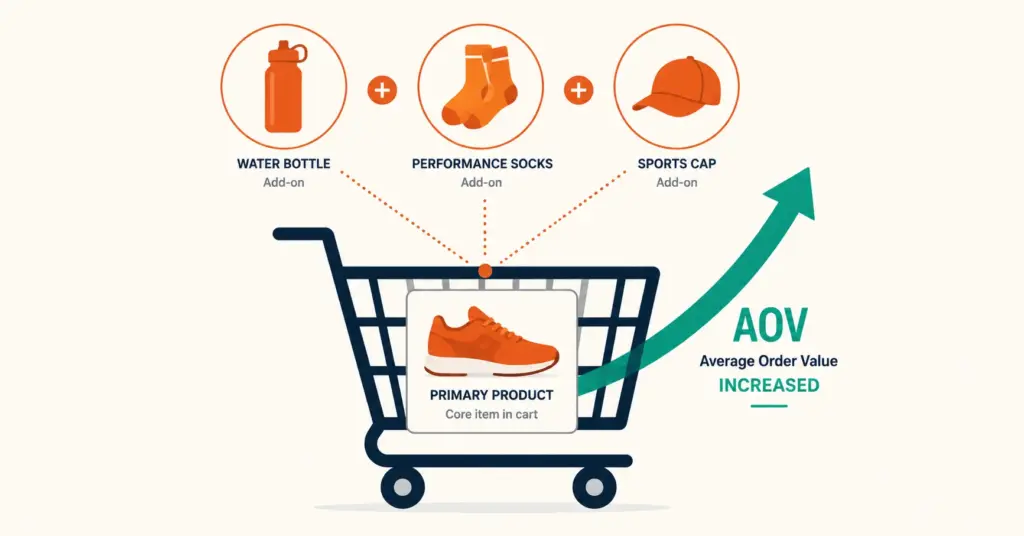
- Upselling encourages customers to buy a higher-priced version of their selected product. Cross-selling recommends complementary products alongside their primary purchase. Together, these tactics lift average order value (AOV) 15 to 30% without increasing traffic or acquisition costs.
- The 10 highest-impact tactics: product page "frequently bought together" bundles, cart page add-ons, checkout order bumps, post-purchase one-click upsells, tiered pricing displays, free shipping threshold progress bars, bundle discounts, subscription upsells, warranty/protection plan offers, and personalized email recommendations.
- The golden rule of effective upselling: the upsell should cost 25 to 40% of the primary product's price. A $20 upsell on a $60 product (33%) converts well. A $50 upsell on a $60 product (83%) feels like a separate purchase decision and converts poorly.
- Post-purchase upsells (offered on the thank-you page after payment) convert at 5 to 15% because the customer has already committed to buying. There is zero risk of cart abandonment since the primary purchase is already complete.
Ecommerce upsell cross sell tactics are the two revenue optimization strategies that increase how much each customer spends per order without requiring additional traffic or acquisition spend. Upselling moves customers toward a higher-priced version of their chosen product (“upgrade to the Pro model for $20 more”). Cross-selling adds complementary products to the order (“add the matching case for $15”). According to McKinsey’s personalization research, product recommendations (the engine behind upsells and cross-sells) drive 35% of Amazon’s total revenue and lift AOV 15 to 30% for brands that implement them effectively.
The economics are compelling because upsell and cross-sell revenue has zero incremental acquisition cost. You already paid to bring the customer to your site. Every dollar of additional AOV drops to gross margin at higher efficiency than acquiring a new customer. A store with $50 AOV and $30 CAC that lifts AOV to $65 through cross-sells generates 30% more revenue per customer without touching ad spend. For acquisition cost context, see our customer acquisition cost guide.
This guide covers the 10 highest-impact upsell and cross-sell tactics, the placement strategy that maximizes conversion without creating friction, the pricing psychology that determines which offers convert, and the measurement framework that isolates AOV lift from each tactic.
What is the Difference Between Upselling and Cross-Selling?
| Tactic | Definition | Example | Typical AOV Lift |
|---|---|---|---|
| Upsell | Higher-priced version of the selected product | “Upgrade to the 64GB model for $30 more” | 10 to 20% |
| Cross-sell | Complementary product alongside the primary purchase | “Add the protective case for $15” | 10 to 25% |
| Bundle | Multiple products packaged at a combined discount | “Buy the camera + lens + bag and save 15%” | 20 to 40% |
| Order bump | Small add-on offered at checkout with one click | “Add gift wrapping for $4.99” | 5 to 15% |
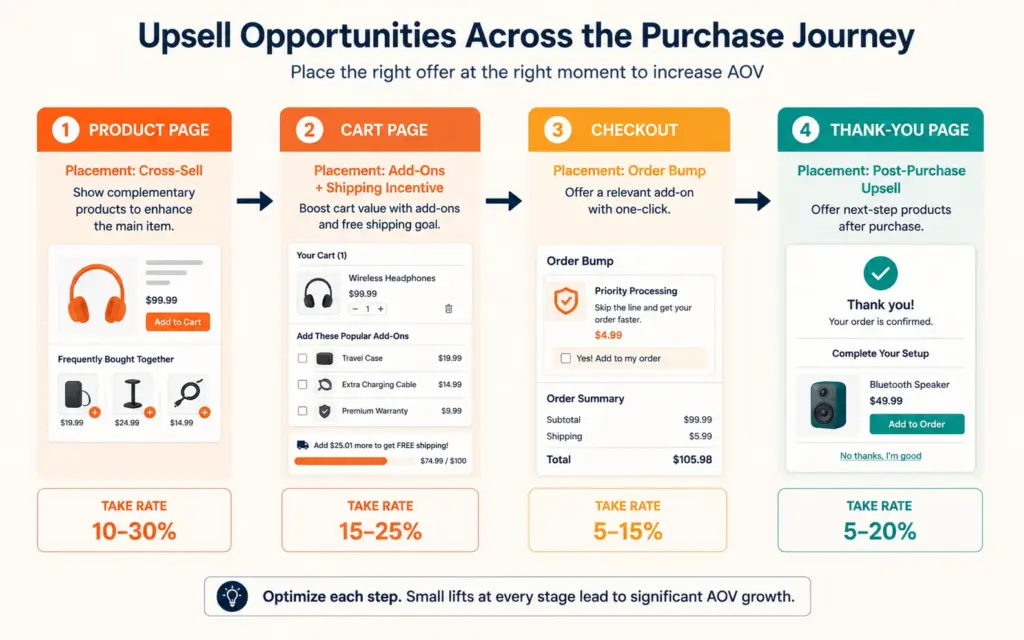
Most effective strategies combine all four. An upsell on the product page, a cross-sell in the cart, an order bump at checkout, and a post-purchase upsell on the thank-you page. Each catches the customer at a different decision moment and compounds the AOV increase.
What Are the 10 Highest-Impact Upsell and Cross-Sell Tactics?
Product page tactics
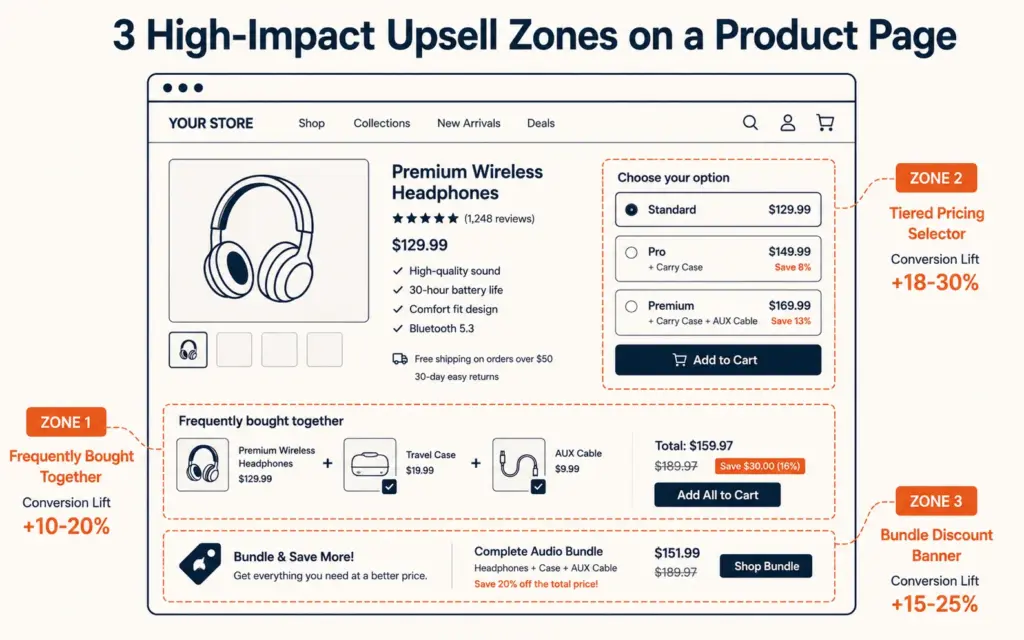
1. “Frequently bought together” bundles. Display 2 to 3 complementary products below the primary product with a combined price and “Add all to cart” button. Amazon’s “Frequently bought together” section generates 35% of its revenue. Implementation: most ecommerce platforms have native or plugin-based bundle functionality. The key: select genuinely complementary products, not random suggestions. A phone case with a phone makes sense; a phone case with a blender does not. For product page optimization, see our product page design guide.
2. Tiered pricing display. Show the selected product alongside higher-tier versions with clear feature comparisons. “Good / Better / Best” layout with the middle option highlighted (the decoy effect makes the middle tier feel like the best value). Tiered displays lift upsell conversion 15 to 25% compared to showing only the selected variant.
3. Bundle discount pricing. “Buy 2 save 10%, Buy 3 save 15%” applied automatically on the product page. Bundle discounts lift units per order 30 to 50% for consumable and replenishable products (supplements, skincare, coffee, pet food). The perceived value of the discount motivates larger purchases even when the customer initially intended to buy one unit. For discount strategy depth, see our discount strategy guide.
Cart page tactics
4. Cart page add-on recommendations. Show 2 to 4 complementary products in the cart based on cart contents. “People who bought [cart item] also added:” with one-click add-to-cart buttons. Cart page cross-sells convert at 8 to 15% click-to-add rate because the customer is already in buying mode. Position recommendations above the checkout button, not below it. For cart optimization context, see our cart abandonment solutions guide.
5. Free shipping threshold progress bar. “You’re $12 away from free shipping!” with a visual progress bar and suggested products that would reach the threshold. Free shipping progress bars lift AOV 8 to 15% by giving customers a financially rational reason to add items. The suggested products should be low-priced add-ons ($10 to $25) that feel like easy additions, not major purchase decisions. For shipping strategy, see our shipping strategies guide.
Checkout tactics
6. Order bump. A single, low-priced add-on offered with a checkbox during checkout: “Add gift wrapping for $4.99” or “Add extended warranty for $7.99.” Order bumps convert at 10 to 25% because the decision is trivially small relative to the purchase already in progress. The add-on should cost under 15% of cart value. Shopify apps like ReConvert and FunnelKit enable order bumps without custom development. For checkout optimization, see our checkout optimization guide.
Post-purchase tactics
7. Thank-you page upsell. After payment is confirmed, show a one-click upsell offer on the order confirmation page. “Add [complementary product] to your order for $X. One click, no re-entering payment.” Post-purchase upsells convert at 5 to 15% because the primary purchase is already complete (zero cart abandonment risk) and the customer is in a positive buying state. This is the highest-converting upsell placement because there is zero downside to offering it.
8. Post-purchase email cross-sell. Send a recommendation email 3 to 7 days after purchase: “You bought [product A]. Customers who bought [A] also love [B] and [C].” Post-purchase emails have 40 to 50% open rates (higher than any other email type) because customers are checking for shipping updates. Embedding cross-sell recommendations in these emails captures attention at peak engagement. For email strategy, see our email marketing strategy guide.
Subscription and protection tactics
9. Subscribe and save upsell. Offer a subscription option on consumable products: “Subscribe and save 15%. Delivery every 30/60/90 days.” Subscriptions lift LTV 2 to 3x versus single purchases and create predictable recurring revenue. Display the per-unit savings prominently (“$2.50/unit vs $3.00 one-time”). Tools like Recharge and Skio handle subscription management on Shopify. For retention context, see our customer retention guide.
10. Warranty and protection plans. Offer extended warranty or product protection on items above $50. “Add 2-year protection for $X.” Protection plans convert at 10 to 20% on qualifying products and generate 80 to 95% gross margin because claim rates are low. Services like Extend and Clyde integrate with Shopify and WooCommerce to automate warranty offers and claims processing.
What Pricing Psychology Makes Upsells Convert?
The 25 to 40% rule
Upsell and cross-sell offers convert best when priced at 25 to 40% of the primary product’s price. A $20 cross-sell on a $60 primary product (33%) feels like a small addition. A $50 cross-sell on the same $60 product (83%) feels like a separate purchase decision requiring separate justification. Keep offers in the “easy yes” range where the incremental cost feels trivial relative to the commitment already made.
Anchoring and the decoy effect
Show 3 options: the customer’s selection, a slightly better version (the upsell target), and a premium version (the decoy). The premium version makes the mid-tier upsell look like great value by comparison. “Basic $29 / Pro $39 / Enterprise $79” makes $39 feel like the sweet spot even though the customer originally considered $29.
Loss framing
“Save $15 when you add [product] today” converts better than “Add [product] for $25.” Framing the offer around what the customer loses by not adding (the savings, the convenience, the protection) is more motivating than framing around the cost. “Your order qualifies for free shipping with [one more item]” frames the shipping cost as a loss the customer can avoid.
Social proof on upsell offers
“78% of customers add [product] to this order” converts 20 to 30% better than the same offer without the statistic. Social proof removes decision uncertainty by signaling that the add-on is normal and expected. According to Barilliance’s upselling research, product recommendations with social proof convert 20 to 30% higher than identical offers without it. Use real data from your order history to generate these percentages.
How Do I Implement Upsells on Shopify and WooCommerce?
Shopify implementation
| Tactic | App / Tool | Cost |
|---|---|---|
| Frequently bought together | Frequently Bought Together (Code Black Belt) | $9.99/month |
| Cart page cross-sells | In Cart Upsell & Cross Sell (InCart) | $19.99/month |
| Order bumps + thank-you upsells | ReConvert or FunnelKit | $7.99 to $14.99/month |
| Bundle pricing | Shopify Bundles (native) or Bold Bundles | Free (native) / $19.99/month |
| Subscription upsell | Recharge or Skio | $99/month |
| Free shipping progress bar | Hextom Free Shipping Bar | Free to $9.99/month |
For WooCommerce, equivalent functionality comes from WooCommerce Product Bundles ($49/year), CartFlows or FunnelKit ($99/year for order bumps and upsells), and WooCommerce Subscriptions ($199/year). For platform-specific plugin recommendations, see our best WooCommerce plugins guide.
How Do I Measure Upsell and Cross-Sell Performance?
The 4 AOV optimization metrics
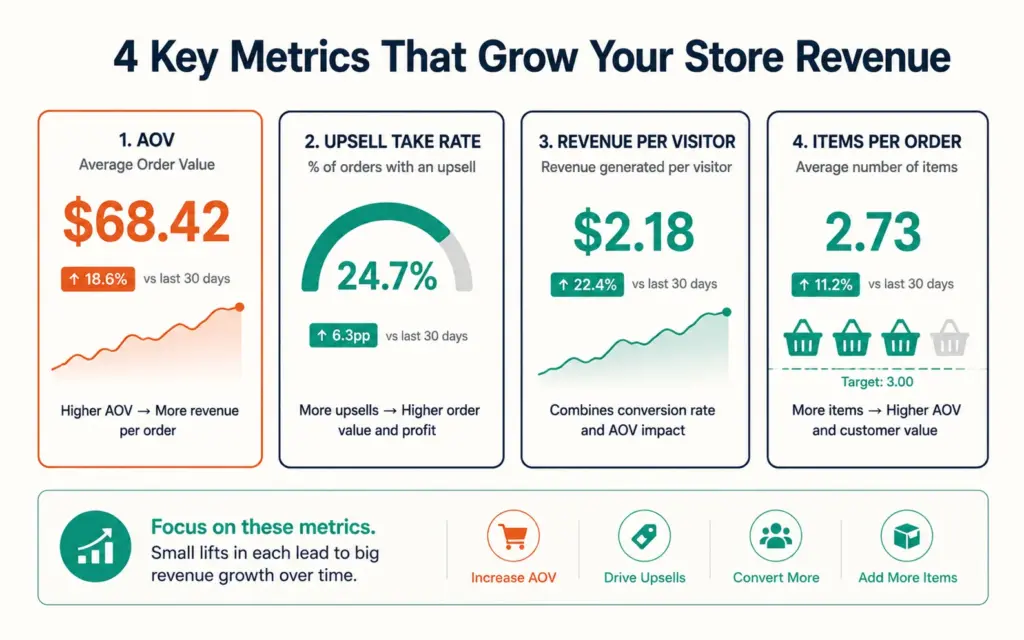
- Average order value (AOV): Total revenue / total orders. Track weekly. Compare before and after each upsell tactic implementation. Target 15 to 30% AOV lift from combined upsell and cross-sell tactics.
- Upsell take rate: Percentage of eligible customers who accept an upsell offer. Benchmark: 5 to 15% for product page upsells, 10 to 25% for order bumps, 5 to 15% for post-purchase offers.
- Revenue per visitor (RPV): Total revenue / total unique visitors. RPV captures both conversion rate and AOV in a single metric. Rising RPV with stable traffic indicates successful AOV optimization.
- Items per order: Average number of items in each order. Cross-sell success shows up here. Target 1.5 to 2.5 items per order for most ecommerce categories.
A/B test each upsell tactic individually for 14+ days before permanent implementation. Some upsells may lift AOV but reduce conversion rate (net neutral or negative on RPV). RPV is the ultimate success metric because it captures the full picture. For testing methodology, see our A/B testing guide. For broader KPI tracking, see our ecommerce KPIs guide.
Common Upsell and Cross-Sell Mistakes
Recommending irrelevant products
Random product recommendations signal lazy implementation and reduce trust. “Customers who bought running shoes also bought: kitchen blender” actively hurts conversion. Every recommendation must be genuinely complementary. Curate product pairings manually for your top 20 products rather than relying solely on algorithmic suggestions.
Offering too many options at once
Showing 8 cross-sell options creates decision paralysis. Limit to 2 to 3 recommendations per placement point. The customer should feel helped, not overwhelmed. One relevant cross-sell converts better than five irrelevant ones. For pricing psychology depth, see our ecommerce pricing strategy guide.
Pricing upsells too aggressively
An upsell that costs 80%+ of the primary product’s price triggers a new purchase evaluation rather than an incremental decision. Stay within 25 to 40% of the primary price. A $15 add-on to a $50 order is easy. A $45 add-on to the same order creates resistance and may actually reduce checkout completion.
Not testing upsells against no-upsell control
Some upsell implementations reduce conversion rate by adding friction to checkout. A poorly placed pop-up upsell might increase AOV 10% but reduce conversion 15%, producing a net revenue decrease. Always A/B test each tactic against a control with no upsell to measure the net RPV impact, not just AOV. For margin impact analysis, see our ecommerce profit margins guide.
Frequently Asked Questions
Upselling encourages buying a higher-priced version of the selected product (e.g., upgrading from 32GB to 64GB storage for $30 more). Cross-selling recommends complementary products alongside the primary purchase (e.g., adding a protective case for $15). Upselling increases per-item revenue; cross-selling increases items per order. Both lift average order value 15 to 30% when implemented together.
Combined upsell and cross-sell tactics typically lift AOV 15 to 30%. Individual tactic impact: product page cross-sells (10 to 25% AOV lift), free shipping threshold bars (8 to 15%), order bumps at checkout (5 to 15% of orders, adding $5 to $15 per accepting customer), post-purchase upsells (5 to 15% take rate), and bundle pricing (20 to 40% on qualifying products). The compounding effect of multiple tactics across the purchase journey produces the 15 to 30% combined lift.
A post-purchase upsell is an offer shown on the order confirmation (thank-you) page immediately after payment completes. The customer can add a complementary product to their order with one click, without re-entering payment information. Post-purchase upsells convert at 5 to 15% because the primary purchase is already complete (zero cart abandonment risk). Tools like ReConvert and FunnelKit enable this on Shopify and WooCommerce.
An order bump is a small, low-priced add-on offered via checkbox during checkout, such as gift wrapping ($4.99), extended warranty ($7.99), or a sample pack ($3.99). Order bumps convert at 10 to 25% because the decision feels trivially small relative to the purchase already in progress. The add-on should cost under 15% of cart value. This is one of the highest-ROI conversion tactics because it adds zero friction to the checkout flow.
Use three selection criteria: genuine complementarity (the products logically go together), price ratio (upsell/cross-sell costs 25 to 40% of primary product price), and purchase data (analyze what customers actually buy together from your order history). Start by manually curating pairings for your top 20 products. Supplement with algorithmic recommendations from your platform’s built-in “related products” engine once manual pairings are established.
Yes, if implemented poorly. Aggressive pop-up upsells, too many recommendations creating decision paralysis, or high-priced upsells that trigger new purchase evaluations can reduce checkout completion. Always A/B test each upsell tactic against a no-upsell control measuring revenue per visitor (RPV), not just AOV. A tactic that lifts AOV 10% but reduces conversion 15% produces a net revenue loss. RPV captures both effects in one metric.
Related Reads
- Product Page Design Guide
- Checkout Optimization
- Discount Strategy Guide
- A/B Testing for Ecommerce
- Ecommerce Profit Margins
- Customer Acquisition Cost
Enjoying this? Get more like it every week.
One email per week with ecommerce strategies, tool picks, and seller insights. No spam.