
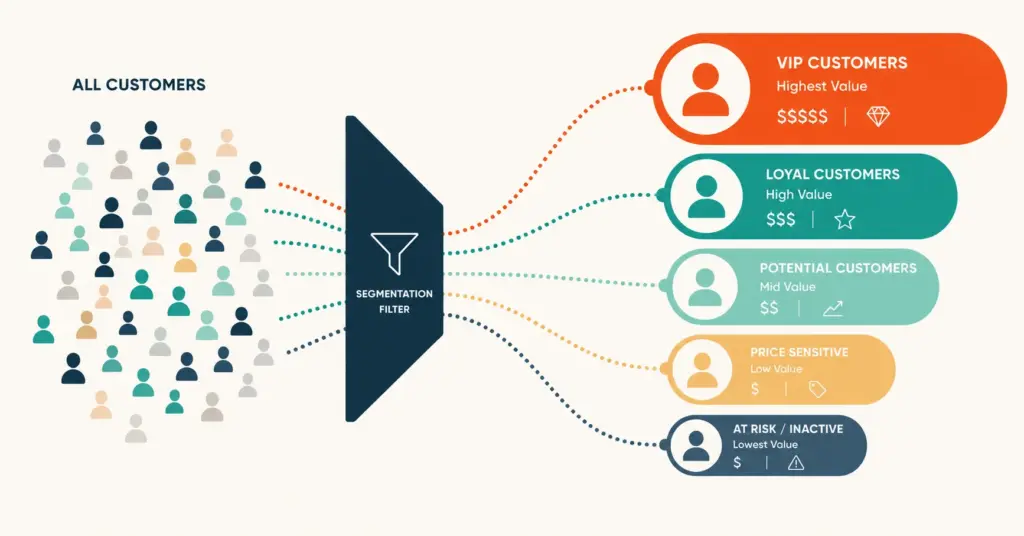
- Customer segmentation divides your audience into groups based on shared characteristics (purchase behavior, demographics, engagement level) so you can deliver targeted messaging that converts 2 to 5x better than one-size-fits-all marketing. Segmented email campaigns alone generate 58% of total email revenue for the average ecommerce store.
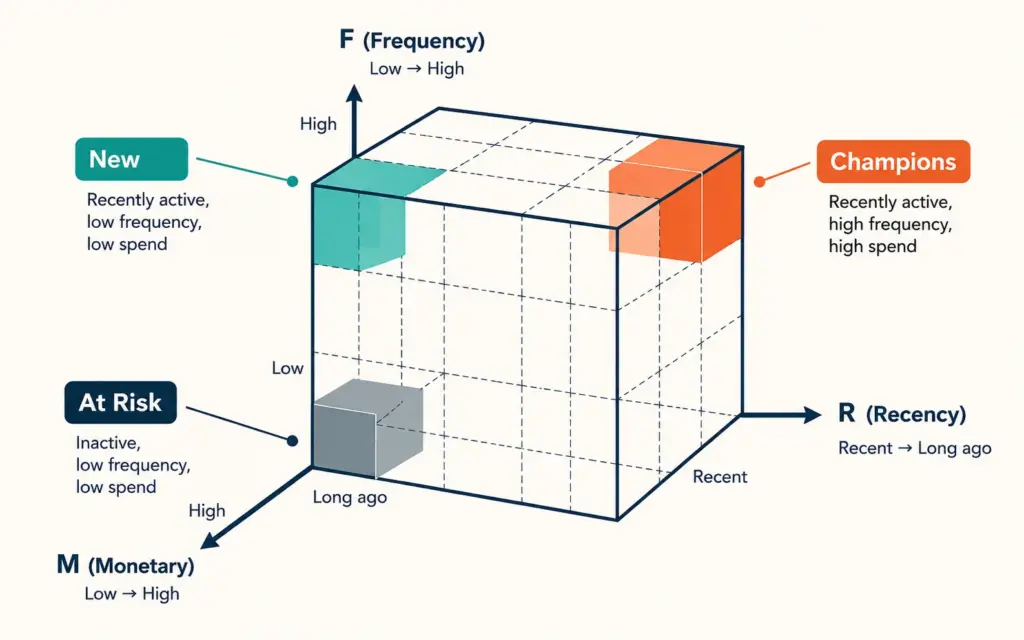
- The RFM model (Recency, Frequency, Monetary value) is the most practical segmentation framework for ecommerce. It creates actionable groups: VIP customers (recent, frequent, high-spend), at-risk customers (previously active, now quiet), and new customers (recent first purchase, unknown potential).
- The 8 essential ecommerce segments: VIP/high-value, repeat buyers, one-time buyers at risk, new customers (0 to 30 days), cart abandoners, browse abandoners, lapsed customers (90+ days inactive), and win-back candidates (180+ days).
- Segmentation without action is analysis paralysis. Every segment needs a corresponding marketing treatment: VIPs get early access, at-risk customers get re-engagement offers, new customers get onboarding sequences, and lapsed customers get win-back campaigns.
Customer segmentation for ecommerce divides your audience into distinct groups based on shared characteristics, from purchase history and browsing behavior to demographics and engagement patterns, so you can deliver targeted messages that match each group’s needs and intent. The alternative, sending every customer the same marketing, wastes budget on irrelevant messages and underperforms by 2 to 5x compared to segmented approaches. According to Klaviyo’s segmentation research, segmented email campaigns generate 58% of total email revenue while representing only 25 to 30% of total sends, meaning segmented messages produce roughly 4x the revenue per email of unsegmented blasts.
The practical challenge isn’t understanding that segmentation works. It’s knowing which segments to create, what data to use, and what action to take for each group. Most ecommerce stores have the data to segment effectively sitting unused in their Shopify, email platform, and analytics tools. The gap is translating that data into automated marketing treatments that run without daily manual intervention. For the email automation that delivers segmented messaging, see our email marketing strategy guide.
What Is the RFM Segmentation Model?
RFM (Recency, Frequency, Monetary value) is the most practical segmentation framework for ecommerce because it uses data you already have: purchase history.
| Dimension | What It Measures | Why It Matters |
|---|---|---|
| Recency | Days since last purchase | Recent buyers are most likely to buy again. Recency is the strongest predictor of next purchase. |
| Frequency | Number of purchases in a period | Repeat buyers are more valuable and more predictable than one-time buyers. |
| Monetary | Total spend in a period | High-spend customers generate disproportionate revenue and deserve disproportionate attention. |
RFM scoring
Score each customer 1 to 5 on each dimension (5 = best). A customer who purchased yesterday (R=5), has bought 8 times this year (F=5), and spent $500 total (M=5) scores 555: your VIP. A customer who purchased 180 days ago (R=1), bought once (F=1), and spent $30 (M=1) scores 111: a lapsed one-time buyer unlikely to return without intervention.
RFM segments that matter
- Champions (R=5, F=4-5, M=4-5): Your best customers. Recent, frequent, high-spend. 5 to 10% of customers generating 30 to 50% of revenue. Treatment: early access, VIP perks, loyalty program top tier.
- Loyal (R=3-4, F=3-5, M=3-5): Consistent buyers who may not be the highest spenders. 10 to 15% of customers. Treatment: cross-sell to increase monetary value, referral program invitations.
- At risk (R=1-2, F=3-5, M=3-5): Previously loyal customers who haven’t purchased recently. Treatment: win-back campaigns with personalized offers based on past purchases.
- New (R=5, F=1, M=varies): Recent first-time buyers. Unknown future value. Treatment: onboarding sequences, post-purchase education, second-purchase incentives.
- Hibernating (R=1-2, F=1-2, M=1-2): Old customers with low engagement. Treatment: aggressive win-back or suppress to save marketing costs.
For the lifetime value perspective that RFM scoring informs, see our lifetime value calculation guide.
What Are the 8 Essential Ecommerce Segments?
1. VIP / high-value customers
Top 10% by total spend or purchase frequency. These customers generate 30 to 50% of revenue and have the highest retention rates. Marketing treatment: exclusive early access to new products, VIP-only discounts, personalized thank-you messages, and loyalty program top-tier benefits. Never send VIPs generic promotional blasts; they deserve personalized communication. For retention depth, see our customer retention guide.
2. Repeat buyers
Customers with 2+ purchases who aren’t yet VIP level. Treatment: cross-sell recommendations based on purchase history, loyalty program enrollment, and product education content that expands their category engagement. Repeat buyers convert to VIPs when they discover additional product lines. For cross-sell strategy, see our upsell and cross-sell guide.
3. One-time buyers at risk
Customers who purchased once 30 to 60 days ago and haven’t returned. 60 to 70% of ecommerce customers never make a second purchase. Treatment: “second purchase” incentive (10 to 15% off), product usage tips, and complementary product recommendations timed to when they’ve had enough time to use the first product.
4. New customers (0 to 30 days)
Recent first-time buyers in the critical onboarding window. Treatment: welcome email series (brand story, product tips, community invitation), shipping and delivery updates, review request at 7 to 14 days, and a gentle cross-sell at 14 to 21 days. The first 30 days determine whether a new customer becomes a repeat buyer or a one-time transaction. For SMS onboarding, see our SMS marketing guide.
5. Cart abandoners
Visitors who added items to cart but didn’t purchase. Treatment: abandoned cart email (1 hour + 24 hours), abandoned cart SMS (if opted in), and retargeting ads showing the carted products. Cart abandonment recovery sequences convert 10 to 20% of abandoners. For the full recovery playbook, see our cart abandonment solutions guide.
6. Browse abandoners
Visitors who viewed product pages but didn’t add to cart. Lower intent than cart abandoners but still valuable. Treatment: browse abandonment email (24 hours after visit) showing viewed products with social proof. Retargeting ads with dynamic product creative. Browse abandonment emails convert 1 to 3% of recipients. For retargeting, see our retargeting strategies guide.
7. Lapsed customers (90+ days inactive)
Previously active customers who haven’t purchased in 90+ days. Treatment: re-engagement campaign with escalating incentives (email 1: “We miss you” + content, email 2: 10% off, email 3: 20% off + free shipping). If no response after 3 touches, suppress from regular campaigns to save marketing costs and reduce unsubscribes.
8. Win-back candidates (180+ days)
Lapsed customers who didn’t respond to re-engagement. Last attempt before suppression. Treatment: “Last chance” offer with the deepest discount you’ll offer (25 to 30% off or a specific product gift). If no response, move to suppressed status. Continuing to market to permanently disengaged subscribers hurts email deliverability. For analytics context, see our customer acquisition cost guide.
How Do I Implement Segmentation?
Tool-based segmentation
| Tool | Segmentation Capability | Best For |
|---|---|---|
| Klaviyo | Real-time behavioral + purchase + engagement segments | Email and SMS segmentation (industry standard) |
| Shopify Customer Segments | Purchase-based segments with filters | Basic RFM and lifecycle segmentation |
| GA4 Audiences | Behavioral website segments shared to Google Ads | Ad targeting and retargeting |
| Meta Custom Audiences | Website behavior + customer list uploads | Facebook/Instagram ad segmentation |
| Triple Whale / Lifetimely | Advanced LTV-based customer segmentation | Acquisition budget allocation by segment value |
Klaviyo is the most common segmentation hub for ecommerce because it combines purchase data (Shopify sync), engagement data (email opens, clicks), and behavioral data (website browsing) in one platform with automated flow triggers. For tech stack context, see our ecommerce tech stack guide.
Implementation steps
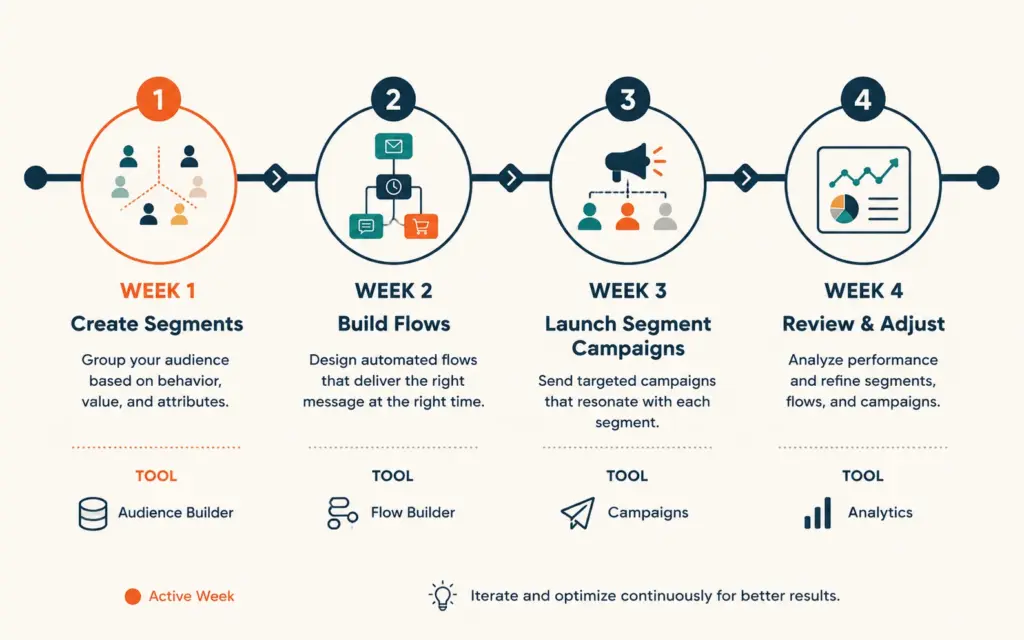
- Week 1: Create the 8 essential segments in your email platform using purchase history and engagement data
- Week 2: Build automated flows for each segment (welcome series for new, cart recovery for abandoners, win-back for lapsed)
- Week 3: Segment your next promotional campaign by customer tier (VIP gets early access, repeat gets standard, new gets educational)
- Week 4: Review segment sizes and flow performance. Adjust segment definitions if groups are too large (too broad) or too small (too narrow)
- Monthly: Add new segments based on product-category behavior, seasonal patterns, or acquisition channel. For attribution by segment, see our attribution modeling guide.
How Does Segmentation Improve Ad Performance?
Segmented ad audiences
Upload customer segments as custom audiences on Meta and Google. Create separate campaigns for each segment with tailored creative and offers:
- VIP customers: Lookalike audience for prospecting (your best customers’ behavioral twins). Typically 20 to 30% lower CPA than broad prospecting.
- Cart abandoners: Dynamic product retargeting with the specific items they carted. 5 to 15% conversion rate.
- Lapsed customers: Re-engagement ads with win-back offers. Cost-effective because you already have their data.
- Exclude recent purchasers: Prevent wasting ad spend on customers who just bought. For ad strategy, see our Facebook ads ecommerce guide.
Segmented landing pages
Direct different segments to different landing pages. New visitors see social proof and brand introduction. Returning visitors see “Welcome back” with personalized product recommendations. VIPs see exclusive collection access. Page-level personalization lifts conversion 10 to 20% versus generic pages. For product page optimization, see our product page design guide.
How Do I Measure Segmentation Effectiveness?
The 4 segmentation metrics
- Revenue per segment: Total revenue attributed to each segment per month. VIPs should generate 30 to 50% despite being 5 to 10% of customers. If VIP revenue share is declining, retention efforts need attention.
- Segment migration: Track how customers move between segments over time. Are new customers converting to repeat? Are repeat customers becoming VIPs? Positive migration indicates effective marketing.
- Campaign performance by segment: Open rate, click rate, and conversion rate segmented by audience. Segmented campaigns should outperform unsegmented by 2 to 5x on conversion rate. For KPI tracking, see our ecommerce KPIs guide.
- Suppression savings: Marketing cost saved by not sending to hibernating/suppressed segments. Removing 20% of disengaged subscribers saves 20% of email and SMS costs while improving deliverability. According to Litmus email marketing research, list hygiene through segmentation-based suppression improves inbox placement rates 15 to 25%.
Common Segmentation Mistakes
Creating segments without corresponding actions
Identifying that 500 customers are “at risk” means nothing if you don’t have a re-engagement campaign targeting them. Every segment needs a marketing treatment. No treatment = no segment. Start with 4 to 5 segments with clear treatments before adding complexity.
Over-segmenting into tiny groups
A segment of 12 customers is too small for statistical significance in campaign performance and too small for effective ad targeting (Meta needs 1,000+ for custom audiences). Keep segments large enough to be actionable: 500+ for email, 1,000+ for ads. Merge similar small segments rather than maintaining dozens of micro-groups. For A/B testing within segments, see our A/B testing guide.
Static segments that never update
A “new customer” segment created in January still containing the same people in June means your segments aren’t dynamic. Use conditional/real-time segments (Klaviyo, Shopify) that automatically update as customer behavior changes. A customer who was “new” in January should have migrated to “repeat” or “at-risk” by June based on their subsequent actions.
Ignoring browse behavior for segmentation
Purchase-only segmentation misses the 96 to 98% of visitors who browse without buying. Browse behavior segments (viewed category X 3+ times, visited product page Y, read blog post Z) enable personalized marketing to non-purchasers. Browse abandonment flows convert 1 to 3% of these visitors into buyers. For broader content personalization, see our content marketing guide.
Frequently Asked Questions
Customer segmentation divides your audience into groups based on shared characteristics: purchase behavior (recency, frequency, spend), demographics (age, location), engagement level (email opens, site visits), and lifecycle stage (new, active, lapsed). Segmented marketing delivers targeted messages matching each group’s needs, converting 2 to 5x better than unsegmented approaches. Segmented emails generate 58% of total email revenue while representing only 25 to 30% of sends.
RFM stands for Recency (days since last purchase), Frequency (number of purchases), and Monetary value (total spend). Each customer is scored 1 to 5 on each dimension. A 555 customer (recent, frequent, high-spend) is your VIP. A 111 customer (old, one-time, low-spend) is hibernating. RFM is the most practical ecommerce segmentation framework because it uses purchase data you already have and creates immediately actionable groups.
Start with 4 to 5 core segments with clear marketing treatments: VIP/high-value, new customers, at-risk/lapsed, cart abandoners, and repeat buyers. Add segments only when you have a specific marketing action for each new group. Most mature ecommerce brands operate with 8 to 12 segments. More than 15 typically creates management complexity without proportional revenue benefit. Keep each segment large enough to be actionable (500+ for email, 1,000+ for ads).
Klaviyo is the industry standard for ecommerce segmentation because it combines purchase data (Shopify sync), email engagement, and website behavior in one platform with automated flow triggers. Shopify’s built-in customer segments handle basic RFM filtering. GA4 audiences enable website behavioral segments shared to Google Ads. Meta Custom Audiences support ad targeting by segment. Triple Whale and Lifetimely add LTV-based segmentation for advanced acquisition analysis.
Segmented email campaigns generate 2 to 5x higher conversion rates than unsegmented blasts because the message matches the recipient’s current relationship with your brand. VIPs receive early access and exclusive offers. New customers receive onboarding and education. At-risk customers receive re-engagement incentives. Cart abandoners receive recovery sequences with product reminders. The result: 58% of email revenue from 25 to 30% of sends.
Yes. Continuously marketing to subscribers who haven’t engaged in 180+ days hurts email deliverability (spam filters learn from non-engagement), wastes per-send costs, and inflates your list size without revenue benefit. After a 3-touch win-back sequence with no response, suppress the subscriber from regular campaigns. You can attempt re-engagement once per quarter but should remove permanently non-responsive contacts annually. Suppression improves inbox placement 15 to 25%.
Related Reads
- Email Marketing Strategy
- Customer Retention Guide
- Retargeting Strategies
- SMS Marketing Guide
- Lifetime Value Calculation
- Customer Acquisition Cost
Enjoying this? Get more like it every week.
One email per week with ecommerce strategies, tool picks, and seller insights. No spam.