
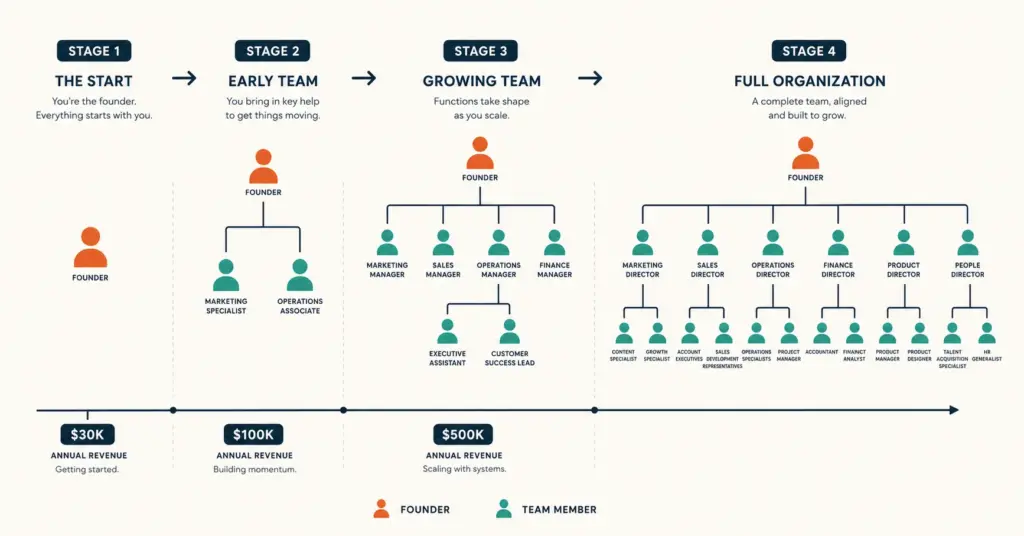
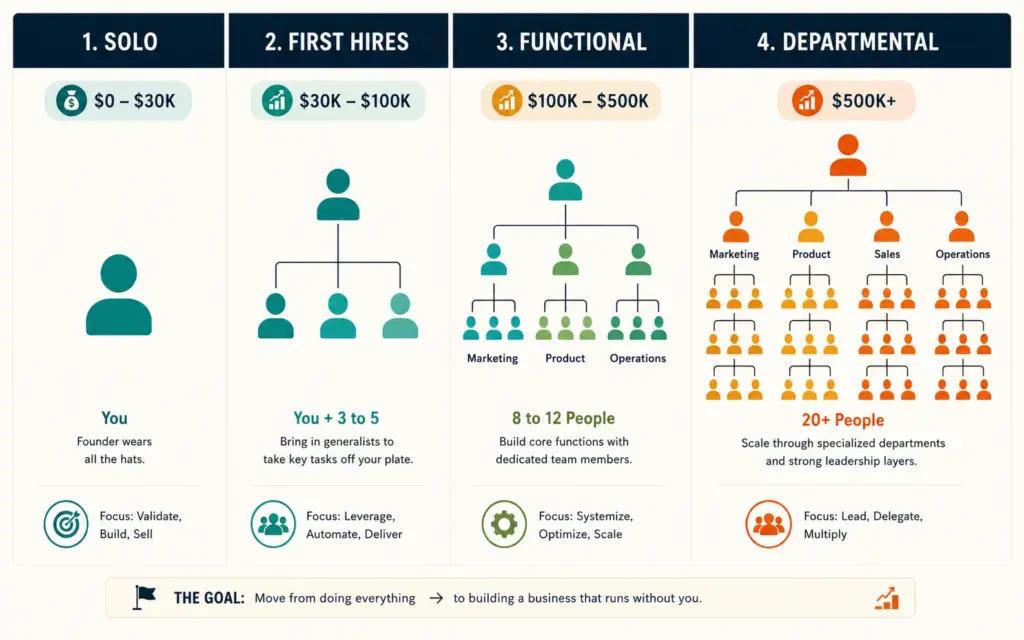
- Ecommerce team structure evolves through 4 stages: solo founder ($0 to $30k/month), founder plus first hires ($30k to $100k/month), functional teams ($100k to $500k/month), and departmental structure ($500k+/month). Each stage has different role priorities, and hiring too early or too late creates either cash drain or growth bottleneck.
- The first 3 hires for most ecommerce businesses: customer service (frees 15 to 20 hours/week of founder time), operations/fulfillment assistant (handles shipping and inventory), and a marketing specialist (manages one acquisition channel independently). Hire in this order unless your specific bottleneck differs.
- The cost of a bad hire in ecommerce averages $30,000 to $75,000 when you factor salary during ramp, training time, lost productivity, and the cost of rehiring. Structured interviews with paid test projects reduce bad-hire rate from 30% to under 10%.
- Outsource before you hire in-house for every role under 20 hours per week. A $10/hour VA handling 15 hours of customer service costs $600/month versus $3,500+/month for a full-time US hire doing the same volume of work with 25 idle hours.
Ecommerce team structure scaling is the process of hiring the right people in the right sequence at the right time to support revenue growth without either overspending on payroll or choking growth with insufficient capacity. The hiring decisions a founder makes between $30k and $200k monthly revenue determine whether the business scales efficiently or drowns in overhead. According to Bureau of Labor Statistics employment data, small business labor costs average 25 to 35% of revenue, making hiring the single largest operational expense after inventory for most ecommerce stores.
Most founders make one of two mistakes: hiring too early (adding $4,000/month in payroll before revenue justifies it) or hiring too late (trying to personally handle 60 hours of weekly work and burning out while growth stalls). The framework in this guide matches hiring decisions to revenue stages, prioritizes roles by time-freed-per-dollar, and provides the evaluation process that prevents the $30,000 to $75,000 cost of a bad hire. For outsourcing as a stepping stone to hiring, see our outsourcing guide.
What Does Each Growth Stage Look Like?
Stage 1: Solo founder ($0 to $30k/month)
The founder handles everything: product sourcing, marketing, customer service, fulfillment, finances, and strategy. This is sustainable up to approximately 50 to 100 orders per day. Beyond that, quality degrades because there aren’t enough hours to maintain every function. Target: identify which tasks consume the most time with the least strategic value, then outsource those first (usually customer service and fulfillment).
Stage 2: Founder + first hires ($30k to $100k/month)
Add 2 to 4 team members (mix of part-time, freelance, and possibly one full-time hire). The founder shifts from doing everything to managing specific functions while retaining strategic decisions, product development, and key vendor relationships. Typical team: 1 customer service person, 1 operations/fulfillment assistant, 1 marketing specialist. For SOP documentation that enables these hires, see our standard operating procedures guide.
Stage 3: Functional teams ($100k to $500k/month)
Hire specialists for each core function: marketing manager (owning the acquisition budget), operations manager (overseeing fulfillment, inventory, shipping), and possibly a creative lead (managing product photography, ad creative, and content). The founder becomes CEO: setting strategy, managing managers, and focusing on growth initiatives rather than daily execution. Team size: 6 to 12 people including freelancers.
Stage 4: Departmental structure ($500k+/month)
Full departments with team leads: Marketing (paid acquisition, organic, email, social), Operations (fulfillment, shipping, inventory, customer service), Product (development, sourcing, quality), and Finance (accounting, planning, analytics). The founder/CEO manages department heads. Team size: 15 to 30+ including contractors and agencies. For financial planning at this scale, see our financial planning guide.
What Should My First 3 Hires Be?
Hire 1: Customer service (frees 15 to 20 hours/week)
Customer service is the highest-time, lowest-strategic-value task for a founder. Every hour spent answering “Where is my order?” is an hour not spent on product development, marketing strategy, or supplier negotiation. Start with a part-time VA ($5 to $15/hour, 15 to 20 hours/week). Provide response templates and escalation rules via SOPs. For CS tool selection, see our ecommerce tech stack guide.
Hire 2: Operations / fulfillment assistant (frees 10 to 15 hours/week)
Order processing, shipping label generation, inventory counts, and return handling. These tasks are process-driven and SOP-friendly, making them ideal for delegation. A part-time fulfillment assistant ($12 to $18/hour, 15 to 20 hours/week) or a 3PL transition handles this function. For 3PL evaluation, see our 3PL guide.
Hire 3: Marketing specialist (drives growth independently)
A specialist who owns one acquisition channel (Meta Ads, Google Ads, or content/SEO) end-to-end. This is the first strategic hire because it adds revenue-generating capacity, not just time savings. The specialist should be experienced enough to operate independently with weekly strategic check-ins, not requiring daily direction. Budget: $3,000 to $6,000/month for a skilled freelancer or junior full-time marketer. For ad strategy depth, see our Facebook ads ecommerce guide.
When to hire vs outsource
Outsource any role under 20 hours per week. A $10/hour VA handling 15 weekly hours costs $600/month. A full-time US hire for the same work costs $3,500+/month for 40 hours, of which 25 are idle. Convert to in-house when the role consistently requires 30+ hours per week and the work demands deep brand knowledge or involves sensitive data. For outsourcing depth, see our outsourcing guide.
How Do I Hire Effectively for Ecommerce?
The structured hiring process
- Define the role output, not the job title. “Generate $30,000/month in Meta Ads revenue at 3:1 ROAS” is better than “Social Media Manager.” Output-defined roles attract candidates who can deliver results, not just fill a chair.
- Screen with a paid test project ($50 to $200). Customer service candidates: handle 10 sample tickets using your templates. Marketing candidates: audit your current ads and propose 3 improvements. Operations candidates: process 5 test orders through your system. Evaluate actual work quality, not interview charm. According to SHRM’s hiring research, structured assessments reduce bad-hire rates from 30% to under 10%.
- Start with a 2-week paid trial. Full onboarding with daily check-ins. Evaluate against specific KPIs. Most mis-hires become apparent within 5 business days. A 2-week trial costs $500 to $1,500; a bad full-time hire costs $30,000 to $75,000.
- Provide clear SOPs and expectations from day one. New hires with documented processes to follow ramp 3x faster than those figuring things out through trial and error. For SOP creation, see our standard operating procedures guide.
Where to find ecommerce talent
| Platform | Best For | Cost Range |
|---|---|---|
| Upwork | Freelance specialists (PPC, SEO, design) | $20 to $100+/hour |
| OnlineJobs.ph | Full-time Filipino VAs and specialists | $4 to $12/hour |
| Full-time in-house hires (managers+) | Salary-based | |
| FreeUp | Pre-vetted ecommerce freelancers | $10 to $75/hour |
| eCommerce industry Slack groups | Experienced ecommerce operators | Varies |
What Are the Key Ecommerce Roles and Their KPIs?
| Role | Primary KPI | Secondary KPIs | Compensation Range (US) |
|---|---|---|---|
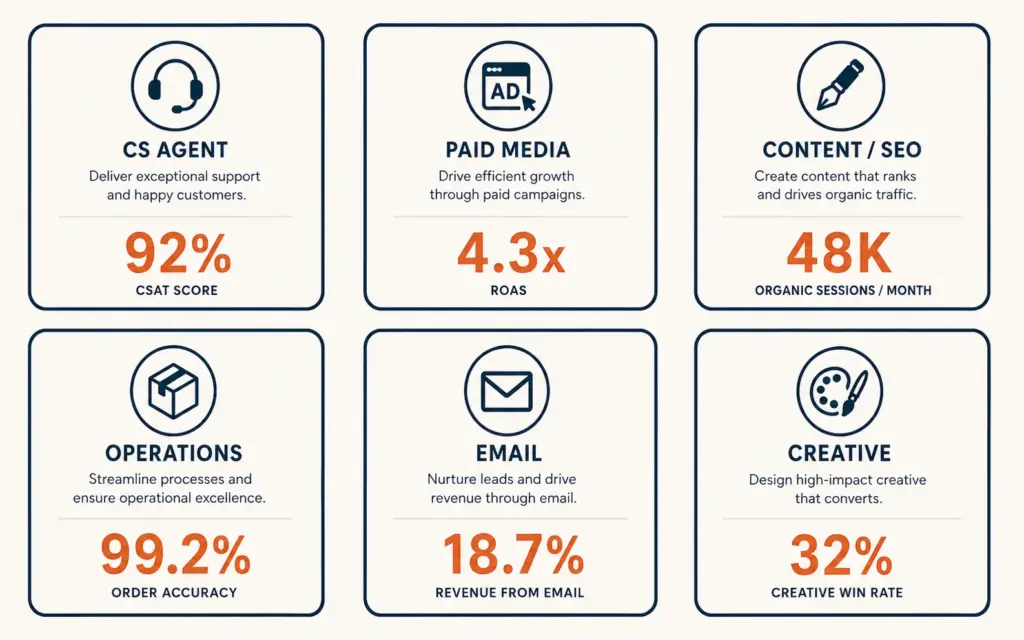
| Customer Service Agent | CSAT > 90% | Response time 85% | $15 to $22/hour |
| Paid Media Specialist | ROAS > 3:1 blended | CPA, new customer ROAS, creative test velocity | $50k to $80k/year |
| Content / SEO Specialist | Organic traffic growth > 10%/month | Keyword rankings, content output, backlinks | $45k to $75k/year |
| Operations Manager | Order accuracy > 99.5% | Ship time, fulfillment cost/order, stockout rate | $55k to $85k/year |
| Email Marketing Manager | Email revenue > 25% of total | List growth, flow revenue, campaign conversion | $50k to $80k/year |
| Creative Lead | Ad creative test win rate > 20% | Production volume, cost per asset, ROAS on creative | $55k to $90k/year |
Every role needs 2 to 3 measurable KPIs agreed upon at hiring. Performance conversations become objective (“CSAT dropped from 92% to 85%”) rather than subjective (“I feel like things aren’t going well”). For KPI framework, see our ecommerce KPIs guide. For ROAS expectations for paid media roles, see our ROAS benchmarks guide.
How Do I Keep Payroll Costs Sustainable?
The 25 to 35% rule
Total people costs (salaries, benefits, freelancers, agencies, outsourced teams) should stay between 25 to 35% of gross profit, not revenue. At $100k/month revenue with 50% gross margin, gross profit is $50k. People costs should run $12,500 to $17,500/month. Exceeding 35% of gross profit signals over-hiring relative to revenue capacity. For margin context, see our ecommerce profit margins guide.
The hybrid team model
The most cost-efficient ecommerce team combines in-house strategic roles (marketing manager, operations manager) with outsourced execution roles (VAs for customer service, freelancers for design, agencies for specialized functions). This model provides strategic continuity from full-time employees and flexible capacity from contractors who scale up or down with demand. For cash flow impact, see our cash flow management guide.
Common Hiring Mistakes
Hiring generalists instead of specialists
A “marketing manager” who does a little of everything often does nothing well. At Stage 2, hire specialists: someone who runs Meta Ads at 3:1 ROAS, someone who writes SEO content that ranks, or someone who manages email flows that generate 25% of revenue. Generalists make sense at Stage 3+ as team leads who coordinate specialists. For marketing channel expertise, see our retargeting strategies guide.
Hiring for skills without cultural evaluation
A technically excellent marketer who doesn’t communicate, misses deadlines, or creates team friction costs more than they produce. Evaluate communication quality, reliability (did they complete the test project on time?), and ownership mentality during the trial period. Skills can be trained; work ethic and communication habits rarely change.
Not firing fast enough
A hire who isn’t working at 30 days won’t be working at 90 days. The sunk cost fallacy (“We’ve already invested 6 weeks training them”) keeps bad hires in seats that could be filled by better candidates. Set a 30-day evaluation checkpoint. If KPIs aren’t on trajectory, have the conversation. The 60-day mark should be decisive. For process documentation that makes transitions smoother, see our standard operating procedures guide.
Paying above market to attract “top talent” too early
An $80k/year CMO at a $50k/month revenue store is an unsustainable overhead. Match compensation to stage: freelancers and VAs at Stage 1 to 2, junior to mid specialists at Stage 2 to 3, and senior leaders at Stage 3 to 4. The right person at the right stage is always better than an over-qualified hire who burns cash and gets bored by the operational reality of early-stage ecommerce.
Frequently Asked Questions
When you consistently spend 20+ hours per week on tasks that don’t directly grow revenue (customer service, order fulfillment, data entry). For most stores, this threshold arrives between $15k and $30k monthly revenue. Start with a part-time virtual assistant ($5 to $15/hour, 15 to 20 hours/week) for customer service or fulfillment rather than a full-time hire. Test delegation with low-risk outsourcing before committing to payroll.
For most ecommerce stores: (1) customer service person (frees 15 to 20 hours/week of founder time), (2) operations/fulfillment assistant (handles shipping, returns, inventory), (3) marketing specialist (owns one acquisition channel independently). Hire in this order unless your specific bottleneck differs. Start each role as part-time or freelance, then convert to full-time when the role consistently requires 30+ hours per week.
Total people costs (salaries, benefits, freelancers, agencies) should stay between 25 to 35% of gross profit (not revenue). At $100k/month revenue with 50% gross margin, target $12,500 to $17,500/month in total people costs. Exceeding 35% of gross profit signals over-hiring relative to revenue. Include freelancers, agencies, and contractors in this calculation, not just full-time employees.
Outsource (freelancers, VAs) any role under 20 hours per week. Convert to in-house when the role consistently requires 30+ hours weekly, demands deep brand knowledge, or involves sensitive data. The hybrid model works best: in-house strategic roles (marketing manager, operations manager) plus outsourced execution (VAs for CS, freelancers for design, agencies for specialized functions). Start every role as outsourced, then bring in-house as volume justifies full-time commitment.
Three tactics: (1) always use a paid test project ($50 to $200) that simulates real work before hiring, evaluating actual output quality rather than interview performance; (2) start with a 2-week paid trial with daily check-ins and specific KPIs before committing to a longer engagement; (3) define the role by outputs (“generate $30k/month in ad revenue at 3:1 ROAS”) not titles (“Social Media Manager”). Structured assessments reduce bad-hire rate from 30% to under 10%.
At $500k+/month, the typical structure has the founder/CEO managing 3 to 4 department heads: Marketing Lead (overseeing paid acquisition, organic/SEO, email/SMS, social/influencer), Operations Lead (fulfillment, shipping, inventory, customer service), Product Lead (development, sourcing, quality), and Finance Lead (accounting, planning, analytics). Each department has 2 to 5 team members including freelancers. Total team size: 15 to 30 people.
Related Reads
- Outsourcing Guide
- Standard Operating Procedures
- Ecommerce Profit Margins
- Financial Planning for Scaling
- Cash Flow Management
- Ecommerce KPIs Guide
Enjoying this? Get more like it every week.
One email per week with ecommerce strategies, tool picks, and seller insights. No spam.