
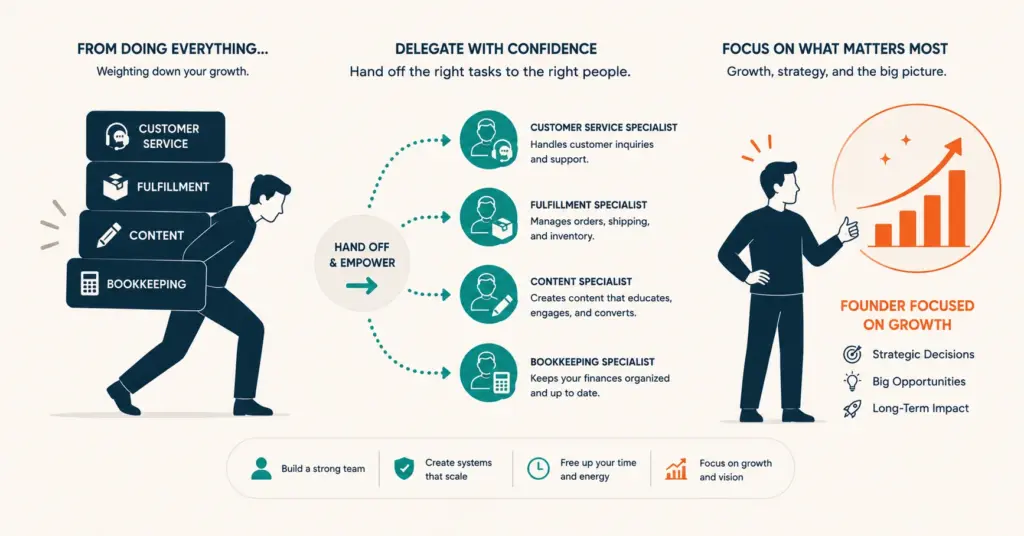
- Ecommerce outsourcing is the practice of delegating operational tasks (customer service, fulfillment, content creation, bookkeeping, ad management) to freelancers, agencies, or virtual assistants rather than doing everything in-house. Most ecommerce founders should start outsourcing when they spend 20+ hours per week on tasks that don't directly grow revenue.
- The delegation priority order: customer service first (highest time drain, lowest strategic value for founders), then fulfillment, then content creation, then bookkeeping, then ad management. Outsource the repetitive before the strategic.
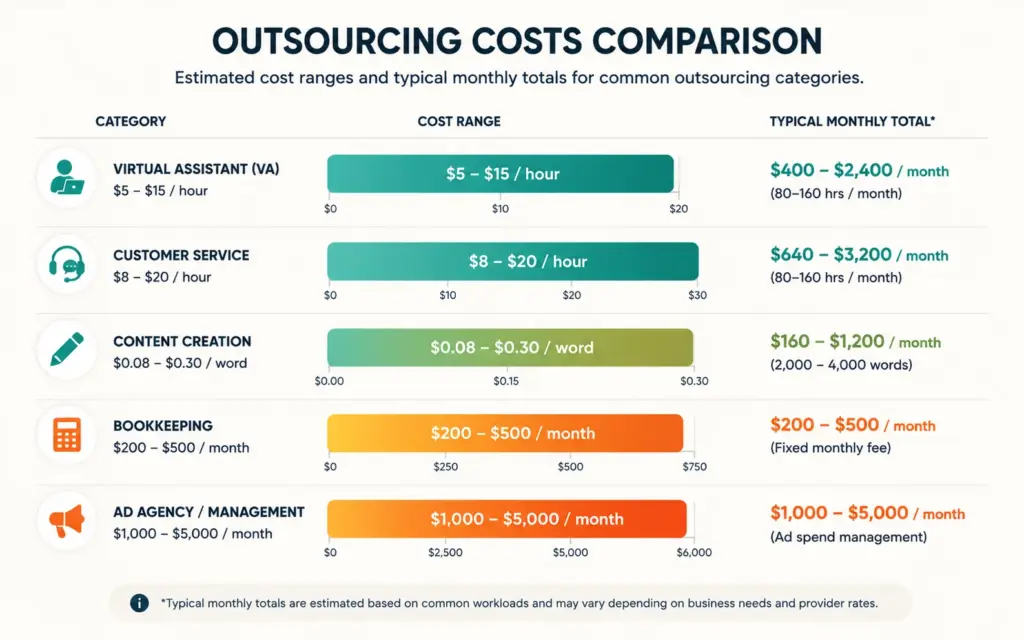
- Cost benchmarks for ecommerce outsourcing: virtual assistants $5 to $15/hour (Philippines, Latin America), customer service agents $8 to $20/hour, content writers $0.08 to $0.30/word, bookkeepers $200 to $500/month, and ad agencies 10 to 20% of ad spend or $1,000 to $5,000/month retainer.
- The most common outsourcing mistake is delegating without documentation. Tasks without clear SOPs (Standard Operating Procedures) produce inconsistent results regardless of who performs them. Write the SOP before hiring the person.
This outsourcing guide covers how ecommerce founders and small teams can delegate operational tasks to free up time for growth-driving activities. Most ecommerce businesses hit a ceiling not because demand stalls, but because the founder is doing customer service, packing orders, writing product descriptions, updating spreadsheets, and managing ads simultaneously. According to Upwork’s Future of Work research, 73% of businesses plan to increase their use of freelancers and outsourced talent through 2026, with ecommerce being one of the fastest-growing outsourcing categories.
The question isn’t whether to outsource but what to outsource first and how to maintain quality when someone else performs tasks you previously handled. The delegation framework in this guide prioritizes tasks by their strategic value to the founder: outsource low-strategic, high-time tasks first and keep high-strategic decisions (product development, brand direction, growth strategy) in-house longest. For broader operations context, see our ecommerce automation guide.
What Should I Outsource First?
The delegation priority framework
| Priority | Task | Why Outsource First | Typical Cost |
|---|---|---|---|
| 1 | Customer service | High time drain, repetitive, process-driven | $8 to $20/hour |
| 2 | Order fulfillment | Physical labor, no strategic value to founder | $3 to $8/order (3PL) |
| 3 | Content creation | Time-intensive, specialized skill, scalable | $0.08 to $0.30/word |
| 4 | Bookkeeping / accounting | Compliance-critical, specialized knowledge | $200 to $500/month |
| 5 | Social media management | Daily posting, community management | $500 to $2,000/month |
| 6 | Ad management | High strategic value, outsource only to proven experts | 10 to 20% of spend |
| 7 | Product photography | Equipment-intensive, one-time per product | $25 to $75/product |
Outsource from the top of this list down. Customer service and fulfillment consume 30 to 50% of founder time in most growing stores and produce zero strategic value when the founder performs them personally. Every hour freed from packing orders is an hour available for product development, marketing strategy, or supplier negotiation. For fulfillment outsourcing specifically, see our 3PL guide.
Where Do I Find Ecommerce Freelancers and VAs?
Hiring platforms by task type
| Platform | Best For | Cost Range | Quality Level |
|---|---|---|---|
| Upwork | Specialized tasks (design, development, PPC, SEO) | $15 to $100+/hour | High (vet through portfolio + reviews) |
| OnlineJobs.ph | Filipino VAs for customer service, admin, data entry | $4 to $10/hour full-time | Good (interview carefully, trial period) |
| Fiverr | One-off tasks (design, video editing, copywriting) | $5 to $200/project | Variable (check reviews, order samples) |
| FreeUp | Pre-vetted ecommerce freelancers | $10 to $75/hour | High (pre-screened top 1%) |
| Agency partners | Ad management, SEO, full marketing | $1,000 to $10,000+/month | High (check case studies + references) |
The hiring process
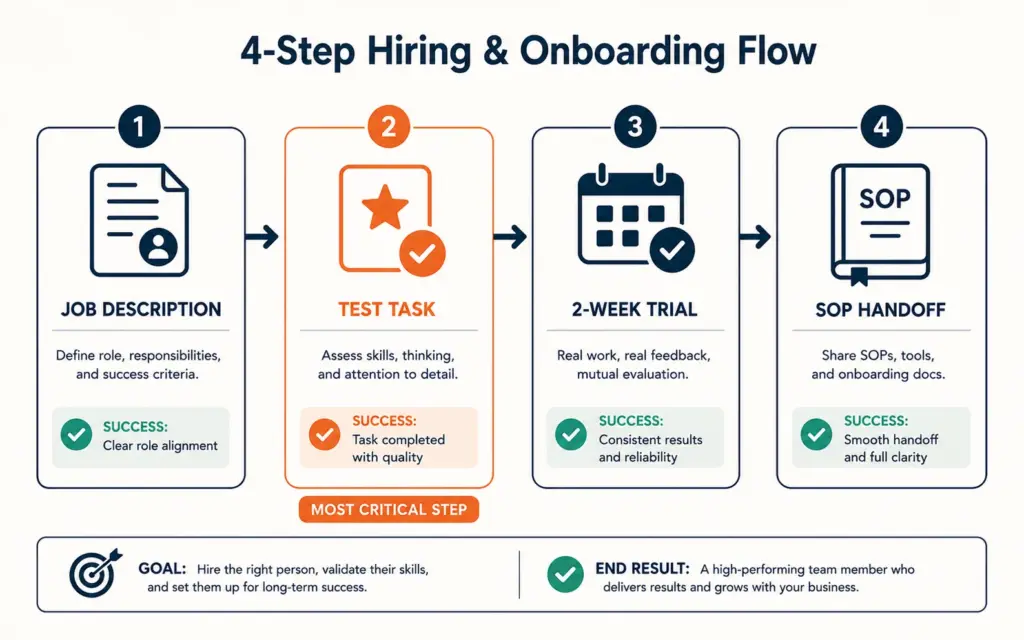
- Write a clear job description: Specific tasks, hours expected, tools used, and measurable deliverables. “Manage customer service” is vague. “Respond to all Gorgias tickets within 4 hours using provided templates, handle returns per SOP, escalate complex issues to founder” is actionable.
- Screen with a paid test task: Pay for a 2 to 4 hour test that simulates real work. Evaluate quality, communication, and deadline adherence. Never hire based on interviews alone.
- Start with a 2-week trial: Full onboarding with daily check-ins. Provide feedback on every deliverable. Most mis-hires become apparent within 5 business days.
- Provide documented SOPs: Every task should have step-by-step documentation with screenshots. SOPs eliminate ambiguity and enable consistent quality regardless of who performs the task.
How Do I Write SOPs for Outsourced Tasks?
SOPs (Standard Operating Procedures) are the documentation that makes outsourcing work. Without SOPs, you’re paying someone to guess how you want things done. With SOPs, you’re paying someone to follow a proven process.
SOP structure
- Task name and purpose: What the task is and why it matters
- Trigger: When to perform the task (daily at 9 AM, when a new order arrives, when a support ticket is created)
- Step-by-step instructions: Numbered steps with screenshots of each action. Include exact button clicks, menu paths, and form fields
- Decision points: If/then scenarios. “If the customer requests a refund over $50, escalate to [name]. If under $50, process immediately using this template.”
- Quality standards: What “done correctly” looks like. Response time targets, formatting requirements, and error tolerance
- Tools and access: Logins, software links, and permissions needed
SOP creation shortcut
Record yourself doing the task using Loom (free screen recording). Narrate each step as you perform it. Share the video as the initial SOP, then have the new hire convert it to a written document with screenshots during onboarding. This takes 15 minutes per task versus 1 to 2 hours writing from scratch. For broader process automation, see our ecommerce automation guide.
How Much Does Ecommerce Outsourcing Cost?
Customer service outsourcing
- Virtual assistant (Philippines): $5 to $10/hour, 20 to 40 hours/week. Handles email, chat, and social media responses. Best for stores with 50 to 200 tickets/week.
- Dedicated agent (US/UK): $15 to $25/hour. Higher language quality, cultural alignment. Best for premium brands where communication quality is a brand differentiator.
- Customer service agency: $8 to $15/ticket or $2,000 to $5,000/month. Managed service with training, QA, and coverage. Best for stores with 200+ tickets/week. For helpdesk tooling, see our ecommerce tech stack guide.
Content creation outsourcing
- Blog writers: $0.08 to $0.30/word ($160 to $600 per 2,000-word article). Niche expertise commands premium rates. For content strategy, see our content marketing guide.
- Product description writers: $5 to $25 per product description depending on length and research required. For writing approach, see our product descriptions guide.
- UGC creators: $50 to $200 per video. Produced specifically for ad creative. For UGC strategy, see our UGC strategy guide.
- Graphic designers: $20 to $75/hour or $500 to $2,000/month retainer. Email templates, social graphics, ad creative. For ad creative approach, see our ad creative tips guide.
Ad management outsourcing
- Freelance PPC specialist: $500 to $2,000/month or 10 to 15% of ad spend. Manages Meta, Google, or TikTok campaigns. For Meta strategy, see our Facebook ads ecommerce guide.
- Agency: $2,000 to $10,000/month or 15 to 20% of ad spend. Full-service management including creative, strategy, and reporting. Best above $10,000/month ad spend where agency expertise justifies the fee. For ROAS expectations, see our ROAS benchmarks guide.
Financial operations outsourcing
- Bookkeeper: $200 to $500/month. Reconciles transactions, categorizes expenses, prepares monthly reports. Essential above $50k/year revenue.
- CPA/accountant: $300 to $800/month or project-based for tax prep. Tax planning, sales tax compliance, financial strategy. For financial planning depth, see our financial planning guide.
When Should I Outsource vs Hire In-House?
| Situation | Outsource | Hire In-House |
|---|---|---|
| Task is under 20 hours/week | Yes | No (not enough for full-time) |
| Task requires deep brand knowledge | Consider carefully | Yes (long-term investment) |
| Task fluctuates seasonally | Yes (scale up/down easily) | No (paying during slow periods) |
| Task is core to competitive advantage | No | Yes (protect differentiation) |
| You need results within 1 week | Yes (freelancers start fast) | No (hiring takes 2 to 8 weeks) |
| Budget is under $3,000/month for role | Yes (VA or freelancer) | No (can’t afford US full-time) |
The general rule: outsource until a role reaches 30+ hours per week of consistent work with stable requirements. At that point, in-house hiring provides better cultural alignment, training investment, and long-term cost efficiency. For operational scaling decisions, see our ecommerce profit margins guide.
How Do I Manage Outsourced Team Members?
Communication structure
- Daily async updates: Freelancers/VAs send end-of-day summaries via Slack or email. What was completed, what’s pending, any blockers.
- Weekly sync calls: 15 to 30 minute video call to review performance, address questions, and align on priorities. Use Zoom or Google Meet.
- Monthly performance review: Compare deliverables against KPIs. Discuss what’s working, what needs improvement, and upcoming priorities.
Quality control
- Spot check 10 to 20% of work: Randomly review support tickets, content drafts, or data entries weekly. Catch quality issues before they become patterns.
- Customer feedback monitoring: Track satisfaction scores on customer service interactions. If CSAT drops after outsourcing, the delegation isn’t working.
- Defined KPIs per role: Customer service: response time under 4 hours, resolution rate above 85%. Content: publish 4 posts/week meeting SEO requirements. Bookkeeping: monthly close within 5 business days.
For tracking the metrics that matter, see our ecommerce KPIs guide.
Common Outsourcing Mistakes
Delegating without documentation
Handing someone a task with “just do what I do” instructions produces inconsistent results. Every outsourced task needs a written SOP with screenshots before the first delegation. The time spent writing documentation saves 10x the time correcting mistakes.
Hiring the cheapest option
A $3/hour VA who produces work requiring 2 hours of your revision time costs more than a $10/hour VA who produces usable work on the first attempt. Evaluate total cost (rate + revision time + management overhead), not hourly rate alone. The second-cheapest option is usually the best value. According to McKinsey’s outsourcing research, companies that prioritize quality over cost in outsourcing decisions achieve 2 to 3x higher satisfaction with outcomes.
Outsourcing strategic decisions too early
Ad strategy, brand positioning, product selection, and pricing decisions should stay with the founder until the business has established clear playbooks. Outsource execution (running the ad campaigns) before outsourcing strategy (deciding what campaigns to run). An agency running your Facebook Ads is execution. An agency deciding your brand direction is premature delegation.
Not setting measurable KPIs
“Do a good job” isn’t measurable. “Respond to all tickets within 4 hours with CSAT above 90%” is. Every outsourced role needs 2 to 3 clear KPIs that the person knows they’re measured against. Without KPIs, performance conversations become subjective and uncomfortable.
Frequently Asked Questions
Start when you spend 20+ hours per week on tasks that don’t directly grow revenue (customer service, order fulfillment, data entry, routine content). If packing orders prevents you from improving products or marketing, the opportunity cost of your time exceeds the cost of a $5 to $10/hour VA. Most stores should begin outsourcing between $10k and $30k monthly revenue when operational tasks consume founder time.
Virtual assistant from Philippines: $5 to $10/hour (20 to 40 hours/week). US-based agent: $15 to $25/hour. Managed customer service agency: $8 to $15/ticket or $2,000 to $5,000/month. For a store handling 100 tickets/week, a Filipino VA at $7/hour for 20 hours/week costs approximately $560/month. This frees 20 hours of founder time weekly, time worth far more than $560 in growth activities.
OnlineJobs.ph for Filipino VAs ($4 to $10/hour full-time). Upwork for specialized freelancers ($15 to $100+/hour). FreeUp for pre-vetted ecommerce specialists ($10 to $75/hour). Fiverr for one-off tasks ($5 to $200/project). Start with a paid 2 to 4 hour test task, followed by a 2-week trial with daily check-ins. Never hire based on interviews alone; evaluate actual work quality.
SOPs (Standard Operating Procedures) are step-by-step documented instructions for performing tasks. They include numbered steps with screenshots, decision-point logic (if/then scenarios), quality standards, and tool access information. SOPs make outsourcing work because they eliminate ambiguity. Without SOPs, freelancers guess at how you want things done, producing inconsistent results. Write the SOP before hiring the person, not after.
Freelancers are better for tasks under $2,000/month: customer service, content writing, graphic design, and bookkeeping. Agencies are better above $2,000/month for complex, multi-person functions: full ad management, comprehensive SEO, or multi-channel marketing. Freelancers cost less but require more management. Agencies cost more but provide managed service, backup coverage, and multi-discipline expertise. Start with freelancers; graduate to agencies as complexity and budget increase.
Keep these in-house longest: product development and selection, brand strategy and positioning, pricing strategy, key vendor and supplier relationships, and financial decision-making. These functions define your competitive advantage and require deep business context. Outsource execution (running ad campaigns, creating content, processing orders) before outsourcing strategy (deciding what to sell, how to position, where to invest).
Related Reads
- Ecommerce Automation
- 3PL Guide
- Ecommerce Profit Margins
- Financial Planning for Scaling
- Content Marketing Guide
- Ecommerce KPIs Guide
Enjoying this? Get more like it every week.
One email per week with ecommerce strategies, tool picks, and seller insights. No spam.