
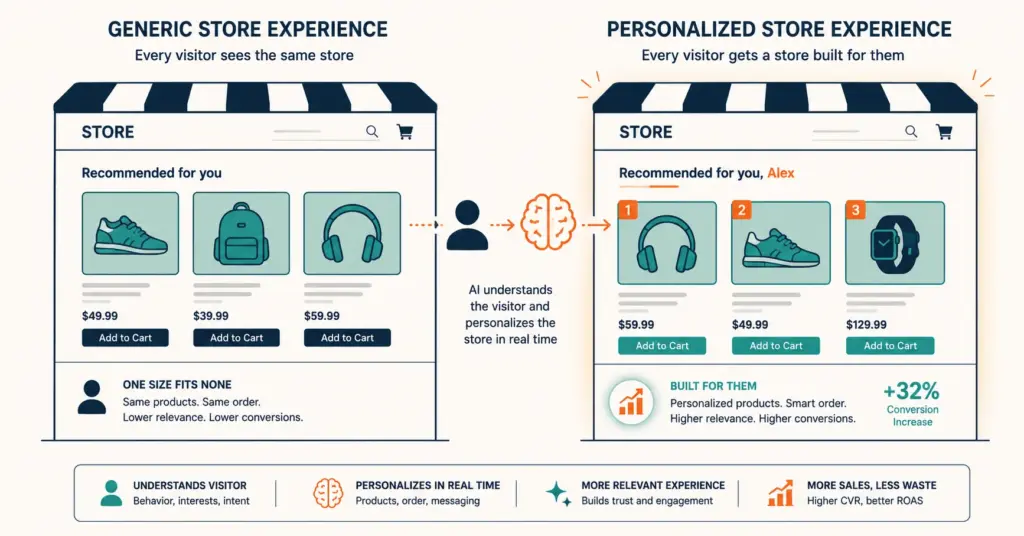
- AI personalization uses machine learning to customize what each visitor sees on your store: which products appear first, what recommendations display, which email content they receive, and how search results are ordered. Personalized experiences convert 10 to 30% higher than generic ones because they surface the right product at the right time instead of making every visitor wade through the same catalog.
- The 5 personalization layers for ecommerce: product recommendations (most impactful, fastest to implement), personalized search results, dynamic email content, on-site content adaptation, and predictive audience segmentation. Each layer builds on customer behavior data that accumulates from the first visit.
- Most stores don't need custom AI infrastructure. Shopify's built-in recommendations, Klaviyo's predictive analytics, and dedicated tools like Nosto or Dynamic Yield handle personalization at a level that competes with Amazon's approach at a fraction of the complexity and cost.
- Personalization ROI depends on traffic volume. Stores with under 5,000 monthly visitors won't generate enough behavioral data for AI models to learn patterns. Above 10,000 monthly visitors, personalization tools produce measurable conversion and revenue lifts within 30 to 60 days.
AI personalization in ecommerce uses machine learning algorithms to customize each visitor’s shopping experience based on their behavior, preferences, and purchase history. Instead of showing every visitor the same homepage, the same product order, and the same recommendations, AI personalization adapts these elements in real-time: a returning customer who previously bought running shoes sees running accessories on the homepage, while a first-time visitor who browsed kitchen products sees bestselling cookware. According to McKinsey’s personalization research, companies that excel at personalization generate 40% more revenue from those activities than average performers, and 71% of consumers expect personalized interactions from the brands they buy from.
The technology powering personalization has shifted from enterprise-only (custom-built recommendation engines costing $100,000+) to accessible (Shopify’s native recommendations, Klaviyo’s predictive features, and purpose-built tools starting at $50/month). The barrier isn’t technology anymore. It’s understanding which personalization layers produce the highest ROI for your store’s traffic level and investing in the right order.
The 5 Personalization Layers
Layer 1: Product recommendations (start here)
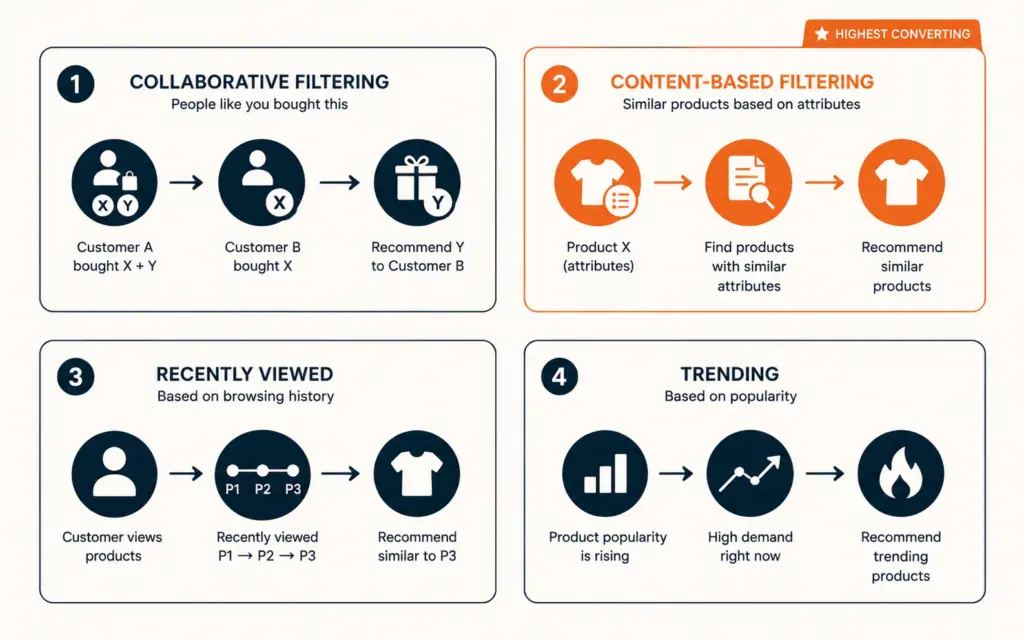
AI-powered product recommendations are the highest-ROI personalization feature because they influence the purchase decision at the point of maximum intent. Recommendation types:
- “Customers also bought” (collaborative filtering): Based on aggregate purchase patterns across all customers. If 30% of buyers who purchased Product A also bought Product B, recommend B on A’s page. This is how the cross-sell and upsell mechanics work at the algorithm level.
- “You might also like” (content-based filtering): Based on product attribute similarity. A customer viewing a blue cotton dress sees other blue dresses, other cotton dresses, and dresses in the same price range. Works well even with limited purchase data.
- “Recently viewed” (behavioral): Shows products the visitor browsed earlier in their session or previous visits. Converts at 2 to 5x the rate of generic recommendations because it resurfaces items the visitor already expressed interest in.
- “Trending now” (popularity-based): Shows best-selling products from the past 7 to 14 days. Effective for new visitors with no behavioral history because it surfaces socially validated products.
Recommendation placement matters: product page recommendations drive 10 to 15% of revenue for stores with them enabled. Homepage recommendations personalize the first impression. Cart page recommendations lift AOV 5 to 10% by suggesting complementary add-ons. The product page layout decisions determine whether recommendation widgets earn attention or get scrolled past.
Layer 2: Personalized search results
AI-powered site search re-ranks results based on individual visitor behavior. A visitor who previously browsed premium products sees luxury items ranked higher in search. A visitor who browsed budget options sees affordable items first. This is invisible to the shopper but dramatically improves the relevance of search results.
Tools: Algolia ($0+ based on volume), Searchspring ($599+/month), or Klevu ($449+/month). Shopify’s native search handles basic keyword matching but doesn’t personalize results by visitor behavior. For stores where 20%+ of visitors use site search, personalized search produces 15 to 25% higher search-to-purchase conversion. The search technology stack decision directly impacts how effectively visitors find what they want.
Layer 3: Dynamic email and SMS content
AI-personalized email replaces static product blocks with dynamically generated recommendations unique to each recipient. A post-purchase email shows complementary products based on what each customer actually bought, not generic best sellers. A browse-abandonment email shows the exact products each visitor viewed, not category-level suggestions.
Klaviyo’s predictive analytics powers this natively: predicted next order date, predicted LTV, and churn risk scoring enable automated campaigns that trigger at the right moment for each individual subscriber. A customer predicted to reorder in 14 days receives a replenishment reminder then, not on a generic 30-day schedule. This timing precision lifts email conversion 20 to 40% versus fixed-schedule campaigns. The behavioral segmentation approach creates the customer groups that personalized email content targets.
Layer 4: On-site content adaptation
Beyond product recommendations, AI can personalize hero banners, promotional messaging, and content blocks based on visitor attributes. A first-time visitor sees a welcome offer and brand introduction. A returning customer sees new arrivals in their preferred category. A cart abandoner returning within 24 hours sees the abandoned product front and center with a time-limited incentive.
Tools: Dynamic Yield (enterprise), Nosto ($99+/month for ecommerce-specific), or Optimizely (A/B testing with personalization). Most mid-market ecommerce stores get 80% of the personalization benefit from Layers 1 and 3 before needing Layer 4’s full-page adaptation capabilities.
Layer 5: Predictive audience segmentation
AI analyzes customer behavior to predict future actions: who’s likely to purchase next, who’s at risk of churning, and what each customer’s predicted lifetime value is. These predictions enable proactive marketing: send retention offers to at-risk customers before they lapse, increase ad spend on lookalike audiences modeled from your highest-LTV customers, and suppress marketing to predicted non-converters.
Klaviyo offers predictive analytics (predicted gender, predicted next order date, predicted LTV) included in standard plans. Triple Whale and Daasity provide deeper predictive segmentation for stores needing advanced channel attribution combined with customer predictions. The cohort-level behavior tracking feeds the historical data that prediction models learn from. The LTV prediction methodology explains how these forward-looking models translate into acquisition and retention budget decisions.
Choosing the Right Personalization Tools
| Tool | Personalization Layers | Best For | Starting Cost |
|---|---|---|---|
| Shopify Native | Basic product recommendations | New stores, simple catalogs | Included |
| Klaviyo | Email/SMS personalization, predictive analytics | Email-centric personalization | Included with Klaviyo |
| Nosto | Product recs, on-site personalization, email | Mid-market DTC brands | $99/month |
| Rebuy | Product recs, cart upsells, checkout offers | Shopify stores focused on AOV | $99/month |
| Dynamic Yield | Full-stack personalization, A/B testing | Enterprise ecommerce | Custom pricing |
| Algolia | Personalized search, browse, recommendations | Large catalogs (500+ SKUs) | Free to custom |
Start with what’s already included (Shopify native recommendations + Klaviyo predictive analytics). Add Nosto or Rebuy when product recommendation revenue exceeds $2,000/month and you want more control over recommendation logic. Enterprise personalization (Dynamic Yield) makes sense above $500k/month revenue with dedicated marketing ops staff.
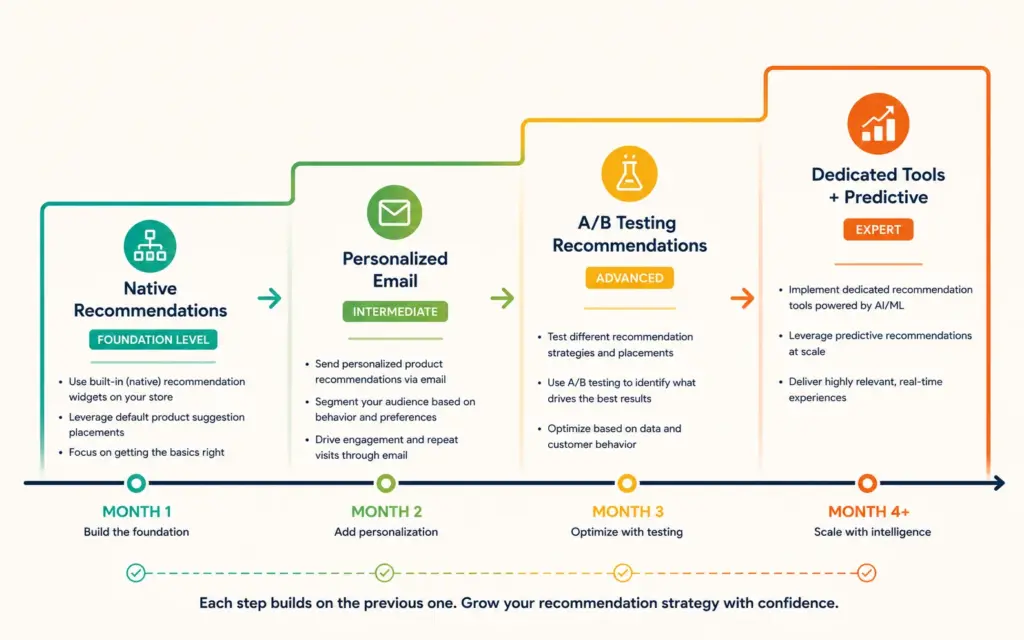
Implementation: The Right Order
- Month 1: Enable native product recommendations on product pages, homepage, and cart page. Configure “recently viewed” and “you might also like” widgets. Zero cost on Shopify.
- Month 2: Set up personalized email flows in Klaviyo: dynamic product blocks in browse abandonment, post-purchase cross-sell, and win-back emails. Replace generic product grids with per-recipient recommendations based on browse and purchase history.
- Month 3: Implement A/B testing on recommendation placements. Test widget position, number of products shown, and recommendation logic (collaborative vs content-based) on your top product pages.
- Month 4+: Add a dedicated personalization tool (Nosto, Rebuy) if recommendation-attributed revenue justifies the cost. Expand to personalized search, homepage content adaptation, and predictive segmentation.
Measuring Personalization ROI
Revenue attributed to recommendations. Track clicks and purchases from recommendation widgets separately. Most personalization tools provide this natively. Benchmark: recommendation-driven revenue should represent 10 to 20% of total revenue for a well-optimized implementation.
Conversion rate lift. Compare conversion rate on pages with personalization enabled vs the baseline before implementation. Target 10 to 30% lift. Use heatmap data to verify that recommendation widgets are actually receiving clicks and attention, not just loading invisibly below the fold.
AOV impact. Measure whether personalized cross-sell recommendations lift average order value compared to generic or no recommendations. The core revenue metrics should include recommendation-attributed revenue as a standard dashboard component.
Email revenue per recipient. Compare revenue per email recipient on personalized campaigns (dynamic product blocks) vs static campaigns (same products for everyone). Personalized email should outperform static by 20 to 50% on revenue per recipient. According to Barilliance’s personalization data, personalized product recommendations in email generate 31% of total ecommerce email revenue.
Common Personalization Mistakes
Personalizing before you have enough data. AI models need behavioral data to learn patterns. Stores with under 5,000 monthly visitors and under 200 monthly orders generate too little data for recommendations to outperform manually curated “best sellers” lists. Build traffic and order volume first through organic content growth and paid acquisition, then layer personalization on top.
Treating personalization as a “set and forget” implementation. Recommendation models need monitoring. Product catalogs change, customer preferences shift seasonally, and new products lack enough interaction data for accurate recommendations. Review recommendation performance monthly. Manually boost new product visibility until the algorithm has enough data to rank them appropriately.
Over-personalizing to the point of creepiness. “We noticed you looked at this product 7 times” feels surveillance-like, not helpful. Effective personalization is invisible: the right products appear without explaining how the algorithm chose them. Show the recommendation, not the reasoning.
Ignoring the cold-start problem for new visitors. First-time visitors have zero behavioral history. Recommendation widgets that show empty or irrelevant results waste the most valuable real estate on the page. Default to popularity-based recommendations (“Best Sellers,” “Trending Now”) for new visitors and switch to behavioral recommendations after 2 to 3 page views build a session profile.
Frequently Asked Questions
AI personalization uses machine learning to customize each visitor’s shopping experience: which products appear first, what recommendations display, how search results are ordered, and what email content they receive. Instead of every visitor seeing the same store, AI adapts the experience based on individual browsing behavior, purchase history, and preferences. Personalized experiences convert 10 to 30% higher than generic ones.
Minimum 5,000 to 10,000 monthly visitors and 200+ monthly orders for AI-powered recommendations to learn meaningful patterns. Below this threshold, manually curated “best sellers” and category-based recommendations perform equally well at zero cost. Above 10,000 monthly visitors, personalization tools produce measurable conversion and revenue lifts within 30 to 60 days of implementation.
Start with what’s already included in your platform: Shopify’s native product recommendations (free) and Klaviyo’s predictive analytics (included with Klaviyo subscription). These cover product page recommendations and personalized email content. Add Nosto ($99/month) or Rebuy ($99/month) when recommendation-attributed revenue exceeds $2,000/month. Enterprise tools (Dynamic Yield) make sense above $500k/month with dedicated marketing ops staff.
Well-implemented product recommendations account for 10 to 20% of total store revenue. Recommendation-driven purchases have 10 to 15% higher AOV than non-recommendation purchases because the algorithm surfaces complementary products. Product page recommendations are the highest-impact placement, followed by cart page and homepage. Personalized email recommendations generate 31% of total email revenue according to industry benchmarks.
Less effectively than for large catalogs. Stores with under 50 products have limited recommendation variety, making algorithmic selection less differentiated from manual curation. For small catalogs: manually curate “frequently bought together” bundles and “you might also like” groups based on your product knowledge. AI personalization becomes increasingly valuable above 100 SKUs where manual curation doesn’t scale and algorithms find non-obvious patterns in customer behavior.
Related but different. Segmentation groups customers into categories (VIP, at-risk, new) and delivers group-level messaging. AI personalization operates at the individual level: each visitor gets a unique experience based on their specific behavior, not their segment’s average behavior. Segmentation is the starting point (group customers); personalization is the advanced layer (individualize the experience). Most stores implement segmentation first, then add AI personalization as traffic and data volume support it.
Related Reads
- Segmenting Your Customer Base
- Tracking Customer Behavior Over Time
- Predicting Long-Term Customer Value
- Building Effective Cross-Sell Experiences
- Personalized Email That Converts
- Evaluating Your Technology Stack
Enjoying this? Get more like it every week.
One email per week with ecommerce strategies, tool picks, and seller insights. No spam.