
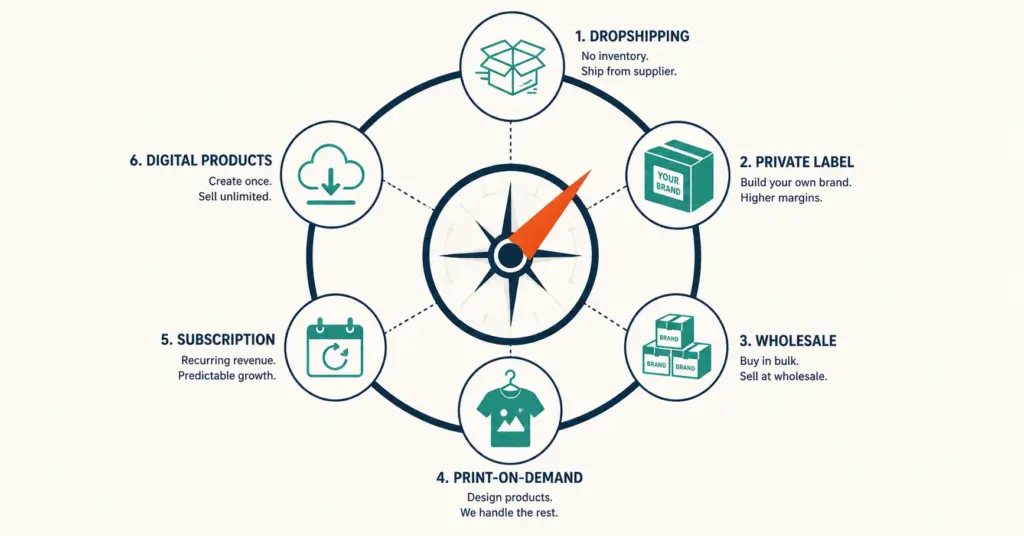
- Six ecommerce business models dominate the landscape: dropshipping (lowest risk, lowest margin), private label (highest margin, highest investment), wholesale/reselling (fastest to launch with physical inventory), print-on-demand (zero inventory for custom designs), subscription boxes (predictable revenue, complex operations), and digital products (infinite margin, no shipping). The right model depends on your capital, risk tolerance, time availability, and skills.
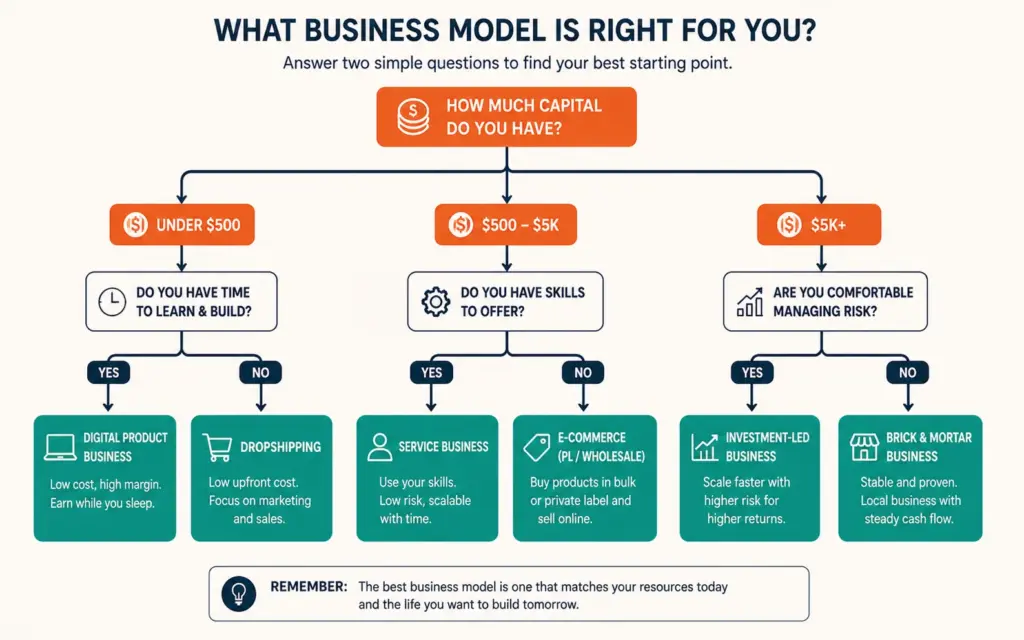
- Startup capital is the most honest filter. Under $500: dropshipping or digital products. $500 to $5,000: print-on-demand or wholesale. $5,000 to $25,000: private label or subscription. Each model has minimum viable capital requirements below which underfunding causes failure, not the model itself.
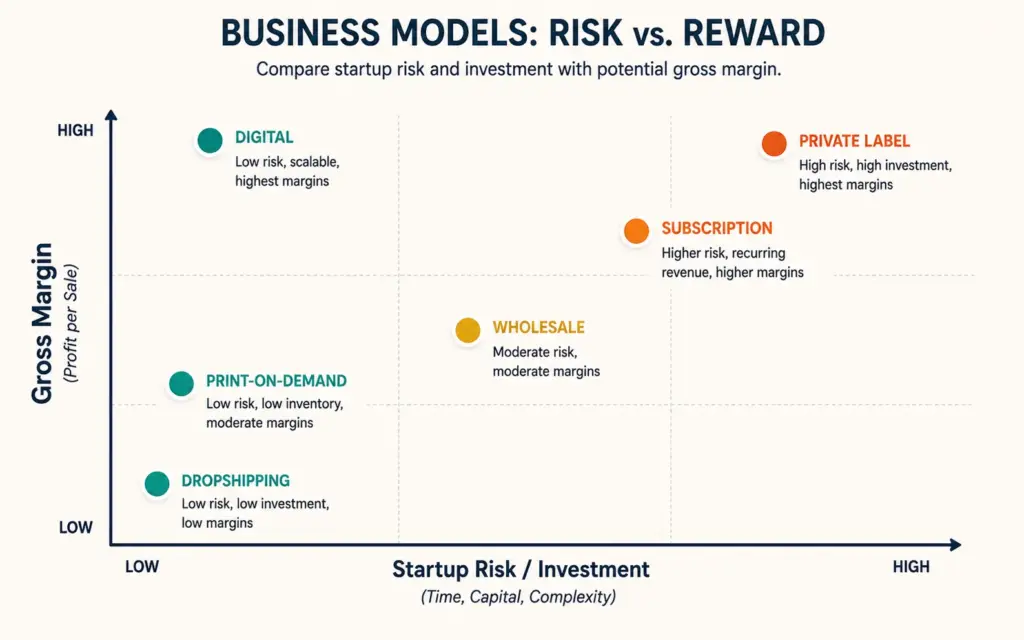
- Margin ranges by model: dropshipping 15 to 30%, wholesale 30 to 50%, private label 40 to 70%, print-on-demand 20 to 40%, subscription 40 to 60%, digital products 70 to 95%. Higher margins usually require higher upfront investment, more operational complexity, or both.
- Most successful ecommerce brands evolve through models over time. Starting as a dropshipper to validate demand, then private labeling the winning products, then adding subscriptions for repeat revenue. The first model is a starting point, not a permanent commitment.
Choosing the right business model comparison is the first strategic decision that shapes everything else: how much capital you need, what margins you’ll earn, how you’ll spend your time, and how fast you can scale. Most first-time sellers pick a model based on a YouTube video or course recommendation without evaluating whether it actually matches their financial situation, skills, and goals. A bootstrapped solo founder with $500 and 10 hours per week needs a fundamentally different model than a funded team with $50,000 and full-time availability. According to Shopify’s ecommerce research, the most common reason new stores fail isn’t product quality or marketing execution; it’s choosing a model that doesn’t fit their constraints and running out of resources before reaching profitability.
This comparison evaluates all six models on the dimensions that actually determine success: startup capital required, margin potential, time investment, operational complexity, and scalability ceiling. No model is universally best. The best model is the one that matches your specific situation right now, with a path to evolve as the business grows.
The 6 Models at a Glance
| Model | Startup Capital | Gross Margin | Time to First Sale | Inventory Risk | Scalability |
|---|---|---|---|---|---|
| Dropshipping | $100 to $500 | 15 to 30% | 1 to 2 weeks | None | Moderate |
| Private Label | $5,000 to $25,000 | 40 to 70% | 2 to 4 months | High | High |
| Wholesale | $1,000 to $10,000 | 30 to 50% | 2 to 4 weeks | Moderate | Moderate |
| Print-on-Demand | $100 to $500 | 20 to 40% | 1 to 2 weeks | None | Moderate |
| Subscription Box | $5,000 to $20,000 | 40 to 60% | 1 to 3 months | Moderate | High |
| Digital Products | $0 to $500 | 70 to 95% | 1 to 4 weeks | None | Very High |
Dropshipping
You list products on your store. When a customer orders, your supplier ships directly to them. You never touch inventory.
Why it works as a starting point: Near-zero financial risk. You can test 50 products with $200 in ad spend and discover which ones sell before investing in inventory. The learning curve is in marketing and store optimization, not supply chain management. Many successful private label brands started as dropshipping operations that validated demand before manufacturing their own version.
Why it has a ceiling: Margins of 15 to 30% leave thin room for advertising costs that typically consume 20 to 40% of revenue. Shipping times of 7 to 21 days from Chinese suppliers create customer satisfaction issues. You can’t control product quality, packaging, or shipping speed. Hundreds of other stores sell identical products, making differentiation nearly impossible at scale. If the economics work at small scale, transition the winners to private label or wholesale within 6 to 12 months.
Best for: Complete beginners with under $500, people testing product ideas before committing capital, and those who want to learn ecommerce marketing skills with minimal financial risk. The startup cost breakdown shows how to launch a dropshipping test for under $300.
Private Label
You design or specify a product, contract a manufacturer to produce it under your brand, and sell it exclusively. You own the brand, the product design, and the customer relationship.
Why it’s the highest-margin model: Manufacturing costs for a product that retails at $40 typically run $6 to $12, producing 50 to 70% gross margins before shipping and fees. Brand ownership creates defensible value: nobody else sells your exact product. You control quality, packaging, branding, and customer experience end-to-end. Most venture-backed DTC brands are private label businesses.
Why it’s the highest-risk model: Minimum order quantities of 500 to 5,000 units require $3,000 to $25,000 upfront before selling a single unit. Product development cycles run 2 to 4 months from concept to inventory-in-hand. If the product doesn’t sell, you’re stuck with inventory that depreciates daily. The supplier sourcing process is critical; a bad manufacturer produces bad products regardless of your brand quality ambitions.
Best for: Founders with $5,000 to $25,000 in available capital, validated product demand (from dropshipping test, pre-orders, or market research), and willingness to wait 3 to 6 months for the product development cycle. The product research methodology should confirm demand before committing manufacturing capital.
Wholesale / Reselling
You buy branded products from manufacturers or distributors at wholesale prices and resell them at retail markup. You hold physical inventory but don’t create products.
Why it’s the fastest physical-product model: No product development cycle. Established brands already have market demand, product reviews, and brand recognition. You can list a known-brand product and start selling within days of inventory arrival. Margins of 30 to 50% are lower than private label but higher than dropshipping, with the added advantage of immediate shipping from your own inventory.
Why it has competitive constraints: You’re competing against every other authorized (and unauthorized) reseller of the same brand. Price competition is constant, especially on Amazon where multiple sellers fight for the Buy Box on identical listings. MAP (Minimum Advertised Price) policies limit how low you can price. Brand authorization requirements can restrict who gets to sell certain products. The Amazon listing approach matters significantly because wholesale products compete on the same listings.
Best for: Sellers with $1,000 to $10,000 starting capital who want physical products without the product development timeline. Particularly strong on Amazon and marketplace channels where established brand demand already exists. Also works well as a complement to private label: sell branded products to generate cash flow while developing your own product line.
Print-on-Demand
You create designs (graphics, artwork, text-based designs) that are printed on physical products (t-shirts, mugs, phone cases, posters) only when a customer orders. The print provider handles production and shipping.
Why it works for creators: Zero inventory risk. Unlimited design variety without upfront production cost. A single designer can list 500+ products across dozens of product types in a month. The creative skill is the competitive advantage, not capital or supply chain expertise. Integrates natively with Shopify, Etsy, and Amazon through providers like Printful, Printify, and Gooten.
Why margins are tight: Base costs are high because single-unit production is expensive. A t-shirt that costs $4 to manufacture at 1,000 units costs $10 to $14 through print-on-demand. Selling at $25 produces 40 to 60% margin before marketing costs. After ad spend, net margins drop to 10 to 20%. Quality control is limited because you can’t inspect products before they ship. The pricing math needs to account for higher base costs than traditional manufacturing.
Best for: Designers, artists, and creators with original artwork or design skills. Niche community brands where the design resonates with a specific audience (hobby, profession, identity, humor). Side projects and passion businesses where creative expression matters more than maximum profit margin.
Subscription Boxes
Customers pay a recurring fee (monthly, quarterly) to receive a curated box of products on a schedule. You assemble and ship the boxes or contract a fulfillment partner.
Why subscription revenue compounds: Predictable recurring revenue makes financial planning straightforward. Customer lifetime value is 3 to 5x higher than single-purchase models because the relationship is ongoing. Churn rates of 5 to 10% monthly still produce 60 to 70% annual retention, meaning most subscribers stay for 6+ months. The LTV advantage of subscriptions makes higher customer acquisition costs sustainable.
Why operations are complex: Curating, sourcing, assembling, and shipping hundreds or thousands of boxes on a fixed monthly schedule requires operational discipline that other models don’t demand. Late boxes, inconsistent quality, and repetitive curation cause churn. Sourcing new products every month at margins that work is an ongoing challenge. Packaging, assembly, and shipping costs per box run $5 to $15, eating into the 40 to 60% gross margin. The fulfillment workflow is substantially more complex for subscription boxes than single-product orders.
Best for: Operators with $5,000 to $20,000 starting capital, strong curation skills in a specific niche, and the operational discipline to deliver consistently every month. Categories where discovery and surprise drive value: beauty, snacks, hobbies, fitness, pet products.
Digital Products
You create and sell downloadable or accessible digital goods: courses, templates, ebooks, software tools, design assets, music, photography presets, or digital planners. No physical inventory, no shipping, no manufacturing.
Why margins are unmatched: After creation cost (your time or contracted creation), the marginal cost of each additional sale approaches zero. A $50 course sold to 1,000 people generates $50,000 revenue at 90%+ margin (minus payment processing and platform fees). No COGS, no packaging, no shipping, no returns. The margin math on digital products is dramatically simpler than physical products.
Why building an audience is essential: Digital products don’t sell themselves through marketplace discovery the way physical products do on Amazon. You need an audience (email list, social following, existing community) to sell to. Most successful digital product creators build the audience first through free content and then monetize with paid products. Without an audience, a digital product sits unsold regardless of quality.
Best for: Content creators, educators, designers, and experts with existing audiences or the ability to build one. Knowledge workers monetizing expertise they already possess. Software developers creating tools for niche markets. Anyone with high expertise and low capital who wants maximum margin with zero physical operations.
Choosing Based on Your Situation
Filter by capital
Under $500 available: dropshipping (test products) or digital products (monetize skills). $500 to $5,000: print-on-demand (if design skills) or wholesale (if product knowledge). $5,000 to $25,000: private label (if willing to wait for development) or subscription (if operational capacity exists). Capital isn’t just startup cost; it includes 3 to 6 months of operating expenses while the business reaches profitability. The cash flow reality of each model differs significantly.
Filter by time availability
10 to 15 hours per week (side project): digital products, print-on-demand, or small-scale dropshipping. These models don’t demand daily operational attention. 30+ hours per week (full-time): private label, wholesale, or subscription. Physical product models with inventory require consistent operational presence for fulfillment, customer service, and supplier management.
Filter by skills
Strong marketing/advertising skills: dropshipping or wholesale (existing products, marketing drives sales). Strong creative/design skills: print-on-demand or digital products. Strong operations/supply chain skills: private label or subscription. Strong content/audience-building skills: digital products. Play to your strengths; you can always outsource weaknesses later through strategic delegation.
The Evolution Path
The most successful ecommerce brands don’t stay locked into one model. They evolve:
Year 1: Start dropshipping or wholesale to validate which products sell and learn marketing fundamentals with low financial risk.
Year 2: Private label the top 3 to 5 products that proved demand in Year 1. Margins increase from 20% to 50%+. Brand identity begins to form. The content investment starts building organic traffic alongside paid channels.
Year 3+: Add subscription options for repeat-purchase products. Launch complementary digital products (guides, courses) that capitalize on accumulated expertise. Expand internationally. The financial model shifts from survival to strategic growth allocation.
Choosing a model today doesn’t mean committing forever. It means choosing the starting point that fits your current resources, then evolving as revenue, experience, and capital allow. According to BigCommerce’s business model analysis, 40% of successful ecommerce brands operate across 2 or more business models simultaneously by their third year.
Frequently Asked Questions
Digital products offer the highest margins (70 to 95%) because there’s no manufacturing, shipping, or inventory cost after creation. Among physical product models, private label generates the highest margins (40 to 70%) because you control manufacturing cost and brand pricing. However, profitability depends on execution, not just model choice. A well-run wholesale business at 35% margin can be more profitable than a poorly managed private label operation at 60% margin if the wholesale business has better unit economics and lower customer acquisition costs.
Dropshipping or print-on-demand for beginners with under $500. Both require minimal capital, carry zero inventory risk, and teach marketing and store operations without large financial stakes. The goal isn’t to build a dropshipping empire; it’s to learn what sells, develop marketing skills, and generate initial revenue that funds a transition to higher-margin models (private label, wholesale) once you have data and experience.
Depends on the model. Dropshipping and digital products: $100 to $500 (domain, Shopify, initial ad spend). Print-on-demand: $100 to $500 (same, no inventory). Wholesale: $1,000 to $10,000 (initial inventory purchase). Private label: $5,000 to $25,000 (product development, manufacturing MOQ, initial marketing). Subscription: $5,000 to $20,000 (product sourcing, packaging, fulfillment setup). Include 3 to 6 months of operating expenses in your capital plan, not just startup costs.
As a learning tool and demand validation method, yes. As a long-term business model, it has significant limitations: thin margins (15 to 30%), long shipping times from overseas suppliers, zero product differentiation, and intense competition on identical products. The viable approach: use dropshipping for 3 to 6 months to identify winning products, then transition those products to private label or wholesale for better margins, faster shipping, and brand defensibility.
Yes, and most mature brands do. A common combination: private label for core products (high margin, brand building), wholesale for complementary products that fill out the catalog (faster to add, known demand), and digital products for audience monetization (guides, courses). Start with one model, master it, then add complementary models as operational capacity allows. 40% of successful ecommerce brands operate across 2+ models by their third year.
Digital products and print-on-demand require the least ongoing time commitment (10 to 15 hours per week). Digital products have zero operational requirements after creation. Print-on-demand handles production and shipping automatically. Both allow you to build during evenings and weekends without daily fulfillment obligations. Dropshipping also works part-time but requires customer service attention during business hours, which can conflict with a full-time job.
Related Reads
- Getting Started in Ecommerce
- What It Actually Costs to Launch
- Finding Products That Sell
- Setting Prices That Work
- Managing Cash While Growing
- Choosing Your Platform
Enjoying this? Get more like it every week.
One email per week with ecommerce strategies, tool picks, and seller insights. No spam.