
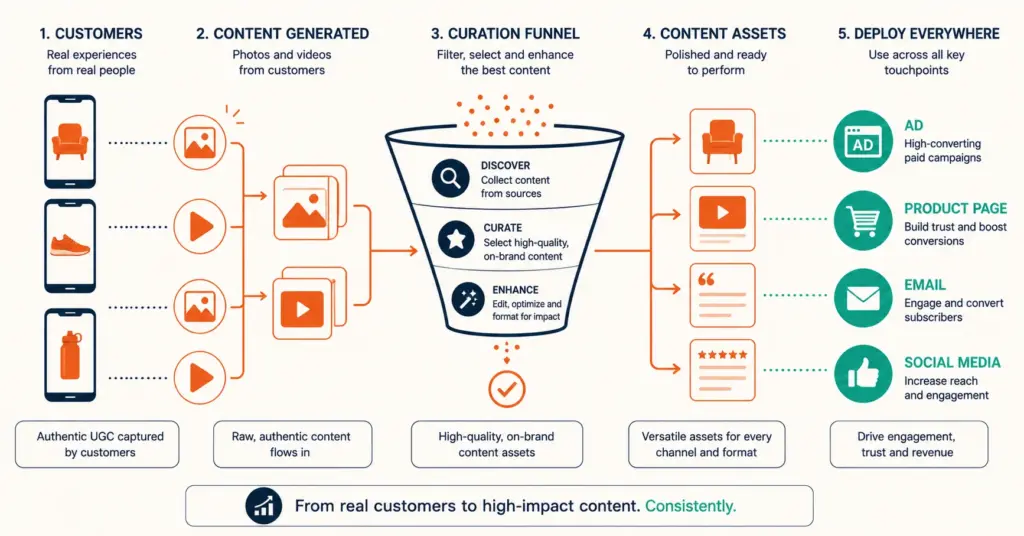
- UGC (user-generated content) is any content created by customers, fans, or hired creators that features your product in authentic, non-studio settings. UGC outperforms brand-produced content by 20 to 50% on CPA in paid ads and lifts product page conversion 15 to 25% when displayed as social proof.
- The UGC collection engine has 3 sources: organic customer content (free, highest authenticity, lowest control), hired UGC creators ($50 to $200/video, high control, scales predictably), and influencer partnerships ($200 to $5,000+, high reach, brand association).
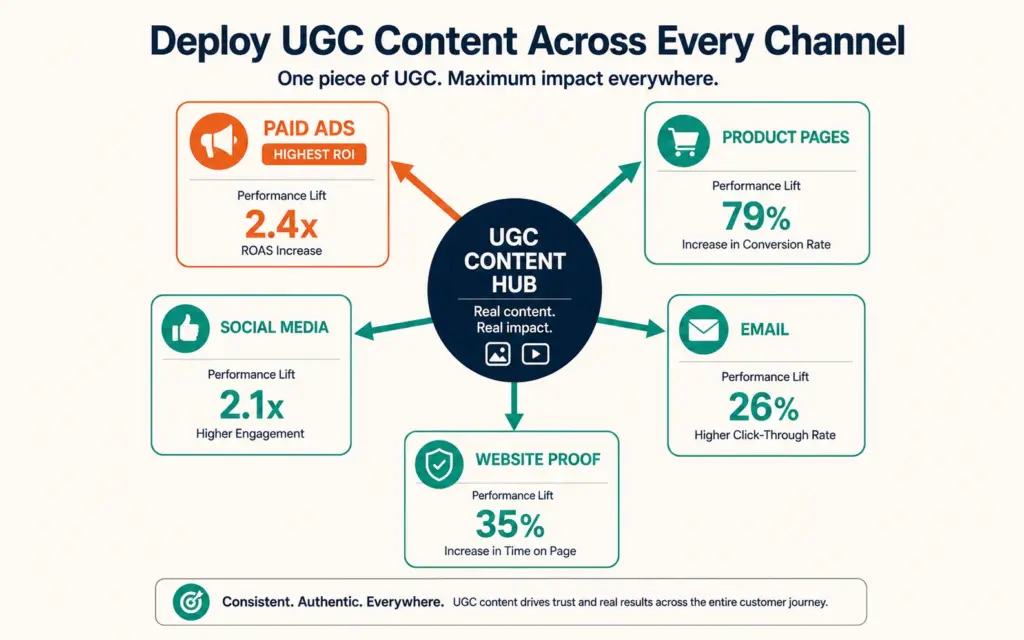
- UGC works across 5 channels simultaneously: paid ads (highest-performing creative format), product pages (review photos and videos), social media organic (feed content and Stories), email marketing (embedded customer content), and website social proof (homepage testimonials, gallery sections).
- The biggest UGC mistake is treating it as a one-time campaign instead of a continuous pipeline. Winning brands generate 20 to 50 new UGC pieces monthly through systematic collection, creating a renewable content library that feeds ads, social, and product pages.
A UGC strategy for ecommerce is the systematic approach to generating, collecting, and deploying user-generated content across paid ads, product pages, social media, and email marketing. UGC includes customer reviews with photos, unboxing videos, social media posts featuring your product, creator-produced testimonial content, and any visual or written content created by someone other than your brand team. According to Nosto’s (formerly Stackla) consumer content research, 79% of consumers say UGC significantly impacts their purchasing decisions, and UGC-based ads generate 4x higher click-through rates than brand-produced creative.
The strategic value of UGC extends beyond marketing metrics. UGC reduces creative production costs 60 to 80% compared to studio shoots, provides an unlimited supply of fresh ad variations (solving creative fatigue), builds authentic social proof that studio content cannot replicate, and generates content at scale without proportional cost increases. For broader creative strategy, see our ad creative tips guide.
This guide covers the 3-source UGC collection engine, where to deploy UGC for maximum revenue impact, the creator partnership models that scale predictably, legal and rights management, and the measurement framework that connects UGC activity to revenue.
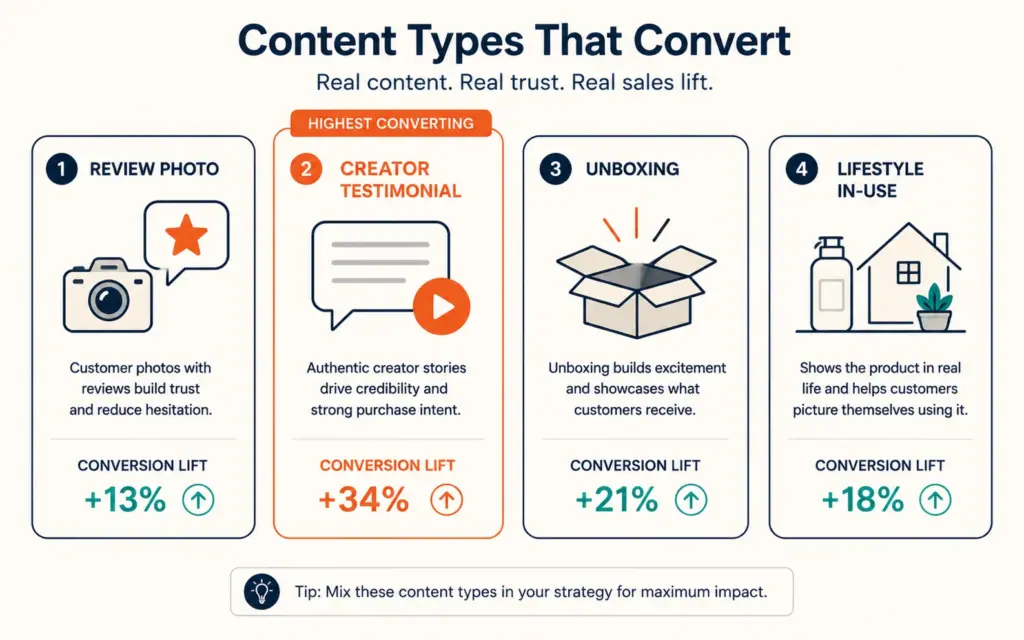
What Types of UGC Drive Ecommerce Revenue?
Review photos and videos
Customer-submitted review media is the most trusted form of UGC because it comes from verified purchasers with nothing to gain. Products with review photos convert 15 to 25% higher than those with text-only reviews. Request photo and video reviews through post-purchase email flows 7 to 14 days after delivery (enough time for product use, not so long they forget). Tools like Judge.me, Loox, and Stamped automate this collection. For email automation, see our email marketing strategy guide.
Creator testimonial videos
15 to 60 second videos of creators talking to camera about their product experience. The “talking head” format feels personal and trustworthy. These videos serve double duty: organic social content and paid ad creative. The key distinction from influencer content: UGC creators produce content for your brand to use, not primarily for their own audience.
Unboxing and first-impression content
The moment a customer opens your package and reacts. Unboxing content performs well because it captures genuine excitement and gives potential buyers a preview of the full purchase experience (packaging quality, presentation, product appearance). Encourage unboxing content through branded packaging with subtle “Share your unboxing” cards and dedicated hashtags.
Product-in-use lifestyle content
Photos and videos of the product in real-life contexts: a coffee maker on a real kitchen counter, shoes on a real hike, skincare products in a real bathroom. Lifestyle UGC outperforms studio lifestyle photography because the settings are recognizably authentic, not aspirationally staged. This content works exceptionally well on product pages and in carousel ads.
How Do I Collect UGC Systematically?
Source 1: Organic customer content (free)
- Post-purchase email request: Send 7 to 14 days after delivery asking for a review with photo/video. Offer a small incentive (10% off next order, loyalty points) for media reviews. Response rate: 5 to 15% of customers.
- Branded hashtag: Create a unique hashtag (#MyBrandName or #BrandExperience) and feature it on packaging, confirmation emails, and social profiles. Monitor the hashtag daily for quality content.
- Social media monitoring: Track brand mentions, product tags, and relevant hashtags across Instagram, TikTok, and Twitter. Customers post about products organically; most brands never see or use this content because they don’t monitor for it.
- On-site upload: Add a “Share your photos” section on product pages that lets customers upload directly. Curate submissions for quality before displaying.
Source 2: Hired UGC creators ($50 to $200/video)
UGC creators produce content specifically for brands to use in ads and marketing, without the expectation of posting to their own audience. This is the most scalable UGC source because you control the brief, timeline, and output volume.
- Platforms: Billo ($50 to $100/video, fast turnaround), Insense ($100 to $200/video, higher quality), or direct Instagram/TikTok outreach to micro-creators.
- The brief: Specify format (talking head, product demo, before/after), key talking points (2 to 3 product benefits), do’s and don’ts, and technical specs (vertical 9:16, well-lit, caption-ready audio).
- Volume: Commission 5 to 10 videos per month from 3 to 5 different creators. Variety in faces, settings, and angles prevents audience fatigue and gives you diverse creative to test.
- Cost model: Budget $300 to $800/month for 5 to 10 videos. This replaces $3,000 to $8,000 in equivalent studio production. For budgeting context, see our ecommerce startup costs guide.
Source 3: Influencer partnerships ($200 to $5,000+)
Influencer content serves two purposes: UGC for your brand to reuse AND distribution to the influencer’s audience. The dual value justifies the higher cost. Negotiate content usage rights in every influencer agreement so you can repurpose their content in paid ads, on product pages, and in email. Without explicit usage rights, you cannot legally reuse influencer content beyond the original post. For influencer strategy depth, see our influencer marketing guide.
Where Should I Use UGC for Maximum Impact?
Paid ads (highest ROI deployment)
UGC-style video ads outperform studio creative by 20 to 50% on CPA across Meta, TikTok, and Google. UGC ads look like organic content in the feed, triggering less ad avoidance behavior. Use UGC as your primary prospecting creative format (60 to 70% of ad variations). Reserve studio creative for retargeting and product-focused bottom-funnel ads. For Meta-specific ad strategy, see our Facebook ads ecommerce guide.
Product pages
Display customer photo and video reviews prominently on product pages. Position a UGC gallery (customer photos in a grid) between the product description and the Add to Cart button. Products with visible UGC on the page convert 15 to 25% higher than those with text-only reviews. For product page optimization, see our product page design guide.
Social media organic
Repost customer content (with permission) to your brand’s social profiles. UGC reposts generate 28% higher engagement than brand-produced content because followers see real people with real products. Credit the original creator with a tag and thank you. Mix: 40% UGC, 30% brand content, 30% educational/lifestyle content. For TikTok-specific strategy, see our TikTok marketing guide.
Email marketing
Embed customer review quotes and photos in abandoned cart emails, post-purchase follow-ups, and promotional campaigns. UGC in emails lifts click-through rates 15 to 25% compared to product-photo-only emails because the social proof addresses purchase hesitation within the email itself. For email strategy depth, see our email marketing strategy guide.
Website social proof sections
Homepage testimonial carousels, dedicated “Customer Gallery” pages, and sidebar social proof widgets display UGC to every visitor. Instagram feed embeds showing recent customer posts create a living social proof wall that updates automatically. For conversion optimization context, see our checkout optimization guide.
How Do I Manage UGC Rights and Legal Considerations?
Content rights you need
- For organic customer content: Request permission via DM or comment before reposting. A simple “Love this! Mind if we share it on our page?” suffices for organic social reuse. For paid ad use, get written permission (email or DM screenshot).
- For hired UGC creators: Include content usage rights in the brief or contract. Standard rights: perpetual use across all owned channels and paid advertising. Specify: social media, website, email, paid ads, and print if applicable.
- For influencers: Negotiate usage rights explicitly in the partnership agreement. Standard: 90-day paid media usage rights. Extended or perpetual rights cost 20 to 50% more. Without negotiated rights, you can only use the content on the influencer’s post (shared, not reposted).
FTC compliance
All UGC used in advertising must comply with FTC disclosure requirements. According to FTC endorsement guidelines, paid creators, gifted product recipients, and affiliate partners must clearly disclose the material connection. “#ad” or “#sponsored” in the post caption. When running UGC as paid ads, the “Paid partnership” label on Meta or “Promotional content” label on TikTok satisfies disclosure requirements.
How Do I Measure UGC Performance?
The 5 UGC metrics
- UGC ad ROAS vs brand creative ROAS: Compare side by side in your ad dashboard. UGC should outperform brand creative on CPA by 20 to 50%. If it doesn’t, the UGC quality or brief needs improvement.
- Product page conversion with vs without UGC: A/B test product pages with UGC gallery enabled vs disabled. Target 15 to 25% conversion lift with UGC present. For testing methodology, see our A/B testing guide.
- UGC collection rate: Percentage of customers who submit photo/video reviews. Target 5 to 15% with email automation and incentives. Below 3% signals the request timing, incentive, or process needs adjustment.
- Content production cost per asset: Total UGC spend / total usable assets produced. Target $30 to $100 per usable video, $5 to $20 per usable photo. Compare against studio production costs ($500 to $2,000 per equivalent asset).
- Creative lifespan: Days before UGC ad performance degrades (CPA increases 20%+). UGC typically lasts 7 to 21 days. Track to determine optimal refresh cadence. For ad creative longevity context, see our ad creative tips guide.
Common UGC Strategy Mistakes
Treating UGC as a one-time campaign
A single UGC collection campaign produces content that lasts 2 to 4 weeks in ads before fatigue. Winning brands build a continuous pipeline: automated review requests, ongoing creator partnerships, monthly influencer content, and social monitoring. Target 20 to 50 new UGC pieces monthly to sustain a testing-driven ad program.
Over-scripting creator content
The value of UGC is authenticity. Giving creators a 500-word script defeats the purpose. Provide 3 to 5 talking points, a general structure (hook, product experience, recommendation), and let creators deliver in their natural voice. Over-scripted UGC sounds like an ad read, which is exactly what it’s supposed to not sound like.
Using UGC without permission
Reposting customer content without permission creates legal liability and damages brand trust. Always request permission before reuse, and maintain a record of approvals. For paid ad use, written permission (email, DM) is the minimum standard. For scaled UGC programs, a simple content release form prevents future disputes.
Only using UGC in ads
UGC deployed only in paid advertising misses 4 other high-impact channels: product pages, organic social, email, and website social proof. Each channel independently lifts conversion. Combined, the compounding effect of UGC across all channels is 2 to 3x the impact of ads-only deployment. For broader marketing measurement, see our ecommerce KPIs guide.
Frequently Asked Questions
UGC (user-generated content) is any content created by customers, fans, or hired creators that features your product in authentic, non-studio settings. This includes review photos and videos, unboxing content, social media posts, creator testimonials, and product-in-use lifestyle content. UGC outperforms brand-produced content by 20 to 50% on ad CPA and lifts product page conversion 15 to 25% because consumers trust authentic peer content more than polished brand creative.
Three tiers: organic customer content is free (request reviews with incentives costing $0 to $5 per submission). Hired UGC creators cost $50 to $200 per video through platforms like Billo and Insense. Influencer partnerships run $200 to $5,000+ depending on follower count and usage rights. A monthly UGC pipeline of 10 to 20 pieces costs $300 to $1,500, replacing $5,000 to $15,000 in equivalent studio production.
Deploy UGC across 5 channels: paid ads (60 to 70% of ad creative variations), product pages (customer photo galleries and video reviews), organic social media (40% of feed content), email marketing (embedded review quotes and photos in campaigns), and website social proof (homepage testimonials, customer gallery pages). Each channel independently lifts conversion. Combined deployment creates 2 to 3x the impact of ads-only use.
Send automated review request emails 7 to 14 days after delivery with a small incentive (10% off next order or loyalty points for photo/video reviews). Create a branded hashtag featured on packaging and confirmation emails. Include a “Share your experience” card in packages. Monitor social mentions daily. Response rate with incentives runs 5 to 15% of customers. Without incentives, expect 1 to 3%.
Yes. Always request permission before reusing customer content, even for organic social reposts. For paid advertising, written permission (email or DM) is the minimum standard. For hired UGC creators, include usage rights in the brief or contract. For influencer partnerships, negotiate usage rights explicitly (standard: 90-day paid media rights). FTC requires disclosure labels on all paid or incentivized content used in advertising.
UGC focuses on content production: creators make content for your brand to use in ads and marketing. The creator’s own audience reach is secondary. Influencer marketing focuses on distribution: you pay for access to the influencer’s audience. Many campaigns blend both: an influencer creates content (UGC value) and posts it to their audience (distribution value). UGC creators cost $50 to $200 per video; influencer posts cost $200 to $5,000+ based on reach.
Related Reads
- Ad Creative Tips
- Influencer Marketing Guide
- TikTok Marketing Guide
- Facebook Ads for Ecommerce
- Email Marketing Strategy
- Product Page Design
Enjoying this? Get more like it every week.
One email per week with ecommerce strategies, tool picks, and seller insights. No spam.