
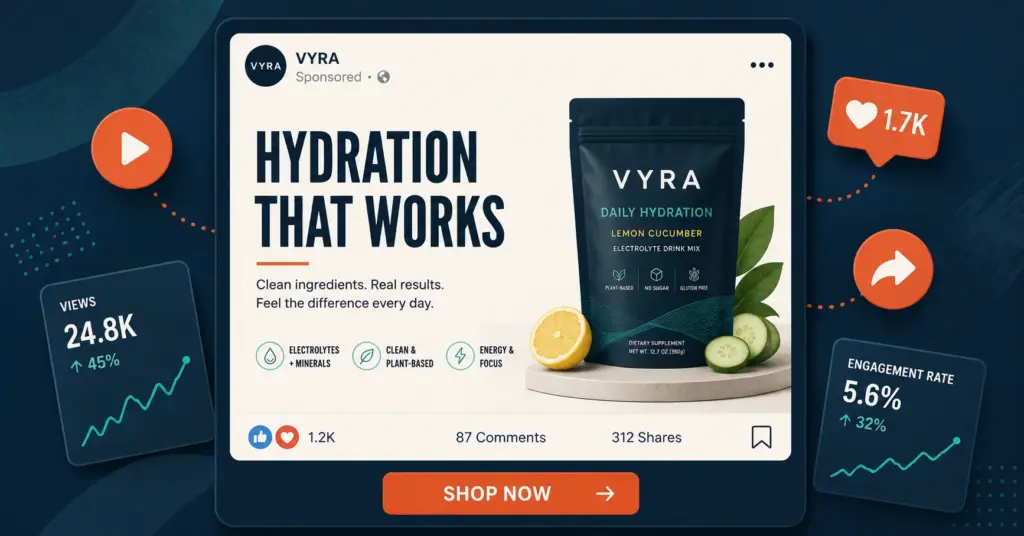
- Ad creative is the single largest performance variable in paid ecommerce advertising. Creative quality drives 50 to 70% of campaign performance on Meta, Google Shopping, and TikTok, while audience and bidding drive the remaining 30 to 50%.
- The 3 creative formats that consistently outperform: short-form video (15 to 30 seconds), UGC-style testimonial content, and problem-solution static ads. Each format fits a specific funnel stage.
- Creative fatigue hits most ecommerce ads after 7 to 14 days at $100+/day spend. Winning brands produce 10 to 20 new creative variations per month and test in structured batches of 3 to 5 concepts.
- The biggest creative mistake is optimizing for engagement metrics (likes, comments, shares) instead of conversion metrics (CPA, ROAS, revenue per click). Entertaining ads that don't convert are expensive entertainment.
Ad creative tips for ecommerce center on one reality: creative quality drives 50 to 70% of paid ad performance on Meta, Google, and TikTok. Audience targeting, bidding strategy, and budget allocation matter, but they optimize within the ceiling your creative sets. A mediocre creative with perfect targeting underperforms a strong creative with broad targeting every time. According to Meta’s own performance research, creative is the single largest driver of ad recall, brand lift, and conversion across all campaign types.
The challenge for ecommerce brands is that creative production feels expensive and subjective. Most stores either spend too little (reusing the same 3 product photos for 6 months) or spend too much (hiring agencies that produce polished but untested concepts). The middle path that works: a structured testing process that produces 10 to 20 variations per month at low cost, tests in small batches, and scales the winners aggressively.
This guide covers the 10 creative tactics that consistently lower CPA 20 to 40% across ecommerce categories, the video structures that convert, the UGC production framework, and the testing process that finds winners without wasting budget.
Why Does Ad Creative Matter More Than Targeting?
Platform algorithms (Meta’s Advantage+, Google’s PMax, TikTok’s Smart Performance) have automated most targeting decisions. The algorithm finds buyers better than manual audience selection for most ecommerce products. What the algorithm can’t do is create compelling creative. That’s still the brand’s job, and it’s the variable that separates $2 CPA from $8 CPA on the same product.
The creative-first funnel
- Top of funnel (awareness): Video ads that stop the scroll and introduce the problem your product solves. 15 to 30 seconds. Hook in the first 2 seconds.
- Middle of funnel (consideration): UGC testimonials, comparison content, and educational demos that build trust. 30 to 60 seconds.
- Bottom of funnel (conversion): Product-focused statics and carousels with clear pricing, offers, and urgency. Retargeting audiences.
Most ecommerce brands run only bottom-funnel creative (product photos with “Shop Now”). Adding top and mid-funnel creative typically lifts overall ROAS 25 to 40% by filling the pipeline with warmer audiences. For broader acquisition context, see our customer retention guide.
What Are the 10 Highest-Impact Ad Creative Tactics?
1. The 2-second hook
On Meta and TikTok, users scroll past content in under 2 seconds. Your creative must interrupt the scroll pattern immediately. Effective hooks: unexpected visual contrast, direct question (“Tired of [problem]?”), product in use with dramatic result, or a jarring statistic. Test 3 to 5 different hooks on the same ad body to isolate which opening captures attention.
2. Problem-solution structure
The highest-converting ad narrative: show the problem (frustration, pain point, inconvenience), then show the product solving it in real-time. “Before your product” vs “after your product” is the simplest version. This structure works across video, static, and carousel formats because it connects emotionally before selling logically.
3. UGC-style production
User-generated content (or UGC-style content produced by creators) outperforms polished studio creative on Meta and TikTok by 20 to 50% on CPA in most ecommerce categories. The reason: UGC looks like native content in the feed, triggers less “ad avoidance” behavior, and builds social proof simultaneously. Hire 3 to 5 UGC creators through Billo, Insense, or direct outreach at $50 to $200 per video.
4. Founder or team-member talking head
A 15 to 30 second video of the founder explaining why they built the product converts 10 to 30% better than generic product ads for DTC brands. The personal connection builds trust that product shots alone cannot. Shoot on a phone, in natural lighting, with a simple background. Over-produced founder videos underperform casual ones.
5. Social proof stacking
Layer multiple proof signals in a single creative: review quote overlay on product image, star rating badge, “10,000+ sold” counter, press mention logo bar. Each signal individually lifts conversion 3 to 8%; stacked together, the compound effect runs 15 to 25%. Static formats work best for social proof stacking because viewers can scan multiple signals at once.
6. Product demo close-ups
Close-up product demos showing texture, application, or functionality convert 15 to 25% better than lifestyle shots for categories where product quality is the purchase driver (beauty, skincare, kitchen tools, supplements). Shoot with macro lens or phone close-up mode. Show the product working, not just existing.
7. Comparison and “vs” ads
“Ours vs theirs” or “before vs after” side-by-side creative consistently outperforms single-frame product ads. The comparison format gives viewers a decision framework within the ad itself. Use split-screen statics or side-by-side video. Important: compare honestly and avoid disparaging specific competitor brands (platform policy risk).
8. Urgency and scarcity (when real)
Countdown timers, “only X left in stock,” and limited-time offers lift click-through 15 to 30% and conversion 8 to 15%. The key: the urgency must be genuine. Fake scarcity on perpetually available products erodes brand trust and violates FTC guidelines. Use for actual flash sales, seasonal promotions, and genuine low-stock moments.
9. Carousel storytelling
Meta carousels that tell a sequential story (problem → solution → proof → offer across 4 to 6 slides) outperform single-image ads by 20 to 30% on cost per landing page view. Each slide should stand alone visually but build narrative momentum. End the carousel with a clear CTA and price. For conversion optimization depth, see our product page design guide.
10. Platform-native formatting
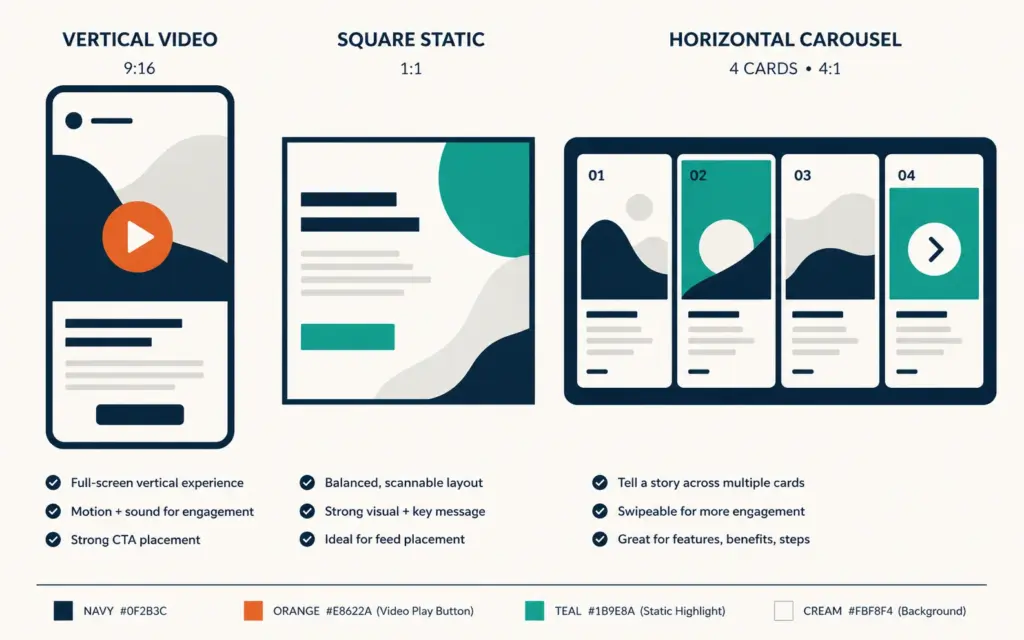
Ads formatted for each platform’s native experience (9:16 vertical for TikTok and Reels, 1:1 square for Meta feed, 16:9 horizontal for YouTube) outperform repurposed cross-platform creative by 15 to 25%. Shoot once in 9:16 (the most versatile format) and crop for other placements rather than reshooting. Captions are mandatory: 85% of Meta video is watched without sound.
How Do I Test Ad Creative Efficiently?
The testing process that finds winners without burning budget:
The 3-2-1 testing framework
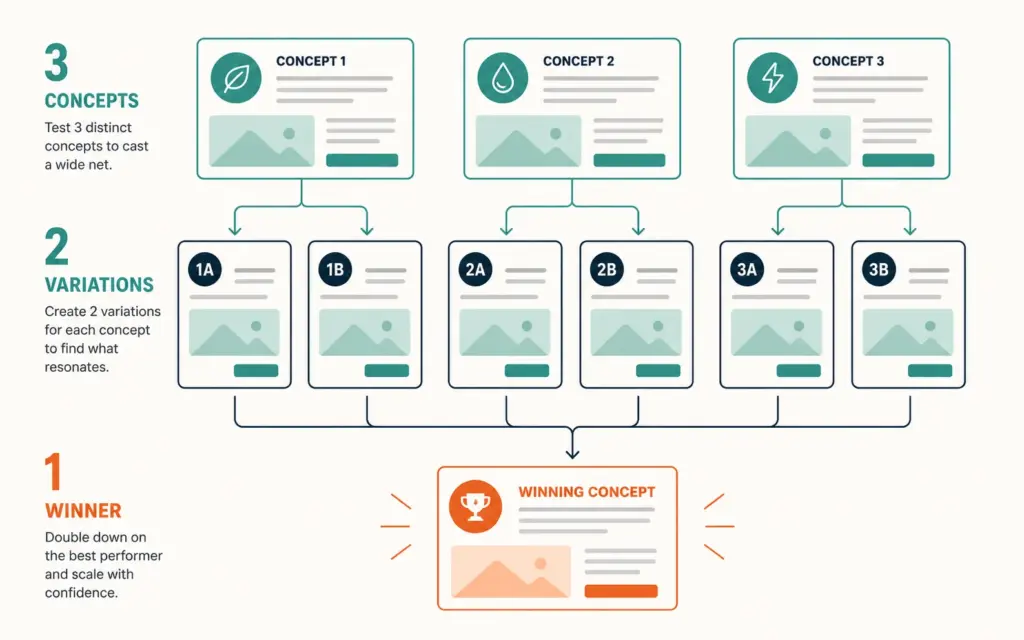
- 3 concepts: Each test batch includes 3 distinct creative concepts (different hooks, angles, or formats). Not 3 minor variations of the same ad.
- 2 variations per concept: Each concept gets 2 executions (different hook, different CTA, different creator). Total: 6 ad variations per batch.
- 1 winner to scale: After 48 to 72 hours of spend at $20 to $50 per variation, identify the top performer by CPA or ROAS. Pause losers. Scale the winner.
Creative testing budget
Allocate 20 to 30% of total ad budget to testing, 70 to 80% to scaling proven winners. At $3,000/month total ad spend, that’s $600 to $900/month on testing (approximately $20 to $30/day across test variations). This produces 8 to 12 tested concepts per month, of which 2 to 3 typically emerge as scalable winners.
When to retire a creative
Creative fatigue shows up as rising CPA or declining CTR over 7 to 14 days at consistent spend. According to TikTok’s creative best practices, the average TikTok ad creative lifespan is 7 to 10 days before performance degrades. Meta ads typically last 10 to 21 days. Plan for constant creative refresh: 10 to 20 new variations per month for active campaigns.
How Do I Produce Ad Creative Affordably?
The $500/month production setup
- UGC creators: 3 to 5 creators at $50 to $150 per video through Billo, Insense, or Instagram outreach. Budget: $200 to $400/month for 3 to 5 videos.
- Founder talking-heads: Shoot on phone, weekly 15-minute sessions. Budget: $0 (your time).
- Static design: Canva Pro ($13/month) or a freelance designer on Fiverr ($25 to $75 per batch of 5 statics).
- Product photography: iPhone with natural light and white background, or a $300 to $500 quarterly studio shoot.
- Editing: CapCut (free) for video editing, or freelance editors at $15 to $30 per video on Fiverr.
This setup produces 15 to 25 creative variations per month at $500 or less, enough to feed a structured testing program at $3,000 to $10,000/month ad spend. For broader cost planning, see our ecommerce startup costs guide.
What Are the Most Common Ad Creative Mistakes?
Using product photos as ads without context
A white-background product photo with “Shop Now” is a catalog, not an ad. It gives the viewer no reason to stop scrolling. Add context: who is the product for, what problem does it solve, why should they care now? Even a simple text overlay stating the benefit (“Cuts meal prep time in half”) transforms a product photo into a scroll-stopping creative.
Optimizing for engagement over conversion
An ad with 500 likes and 50 comments but zero purchases is expensive entertainment. Platform algorithms optimize for the metric you choose. If you optimize for link clicks, you get clickers. If you optimize for purchases, you get buyers. Set the conversion event to “purchase” from day one and evaluate creative by CPA and ROAS, not engagement. For measurement depth, see our ecommerce KPIs guide.
Running the same creative for 3+ months
Every creative has a lifespan. At consistent daily spend, creative fatigue sets in at 7 to 21 days. Stores running the same 3 ads for 6 months see CPA double or triple as the audience saturates. Build a creative pipeline that refreshes 10 to 20 variations monthly.
Over-producing at launch
Spending $5,000 on a professional video shoot before testing any concept is a gamble. The concept might not resonate regardless of production quality. Test concepts cheaply first (phone-shot UGC, simple statics), identify what resonates, then invest in polished production on validated winners.
Ignoring platform-specific formatting
A 16:9 horizontal video on TikTok wastes 60% of the screen. A 9:16 vertical video on Google Display looks cropped. Format creative for each placement or your CTR pays the penalty. The 9:16 vertical format is the most versatile starting point because it covers TikTok, Reels, Stories, and can be center-cropped to 1:1 for feed placements. For retargeting creative specifically, see our retargeting strategies guide.
Frequently Asked Questions
A good ecommerce ad creative stops the scroll in under 2 seconds, communicates a clear problem-solution narrative, includes social proof (reviews, sales count, press mentions), and ends with a specific call to action with pricing or offer. The three formats that consistently perform: short-form video (15 to 30 seconds), UGC testimonial content, and problem-solution static ads. Good creative converts; great creative scales to high spend without CPA degradation.
Plan for 10 to 20 new creative variations per month for active campaigns. Creative fatigue hits most ecommerce ads after 7 to 14 days at $100+/day spend. The specific refresh rate depends on spend level: at $1,000/month, 5 to 8 new variations suffice; at $10,000/month, you need 15 to 25 new variations to maintain performance. Build a production pipeline, not a one-time shoot.
Most ecommerce stores can produce competitive creative for $300 to $800/month using UGC creators ($50 to $150/video), phone-shot founder content ($0), Canva statics ($13/month), and freelance editing ($15 to $30/video). This produces 15 to 25 variations monthly. Professional agency production ($5,000+/month) makes sense above $50k/month ad spend where production quality measurably lifts conversion.
Both, at different funnel stages. Video outperforms static for top-of-funnel awareness (15 to 30 second problem-solution or UGC) because it captures attention and builds emotional connection. Static outperforms video for bottom-of-funnel retargeting (social proof stacking, price-focused offers) because viewers need quick information to convert. Most successful brands run 60% video and 40% static across their campaigns.
User-generated content (UGC) is creative produced by customers, fans, or hired creators that looks like authentic, non-professional content rather than polished brand advertising. UGC outperforms studio creative by 20 to 50% on CPA because it matches the organic content experience in social feeds, triggers less ad avoidance, and builds trust through apparent authenticity. Brands hire UGC creators through platforms like Billo and Insense at $50 to $200 per video.
Use the 3-2-1 framework: test 3 distinct creative concepts with 2 variations each (6 total ads per batch) at $20 to $50 per variation for 48 to 72 hours. Identify the top performer by CPA or ROAS, pause the losers, and scale the winner. Allocate 20 to 30% of total ad budget to testing and 70 to 80% to scaling proven winners. At $3,000/month spend, that’s $600 to $900/month on testing, producing 8 to 12 tested concepts monthly.
Related Reads
- Retargeting Strategies
- Customer Retention Guide
- TikTok Shop Strategy
- Ecommerce KPIs Guide
- Product Page Design
- Ecommerce Startup Costs
Enjoying this? Get more like it every week.
One email per week with ecommerce strategies, tool picks, and seller insights. No spam.