

- Retargeting strategies bring back visitors who left your store without buying. Only 2 to 4% of ecommerce visitors convert on first visit, meaning 96 to 98% of traffic leaves without purchasing. Retargeting recovers 10 to 25% of those lost visitors at 3 to 5x higher conversion rates than cold prospecting.
- The 8 highest-performing retargeting tactics: dynamic product ads, cart abandonment retargeting, sequential messaging (awareness to conversion), audience exclusion, cross-platform retargeting, lookalike expansion from converters, frequency capping, and post-purchase retargeting for upsells.
- Dynamic product retargeting (showing visitors the exact products they viewed) outperforms generic retargeting by 3 to 6x on click-through rate and 2 to 4x on ROAS because the creative matches demonstrated interest.
- The most common retargeting mistake is showing ads to people who already purchased. Post-purchase retargeting should upsell complementary products, not re-sell the same item. Exclusion rules are as important as targeting rules.
Retargeting strategies (also called remarketing) are the paid advertising tactics that re-engage visitors who left your ecommerce store without completing a purchase. Only 2 to 4% of ecommerce visitors convert on their first visit, meaning 96 to 98% of your traffic, traffic you already paid for through SEO, ads, or social, leaves without buying anything. Retargeting brings them back at 3 to 5x higher conversion rates than cold prospecting because these visitors already know your brand and have demonstrated interest by visiting specific product pages.
The economics are compelling. Retargeting ads typically run ROAS of 8:1 to 15:1 compared to 3:1 to 6:1 for prospecting campaigns. The audience is smaller (your site visitors vs the entire internet), but the conversion probability is dramatically higher. According to Criteo’s retargeting research, website visitors who are retargeted are 70% more likely to convert than those who aren’t. For broader ad strategy, see our ad creative tips guide.
This guide covers the 8 highest-performing retargeting tactics, the audience segmentation framework that matches message intensity to buyer intent, the cross-platform setup for Meta, Google, and TikTok, and the exclusion rules that prevent the most common (and most wasteful) retargeting mistakes.
How Does Ecommerce Retargeting Work?
Retargeting works through tracking pixels and audience lists. When a visitor lands on your store, tracking pixels (Meta Pixel, Google Ads tag, TikTok Pixel) record their visit. Those visitors are added to retargeting audiences. When those visitors browse Facebook, Instagram, Google, YouTube, or TikTok, your retargeting ads follow them with product-specific messaging.
The retargeting ecosystem
| Platform | Pixel/Tag | Where Ads Show | Best Retargeting Format |
|---|---|---|---|
| Meta | Meta Pixel + CAPI | Facebook, Instagram, Messenger, Audience Network | Dynamic product ads, carousel |
| Google Ads tag + GA4 | Google Display, YouTube, Gmail, Search | Dynamic remarketing, YouTube pre-roll | |
| TikTok | TikTok Pixel | TikTok feed | Video retargeting, spark ads |
| Pinterest Tag | Pinterest feed, search | Shopping ads retargeting |
Server-side tracking is now essential
iOS App Tracking Transparency blocks Meta Pixel tracking for 30 to 40% of iPhone users. Ad blockers affect another 15 to 25% of desktop traffic. Without server-side tracking (Meta Conversions API, Google Enhanced Conversions), your retargeting audiences are 30 to 50% smaller than they should be. Implement server-side tracking before scaling retargeting spend. For tracking setup depth, see our tracking setup guide.
What Are the 8 Highest-Performing Retargeting Tactics?
1. Dynamic product retargeting
Show visitors the exact products they viewed on your site. Dynamic ads automatically pull product images, titles, and prices from your product catalog feed. CTR runs 3 to 6x higher than generic retargeting because the ad matches demonstrated interest. Setup requires connecting your product catalog to Meta (Commerce Manager), Google (Merchant Center), or TikTok (Catalog Manager). This is the single highest-ROI retargeting tactic for any ecommerce store with 50+ SKUs.
2. Cart abandonment retargeting
Target visitors who added items to their cart but didn’t check out. Cart abandoners have the highest purchase intent of any retargeting audience. Show the carted products with a simple CTA (“Complete your order”) for the first 48 hours, then add a modest incentive (free shipping or 10% off) after 48 hours. Conversion rates on cart retargeting run 5 to 15% versus 1 to 3% for general site visitor retargeting. For the full cart recovery stack (email + SMS + ads), see our cart abandonment solutions guide.
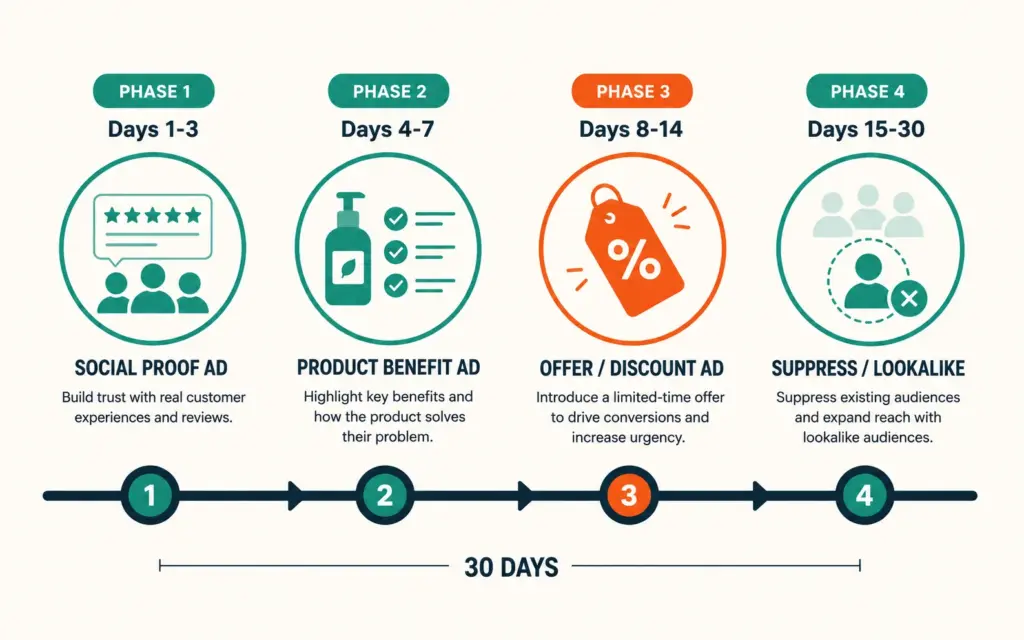
3. Sequential retargeting (awareness to conversion)
Instead of showing the same ad repeatedly, build a sequence that moves visitors through a funnel:
- Days 1 to 3: Social proof ad (reviews, testimonials, “10,000+ customers”) builds trust
- Days 4 to 7: Product benefit ad (specific problem your product solves) builds desire
- Days 8 to 14: Offer ad (free shipping, 10% off, bundle deal) creates urgency
- Days 15 to 30: Last-chance ad or suppress and move to lookalike targeting
Sequential retargeting lifts conversion 20 to 40% compared to showing the same ad across the entire window because each message addresses the likely objection at that stage of consideration.
4. Audience exclusion rules
Exclusion is as important as targeting. Essential exclusions:
- Recent purchasers (7 to 30 days): Don’t show purchase retargeting to people who already bought. The exception: cross-sell complementary products after 7+ days.
- Repeat non-converters: After 30 days of retargeting without conversion, suppress and reallocate budget. These visitors aren’t going to buy; continued ads waste spend and create annoyance.
- Internal traffic: Exclude your team’s IP addresses and emails from retargeting audiences. Employee ad impressions inflate costs and distort reporting.
5. Cross-platform retargeting
A visitor who sees your retargeting ad on Facebook, then again on Google Display, then again on YouTube converts at 2 to 3x the rate of single-platform retargeting. The frequency across platforms creates omnipresence without the fatigue of seeing the same ad in the same place. Run retargeting on at least 2 platforms (Meta + Google is the standard combination). For attribution across platforms, see our attribution modeling guide.
6. Lookalike expansion from retargeting converters
Build lookalike audiences from your highest-converting retargeting segment (cart abandoners who purchased after retargeting). These lookalikes share behavioral patterns with people who needed a nudge to buy, making them higher-quality acquisition audiences than generic lookalikes. On Meta, 1% lookalikes from retargeting converters typically outperform 1% lookalikes from all purchasers by 15 to 25% on CPA.
7. Frequency capping
Cap retargeting ad frequency at 3 to 5 impressions per user per day across all placements. Above 5 daily impressions, annoyance outweighs persuasion. Research from Insider Intelligence shows ad fatigue onset begins after the 7th weekly impression, with negative brand sentiment measurable after the 15th. Many stores run retargeting without frequency caps and wonder why brand sentiment declines. Set caps at the ad set level on Meta and campaign level on Google Display. Monitor frequency in ad reporting dashboards weekly.
8. Post-purchase retargeting for upsells
After purchase, retarget customers with complementary products, accessories, or replenishment offers (for consumables). Wait 7 to 14 days after purchase to allow delivery and first use. “You bought [A], customers also love [B]” creative converts at 3 to 8% on retargeted purchasers, significantly higher than cold prospecting. This tactic extends customer lifetime value without email dependency. For retention depth, see our customer retention guide.
How Do I Segment Retargeting Audiences?
Segmentation determines ad spend efficiency. Broader audiences waste budget on low-intent visitors; narrow audiences concentrate spend on high-probability converters.
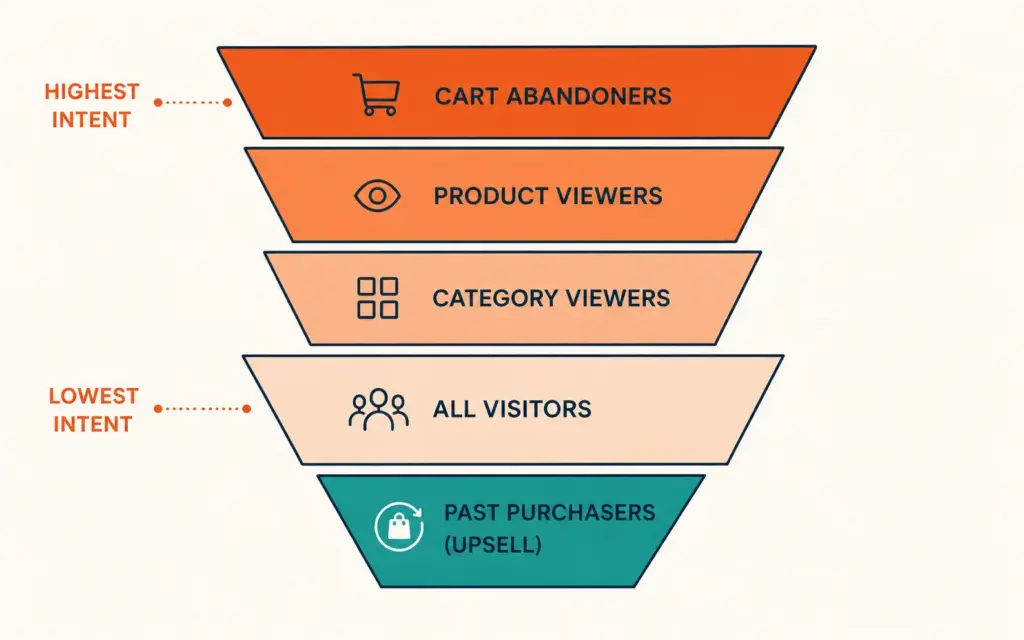
The 5-tier retargeting framework
| Tier | Audience | Intent Level | Suggested Budget Share | Typical ROAS |
|---|---|---|---|---|
| 1 (Highest) | Cart abandoners (1 to 7 days) | Very high | 30 to 40% | 10:1 to 20:1 |
| 2 | Product page viewers (1 to 14 days) | High | 25 to 30% | 6:1 to 12:1 |
| 3 | Category/collection viewers (1 to 14 days) | Medium | 15 to 20% | 4:1 to 8:1 |
| 4 | Homepage/blog visitors (1 to 30 days) | Low | 5 to 10% | 2:1 to 5:1 |
| 5 | Past purchasers (30 to 180 days) | Upsell | 10 to 15% | 5:1 to 10:1 |
Allocate 55 to 70% of retargeting budget to Tiers 1 and 2 (cart abandoners and product viewers). These audiences have the highest intent and produce the best ROAS. Tiers 3 and 4 fill the pipeline but at lower efficiency. Tier 5 extends LTV at moderate cost.
Time-based audience windows
Recency matters more than reach. A visitor from 2 days ago converts at 5 to 10x the rate of a visitor from 28 days ago. Create separate audiences for 1 to 3 days, 4 to 7 days, 8 to 14 days, and 15 to 30 days. Bid more aggressively on recent windows and reduce bids as recency fades. Most platforms allow audience stacking with bid adjustments by recency.
How Do I Set Up Retargeting on Meta and Google?
Meta retargeting setup
- Install Meta Pixel + Conversions API: Pixel fires on page load; CAPI sends server-side events. Together they capture 70 to 90% of visitor data despite iOS restrictions.
- Create custom audiences: Ads Manager > Audiences > Custom Audience > Website. Create audiences by page type (product, cart, collection) and recency window (1-3d, 4-7d, 8-14d, 15-30d).
- Connect product catalog: Commerce Manager > Add Catalog > upload product feed. Enables dynamic product ads that automatically show viewed products.
- Build campaign: Sales objective > Advantage+ catalog ads or manual product retargeting. Set budget, frequency cap, and exclusions (purchasers, internal traffic).
Google retargeting setup
- Install Google Ads tag + Enhanced Conversions: Through Google Tag Manager for centralized management.
- Link Google Analytics 4: GA4 audiences automatically share with Google Ads when accounts are linked.
- Connect Merchant Center: Product feed enables dynamic remarketing on Google Display Network.
- Build campaign: Performance Max with audience signals including your retargeting lists, or dedicated Display remarketing campaign for more control. For PMax depth, see our Google Shopping Ads guide.
How Much Should I Spend on Retargeting?
Retargeting budget depends on total traffic volume and ad spend allocation:
Budget allocation rule
Allocate 15 to 25% of total paid ad budget to retargeting. At $5,000/month total ad spend, that’s $750 to $1,250/month on retargeting. Below 15% starves high-converting audiences. Above 25% typically means your retargeting audiences are too small to absorb the budget without excessive frequency.
When retargeting budget should increase
Increase retargeting allocation when: prospecting campaigns drive significantly more traffic (larger retargeting pool), ROAS on retargeting consistently exceeds prospecting by 3x+, or you launch new product lines that benefit from re-engaging existing traffic. For measuring spend efficiency, see our ecommerce KPIs guide.
What Are the Most Common Retargeting Mistakes?
Retargeting recent purchasers with the same product
Showing someone an ad for the exact product they purchased 3 days ago wastes budget and creates negative brand association (“they’re tracking me”). Exclude purchasers from product retargeting for at least 7 to 14 days. After that window, retarget with complementary products only.
Running retargeting without frequency caps
Uncapped retargeting creates the “stalker ad” experience. Visitors see your ad 15 to 20 times per day and develop brand aversion. Cap at 3 to 5 impressions per user per day. Monitor frequency metrics weekly and reduce budgets if average frequency exceeds 7 per week.
Using generic creative for all retargeting tiers
A homepage visitor and a cart abandoner need completely different messages. Generic “Shop Now” ads convert 3 to 5x worse than intent-matched creative. Cart abandoners need “Complete your order” with product images. Product viewers need social proof and benefits. Homepage visitors need brand introduction and category discovery.
Ignoring iOS tracking losses
Without Meta CAPI and Google Enhanced Conversions, your retargeting audiences are missing 30 to 50% of iOS visitors. You’re optimizing on incomplete data and serving ads to a biased subset of your traffic. Install server-side tracking before scaling retargeting spend. For the complete tracking setup, see our tracking setup guide.
Not excluding converters from prospecting
If existing customers see prospecting ads (cold audience ads), you’re paying prospecting CPMs for people who already know your brand. Exclude all customer email lists and website purchaser audiences from prospecting campaigns. This forces prospecting budget toward actual new customers and prevents inflated prospecting ROAS from existing customer conversions. For broader pricing and margin impact, see our ecommerce profit margins guide.
Frequently Asked Questions
Ecommerce retargeting is the practice of showing paid ads to visitors who previously visited your store but didn’t purchase. Tracking pixels (Meta Pixel, Google Ads tag) record visitor behavior, and ads follow those visitors across Facebook, Instagram, Google, YouTube, and other platforms. Retargeting converts at 3 to 5x higher rates than cold prospecting because visitors already know your brand and have demonstrated product interest.
Allocate 15 to 25% of total paid ad budget to retargeting. At $5,000/month total spend, that’s $750 to $1,250/month. Concentrate 55 to 70% of retargeting budget on cart abandoners and product viewers (highest intent). Below 15% allocation starves high-converting audiences. Above 25% typically means excessive frequency on small audience pools.
Dynamic product retargeting automatically shows visitors the exact products they viewed on your site, pulling images, titles, and prices from your product catalog feed. It outperforms generic retargeting by 3 to 6x on click-through rate because the ad matches demonstrated interest. Setup requires connecting your product catalog to Meta Commerce Manager, Google Merchant Center, or TikTok Catalog Manager.
The optimal retargeting window is 14 to 30 days for most ecommerce products. Cart abandoners convert best within 1 to 7 days. Product viewers convert best within 1 to 14 days. Beyond 30 days, conversion probability drops to near-prospecting levels, and the budget is better spent on lookalike audiences. High-consideration products (furniture, electronics above $500) may justify 60-day windows.
In practice, retargeting and remarketing are used interchangeably. Technically, “retargeting” traditionally refers to display and social ad campaigns targeting past visitors, while “remarketing” historically referred to email campaigns re-engaging past visitors or customers. Google uses “remarketing” in its ad platform terminology. Meta uses “retargeting” and “custom audiences.” The strategy is the same regardless of terminology.
Meta requires at least 1,000 people in a custom audience before it can serve ads. Google has similar minimums. Practically, retargeting becomes worthwhile above 5,000 monthly website visitors because smaller audiences exhaust quickly and frequency becomes excessive. Below 5,000 visitors, focus on growing traffic through prospecting, SEO, and content marketing before investing in retargeting.
Related Reads
- Ad Creative Tips
- Google Shopping Ads Guide
- Customer Retention Guide
- Tracking Setup Guide
- Attribution Modeling
- Cart Abandonment Solutions
Enjoying this? Get more like it every week.
One email per week with ecommerce strategies, tool picks, and seller insights. No spam.