

- Pricing is the single fastest lever on profit, and beginners get it wrong in both directions: pricing too low (unable to survive their own costs) or too high (nobody buys). The goal is a price that both sells and leaves real profit after every cost, not just the cost of the product itself.
- Start with your true costs. Product cost is only part of it: add shipping, payment processing (about 2.9% + $0.30), packaging, platform and app fees, returns, and your time. Many beginners price against product cost alone and discover they're barely breaking even or losing money once all costs are counted.
- Two foundational approaches: cost-plus pricing (add a target margin to your total cost, simple and safe) and value-based pricing (price on the value the product delivers to the customer, potentially far more profitable). Beginners often start cost-plus and evolve toward value-based as they understand their customers.
- Psychological pricing tactics genuinely affect sales: charm pricing ($19.99 vs $20), price anchoring (showing a higher option to make your target look reasonable), and bundling. These aren't tricks so much as well-documented patterns in how people perceive prices, and they work alongside sound cost and value math.
A pricing strategy beginners can actually use starts with a hard truth: the price you set is the single fastest lever on your profit, and it’s the one new store owners most often get wrong. Price too low and you can’t survive your own costs, working hard to lose money on every sale. Price too high and nobody buys, leaving you with inventory and no revenue. The goal is the price that lives in between: one that both sells and leaves real profit after every cost, not just the cost of the product. Getting there isn’t guesswork; it’s a process built on understanding your true costs, your customer’s perception of value, and a few well-documented patterns in how people respond to prices.
Most beginner pricing mistakes come from a single error: pricing against product cost alone. You buy a product for $10, decide to sell it for $20, and assume you’re making $10. Then shipping, payment fees, packaging, platform fees, and returns quietly eat most of that, and you discover you’re barely breaking even. This guide covers how to price correctly from the start: counting all your costs, choosing an approach, and using psychological pricing that works alongside sound math. The ecommerce pricing strategy guide covers advanced tactics; this is the beginner foundation.
Start With Your True Costs, Not Just Product Cost
Before you can price for profit, you need to know what a sale actually costs you. Product cost (what you pay for the item) is only the beginning. Your true cost per sale includes:
- Product cost: What you pay the supplier or to make the item.
- Shipping: What it costs to get the product to the customer (if you absorb it) or the portion you subsidize.
- Payment processing: Roughly 2.9% + $0.30 per transaction. On a $30 order, that’s about $1.17.
- Packaging: Boxes, filler, tape, branded materials.
- Platform and app fees: Your share of monthly platform and app costs, spread across your orders.
- Returns: Return rates run 15 to 25% in some categories, and each return has costs even if the item is resold.
- Your time: Often ignored, but your labor has value. A price that ignores your time isn’t sustainable.
Add these up to find your true cost per sale. This is the floor: any price below it loses money. According to Shopify’s pricing strategy guide, understanding your full cost structure before setting a price is the step new sellers most often skip, and the one that most reliably determines whether a store is profitable. The profit margin calculator computes your true margin once all these costs are counted, and the break-even calculator shows how many units you need to sell to cover fixed costs at a given price. Knowing these numbers is what separates pricing for profit from pricing by guesswork. The ecommerce profit margins benchmarks by category show what margin is realistic for your product type.
Two Foundational Pricing Approaches
Cost-Plus Pricing: Simple and Safe
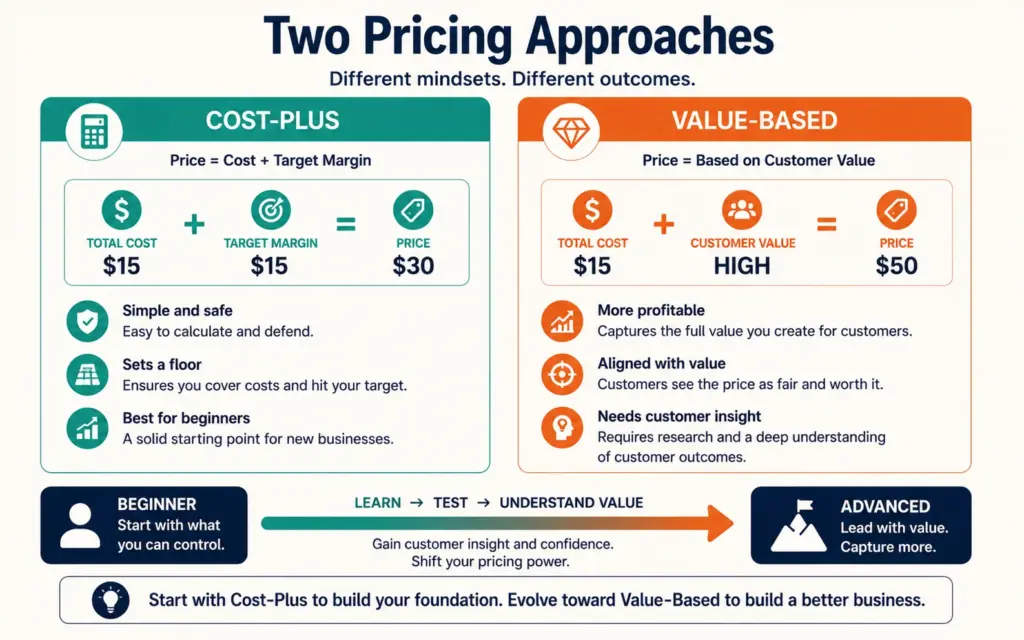
Cost-plus pricing adds a target margin to your total cost. If your true cost per sale is $15 and you want a 50% margin, you price at $30 ($15 cost is 50% of the $30 price). It’s simple, ensures you cover costs, and is a safe starting point for beginners.
The limitation: cost-plus pricing ignores what the customer is willing to pay. A product that costs you $15 might deliver $60 of value to the right customer, and cost-plus pricing would leave that money on the table by pricing at $30. Cost-plus is a floor and a starting point, not a ceiling. Use it to ensure you never price below profitability, then consider whether value-based pricing could capture more.
Value-Based Pricing: Potentially Far More Profitable
Value-based pricing sets the price on the value the product delivers to the customer, not on your cost. A product that solves an expensive problem, saves significant time, or delivers a premium experience can command a price far above cost-plus. A $15-cost skincare product positioned as a premium solution might sell for $50 because that’s what it’s worth to customers seeking that result.
Value-based pricing requires understanding your customer: what problem your product solves, what alternatives cost, and what the outcome is worth to them. It’s more profitable but requires more customer insight, which is why beginners often start cost-plus and evolve toward value-based as they learn their market. The niche validation work that reveals your customer’s pain points also reveals what solving those pains is worth, which is the foundation of value-based pricing.
Psychological Pricing That Actually Works
How people perceive prices isn’t purely rational, and a few well-documented patterns can improve sales without changing your underlying economics much:
Charm pricing ($19.99 vs $20). Prices ending in .99 or .95 consistently perceive as meaningfully lower than the round number just above, even though the difference is a cent. The left-digit effect (we anchor on the first digit) makes $19.99 feel closer to $19 than $20. According to Investopedia’s explanation of psychological pricing, this pattern is one of the most consistently observed effects in consumer behavior research. Widely used because it works.
Price anchoring. Showing a higher-priced option makes your target price look reasonable by comparison. A three-tier pricing structure (good/better/best) uses the premium tier to anchor the middle tier as sensible value. The AOV optimization guide covers anchoring and tiered pricing in depth.
Bundling. Grouping products at a combined price that feels like a deal raises perceived value and average order value. Customers perceive the bundle as savings even when the discount is modest. The bundling strategies guide covers bundle construction.
These aren’t manipulation so much as working with how people naturally perceive prices. They complement sound cost and value math rather than replacing it. The conversion rate optimization discipline applies: test price presentations to see what actually moves your conversion, since perception effects vary by audience and product.
Common Beginner Pricing Mistakes to Avoid
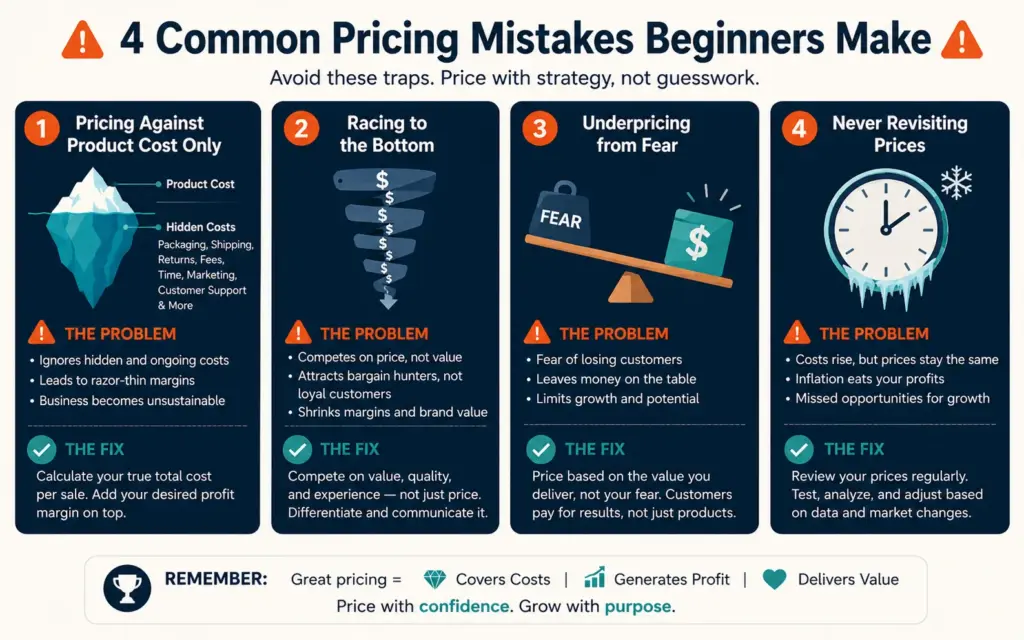
Pricing against product cost alone. The most common and costly mistake. Count all your costs (shipping, fees, packaging, returns, time), not just what you paid for the product, or you’ll price below real profitability.
Racing to the bottom on price. Competing purely on being cheapest is a losing game for most small stores. You can’t out-cheap Amazon or large competitors, and low prices attract low-loyalty, deal-hunting customers. Compete on value, brand, or experience instead. The domain and branding that differentiates you lets you charge more than the cheapest option.
Underpricing out of fear. Beginners often set prices too low, afraid nobody will pay more. This trains customers to expect low prices, erodes margin, and makes the business unsustainable. Price for the value you deliver and test whether customers accept it, rather than assuming they won’t.
Never revisiting prices. Costs change, value perception changes, and competitors move. Review your prices periodically against your costs and market rather than setting them once and forgetting. The ecommerce KPIs to watch include margin per product and conversion rate at your current prices, so you can spot when a price adjustment is warranted.
A Simple Pricing Process for Your First Products
- Calculate your true cost per sale (product, shipping, fees, packaging, returns allowance, time).
- Set a cost-plus floor at your target minimum margin so you never price below profitability.
- Research what customers pay for comparable products and what value your product delivers, to see if value-based pricing supports a higher price.
- Apply psychological pricing (charm pricing, anchoring within a tier structure) to the price you’ve landed on.
- Test and adjust. Watch conversion and margin, and refine. Pricing isn’t set once; it’s refined as you learn.
This process gives you a price grounded in real costs, informed by customer value, and presented in a way that sells, which is exactly what beginner pricing should achieve. The first store checklist places pricing early because every other decision (marketing budget, profitability, sustainability) depends on getting it right.
Frequently Asked Questions
Start by calculating your true cost per sale: product cost plus shipping, payment processing (about 2.9% + $0.30), packaging, platform fees, a returns allowance, and your time. Set a cost-plus floor by adding your target margin to that total, so you never price below profitability. Then research what customers pay for comparable products and what value yours delivers, to see if you can price higher. Apply psychological pricing (charm pricing, anchoring), then test and adjust based on conversion and margin.
Cost-plus pricing adds a target margin to your total cost (cost $15, want 50% margin, price $30). It’s simple and safe but ignores what customers will pay. Value-based pricing sets the price on the value the product delivers to the customer, which can be far above cost. A $15-cost product solving an expensive problem might sell for $50. Cost-plus is a safe starting floor; value-based is potentially more profitable but requires understanding your customer. Beginners often start cost-plus and evolve toward value-based.
All of them, not just product cost. Include: product cost (supplier or manufacturing), shipping you absorb, payment processing (about 2.9% + $0.30 per order), packaging, your share of platform and app fees spread across orders, a returns allowance (15 to 25% in some categories), and your time. Adding these gives your true cost per sale, which is the floor below which any price loses money. Pricing against product cost alone is the most common beginner mistake and the fastest route to unprofitable sales.
Yes, it’s one of the most consistently documented pricing effects. Prices ending in .99 or .95 perceive as meaningfully lower than the round number just above, because of the left-digit effect: we anchor on the first digit, so $19.99 feels closer to $19 than to $20 despite being a cent away. It’s widely used across retail because it reliably improves conversion. It works alongside sound cost and value math, not as a replacement for it. Test it on your products to confirm the effect for your audience.
Generally no. Competing purely on being the cheapest is a losing game for most small stores: you can’t out-cheap Amazon or large competitors, and rock-bottom prices attract low-loyalty, deal-hunting customers while eroding your margin. Instead, compete on value, brand, experience, or service, which lets you charge more than the cheapest option. Strong branding and a clear value proposition let customers justify paying your price rather than defaulting to whoever is cheapest. Price for the value you deliver, not to win a race to the bottom.
Periodically, since costs, customer value perception, and competitors all change over time. Review your prices against your current costs and market rates at least quarterly, and whenever your costs change significantly (supplier price increases, shipping cost changes) or you notice conversion or margin shifting. Setting prices once and never revisiting them means you slowly drift out of profitability as costs rise or miss opportunities to capture more value as your brand strengthens. Watch margin per product and conversion rate to know when adjustment is warranted.
Related Reads
- Ecommerce Pricing Strategy
- Niche Validation
- First Store Checklist
- AOV Optimization
- Bundling Strategies
- Ecommerce Profit Margins
Enjoying this? Get more like it every week.
One email per week with ecommerce strategies, tool picks, and seller insights. No spam.