
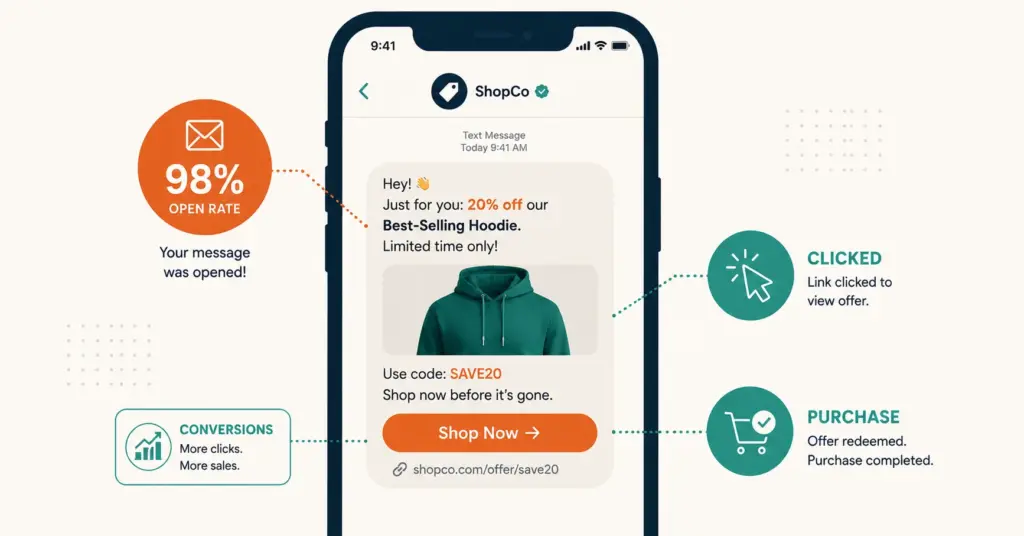
- SMS marketing for ecommerce delivers promotional and transactional text messages directly to customers' phones. With 98% open rates (versus 20 to 25% for email) and 36% click-through rates, SMS is the highest-engagement marketing channel available. Most ecommerce brands generate 15 to 25% of their email revenue from SMS within 6 months of launch.
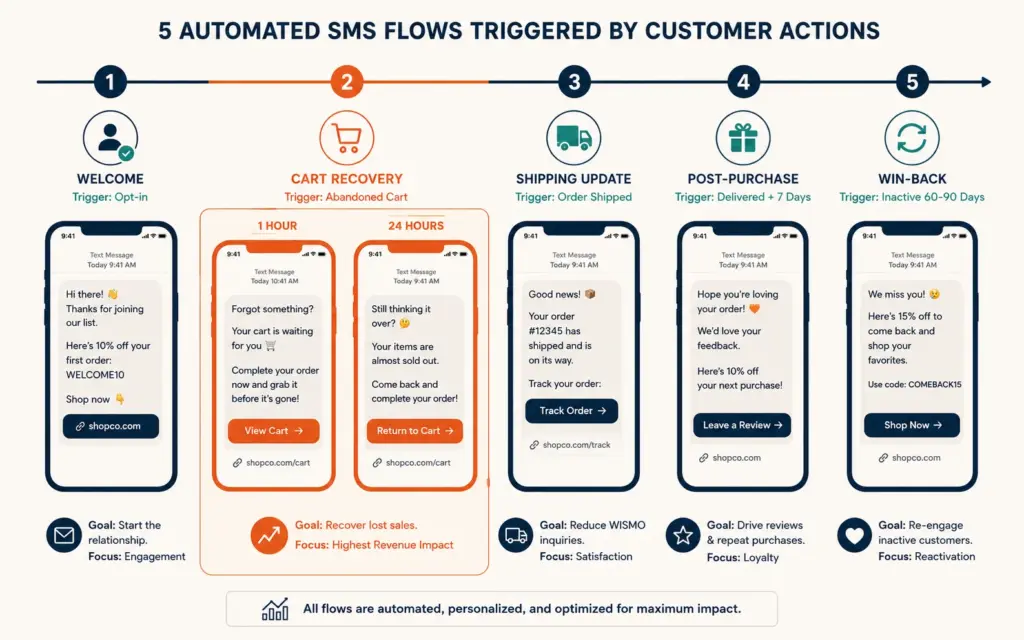
- The 5 essential SMS automations: welcome series (immediate opt-in discount), abandoned cart recovery (1 hour + 24 hour texts), shipping notifications (real-time tracking), post-purchase follow-up (review request + cross-sell), and win-back (re-engage lapsed customers at 60 to 90 days).
- TCPA compliance is non-negotiable. Sending texts without explicit opt-in consent carries penalties of $500 to $1,500 per unsolicited message. Every SMS must include an opt-out mechanism ("Reply STOP to unsubscribe"). Violating compliance can cost more than the entire SMS program generates.
- SMS and email are complementary, not competing. Email handles long-form content, storytelling, and product education. SMS handles urgency, time-sensitive offers, and transactional updates. Running both generates 20 to 30% more revenue than either channel alone.
This SMS marketing guide covers everything ecommerce stores need to launch and scale text message marketing as a direct revenue channel. SMS delivers messages directly to the device people check 96 times per day, with 98% open rates compared to email’s 20 to 25%. The engagement difference translates directly to revenue: according to Klaviyo’s SMS marketing research, ecommerce brands using SMS alongside email generate 15 to 25% incremental revenue from the text channel within 6 months of launch, with top performers reaching 30%+ of email-equivalent revenue.
The barrier to SMS adoption isn’t technology (most email platforms now include SMS). It’s compliance knowledge and strategy design. TCPA regulations impose severe penalties for unsolicited texts, and customers who feel spammed will opt out permanently. The brands that succeed with SMS treat it as a high-value, low-frequency channel: fewer than 6 to 8 messages per month, each delivering genuine value (exclusive offers, shipping updates, restock alerts) rather than generic promotions. For email strategy that pairs with SMS, see our email marketing strategy guide.
How Does SMS Marketing Work for Ecommerce?
SMS marketing operates through two message types:
Automated flows (triggered by customer actions)
| Flow | Trigger | Timing | Typical Revenue Contribution |
|---|---|---|---|
| Welcome series | SMS opt-in | Immediately + 24 hours | 15 to 20% of SMS revenue |
| Abandoned cart | Cart created, no purchase | 1 hour + 24 hours | 25 to 35% of SMS revenue |
| Shipping notification | Order shipped | Immediately | Low direct revenue, high satisfaction |
| Post-purchase | Delivery confirmed | 3 to 7 days after delivery | 10 to 15% of SMS revenue |
| Win-back | No purchase in 60 to 90 days | 60, 75, 90 days | 5 to 10% of SMS revenue |
Automated flows generate 60 to 70% of total SMS revenue because they’re triggered by high-intent customer actions (opting in, abandoning a cart, receiving a delivery). Set up flows before sending any campaigns. For cart recovery depth, see our cart abandonment solutions guide.
Campaigns (sent to your full SMS list on a schedule)
Promotional messages sent to segments of your SMS list: flash sales, new product launches, restock alerts, holiday promotions. Campaigns generate 30 to 40% of SMS revenue. Limit to 4 to 6 campaigns per month maximum. Higher frequency drives opt-outs that permanently shrink your list.
What Are the TCPA Compliance Rules for SMS?
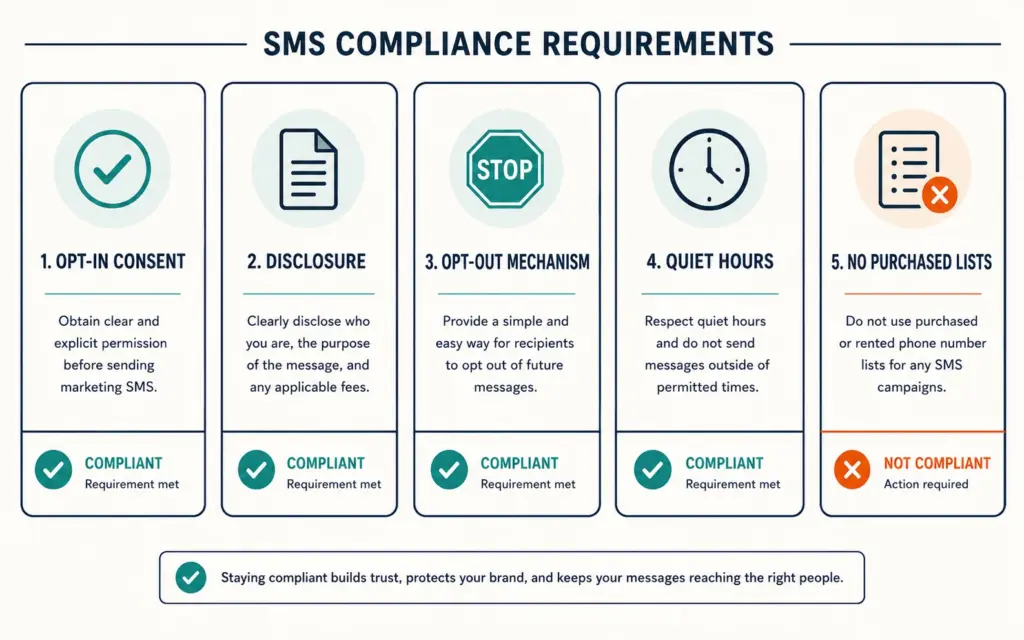
The Telephone Consumer Protection Act (TCPA) and state-level regulations govern commercial text messages. Non-compliance carries penalties of $500 to $1,500 per unsolicited message. A single blast to 5,000 subscribers without proper consent could result in $2.5M to $7.5M in liability.
The compliance checklist
- Explicit opt-in required: Customers must actively consent to receive texts. Pre-checked boxes don’t qualify. Double opt-in (text keyword to confirm) is the safest approach.
- Clear disclosure at opt-in: Tell subscribers what they’ll receive, how often, and that message and data rates may apply. Include a link to your SMS terms and privacy policy.
- Every message includes opt-out: “Reply STOP to unsubscribe” must appear in every text. Process opt-outs immediately (within 10 seconds).
- Quiet hours: Don’t send marketing texts before 8 AM or after 9 PM in the recipient’s local time zone. Most platforms enforce this automatically.
- No purchased lists: Never buy SMS subscriber lists. Every subscriber must have opted in directly through your own collection points.
All major SMS platforms (Klaviyo, Postscript, Attentive) handle compliance infrastructure automatically, but you’re legally responsible for the consent collection process. According to FCC consumer protection guidelines, commercial texters bear the burden of proving prior express written consent for each recipient.
How Do I Build an SMS Subscriber List?
The 6 list-building tactics
- Checkout opt-in checkbox: Add an SMS consent checkbox during checkout. “Text me order updates and exclusive offers.” Conversion rate: 15 to 25% of checkout completions when the value proposition is clear. For checkout optimization, see our checkout optimization guide.
- Pop-up with SMS-specific incentive: “Get 15% off your first order. Enter your phone number.” SMS-specific pop-ups convert 3 to 8% of visitors. Use exit-intent or time-delayed triggers. The incentive must be SMS-exclusive (not available through email) to justify sharing a phone number.
- Keyword opt-in: “Text JOIN to 55555 for 10% off.” Print on packaging inserts, social media bios, and email footers. Converts 2 to 5% of people who see it, with high intent because they actively text to subscribe.
- Post-purchase email: “Want faster updates? Add your number for shipping texts and exclusive SMS-only deals.” Sent 24 hours after first purchase. Converts 8 to 15% of email subscribers to SMS because they’ve already bought and trust you.
- Social media stories: “Swipe up to join our text list for early access to drops and flash sales.” Works for brands with engaged Instagram or TikTok followings. For social strategy, see our TikTok marketing guide.
- In-store or event collection: QR code displayed at physical events, pop-ups, or retail locations. “Scan to get 20% off + join our text list.” Converts physical-world interactions into digital subscribers.
List growth expectations
Most ecommerce stores build an SMS list that’s 15 to 30% the size of their email list within 12 months. A store with 10,000 email subscribers should target 1,500 to 3,000 SMS subscribers by month 12. SMS lists are smaller but dramatically more engaged (98% open vs 20 to 25%).
What Are the 5 Essential SMS Automations?
1. Welcome series
Trigger: SMS opt-in. Message 1 (immediately): Deliver the opt-in incentive with a direct link. “Welcome! Here’s your 15% off: [link]. Use code SMS15 at checkout.” Message 2 (24 hours later): Introduce best sellers or the brand story with a product link. Keep to 2 messages maximum in the welcome series.
2. Abandoned cart recovery
Trigger: Cart created, no purchase within 1 hour. Message 1 (1 hour): “Still thinking it over? Your [product name] is waiting: [cart link].” Message 2 (24 hours): “Your cart expires soon. Complete your order and get free shipping: [cart link].” SMS cart recovery converts 10 to 20% of abandoners, complementing email recovery (which converts 5 to 10%). Running both SMS and email recovery together captures 15 to 25% of abandoned carts.
3. Shipping notifications
Trigger: Order shipped. “Your order is on the way! Track it here: [tracking link].” Shipping texts are the most appreciated SMS messages because they deliver immediate utility. They also reduce “where is my order” support tickets 30 to 50%. For shipping strategy, see our shipping strategies guide.
4. Post-purchase follow-up
Trigger: 5 to 7 days after delivery. “How’s your [product]? We’d love a quick review: [review link].” Optional follow-up 14 days later with a cross-sell: “Customers who bought [A] also love [B]. Shop now: [link].” For cross-sell strategy, see our upsell and cross-sell guide.
5. Win-back
Trigger: No purchase in 60 to 90 days. “We miss you! Here’s 20% off your next order: [link]. Expires in 48 hours.” Win-back texts recover 3 to 8% of lapsed customers. The urgency of a 48-hour expiration drives immediate action. For retention depth, see our customer retention guide.
How Do I Choose an SMS Marketing Platform?
| Platform | Best For | SMS Cost | Key Strength |
|---|---|---|---|
| Klaviyo SMS | Stores already using Klaviyo email | $0.007 to $0.015/SMS | Unified email + SMS in one platform |
| Postscript | Shopify-native SMS specialists | $0.007 to $0.015/SMS | Deep Shopify integration, strong automations |
| Attentive | High-volume brands ($50k+ monthly) | Custom pricing | Advanced segmentation, dedicated support |
| Omnisend | Budget all-in-one email + SMS | $0.015/SMS | Affordable combined platform |
If you already use Klaviyo for email, add Klaviyo SMS (same platform, unified data, no additional integration). If you want a dedicated SMS specialist on Shopify, use Postscript. For tech stack context, see our ecommerce tech stack guide.
How Do I Measure SMS Marketing ROI?
The 5 SMS metrics
- Revenue per message: Total SMS-attributed revenue / total messages sent. Benchmark: $0.10 to $0.50 per message for campaigns, $1 to $5 per message for flows.
- Click-through rate: Clicks / messages delivered. Benchmark: 15 to 36%. Below 10% signals poor offer relevance or list fatigue.
- Opt-out rate per campaign: Unsubscribes / messages sent. Benchmark: below 2% per campaign. Above 3% signals over-sending or irrelevant content.
- List growth rate: New subscribers / total list size per month. Target 5 to 15% monthly growth through the collection tactics above.
- Cost per conversion: Total SMS platform cost / SMS-attributed conversions. Compare against email cost per conversion and paid ad CPA. For CAC context, see our customer acquisition cost guide.
Common SMS Marketing Mistakes
Sending too many messages
More than 6 to 8 texts per month drives opt-outs. Each opt-out permanently removes a subscriber you paid to acquire. A 5% monthly opt-out rate from over-messaging depletes 46% of your list in one year. Quality over quantity: fewer, more targeted messages with higher value per text.
Treating SMS like email
SMS messages are 160 characters. Email newsletters are 500+ words. Trying to fit email content into a text creates truncated, confusing messages. SMS should be concise, urgent, and action-oriented: one offer, one link, one CTA. Save storytelling and education for email.
Sending without segmentation
Blasting the same message to your entire list wastes money and drives opt-outs from irrelevant offers. Segment by: purchase history (send restock reminders to past buyers), engagement (send re-engagement to inactive subscribers), and lifecycle stage (different offers for first-time vs repeat customers). For measurement depth, see our ecommerce KPIs guide.
Skipping compliance setup
Sending texts without proper opt-in consent, missing opt-out language, or texting during quiet hours creates legal liability that can exceed total program revenue. Set up compliance infrastructure before sending a single text. Use a compliant platform (Klaviyo, Postscript, Attentive) that enforces rules automatically.
Frequently Asked Questions
Yes. SMS delivers 98% open rates and 15 to 36% click-through rates, generating 15 to 25% of email-equivalent revenue for most ecommerce brands within 6 months. The ROI is high because per-message costs ($0.007 to $0.015) are low relative to conversion rates. SMS is particularly effective for abandoned cart recovery (10 to 20% conversion), flash sales, and restock alerts where urgency drives immediate action.
Limit campaigns to 4 to 6 per month (1 to 2 per week maximum). Automated flows (welcome, cart abandonment, shipping, post-purchase) send as triggered and don’t count toward this limit. Total messages including flows typically reaches 6 to 10 per subscriber per month. Above 8 to 10 messages monthly, opt-out rates increase significantly. Each opt-out permanently removes a subscriber you paid to acquire.
Per-message costs run $0.007 to $0.015 for domestic US texts depending on platform and volume. Platform fees range from $0 (Klaviyo includes SMS in higher plans) to $100+/month for dedicated SMS platforms. A 5,000-subscriber list sending 6 messages per month costs approximately $210 to $450 in message fees. Most brands achieve 10 to 25x ROI on SMS spend within 6 months of launch.
Yes. They’re complementary, not competing. Email handles long-form content, product education, and storytelling. SMS handles urgency, time-sensitive offers, and transactional updates. Running both generates 20 to 30% more revenue than either channel alone. The overlap in subscribers (15 to 30% of email subscribers also opt into SMS) means messages reinforce each other without redundancy when timed properly.
TCPA (Telephone Consumer Protection Act) requires explicit opt-in consent before sending commercial texts, clear disclosure of what subscribers will receive, opt-out mechanism in every message (“Reply STOP”), and quiet hours (no texts before 8 AM or after 9 PM local time). Penalties for non-compliance are $500 to $1,500 per unsolicited message. All major SMS platforms handle compliance infrastructure, but you’re legally responsible for the consent collection process.
If you use Klaviyo for email, add Klaviyo SMS for unified data and flows in one platform. If you want a dedicated SMS specialist, Postscript offers the deepest Shopify integration with strong automation and segmentation. Attentive is the premium choice for high-volume brands ($50k+ monthly revenue). Omnisend is the budget option combining email and SMS. Choose based on existing email platform and monthly message volume.
Related Reads
- Email Marketing Strategy
- Customer Retention Guide
- Cart Abandonment Solutions
- Upsell and Cross-Sell Guide
- Ecommerce Tech Stack
- Customer Acquisition Cost
Enjoying this? Get more like it every week.
One email per week with ecommerce strategies, tool picks, and seller insights. No spam.