
- Reviews and social proof are the trust signals that bridge the gap between online product discovery and purchase confidence. 93% of consumers read reviews before buying online, and products with 50+ reviews convert 4.6% higher than those with zero reviews. Social proof reduces perceived risk for buyers who can't touch, try, or test your product before paying.
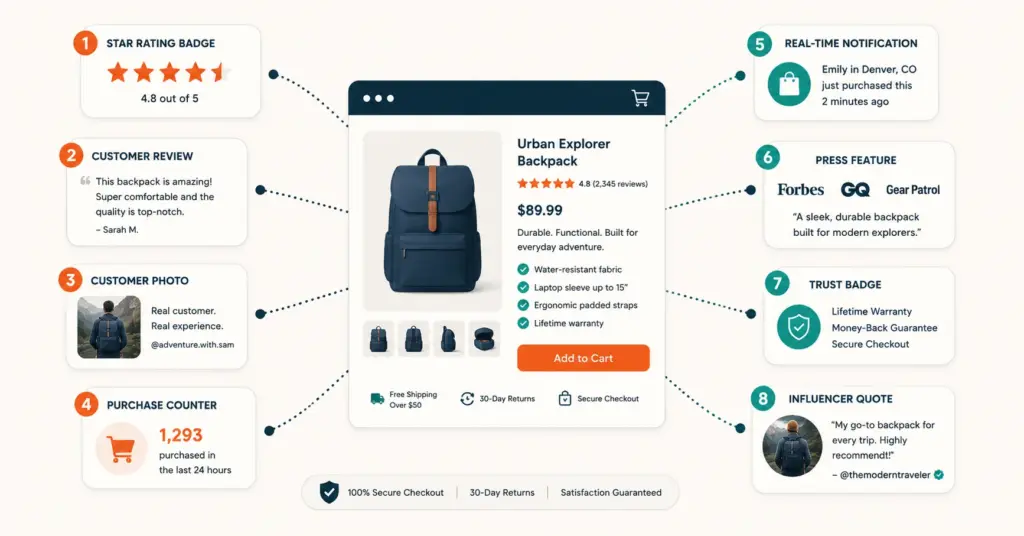
- The 8 types of ecommerce social proof: customer reviews (text), review photos and videos, star ratings and aggregate scores, purchase counters ("2,500 sold"), real-time activity notifications ("12 people viewing this"), expert endorsements and press mentions, trust badges and certifications, and influencer/creator testimonials.
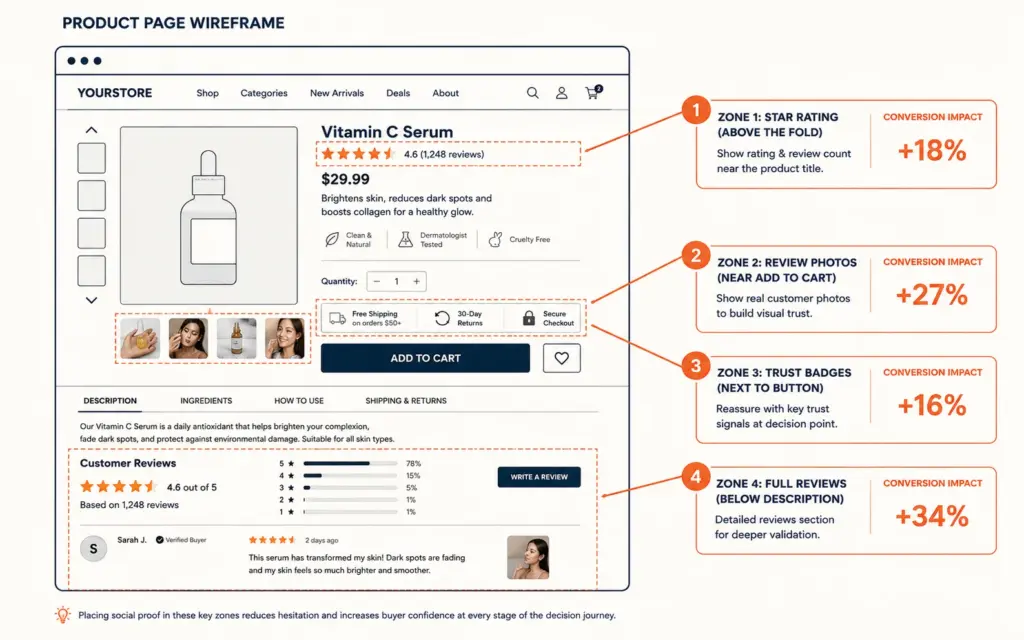
- Review placement matters as much as review content. Star ratings above the fold on product pages lift click-to-add-to-cart 8 to 12%. Review photos near the Add to Cart button lift conversion 15 to 25%. Full review sections below the product description serve comparison shoppers who scroll deep before deciding.
- The most common social proof mistake is displaying zero reviews on new products. Empty review sections signal "nobody has bought this," which is the opposite of social proof. Use founder testimonials, beta tester quotes, or influencer endorsements as placeholder proof until customer reviews accumulate.
Reviews social proof signals are the trust elements that convert hesitant online browsers into confident buyers. Unlike physical retail where shoppers can touch products, read packaging, and ask store employees questions, ecommerce requires buyers to trust a screen. Reviews, ratings, photos, testimonials, and social signals replace the physical trust-building that happens in stores. According to PowerReviews’ consumer research, 93% of consumers read reviews before purchasing online, and products with 50+ reviews convert 4.6% higher than products with no reviews. The absence of social proof is itself a negative signal: “If nobody else bought this, why should I?”
Social proof works because of a psychological principle called informational social influence: when people are uncertain about a decision, they look to others’ behavior for guidance. A product page with 500 reviews, customer photos, and a 4.7-star rating communicates “many people bought this and most were satisfied.” That message does more persuasion work than any product description or marketing claim. For the product page context where social proof lives, see our product page design guide.
What Are the 8 Types of Ecommerce Social Proof?
1. Customer text reviews
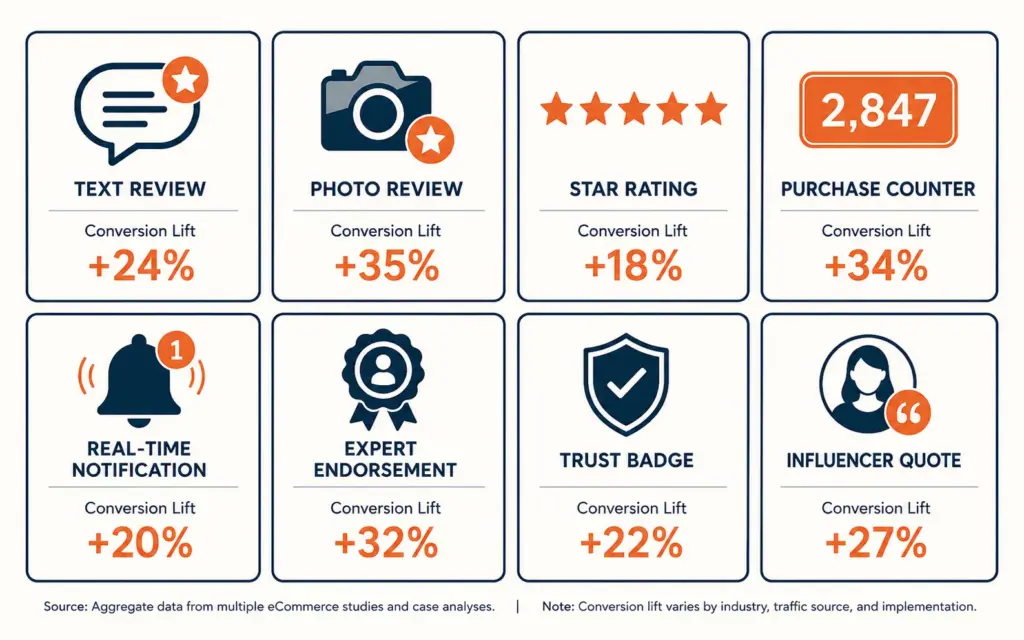
Written reviews from verified purchasers. The foundation of ecommerce social proof. Detailed reviews that describe the purchase experience, product quality, and specific use cases provide the most conversion value. Reviews addressing common purchase objections (“I was worried it would be too small, but it fits perfectly”) are worth 5x more than “Great product!” reviews.
2. Review photos and videos
Customer-submitted visual content showing the product in real settings. Review photos convert 15 to 25% better than text-only reviews because they provide visual confirmation that the product matches expectations. Review videos (unboxing, product-in-use) are even more persuasive. Encourage photo and video submissions through your review request flow. For UGC collection tactics, see our UGC strategy guide.
3. Star ratings and aggregate scores
The 4.7-star badge next to the product title. This is the most scanned piece of social proof on any product page. Products rated 4.2 to 4.7 stars convert best (perceived as genuine). Perfect 5.0 ratings can actually reduce trust because they seem too good to be true. Display star rating and review count above the fold on every product page.
4. Purchase counters
“2,500+ sold” or “Ordered 47 times this week.” Purchase volume signals popularity and reduces perceived risk. If thousands of people bought this product, it’s probably safe to buy. Display on product pages, especially for newer products building their review base.
5. Real-time activity notifications
“Sarah from Austin just purchased this” or “12 people are viewing this right now.” Real-time social proof creates urgency and validates active demand. Use sparingly (1 notification per page view, not a constant stream) to avoid feeling manipulative. Tools: Fomo, ProveSource, or Nudgify. Limit to high-traffic products where the activity is genuine.
6. Expert endorsements and press mentions
“As featured in [Publication]” or “[Expert name] recommends this product.” Third-party authority signals trust beyond peer validation. Display press logos, certification badges, and expert quotes prominently on product pages and the homepage. Even one recognizable press mention lifts conversion 5 to 10%.
7. Trust badges and certifications
SSL badges, payment security icons (Visa, Mastercard, PayPal logos), satisfaction guarantees, and industry certifications (organic, cruelty-free, FDA-registered). These reduce transaction anxiety at the payment step. Place near the Add to Cart button and again at checkout. For checkout trust optimization, see our checkout optimization guide.
8. Influencer and creator testimonials
Content from recognized creators in your niche endorsing your product. Influencer testimonials carry authority weight between peer reviews and expert endorsements. Display as embedded social posts, quote blocks, or video testimonials on product pages. For influencer strategy, see our influencer marketing guide.
How Do I Collect More Product Reviews?
Automated review request flows
The most effective review collection uses automated post-purchase emails timed to product experience:
- Email 1 (7 days after delivery): “How’s your [product name]? Leave a quick review.” Simple star-rating click that opens the full review form. Timing: enough time to use the product, not so long they forget the experience.
- Email 2 (14 days, non-responders only): “Your opinion matters. Share your experience with [product].” Include an incentive: 10% off next order or loyalty points for photo/video reviews.
- SMS request (10 days, if opted in): “Quick favor: rate your [product] with one tap: [link].” SMS review requests convert 2 to 3x higher than email because of 98% open rates. For SMS strategy, see our SMS marketing guide.
Review collection benchmarks
| Method | Response Rate | Photo/Video Rate |
|---|---|---|
| Email request (no incentive) | 3 to 8% | 5 to 10% of reviews |
| Email request (with incentive) | 8 to 15% | 15 to 25% of reviews |
| SMS request | 10 to 20% | 10 to 15% of reviews |
| In-package insert card | 2 to 5% | 5 to 10% of reviews |
Review collection tools
| Tool | Best For | Cost |
|---|---|---|
| Judge.me | Shopify, best value, photo reviews | Free to $15/month |
| Loox | Photo-focused reviews, visual display | $9.99/month |
| Stamped.io | Reviews + loyalty + NPS combined | $23/month |
| Yotpo | Enterprise, multi-channel reviews | Free to $79/month |
For platform plugin context, see our best WooCommerce plugins guide (WooCommerce equivalents) and our ecommerce tech stack guide.
Where Should I Display Social Proof for Maximum Impact?
Product page placement
- Star rating + review count: Above the fold, next to the product title. This is the first trust signal visitors scan. Products with visible star ratings get 12% higher click-to-add-to-cart rates.
- Review photos: Near the Add to Cart button. Visual social proof at the decision point reduces last-second hesitation. A gallery of 5 to 8 customer photos showing the product in real settings.
- Full review section: Below product description. Detailed reviews serve comparison shoppers who scroll deep before deciding. Sort by “most helpful” as default, with filter options for star rating and photo-only reviews.
- Trust badges: Next to Add to Cart and at checkout. Payment security icons and guarantee badges reduce transaction anxiety at the commitment moment. For checkout optimization, see our checkout optimization guide.
Beyond product pages
- Homepage: Testimonial carousel featuring your highest-rated products or most compelling customer quotes. “Trusted by 10,000+ customers” badge in the hero section.
- Collection pages: Star ratings and review counts on product cards in grid view. This helps shoppers compare products by social proof before clicking into individual pages.
- Cart page: “Rated 4.8/5 by 500 customers” reassurance near the checkout button. For cart recovery context, see our cart abandonment solutions guide.
- Email marketing: Top review quotes in abandoned cart emails and promotional campaigns. Social proof in emails lifts click-through 15 to 25%. For email strategy, see our email marketing strategy guide.
- Paid ads: Review quotes and star ratings as ad overlays. UGC review content in video ads. For ad creative, see our ad creative tips guide.
How Do I Handle Negative Reviews?
Respond to every negative review
Public responses to negative reviews build more trust than the negative review destroys. A thoughtful response (“We’re sorry about your experience. We’ve [specific action taken] and would love to make this right. Please reach out to [contact].”) shows potential buyers that you care about customer satisfaction. According to BrightLocal’s consumer review survey, 89% of consumers read business responses to reviews, and stores that respond to negative reviews see 33% higher purchase likelihood.
Use negative reviews as product intelligence
Recurring complaints reveal real product issues faster than any internal QA process. If 15% of reviews mention sizing runs small, update the size guide. If 10% mention a quality issue, fix the manufacturing. Negative reviews are free product feedback at scale. For product improvement context, see our product descriptions guide (address common concerns in descriptions proactively).
Never delete or fake reviews
Deleting negative reviews destroys trust if discovered and violates FTC guidelines. Fake positive reviews violate platform terms of service and FTC regulations, carrying penalties of $50,000+ per violation. The 4.2 to 4.7 star range with a mix of positive and critical reviews actually converts better than perfect 5.0 because it feels authentic.
How Do I Build Social Proof for New Products?
The zero-review problem
New products with zero reviews face a cold-start problem: nobody wants to be the first buyer of an unreviewed product. Solutions:
- Founder or team testimonial: “Our team tested 47 prototypes to get this right. Here’s why we’re proud of the result.”
- Beta tester quotes: Send products to 10 to 20 people before launch. Use their quotes as initial social proof. Clearly label as “Early tester feedback.”
- Cross-product credibility: “From the makers of [popular product with 500+ reviews].” Transfer trust from established products.
- Influencer launch reviews: Coordinate 3 to 5 influencer reviews to publish on launch day. For influencer coordination, see our influencer marketing guide.
- First-buyer incentive: “Be one of our first 50 reviewers and receive a $10 store credit.” Accelerates review velocity. For discount approach, see our discount strategy guide.
For pre-launch social proof building, see our pre-launch marketing guide.
How Do I Measure Social Proof Impact?
The 4 social proof metrics
- Review coverage: Percentage of products with 5+ reviews. Target 80%+ of active products. Products without reviews underperform by 15 to 30% on conversion.
- Average rating: Overall star rating across all products. Target 4.2 to 4.7. Below 4.0 signals product quality issues requiring investigation.
- Conversion rate by review count: Compare conversion on products with 0, 1 to 10, 11 to 50, and 50+ reviews. The conversion lift quantifies the ROI of review collection efforts. For A/B testing review display changes, see our A/B testing guide.
- Review velocity: New reviews collected per week. Rising velocity indicates healthy collection flows. Declining velocity means request timing, incentives, or delivery experience need attention. For analytics framework, see our ecommerce KPIs guide.
Frequently Asked Questions
The conversion impact starts at 1 review (any review is better than none) and compounds up to approximately 50 reviews, after which additional reviews provide diminishing returns. Products with 10+ reviews convert significantly better than those with 0 to 5. Products with 50+ reviews hit the maximum social proof effect, converting 4.6% higher than zero-review products. Target 10 reviews per product within 60 days of launch as the minimum viable social proof threshold.
Judge.me offers the best value: free tier covers basic reviews with email requests, and the $15/month plan adds photo reviews, Q&A, and review carousels. Loox ($9.99/month) specializes in visual reviews with photo-first display. Stamped.io ($23/month) combines reviews with loyalty points and NPS surveys. Yotpo is the enterprise choice for multi-channel review syndication. Start with Judge.me free, upgrade when photo reviews and advanced display become priorities.
Three placement zones: star rating and review count above the fold next to the product title (first trust signal visitors scan), customer photo gallery near the Add to Cart button (visual proof at the decision point), and the full review section below the product description (for comparison shoppers who scroll deep). Additionally, display trust badges (payment security, guarantees) next to the Add to Cart button and at checkout.
Automated post-purchase email at 7 days after delivery (3 to 8% response without incentive, 8 to 15% with incentive). SMS review request at 10 days for opted-in subscribers (10 to 20% response). In-package insert card with QR code (2 to 5%). Offer 10% off next order or loyalty points for photo and video reviews. The combination of email, SMS, and package insert captures reviews from 15 to 25% of customers.
Yes, respond to every negative review publicly. A thoughtful response showing you take the concern seriously and have taken specific action builds more trust than the negative review destroys. 89% of consumers read business responses to reviews. Stores that respond to negatives see 33% higher purchase likelihood. Never delete genuine negative reviews or post fake positive reviews; both destroy trust and violate FTC guidelines.
Products rated 4.2 to 4.7 stars convert best. This range signals “very good” while remaining believable. Perfect 5.0 ratings can reduce trust because they appear too good to be true or suggest filtered reviews. Below 4.0 signals quality concerns that hurt conversion. If your average rating drops below 4.0, investigate product quality, shipping damage, or expectation-setting issues in your product descriptions before investing more in review collection.
Related Reads
- Product Page Design Guide
- Product Descriptions Guide
- Checkout Optimization
- UGC Strategy Guide
- Influencer Marketing Guide
- Email Marketing Strategy
Enjoying this? Get more like it every week.
One email per week with ecommerce strategies, tool picks, and seller insights. No spam.