
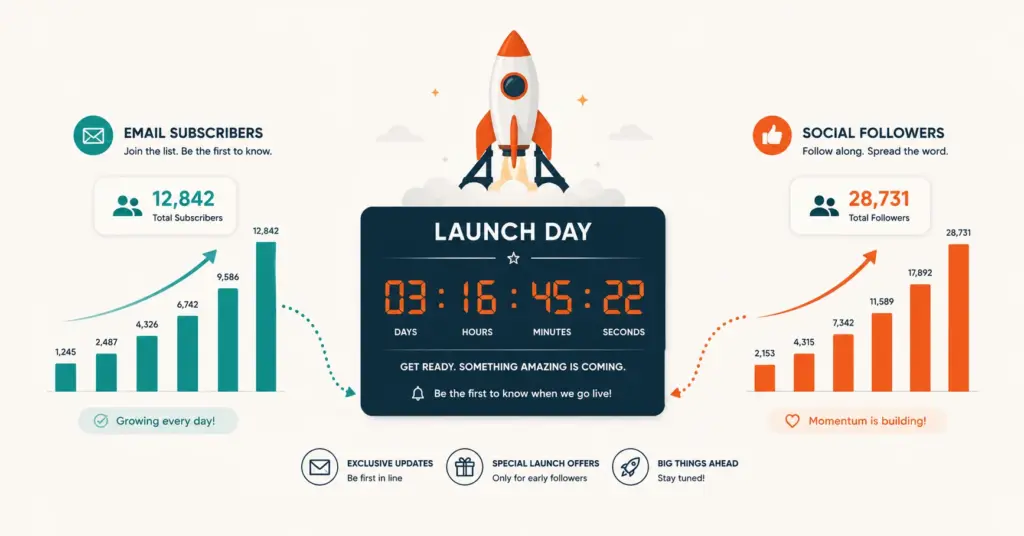
- Pre-launch marketing builds demand, an email list, and social following before your store opens so launch day generates immediate sales instead of silence. Stores that pre-launch for 60 to 90 days generate 3 to 10x more first-week revenue than stores that launch without advance marketing.
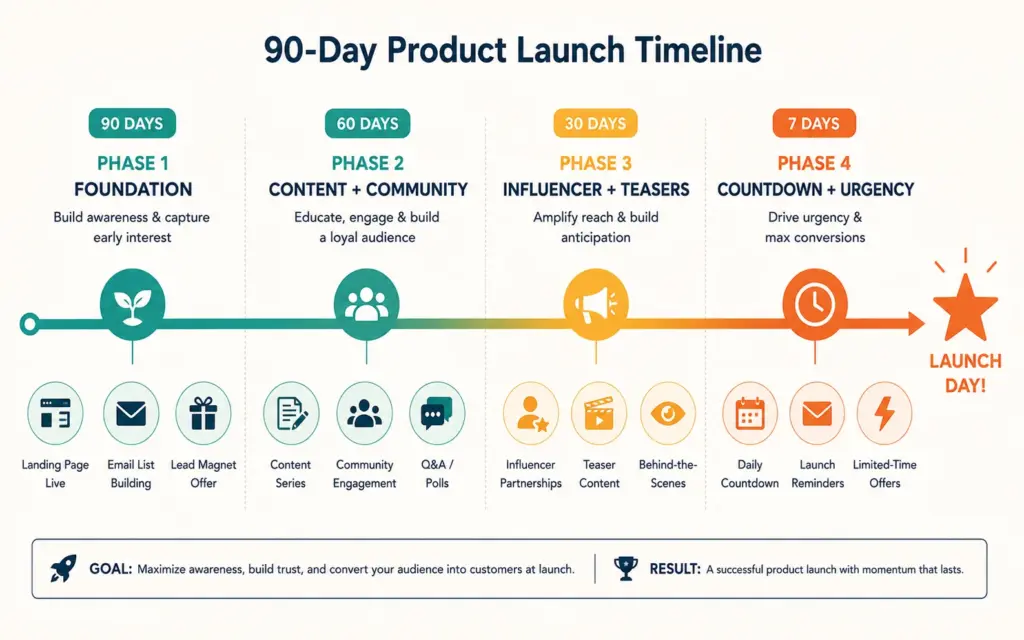
- The pre-launch timeline: 90 days out (landing page + email collection), 60 days (social content + community building), 30 days (influencer seeding + early access teasers), 7 days (countdown + urgency), launch day (email blast + ads + social push).
- The minimum pre-launch stack: a landing page with email capture (ConvertKit, Shopify password page, or Carrd), a social media presence on 1 to 2 platforms, and 500+ email subscribers before opening. Every subscriber is a potential day-one customer.
- The most common pre-launch mistake is building in silence for 6 months then expecting sales on day one. Building the product and building the audience should happen simultaneously, not sequentially.
Pre-launch marketing for ecommerce is the strategic process of building an audience, generating demand, and collecting email subscribers before your store opens for business. The goal is simple: when you flip the switch on launch day, there are people already waiting to buy. According to Shopify’s launch marketing research, ecommerce brands that run structured pre-launch campaigns for 60 to 90 days generate 3 to 10x more first-week revenue than brands that launch without advance marketing. The difference between a successful launch and a quiet one is almost always the pre-launch work, not the product quality.
Most first-time ecommerce founders spend months perfecting their product, building their website, and setting up operations, then flip the store live and wonder why nobody shows up. The product was ready, but the audience wasn’t. Pre-launch marketing solves this by running audience development in parallel with store development so both are ready simultaneously. For the complete store setup that runs alongside pre-launch marketing, see our starting an ecommerce business guide.
What Is the Pre-Launch Marketing Timeline?
90 days before launch: Foundation
- Create your landing page. A simple page with your brand name, one-sentence value proposition, product teaser image, and email capture form. “Be the first to know when we launch. Get 15% off your first order.” Tools: Shopify password page (free with store), Carrd ($19/year), or ConvertKit landing page (free tier).
- Set up email collection. Every marketing activity from this point forward drives people to the email capture form. Email subscribers are your launch-day revenue source. Target 500+ subscribers before opening. For email platform selection, see our ecommerce tech stack guide.
- Claim social accounts. Register your brand name on Instagram, TikTok, and 1 to 2 other relevant platforms. Post your first piece of content: the brand story, the problem you’re solving, or a behind-the-scenes look at product development.
60 days before launch: Content and community
- Post 3 to 5 times per week on social. Behind-the-scenes content (product development, packaging design, founder story), educational content about your niche, and teaser reveals of the product. Don’t show everything; build anticipation. For content strategy, see our content marketing guide.
- Engage in niche communities. Reddit communities, Facebook groups, and forums where your target customers gather. Provide genuine value (answer questions, share expertise) without hard selling. Build recognition as a knowledgeable member before revealing you have a product launching.
- Start collecting UGC from beta testers. Send product samples to 10 to 20 friends, family, or early supporters. Ask for honest feedback, photos, and short video testimonials. This content becomes your launch-day social proof. For UGC approach, see our UGC strategy guide.
30 days before launch: Amplification
- Seed 10 to 20 micro-influencers. Gift your product to creators in your niche (1,000 to 50,000 followers). No payment required for most micro-influencers; the free product is sufficient. 30 to 50% will post organically. Their content provides third-party validation that your own marketing cannot. For influencer tactics, see our influencer marketing guide.
- Send weekly email updates to your list. Product sneak peeks, founder updates, and “launch is coming” teasers. Build a relationship with subscribers before asking them to buy. The pre-launch email sequence educates and excites so launch-day conversions feel like a natural next step.
- Prepare launch-day assets. Email blast (segmented: early subscribers get VIP early access), social media posts for launch day, ad creative if running paid on launch, and press kit or media outreach if targeting publications.
7 days before launch: Urgency
- Countdown on social and email. “7 days to launch” through “1 day to launch” daily posts. Each day reveals one product feature, one testimonial, or one FAQ answer. Countdown stickers on Instagram Stories create visual urgency.
- VIP early access email. Send your earliest subscribers a 24 to 48 hour head start: “Because you’ve been here from the beginning, you get to shop first.” This rewards loyalty and creates urgency for remaining subscribers (“VIPs are already buying”). For email strategy, see our email marketing strategy guide.
Launch day: Execution
- Email blast at 7 to 9 AM: “We’re live! Shop now + your 15% launch discount.” Include product images, direct links, and the social proof collected from beta testers and influencers.
- Social media push: 3 to 5 posts throughout the day. Product reveals, customer reactions (if early access generated purchases), and behind-the-scenes of the launch day experience.
- Paid ads (optional): If budget allows, launch Meta or TikTok ads targeting lookalike audiences of your email subscribers. Start with $50 to $100/day. For ad setup, see our Facebook ads ecommerce guide.
How Do I Build a Pre-Launch Email List?
The 5 list-building tactics
- Landing page with incentive: “Join the waitlist for 15% off at launch.” Incentive-based signups convert 5 to 15% of visitors. The incentive (discount, free shipping, exclusive access) gives a concrete reason to hand over an email address.
- Social media to email funnel: Every social post ends with “Link in bio to join the waitlist.” Social followers become email subscribers, which you own (unlike social followers, which platforms control). Target converting 3 to 5% of social followers to email.
- Content lead magnets: Offer a free guide, checklist, or resource related to your niche. “Download our free [niche] starter guide” captures emails from people interested in your product category before they know about your specific product. For content approach, see our content marketing guide.
- Giveaway or contest: “Enter to win [your product] before anyone else can buy it.” Giveaways generate 3 to 5x the email signups of standard landing pages but attract lower-quality subscribers (some just want free stuff). Use sparingly and combine with educational content to filter for genuine interest.
- Referral program for waitlist: “Share your waitlist link. For every 3 friends who join, unlock an extra 5% off at launch.” Referral-driven list building is the most cost-effective tactic because each subscriber recruits additional subscribers at zero cost. Tools: Viral Loops, KickoffLabs, or SparkLoop.
List size targets
| Pre-Launch List Size | Expected Launch-Day Revenue (at 10% conversion) | Effort Level |
|---|---|---|
| 100 subscribers | $300 to $500 (10 orders) | Minimal, friends and family |
| 500 subscribers | $1,500 to $2,500 (50 orders) | Active social + landing page |
| 2,000 subscribers | $6,000 to $10,000 (200 orders) | Content + influencers + referral |
| 5,000+ subscribers | $15,000 to $25,000+ (500 orders) | Full pre-launch campaign |
These estimates assume 10% of subscribers purchase on launch day at $30 to $50 AOV. Actual conversion depends on product-market fit, pricing, and pre-launch relationship quality. For pricing strategy, see our ecommerce pricing strategy guide.
What Pre-Launch Content Works Best?
Content that builds anticipation
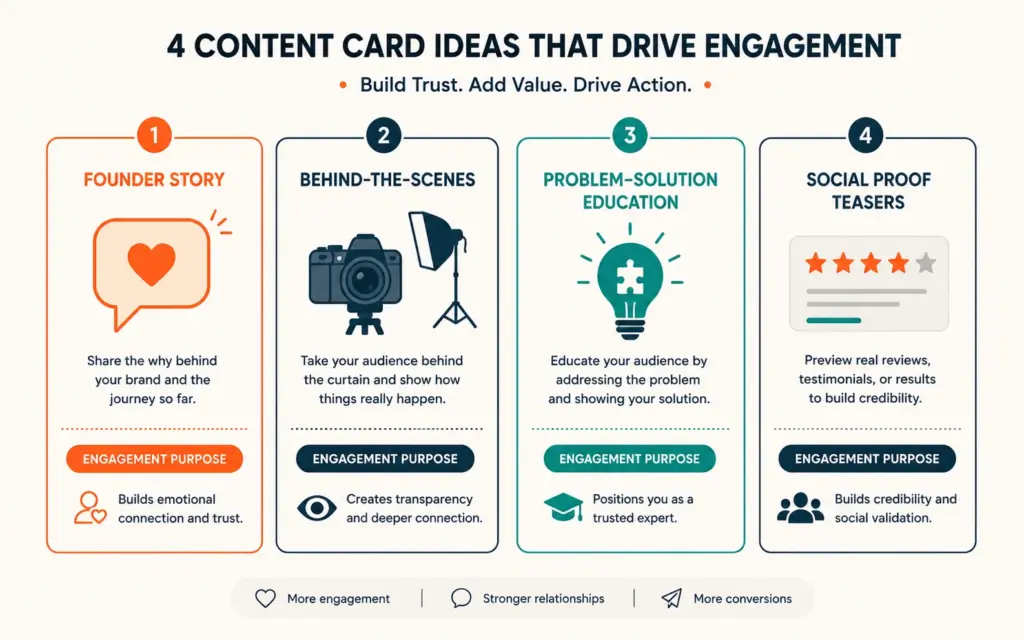
- Founder story: Why you’re building this product. Personal narrative creates emotional connection. “I couldn’t find a [product] that [benefit], so I built one.” Perform well as Instagram carousels and TikTok talking-head videos.
- Behind-the-scenes: Product development, packaging design, supplier visits, prototyping failures and successes. BTS content humanizes the brand and creates investment in the outcome. For Instagram content format, see our Instagram ecommerce guide.
- Problem-solution education: Content about the problem your product solves without directly promoting the product. A coffee brand posting about brewing technique. A skincare brand posting about ingredient science. Position yourself as an expert before you ask anyone to buy from you.
- Social proof teasers: Beta tester quotes, influencer first impressions, and “early reaction” videos. Third-party validation is more persuasive than self-promotion. For social proof depth, see our product descriptions guide.
Content that builds community
Ask questions (“What’s your biggest frustration with [category]?”), run polls, and respond to every comment. Pre-launch community building isn’t about broadcasting; it’s about conversation. People who feel heard before launch become loyal customers after launch. For TikTok-specific community tactics, see our TikTok marketing guide.
How Do I Plan the Actual Launch Day?
The launch-day checklist
- Store tested and live: Complete checkout test (real purchase), all product pages live, shipping rates correct, payment processing verified
- Email scheduled: Launch announcement scheduled for 7 to 9 AM in your primary timezone. Second email at 2 PM for non-openers. For email automation, see our email marketing strategy guide
- Social posts prepared: 3 to 5 posts scheduled throughout the day. First post at store opening, midday update, evening “last chance for launch discount”
- Ad campaigns ready: If running paid, campaigns set to launch simultaneously with the email blast. Start conservative ($50 to $100/day) and scale based on ROAS. For ROAS expectations, see our ROAS benchmarks guide
- Customer service ready: Live chat or email monitoring during launch hours. Respond to all inquiries within 1 hour. First impressions set the tone for the customer relationship
- Analytics verified: GA4 tracking, Meta Pixel, and conversion events all firing correctly. You need to measure launch performance in real-time. For tracking setup, see our tracking setup guide
How Much Should I Budget for Pre-Launch Marketing?
| Budget Tier | Total Pre-Launch Spend | Allocation |
|---|---|---|
| Bootstrap ($0 to $500) | $0 to $500 | Free tools (Canva, Shopify password page), organic social, sweat equity |
| Starter ($500 to $2,000) | $500 to $2,000 | Landing page tool ($100), product samples for 10 influencers ($500), small giveaway ($200), launch-day ads ($500) |
| Growth ($2,000 to $10,000) | $2,000 to $10,000 | Paid influencer seeding ($2,000), content creation ($1,000), launch-week ad budget ($3,000), referral tool ($500) |
The bootstrap approach works. Most successful DTC brands launched with under $1,000 in pre-launch marketing. The investment is primarily time (content creation, community engagement, email writing) rather than money. For startup budget context, see our ecommerce startup costs guide.
Common Pre-Launch Mistakes
Building in silence
The founder spends 6 months perfecting the product and website without telling anyone it exists. Launch day arrives with zero subscribers, zero social followers, and zero anticipation. The fix: start marketing the day you decide to build. Share the journey, not just the finished product. According to Neil Patel’s launch marketing analysis, brands that share their building process generate 3 to 5x more pre-launch signups than those that reveal the product only at launch.
Collecting emails without nurturing
A list of 2,000 emails collected 3 months ago but never emailed is a list of 2,000 strangers. Send weekly updates during pre-launch. Share progress, ask for input, and build the relationship. Nurtured subscribers convert 3 to 5x higher on launch day than un-nurtured lists.
Launching without a tested checkout
Nothing kills launch-day momentum faster than a broken checkout, incorrect shipping rates, or failed payment processing. Complete a full test purchase (real money, real checkout, real shipping rate calculation) 48 hours before launch. Fix issues before they cost you sales. For checkout optimization, see our checkout optimization guide.
Setting unrealistic revenue expectations
A 500-person email list won’t generate $50,000 on launch day. 10% conversion at $50 AOV produces $2,500. Set realistic expectations based on list size and conversion benchmarks. A strong launch is one that validates demand and produces initial reviews, not one that hits profitability on day one.
Frequently Asked Questions
Start pre-launch marketing 60 to 90 days before your store opens. The first 30 days focus on building a landing page, starting email collection, and establishing social media presence. The middle 30 days focus on content creation, community building, and influencer seeding. The final 30 days focus on amplification, countdown urgency, and launch-day preparation. Starting earlier than 90 days risks losing momentum; starting later than 60 days limits audience size at launch.
Target a minimum of 500 subscribers for a meaningful launch. At 10% conversion rate and $50 AOV, 500 subscribers produce approximately $2,500 in launch-day revenue (50 orders). This gives you initial sales, early reviews, and momentum to build on. Stores launching with 2,000+ subscribers typically generate $6,000 to $10,000+ in the first week. Every subscriber is a potential day-one customer, so list building is the highest-priority pre-launch activity.
Five tactics: create a landing page with a launch discount incentive (15% off for waitlist members), funnel social media followers to the email signup, offer a free niche-relevant guide as a lead magnet, run a product giveaway to drive signups, and implement a referral program where subscribers invite friends for additional perks. The referral approach is most cost-effective because each subscriber recruits others at zero cost. Tools like Viral Loops or SparkLoop automate waitlist referrals.
Bootstrap launches work with $0 to $500 using free tools (Canva, Shopify password page, organic social). A starter budget of $500 to $2,000 adds product samples for influencers, a small giveaway, and launch-day ad spend. A growth budget of $2,000 to $10,000 includes paid influencer seeding, professional content creation, and a full launch-week ad campaign. The investment is primarily time rather than money: content creation, community engagement, and email nurturing.
Four content types build pre-launch demand: founder story (why you’re building this product), behind-the-scenes (product development, packaging, prototyping), problem-solution education (content about the problem your product solves without direct promotion), and social proof teasers (beta tester quotes, influencer reactions). Mix these across Instagram, TikTok, and email at 3 to 5 posts per week. Ask questions and respond to comments to build community alongside content.
Generally no for the pre-launch phase; save ad budget for launch day and the first week. Pre-launch marketing works best through organic content, email list building, and influencer seeding because these build genuine audience relationships. The exception: if your landing page converts email signups at under $1 per subscriber through Meta lead gen ads, the math may justify pre-launch ad spend to accelerate list building. Launch-day ads should start at $50 to $100/day and scale based on ROAS.
Related Reads
- Starting an Ecommerce Business
- Ecommerce Startup Costs
- Ecommerce Pricing Strategy
- Email Marketing Strategy
- Influencer Marketing Guide
- UGC Strategy Guide
Enjoying this? Get more like it every week.
One email per week with ecommerce strategies, tool picks, and seller insights. No spam.