
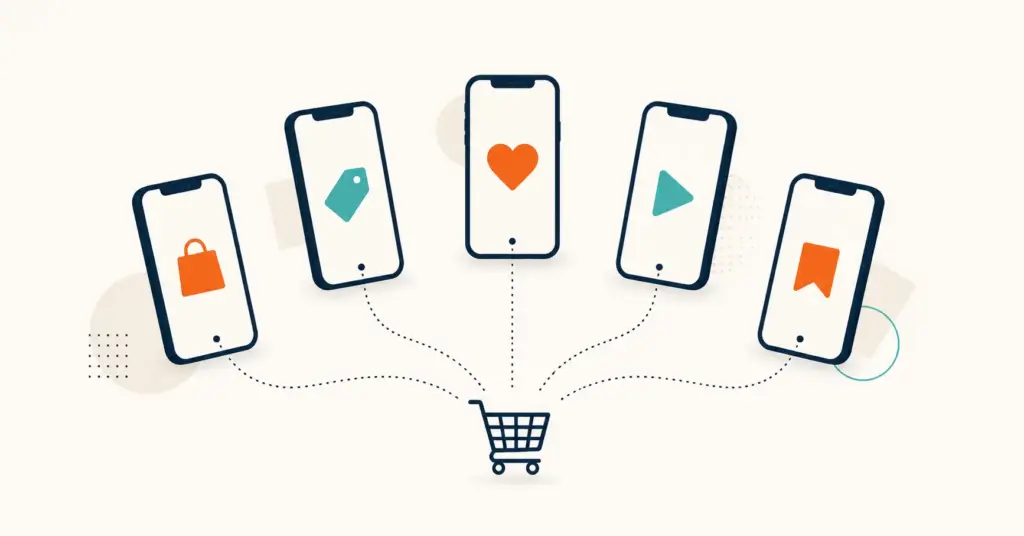
- Social commerce platforms let buyers discover, evaluate, and purchase products without leaving social media apps. US social commerce revenue hit $80+ billion in 2025 and is projected to exceed $100 billion by 2027, driven by TikTok Shop, Instagram Shopping, and Facebook Shops.
- TikTok Shop is the fastest-growing social commerce channel in the US, with GMV exceeding $20 billion in 2024. It performs best for impulse-purchase products under $50 targeting 18 to 34 year old buyers.
- Instagram Shopping and Facebook Shops share Meta's Commerce Manager backend but serve different audiences. Instagram skews toward visual, aspirational products (fashion, beauty, home decor). Facebook Shops reach a broader age demographic and work better for functional products.
- Social commerce works best as a supplementary channel, not a primary revenue source. Stores that generate 15 to 25% of revenue from social commerce while maintaining their own website as the primary channel have the most resilient revenue mix.
Social commerce platforms are the tools built into social media apps that let buyers discover, evaluate, and purchase products without leaving the platform. Instead of social media driving traffic to your website, social commerce closes the sale inside TikTok, Instagram, Facebook, Pinterest, or YouTube. US social commerce revenue exceeded $80 billion in 2025, representing roughly 6% of total US ecommerce, and is projected to pass $100 billion by 2027.
The shift matters for ecommerce sellers because attention lives on social platforms and every click to an external website loses 40 to 60% of potential buyers. Social commerce removes that friction by keeping the entire purchase journey inside the app where the buyer discovered the product. This guide covers the five platforms with native social commerce features in the US, how each platform fits different product types, the fees and setup requirements, and the strategy for integrating social commerce alongside your main store. For a broader platform view, see the best ecommerce platform comparison.
The US Social Commerce Market in 2026
Social commerce in the United States is growing at 25 to 30% annually, significantly faster than traditional ecommerce growth of 8 to 10%. Three factors are driving the acceleration: TikTok Shop’s aggressive expansion (now the largest single social commerce platform by GMV), improved checkout features across all platforms, and generational behavior shifts where 18 to 34 year olds increasingly prefer discovering and buying products within social apps rather than searching on Google or visiting standalone websites.
Despite the growth, social commerce still represents roughly 6% of total US ecommerce versus 15 to 20% in China, where platforms like Douyin (TikTok’s Chinese counterpart) and WeChat have integrated shopping for years. The gap represents the remaining opportunity for US sellers who build social commerce capabilities now.
TikTok Shop
TikTok Shop is the fastest-growing social commerce channel in the US, with GMV exceeding $20 billion in 2024. It operates as a full marketplace within TikTok, allowing sellers to list products, run live shopping sessions, partner with creators for affiliate commissions, and fulfill orders through TikTok’s logistics network or self-fulfillment.
Who TikTok Shop works for
TikTok Shop performs best for impulse-purchase products under $50 with strong visual appeal. Top-performing categories include beauty and skincare, fashion accessories, gadgets, kitchen products, and health supplements. The platform skews 18 to 34 years old, with 60% of US TikTok Shop buyers under 35. Products that demonstrate well in short video (before/after, unboxing, “watch me use this”) outperform products that require research or comparison shopping. For deeper TikTok strategy, see the TikTok Shop strategy guide.
Fees and requirements
TikTok Shop charges a commission fee of 2 to 8% per transaction depending on product category (most categories sit at 5%). Sellers also pay a 2% payment processing fee. Total take rate runs 7 to 10% per sale. Setup requires a US business entity, tax ID, and product listings that comply with TikTok’s commerce policies. Approval takes 1 to 5 business days for most categories.
The affiliate model advantage
TikTok Shop’s affiliate marketplace lets sellers offer commission (typically 10 to 20%) to TikTok creators who feature their products in videos. This is TikTok Shop’s strongest differentiator: creators with built audiences generate sales at zero upfront cost to the seller. The commission only triggers on completed purchases. Stores with strong affiliate programs consistently outperform stores that rely only on their own content on TikTok.

Instagram Shopping
Instagram Shopping lets sellers tag products in posts, Stories, Reels, and the Explore page. Buyers tap a product tag, see the product details, and can purchase through Instagram Checkout (US sellers only) or be redirected to the seller’s website. Instagram’s visual format makes it the strongest social commerce platform for aspirational and aesthetics-driven products.
Who Instagram Shopping works for
Fashion, beauty, home decor, lifestyle accessories, and premium food brands perform best on Instagram. The platform skews 25 to 44 years old, slightly older and higher income than TikTok. Products photographed well in lifestyle settings (worn, styled, in context) outperform product-on-white-background studio shots. User-generated content from customers wearing or using products drives 4 to 6x higher engagement than brand-produced content.
Setup and integration
Instagram Shopping requires a business or creator account, a Facebook Page linked to the Instagram account, a product catalog in Meta Commerce Manager, and compliance with Instagram’s commerce policies. Shopify, BigCommerce, and WooCommerce all sync product catalogs to Meta Commerce Manager automatically through native integrations or apps. Once approved, product tagging becomes available in the content creation flow. For Instagram advertising, see the Facebook and Instagram ads guide.
Instagram Checkout vs website redirect
Instagram Checkout (US only) processes the transaction entirely within Instagram. The buyer never leaves the app. Conversion rates on Instagram Checkout run 2 to 3x higher than website redirect because each app switch loses 40 to 60% of buyers. The tradeoff: Instagram keeps the customer data, you get the order but limited buyer information for email marketing. Many sellers enable Checkout for impulse products while directing higher-ticket items to their website where they capture the full customer relationship.
Facebook Shops
Facebook Shops creates a storefront within your Facebook Page where visitors can browse products, save items, and purchase through Facebook Checkout or an external website link. Facebook and Instagram share the same backend (Meta Commerce Manager), so product catalogs set up for Instagram automatically populate Facebook Shops.
Who Facebook Shops works for
Facebook’s audience skews older than Instagram and TikTok (30 to 65+ is the active buying demographic). Products that perform well include home improvement, gardening, pet supplies, automotive accessories, plus-size fashion, and functional goods that solve a clear problem. Facebook’s marketplace-adjacent placement and group-sharing behavior also benefit resellers, vintage sellers, and local service businesses. The overlap with Facebook Marketplace creates discovery opportunities that other platforms don’t offer.
Fees and features
Facebook Checkout charges a 5% selling fee per shipment (or $0.40 for shipments under $8). No monthly subscription. Facebook Shops supports collections (curated product groupings), live shopping broadcasts, and customer messaging through Messenger for pre-purchase questions. Integration with Shopify, WooCommerce, and BigCommerce syncs inventory, pricing, and order management automatically.
Pinterest Shopping
Pinterest Shopping turns product Pins into shoppable listings. Sellers upload their product catalog (via Shopify, BigCommerce, or direct feed), and products appear as Product Pins with pricing, availability, and a direct “Buy” link. Pinterest’s search-driven discovery makes it fundamentally different from feed-based platforms like TikTok and Instagram.
Who Pinterest Shopping works for
Pinterest’s audience is predominantly female (60%+), skews 25 to 44, and uses the platform for planning purchases (weddings, home renovation, recipes, outfits, gifts). Products with strong search intent perform best: home decor, wedding supplies, recipes, DIY supplies, fashion, and seasonal items. Pinterest traffic converts at 2.3x higher AOV than other social platforms because buyers on Pinterest are in planning mode, not scrolling mode. They arrive with intent.
The long tail advantage
Unlike TikTok and Instagram where content dies within 48 hours, Pinterest content has a half-life of 3 to 6 months. A well-optimized Product Pin continues driving traffic and sales months after posting. This makes Pinterest the best social commerce channel for evergreen products and stores with limited content creation bandwidth. For SEO-like optimization on Pinterest, treat Pin titles and descriptions like product page SEO: include the search terms buyers use.
YouTube Shopping
YouTube Shopping lets creators and brands tag products in videos, Shorts, and live streams. Viewers see a product shelf below the video or tap tagged products during playback to purchase. YouTube Shopping integrates with Shopify for automatic product syncing and checkout.
Who YouTube Shopping works for
Products that benefit from demonstration, explanation, or review content perform best. Electronics, software tools, kitchen appliances, beauty tutorials, fitness equipment, and educational products. YouTube’s audience spans all demographics but the shopping features are most adopted by 18 to 44 year olds. Long-form video (8 to 15 minutes) with embedded product tags converts better than Shorts for products above $30 because buyers need context before purchasing at higher price points.
The creator partnership model
YouTube Shopping allows creators to tag products from partner brands in their videos, earning affiliate commission on sales. For sellers, this means exposure to established YouTube audiences without producing video content. The YouTube Shopping affiliate program is less mature than TikTok Shop’s affiliate marketplace but growing rapidly. Partnering with 3 to 5 YouTube creators in your niche provides consistent social commerce revenue with minimal ongoing effort from the seller side.

Platform Comparison for Ecommerce Sellers
| Platform | Best Product Price Range | Primary Audience | Fee Structure | Content Lifespan |
|---|---|---|---|---|
| TikTok Shop | Under $50 | 18 to 34 | 5% commission + 2% processing | 24 to 72 hours |
| Instagram Shopping | $25 to $150 | 25 to 44 | 5% on Checkout, free for website redirect | 24 to 48 hours |
| Facebook Shops | $15 to $100 | 30 to 65+ | 5% per shipment via Checkout | 24 to 72 hours |
| Pinterest Shopping | $30 to $200 | 25 to 44, 60% female | Free (organic), CPC for promoted | 3 to 6 months |
| YouTube Shopping | $30 to $300 | 18 to 44 | Free via Shopify integration | Months to years |
The pattern: TikTok and Instagram dominate impulse purchases at lower price points. Pinterest and YouTube work for considered purchases at higher price points. Facebook covers the broadest age range. Most sellers should start with 1 to 2 platforms that match their product type and audience, not all five.
Social Commerce Strategy for Ecommerce Stores
Start with one platform, not five
Pick the platform where your ideal customer already spends time and where your product type matches the platform’s strength. Selling $35 skincare products to 25-year-olds? Start with TikTok Shop. Selling $120 home decor to 35-year-olds? Start with Instagram or Pinterest. Spreading effort across five platforms at launch produces mediocre results everywhere.
Treat social commerce as supplementary, not primary
Social commerce should represent 15 to 25% of total revenue for a well-diversified store. Stores that depend on social commerce for 50%+ of revenue are vulnerable to algorithm changes, policy shifts, and platform fee increases. Maintain your own website (Shopify, WooCommerce, BigCommerce) as the primary channel where you control the customer relationship, pricing, and data. For platform selection, see the Shopify vs WooCommerce comparison.
Use social commerce for discovery, website for retention
The strongest strategy: acquire new customers through social commerce (lower friction first purchase), then move them to your email list for repeat purchases through your website (higher margins, full customer data). Include a card insert in social commerce orders with a website-exclusive discount code for the next purchase. This bridges the acquisition channel to the retention channel.
Content that drives social commerce sales
Across all platforms, three content formats consistently drive the most social commerce sales: creator-generated product reviews (authentic, not scripted), product demonstration videos (showing the product solving a problem or before/after), and user-generated customer testimonials (real buyers sharing their experience). Brand-produced promotional content (“SALE! 20% off!”) consistently underperforms all three formats by 3 to 5x. For content creation depth, see the ecommerce content marketing guide.
Frequently Asked Questions
Social commerce is the buying and selling of products directly within social media platforms. Unlike social media marketing (which drives traffic to an external website), social commerce lets the buyer discover, evaluate, and purchase the product without leaving the social app. TikTok Shop, Instagram Shopping, Facebook Shops, Pinterest Shopping, and YouTube Shopping are the five main social commerce platforms in the US.
For physical products under $50 targeting younger buyers, TikTok Shop offers the fastest path to sales through its affiliate creator marketplace. For visual, aspirational products targeting 25 to 44 year olds, Instagram Shopping has the strongest discovery features. For evergreen products where you want long-lasting content, Pinterest Shopping provides the best return on content creation time. Start with the one platform where your audience already exists.
Most social commerce platforms charge 5 to 8% per transaction. TikTok Shop takes 5% commission plus 2% processing (7% total). Instagram and Facebook Checkout charge 5% per shipment. Pinterest Shopping is free for organic product listings. YouTube Shopping via Shopify integration has no additional platform fee. All are lower than Amazon’s 8 to 15% referral fee for most categories.
Technically yes. TikTok Shop, Instagram Checkout, and Facebook Shops all process transactions without requiring an external website. However, selling exclusively through social platforms means you don’t own the customer relationship, can’t build an email list effectively, and are fully dependent on platform algorithms for visibility. A website (even a basic Shopify store) provides a safety net and a channel you control.
US social commerce revenue exceeded $80 billion in 2025, representing roughly 6% of total US ecommerce. The market is growing at 25 to 30% annually, significantly faster than overall ecommerce growth of 8 to 10%. Projections put US social commerce above $100 billion by 2027. For comparison, China’s social commerce market is $500+ billion, representing 15 to 20% of total ecommerce.
No. TikTok Shop’s affiliate marketplace lets sellers partner with established creators who promote products to their audiences. Pinterest Shopping is search-driven, so follower count matters less than content optimization. Facebook Shops benefits from Facebook Ads targeting rather than organic following. A following helps for Instagram Shopping, but even there, paid promotion and shoppable Reels reach non-followers through the algorithm.
Related Reads
- TikTok Shop Strategy
- Facebook and Instagram Ads
- Ecommerce Content Marketing
- Shopify vs WooCommerce
- Best Ecommerce Platform
- Customer Retention Guide
Enjoying this? Get more like it every week.
One email per week with ecommerce strategies, tool picks, and seller insights. No spam.