
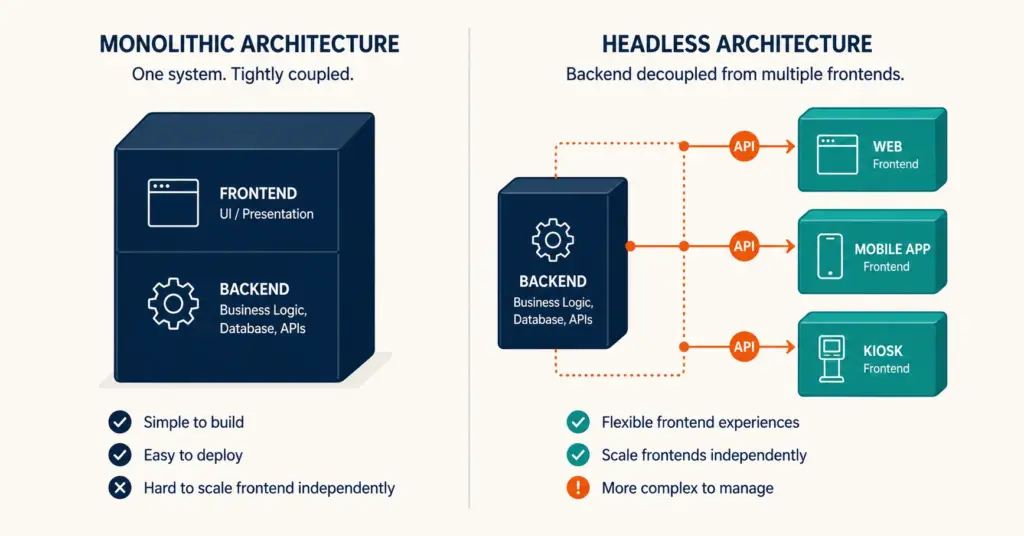
- Headless commerce separates the frontend (what customers see and interact with) from the backend (product catalog, orders, payments, inventory). This decoupling allows brands to build custom frontend experiences (progressive web apps, mobile apps, in-store kiosks, IoT interfaces) while keeping their commerce engine handling the transactional logic. Traditional platforms (Shopify, BigCommerce) bundle frontend and backend together.
- Most ecommerce stores under $5M annual revenue do not need headless commerce. The development cost ($50,000 to $300,000 for initial build), ongoing maintenance complexity, and developer dependency outweigh the performance and customization benefits for stores that can achieve their goals with a well-optimized theme on a traditional platform.
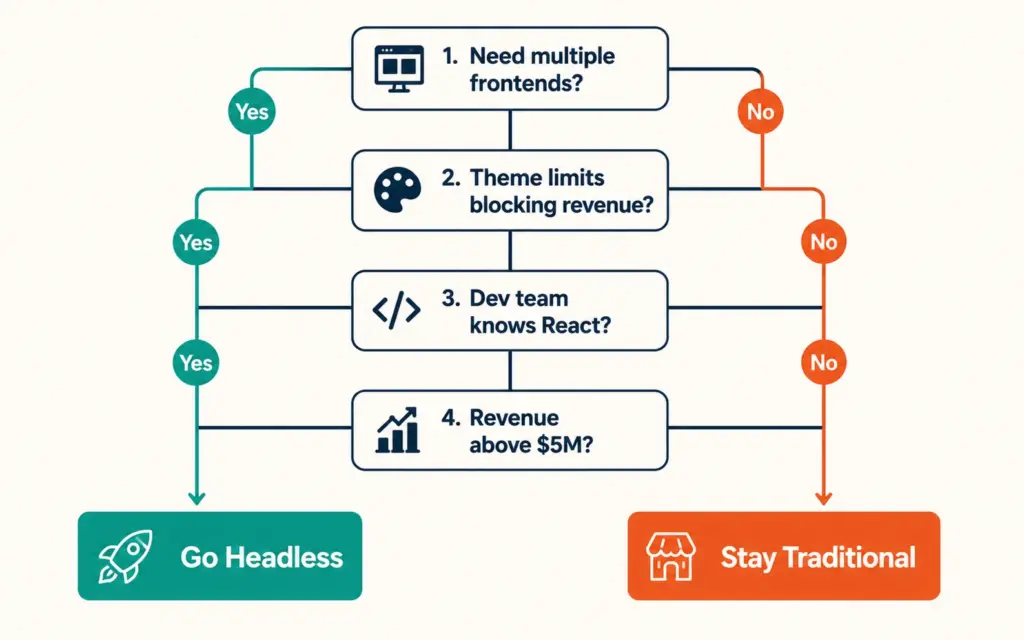
- Headless makes sense when: your brand requires a completely custom frontend experience that no theme can deliver, you need to power multiple frontend touchpoints (web, mobile app, in-store, IoT) from a single backend, page speed and Core Web Vitals are business-critical and theme optimization has hit a ceiling, or your dev team is already React/Next.js proficient and comfortable owning the frontend stack.
- Platform options: Shopify Hydrogen (headless Shopify, React-based), Medusa.js (open-source, Node.js), commercetools (enterprise API-first), BigCommerce headless (API-driven with existing BigCommerce backend). Each fits different budget levels, team capabilities, and scale requirements.
Headless commerce platforms decouple the customer-facing frontend from the backend commerce engine, connected only through APIs. In traditional ecommerce (Shopify with a theme, WooCommerce with a template), the platform controls both what the customer sees and how transactions process. In headless, the backend handles products, orders, payments, and inventory while a separate frontend application (built in React, Next.js, Vue, or similar frameworks) controls the customer experience. According to commercetools’ architecture documentation, this separation enables brands to build entirely custom experiences without the constraints of theme-based design systems, at the cost of significantly higher development complexity and ongoing maintenance.
The headless approach is heavily marketed by agencies and technology vendors, creating adoption pressure that leads many stores to invest in architecture they don’t need. This guide provides the decision framework for determining whether headless commerce delivers ROI for your specific situation, and which platform fits if the answer is yes. The Shopify vs WooCommerce comparison covers the traditional platform decision; this guide addresses when to move beyond traditional platforms entirely.
How Headless Architecture Works
Traditional (monolithic) architecture
Shopify, BigCommerce, WooCommerce: the platform provides both the storefront (themes, templates, page builder) and the commerce engine (product management, checkout, payments, orders). Everything is tightly integrated. Changes to the frontend are constrained by the theme system. Benefits: fast setup, low maintenance, no developer dependency for day-to-day operations. Limitations: customization bounded by theme capabilities, page speed constrained by platform’s rendering approach, and difficulty powering non-web experiences (mobile apps, in-store displays).
Headless (decoupled) architecture
The commerce backend exposes product data, cart functionality, checkout, and order management through APIs. A separate frontend application (typically a React or Next.js single-page app) consumes these APIs and renders the customer experience. The frontend team has complete control over design, performance, and interaction patterns without backend constraints. Benefits: unlimited frontend customization, superior page speed (static site generation + CDN), multi-channel from a single backend. Limitations: requires frontend developers for every change, higher build and maintenance cost, and no visual page builder for non-technical team members.
When Headless Commerce Makes Sense
You need multiple frontend touchpoints
If your brand requires a website, a native mobile app, an in-store kiosk, and a progressive web app, all pulling from the same product catalog and order system, headless is the architecturally correct solution. A traditional platform would require separate systems for each touchpoint with complex synchronization. Headless provides one backend that all frontends consume through the same API. The ecommerce tools and tech stack complexity multiplies with each additional touchpoint on traditional platforms but remains manageable with headless.
Page speed is a competitive differentiator
Headless frontends built with Next.js or Remix use static site generation (SSG) and server-side rendering (SSR) to achieve sub-second page loads. Traditional Shopify themes, even well-optimized ones, typically load in 2 to 4 seconds on mobile due to platform-level JavaScript overhead and render-blocking resources that can’t be removed. If your market is performance-sensitive (media, fashion, or categories where every 100ms of load time affects conversion), headless delivers measurable speed advantages. For stores where a 2-second theme is acceptable, the speed benefit doesn’t justify the investment.
Your dev team is already React/Next.js proficient
Headless development requires JavaScript framework expertise. If your team (in-house or agency) already builds in React and Next.js, the headless transition uses existing skills. If your team manages a Shopify store using Liquid templates and you’d need to hire a frontend development team specifically for headless, the human capital cost alone makes traditional platforms more economical. The ongoing maintenance difference: a theme update is a drag-and-drop operation. A headless frontend update requires a developer writing, testing, and deploying code.
Theme limitations are actually blocking revenue
This is the criterion most stores fail on. Headless is worth the investment when specific frontend requirements are genuinely impossible within a theme system AND those requirements have a quantifiable revenue impact. Custom product configurators, augmented reality try-on experiences, and complex interactive shopping experiences are examples of features that may require headless. “We want a slightly different homepage layout” or “our theme doesn’t support a specific animation” are not headless-worthy requirements.
When Headless Commerce Is Overkill
Annual revenue under $5M. The $50,000 to $300,000 initial build cost and $2,000 to $10,000/month ongoing maintenance cost require significant revenue to justify. A store doing $1M/year would spend 5 to 30% of annual revenue on headless infrastructure. That budget produces dramatically more ROI invested in facebook ads for ecommerce, A/B testing ecommerce optimization, or email marketing strategy improvement.
Non-technical founding team. Without in-house developers or a retained agency, every frontend change (banner swap, product page adjustment, promotional landing page) requires a development ticket. Traditional platforms let non-technical team members make these changes in minutes through visual editors. Headless removes that capability entirely.
DTC-only with standard shopping flow. If your customer journey is: browse products → add to cart → checkout → receive order, a traditional platform handles this identically to headless with far less complexity. Headless shines for non-standard experiences. Standard shopping flows don’t benefit.
“We want better performance.” Theme optimization (image compression, app removal, code cleanup) typically achieves 80% of headless performance gains at 5% of the cost. The mobile CRO speed improvements on traditional platforms often close the performance gap sufficiently. Migrate to headless only after exhausting traditional optimization.
Headless Commerce Platform Options
| Platform | Backend | Frontend | Best For | Cost |
|---|---|---|---|---|
| Shopify Hydrogen | Shopify | React (Remix) | Shopify stores going headless | Shopify Plus ($2,300+/mo) + dev costs |
| Medusa.js | Open-source (Node.js) | Any (Next.js common) | Budget-conscious, dev-heavy teams | Free software + hosting + dev |
| commercetools | Cloud API-first | Any | Enterprise ($50M+ revenue) | Custom pricing ($2,000+/mo) |
| BigCommerce Headless | BigCommerce | Any (Next.js common) | Existing BigCommerce stores | BigCommerce plan + dev costs |
| Saleor | Open-source (Python/GraphQL) | Any | Developer-first teams | Free software + hosting + dev |
Shopify Hydrogen
Shopify’s official headless framework. Uses Remix (React) for the frontend and Shopify’s Storefront API for the backend. Benefit: you keep Shopify’s checkout, payment processing, and order management while building a custom frontend. Limitation: requires Shopify Plus ($2,300+/month), and the React/Remix stack requires experienced frontend developers. Best for existing Shopify stores with established product catalogs and order workflows that need frontend freedom without backend migration. The BigCommerce vs Shopify comparison is relevant here: both platforms offer headless options, but Shopify Hydrogen has more community support and documentation.
Medusa.js
Open-source headless commerce engine built in Node.js. Free software with self-hosted infrastructure. The most cost-effective option for developer teams comfortable managing their own backend. Plugin ecosystem for payments, fulfillment, and notifications. Pairs with Next.js for the frontend. Total cost: hosting ($50 to $200/month on Vercel + Railway/Render) plus development time. Best for startups with strong technical co-founders who want complete control without platform fees. The plugin ecosystem covers Stripe for payments, various fulfillment providers, and notification services. Deployment on Vercel or Railway keeps monthly infrastructure costs under $200 for most mid-size catalogs, making Medusa the most budget-friendly headless option available.
commercetools
Enterprise-grade API-first commerce platform. MACH architecture (Microservices, API-first, Cloud-native, Headless). Powers large retailers with complex multi-market, multi-currency, multi-brand requirements. Custom pricing starting at $2,000+/month. Requires dedicated engineering teams. Best for businesses above $50M annual revenue with complex commerce requirements that no single platform can handle. Overkill for anything smaller. When evaluating enterprise platforms, the ERP for ecommerce integration requirements often determine whether a composable approach is necessary or whether a single-platform solution handles inventory, orders, and fulfillment adequately.
The Migration Path
Moving from traditional to headless isn’t a weekend project. Typical timeline: 3 to 6 months for initial build, plus ongoing iteration.
- Month 1: Architecture planning and technology selection. Choose the backend (keep existing or migrate), frontend framework, and hosting infrastructure. According to Vercel’s commerce deployment data, Next.js with Vercel hosting is the most common headless frontend stack for mid-market ecommerce, combining performance with developer productivity.
- Month 2-3: Frontend development. Build product pages, collection pages, cart, and integrate with the commerce API. Recreate every customer-facing feature from the existing store.
- Month 4: Checkout and payment integration. Connect to the payment processor, implement shipping calculation, and configure tax computation.
- Month 5: Testing. Cross-device, cross-browser, load testing, and full purchase flow verification.
- Month 6: Migration. DNS cutover, 301 redirects from old URLs, analytics verification, and performance monitoring for the first 30 days. Confirm that all tracking setup elements (GA4, Meta Pixel, conversion events) fire correctly on the new frontend architecture. Headless frontends require re-implementation of tracking scripts that were platform-native on Shopify or WooCommerce. The ecommerce technical SEO redirect mapping is critical: every old URL must redirect to its new equivalent or organic traffic drops 20 to 40%.
Frequently Asked Questions
Headless commerce separates the customer-facing frontend (website, app, kiosk) from the backend commerce engine (products, orders, payments), connected through APIs. The frontend team has complete design freedom without backend constraints. Traditional platforms (Shopify, BigCommerce) bundle frontend and backend together. Headless costs more and requires developers but enables unlimited customization and superior performance.
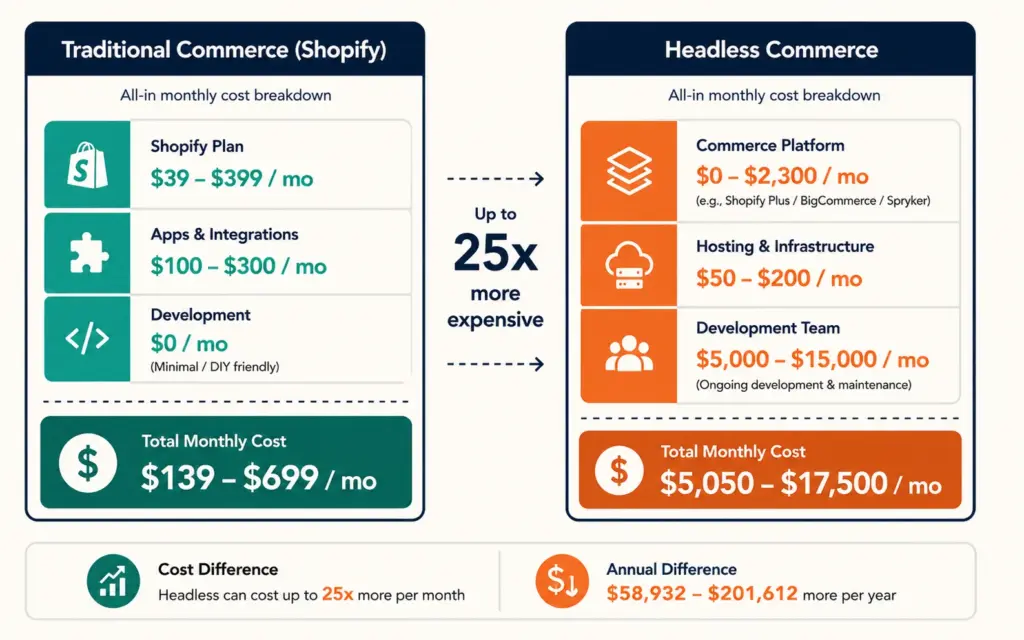
Initial build: $50,000 to $300,000 depending on complexity and team rates. Ongoing maintenance: $2,000 to $10,000/month for hosting, security updates, bug fixes, and feature development. Platform costs vary: Shopify Hydrogen requires Shopify Plus ($2,300+/month), Medusa.js is free software with $50 to $200/month hosting, commercetools starts at $2,000+/month. Total first-year cost: $75,000 to $400,000 for mid-market implementations.
Typically yes. Headless frontends using static site generation and CDN delivery achieve sub-second page loads. Shopify themes typically load in 2 to 4 seconds on mobile. The speed difference is measurable but whether it produces meaningful conversion lift depends on your category and audience. Theme optimization closes 80% of the gap at 5% of the cost. Headless speed benefits justify the investment only when traditional optimization has been exhausted.
Probably not. Most stores under $5M annual revenue achieve their goals with well-optimized traditional platforms. You likely need headless if: you require multiple frontend touchpoints (web + app + kiosk), page speed optimization has hit theme-level ceilings, your frontend requirements are genuinely impossible within a theme system, and your team has React/Next.js expertise. If none apply, traditional platforms deliver better ROI.
Yes, through Shopify Hydrogen. Hydrogen uses Remix (React) for the frontend and Shopify’s Storefront API for the backend. You keep Shopify’s checkout, payments, and order management while building a fully custom frontend. Requires Shopify Plus ($2,300+/month). Benefit: no backend migration, keep existing product data and workflows. Limitation: still dependent on Shopify’s API capabilities and checkout customization limits.
Composable commerce extends headless by allowing brands to select best-of-breed services for each commerce function: one vendor for product catalog, another for search, another for checkout, another for payments. Each component connects via APIs. It’s the most flexible and most complex architecture, appropriate only for large enterprises with dedicated engineering teams. For most ecommerce stores, headless (simpler than composable) or traditional (simpler than headless) is the right architecture choice.
Related Reads
- Shopify vs WooCommerce
- BigCommerce vs Shopify
- Ecommerce Tools and Tech Stack
- Mobile CRO
- Ecommerce Technical SEO
- Financial Planning and Scaling
Enjoying this? Get more like it every week.
One email per week with ecommerce strategies, tool picks, and seller insights. No spam.