
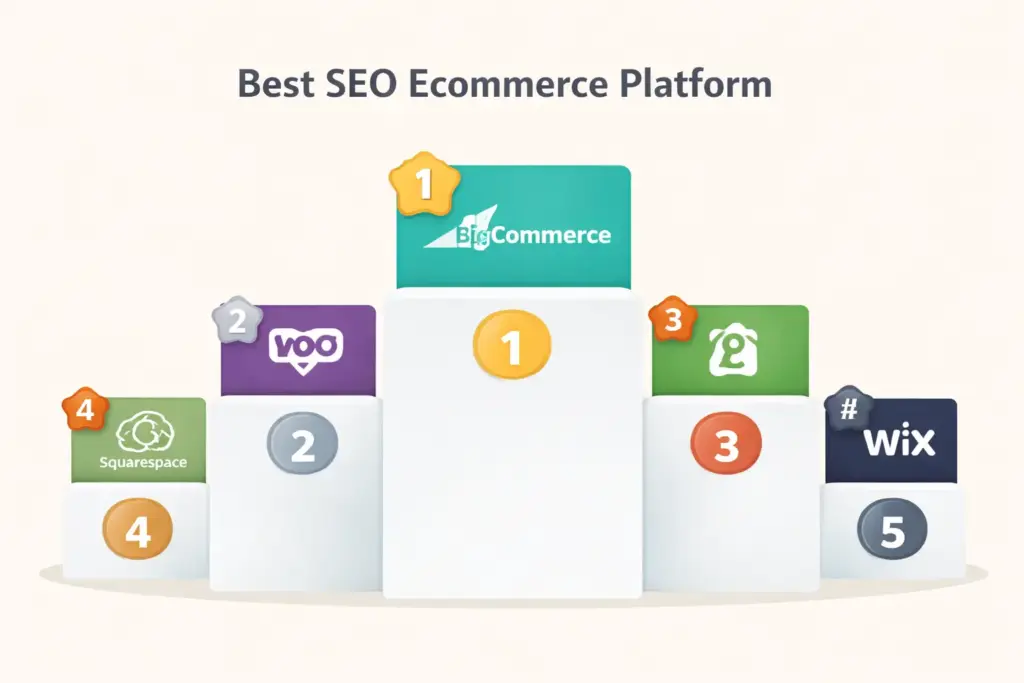
- BigCommerce is the best seo ecommerce platform for native features: fully customizable URLs, built-in Product schema, AJAX faceted navigation, and automatic sitemaps without any apps.
- WooCommerce wins for maximum SEO flexibility because it runs on WordPress, the most SEO-mature CMS on the web, with access to Rank Math and Yoast SEO plugins that surpass any hosted platform's built-in tools.
- Shopify ranks third for SEO due to forced URL prefixes (/products/, /collections/) and app dependency for advanced SEO features, but its speed, ecosystem, and ease of use offset these limitations for most sellers.
- The "best" platform for SEO depends on your technical skills. BigCommerce delivers the strongest out-of-box SEO. WooCommerce delivers the strongest possible SEO if you have the skills to configure it. Shopify delivers good-enough SEO with the least effort.
The best seo ecommerce platform is the one that gives search engines the clearest signals about your products while requiring the least workaround effort from you, covering URL structure control, structured data markup, page speed, crawlability management, blogging capabilities, and technical SEO configuration options. Not every platform treats these equally, and the differences directly impact how much organic traffic your store can generate.
Most “best platform for SEO” articles are written by platforms promoting themselves. This one isn’t. I’m ranking five platforms based on nine specific SEO factors, with clear winners and losers per category. The overall ranking may surprise you because the most popular platform isn’t the best for SEO.
If you’re choosing a platform and organic search traffic will be a primary growth channel, this comparison matters more than pricing or design. For the full platform picture including non-SEO factors, our ecommerce platform comparison covers everything.
The 9 SEO Factors That Actually Matter
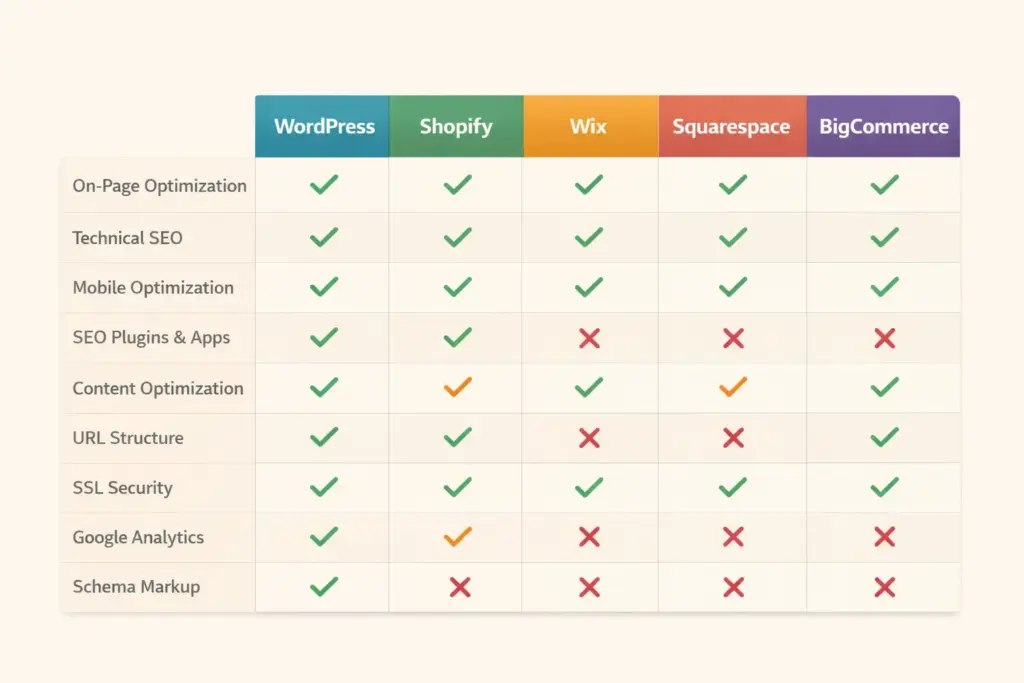
| SEO Factor | BigCommerce | WooCommerce | Shopify | Squarespace | Wix |
|---|---|---|---|---|---|
| URL customization | Full control | Full control | Forced prefixes | Limited | Limited |
| Product schema | Auto (native) | Plugin (Rank Math) | Theme-dependent | Basic auto | Basic auto |
| Page speed | Fast (Akamai CDN) | Varies (hosting) | Fast (global CDN) | Good | Good |
| XML sitemap | Auto | Plugin | Auto | Auto | Auto |
| 301 redirects | Built-in panel | Plugin/.htaccess | Built-in panel | Built-in | Built-in |
| Canonical tags | Auto + manual | Plugin (full control) | Auto (limited) | Auto | Auto |
| Blogging/content | Basic | Excellent (WordPress) | Good | Good | Good |
| Faceted nav handling | AJAX (native) | Plugin + config | App-dependent | Limited | Limited |
| Meta tag control | Full (all pages) | Full (plugin) | Full (all pages) | Full | Full |
1. BigCommerce: Best Native SEO (Overall Winner)
BigCommerce wins because it solves the most SEO problems without requiring third-party apps or technical workarounds.
URL structure. Full control over every URL path. Your running shoes category sits at /running-shoes/ not /collections/running-shoes/. Clean, keyword-rich URLs without platform-imposed prefixes. This is BigCommerce’s single biggest SEO advantage over Shopify.
Structured data. Product, Offer, AggregateRating, and BreadcrumbList schema are generated automatically on every product page. No app needed. Rich results (star ratings, pricing, availability) appear in Google without configuration.
Faceted navigation. BigCommerce’s built-in filtering uses AJAX that doesn’t create duplicate indexable URLs. This solves the biggest technical SEO problem in ecommerce without custom development.
Where it loses: Blogging is basic. If content marketing is central to your SEO strategy, BigCommerce’s blog can’t compete with WordPress or even Shopify’s blogging capabilities. Many BigCommerce stores run a separate WordPress blog on a subdomain to compensate.
SEO verdict: Best for stores that want the strongest out-of-box SEO with minimal configuration. Ideal for catalog-heavy stores (500+ products) where technical SEO automation saves significant time.
2. WooCommerce: Best Possible SEO (If You Configure It)
WooCommerce runs on WordPress, which has been the world’s dominant CMS for two decades partly because of its SEO flexibility. With Rank Math or Yoast SEO installed, WooCommerce offers more granular SEO control than any hosted platform.
URL structure. Full customization through WordPress permalink settings. Any URL pattern you want is possible.
Content marketing. WordPress is the gold standard for blogging and content. Buying guides, comparison articles, and category content all benefit from WordPress’s mature editor, taxonomy system, and plugin ecosystem. No other seo ecommerce platform matches this for content-driven organic growth.
Plugin power. Rank Math adds schema markup, redirect management, sitemap generation, breadcrumb control, and advanced meta tag editing with precision no hosted platform can match. Need custom schema types? FAQ markup? HowTo markup? Rank Math handles it with checkboxes, not code.
Where it loses: SEO quality depends entirely on your configuration. A badly configured WooCommerce store has WORSE SEO than a default Shopify store. Speed depends on hosting quality. Security and updates are your responsibility. The ceiling is highest, but the floor is lowest.
SEO verdict: Best for technical users or stores that can hire a developer. Maximum SEO capability, but you earn every bit of it through setup and maintenance. Ideal for content-heavy stores where blog traffic drives product discovery.
3. Shopify: Good Enough SEO, Best Everything Else
Shopify’s SEO is genuinely good, not great. It handles 80% of SEO needs automatically and the remaining 20% through apps. For most stores, that’s sufficient because the time saved on non-SEO tasks (design, payments, shipping, app integrations) gets reinvested into marketing that drives results.
Where Shopify wins: Consistent fast page speed across all stores (global CDN). Automatic XML sitemaps. Clean canonical tag handling for product variants. Built-in 301 redirect management. Blog functionality that’s good enough for most content strategies.
Where Shopify loses: Forced URL prefixes (/products/, /collections/, /pages/) waste URL characters and add unnecessary depth. Product schema markup depends on your theme (not all themes include it properly). Advanced faceted navigation SEO requires paid apps. These limitations are real but rarely deal-breaking for stores under 2,000 products.
SEO verdict: Best for sellers who want good SEO without thinking about SEO. The “set it and forget it” approach works for stores where paid advertising and social media drive more revenue than organic search.
4. Squarespace: Adequate SEO, Beautiful Design
Squarespace handles SEO basics (meta tags, sitemaps, SSL, mobile responsiveness) but lacks the depth needed for competitive organic markets. No bulk editing, limited structured data control, basic canonical handling, and URL structures that include unnecessary date prefixes on blog posts by default.
SEO verdict: Adequate for brand-focused stores in low-competition niches. Not competitive against Shopify or BigCommerce stores targeting the same keywords.
5. Wix: Improving But Still Behind
Wix has invested heavily in SEO over the past two years. Server-side rendering, automatic structured data, and the Wix SEO Wiz provide a decent foundation. But limited URL flexibility, slower page speeds than competitors, and weaker technical SEO controls keep it behind the top three for serious ecommerce SEO.
SEO verdict: Fine for small stores under 50 products that don’t compete in organic search. Not recommended when SEO is a primary traffic strategy.
Choosing Based on YOUR SEO Reality
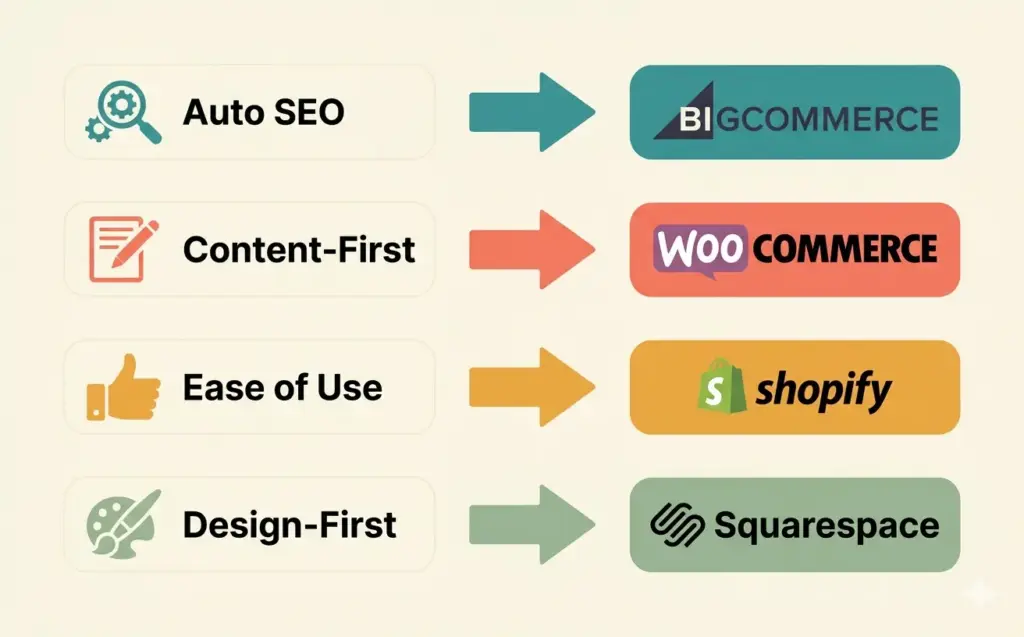
The best seo ecommerce platform depends on your specific situation:
You want SEO to work without you thinking about it. BigCommerce. The native features handle the most important technical factors automatically. You spend time on products and marketing instead of SEO configuration.
You’re a content-first brand where blog traffic matters most. WooCommerce. WordPress’s content tools are unmatched. Your buying guides, comparisons, and educational content will perform better on WordPress than any hosted platform.
SEO is important but not your primary channel. Shopify. Good-enough SEO plus the best overall ecommerce experience. The time you save on operations gets reinvested into paid ads and social media that generate faster results.
You sell to a local or niche audience with low search competition. Squarespace or Wix. Adequate SEO for non-competitive markets, with design advantages that matter more than SEO optimization in these contexts.
You run multiple sales channels (Amazon + eBay + your store). BigCommerce. Native multi-channel selling plus the strongest SEO means you compete on both marketplace and organic fronts without app stacking.
Whatever platform you choose, the fundamentals covered in our category page SEO guide and technical SEO checklist apply universally. Platform choice changes HOW you implement SEO, not WHETHER you need it. Your startup budget and business model should guide the final decision.
Frequently Asked Questions
BigCommerce is the best seo ecommerce platform for native features without apps. WooCommerce offers the highest SEO ceiling with proper configuration. Shopify provides good-enough SEO with the easiest setup. The right choice depends on your technical skills and how central organic search is to your growth strategy.
Shopify is good for SEO but not the best. It handles 80% of SEO needs automatically but has limitations: forced URL prefixes, theme-dependent schema markup, and app dependency for advanced features. BigCommerce and WooCommerce both offer stronger native SEO capabilities. Shopify wins on overall ease of use and ecosystem.
Yes, but less than content quality and backlinks. Platform affects technical foundations: URL structure, page speed, structured data, and crawlability. A well-optimized WooCommerce store will outrank a default Shopify store for the same keywords. But great content on Shopify will outrank thin content on WooCommerce. Platform is the foundation, not the whole building.
BigCommerce offers fully customizable URLs without forced prefixes, native Product schema on all pages, built-in AJAX faceted navigation that prevents duplicate content, and zero transaction fees. Shopify requires apps to match several of these features and forces /products/ and /collections/ into every URL, which is a structural SEO disadvantage.
WooCommerce has a higher SEO ceiling than Shopify because WordPress offers superior content tools, Rank Math provides more granular control, and URLs are fully customizable. However, WooCommerce requires more technical knowledge to configure properly. A poorly set up WooCommerce store performs worse than a default Shopify store.
Yes, but platform migrations carry SEO risk. URL changes require 301 redirects for every page. Structured data may need reconfiguration. Rankings can temporarily drop during migration. If SEO matters to your business, choosing the right platform from the start is cheaper than migrating later. Plan redirects carefully and monitor Search Console during any migration.
Related Reads
- Best Ecommerce Platform Comparison
- BigCommerce SEO Review
- How to Sell on Shopify
- Squarespace Ecommerce Review
- Ecommerce SEO Complete Guide
- Technical SEO Audit Checklist
Enjoying this? Get more like it every week.
One email per week with ecommerce strategies, tool picks, and seller insights. No spam.